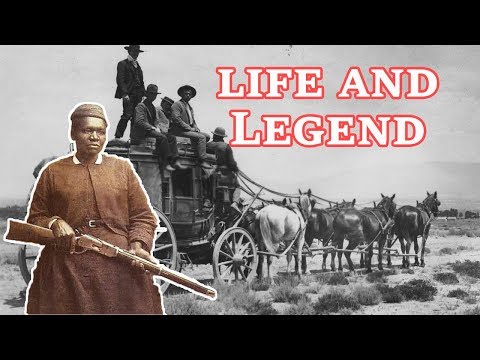
In the rugged expanse of the American West, where legends were forged in gunpowder and grit, one name stood apart—not for the tales spun around campfires, but for the unyielding reality of a life lived on her own terms. Mary Fields, known to all as Stagecoach Mary, was a force of nature: a six-foot-tall, two-hundred-pound Black woman who drank whiskey, smoked cigars, and packed a revolver with equal flair. Born into slavery in 1832, she defied every expectation placed upon her, blazing a trail through a world that sought to confine her. This is the story of a woman who stared down bandits, braved blizzards, and became a beloved icon of the frontier—a testament to the power of an indomitable spirit.
But before the legends, before the nickname, there was simply Mary—a woman whose earliest years were stolen by the brutal institution of slavery. In Hickman County, Tennessee, she labored in cotton fields, her name unrecorded, her existence reduced to a number in a ledger. Yet even then, her towering stature and fierce demeanor hinted at the extraordinary life to come. When the Civil War ended and freedom finally came, Mary embarked on a journey that would take her from the steamboats of the Mississippi to the quiet convents of Ohio, and ultimately to the wilds of Montana. Along the way, she would forge an unlikely friendship, defy the norms of her time, and earn a place in history as one of the toughest women the West had ever seen.
Mary’s journey westward began not with ambition, but with loyalty. When word reached her that her dear friend Mother Amadeus had fallen gravely ill in the Montana Territory, Mary did not hesitate. She dropped everything and traveled sixteen hundred miles alone—through unfamiliar terrain, across rivers, and into the harsh frontier—to nurse the Mother Superior back to health. That journey, undertaken by a Black woman traveling solo through the American West in the 1880s, was an act of extraordinary courage in itself.
Once Mother Amadeus recovered, Mary found herself drawn to the rugged beauty of Montana. She stayed, taking up work at the convent near Cascade, where she built churches, hauled lumber and stone on her back, and refused any man’s help with the heavy loads. The nuns, though initially startled by her loud manner and fierce temper, came to rely on her unshakable work ethic.
But Mary’s refusal to conform to anyone’s expectations would soon cost her. She smoked, drank, swore, and dressed in men’s clothing—behaviors that scandalized the bishop and the more straitlaced members of the community. Complaints piled up. And then came the final straw: an argument with the convent’s janitor that escalated until both of them drew guns.
The bishop ordered Mary to leave the convent and never return. It was a harsh blow, but Mary had never been one to crumble. She struck out on her own, taking whatever odd jobs she could find—farming, laundry, animal care, even building repairs. Around this time, the Native Americans in the region gave her a nickname: White Crow, for she acted like a white woman yet had black skin. She was the first and one of the only African Americans in the town, and the local whites hardly knew what to make of her.
One schoolgirl wrote of her with disdain: “She drinks whiskey and she swears and she’s a Republican, which makes her a low, foul creature.” Yet opinions would shift with time. Mary opened a restaurant and served food to anyone—whether they could pay or not. Her generosity to the needy, however, drove her into bankruptcy within ten months.
Still, Mary pressed on. She could often be found in saloons, drinking strong liquor and getting into gunfights. Then, in 1895, her old friend Mother Amadeus donated a stagecoach to encourage travel in the remote region—and the U.S. Post Office opened a star route for faster mail delivery. Mary, at around sixty-three years old, applied for the position of mail courier.
The competition was fierce. Every other applicant was a man, and most were half her age. Yet Mary won the position outright—not through favoritism, but by hitching a team of horses to the harness faster than any of them could manage. She became the second woman and the first African American ever to work as a star route carrier.
The job was brutal. She had to receive mail from passing trains, load it into her stagecoach, and navigate rough roads, muddy fields, and all manner of terrain. Bandits and thieves were a constant threat, but Mary carried a rifle and a revolver, and she knew how to use both. She quickly earned a reputation for reliability, never missing a single day of work.
That reliability earned her the nickname that would stick forever: Stagecoach Mary. She handled her team of horses and a mule named Moses with expert precision. When heavy snow made the roads impassable for the horses, she strapped on snowshoes, threw the mailbags over her shoulders, and walked into town herself.
Her toughness was legendary. Rumor had it she once fended off an angry pack of wolves with her rifle—and given her marksmanship, the tale may well be true. Her temperament was compared to that of a grizzly bear. Stagecoach Mary was not to be crossed under any circumstances.
Yet many fools tried. When a man seriously offended her, she pelted him with rocks until he cried. When a cowboy challenged her to a duel, she accepted—and drew her six-shooter so fast that her opponent never stood a chance. She purposely shot close to his head so he could feel the wind of the bullet. Frightened, the man conceded immediately and never spoke to her again.
Despite her intimidating presence, the people of Cascade came to admire her generosity and kindness. Children adored her. The town’s schools closed each year on her birthday to celebrate her life. Local restaurants gave her free meals, and in saloons everyone wanted to talk to her.
When Montana passed a law forbidding women from entering saloons, Mary was barred from one of her favorite places. But the mayor of Cascade granted her a personal exemption. Besides, nobody was brave enough to try and keep her out.
In 1903, at seventy-one years old, age finally caught up with her. After eight years of service, Mary retired from the star route. She spent the remainder of her life babysitting the children of Cascade and running a laundry service from her home.
Mary Fields died of liver failure on December 5, 1914, at Columbus Hospital in Great Falls. She was eighty-two years old. The whole town mourned her passing—her funeral was one of the largest Cascade had ever seen. She was buried just outside of town.
The West was full of strong and courageous people, but none of them were quite like Stagecoach Mary. Many legends of the Wild West had their stories exaggerated, fiction mixing with fact. But Mary needed no exaggeration. She was described as one of the freest souls ever to draw breath.
Her grave still lies just beyond the edge of Cascade, a simple stone beneath the vast Montana sky she once rode beneath with mailbags strapped to her back. Travelers who stumble upon it often pause, struck by the quiet weight of a life that refused every box the world tried to force her into—slave, servant, woman, Black. Mary Fields belonged to none of those categories and to all of them at once.
In the decades since her death, her story has only grown. Historians comb through old ledgers and letters, piecing together the fragments of a life lived so fiercely that even the documents meant to erase her could not hold her down. She is remembered now as a pioneer of the postal service, a symbol of Black resilience, and a woman who simply would not be diminished.
But perhaps the truest measure of Stagecoach Mary is not in the records or the legends. It is in the children she babysat in her final years, the neighbors she fed for free, the nuns she nursed back to health, and the town that closed its schools on her birthday. She gave as fiercely as she fought, and she asked no one’s permission to live exactly as she pleased.
So when the campfire stories fade and the history books turn their pages, one truth remains. The West was never tamed by men alone. It was carried, mile by snowy mile, on the shoulders of a woman who walked where no one else dared.
What would you have asked Stagecoach Mary if you’d met her in a Cascade saloon all those years ago?
Report this article
Select a reason for reporting:






