January 7, 1988. Hill 3234, Afghanistan. The frozen ground offered no mercy as 39 Soviet paratroopers huddled behind crumbling stone walls, their breath misting in the biting cold. They had spent the past week fortifying this strategic height, knowing it was only a matter of time before the enemy struck. Little did they know that within hours, they would face a relentless assault by over 250 Mujahideen and Pakistani mercenaries, a force determined to reclaim this vital pass at any cost.
The Soviet-Afghan War had raged for nearly nine years, a brutal conflict that had already claimed the lives of around three million Afghans and was often called the Soviet Union’s Vietnam. The Mujahideen, Islamist resistance groups backed by the United States, the UK, China, and Arab states, fought fiercely against the Soviet-backed Afghan government. Hill 3234, a barren peak overlooking the Satukandav Pass, was a critical supply route, and both sides knew its capture could turn the tide.
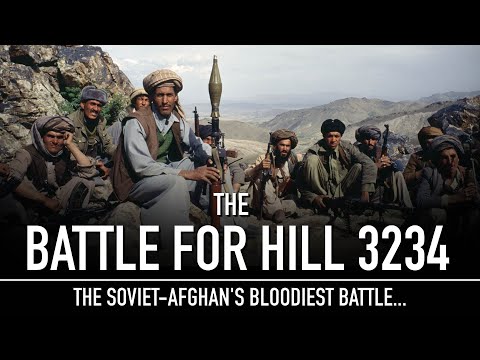
For the men of the 9th Company, 345th Independent Guards Airborne Regiment, the mission was clear: hold the hill at all costs. They had set up camp on December 31, 1987, after Operation Magistral had initially secured the pass. But the Mujahideen, led by the cunning Jalaluddin Haqqani, had retreated across the Pakistani border to regroup. Now, they were back, and they were coming in force.
“They came from three directions, using the terrain to their advantage,” recalled one survivor. The paratroopers had built dry-stone walls for cover, but the ground was too frozen to dig trenches. They had only a single grenade launcher and a few rocket launchers, and their fields of fire were limited. Still, they were veterans, hardened by years of conflict, and they were not about to give up without a fight.
At 3:30 PM, the first barrage hit. Hundreds of mortar rounds and rockets rained down, shattering the stone walls and wounding several soldiers. The Mujahideen, armed with walkie-talkies and supported by Pakistani Special Forces, moved with chilling coordination. “They waited until we ducked for cover before advancing,” another soldier remembered. The attack was better planned than anything they had seen before.
The Soviets called in artillery support, and for a moment, the onslaught paused. But it was short-lived. By 4:10 PM, another wave came, this time targeting the heavy machine gun that had been holding the enemy at bay. The gunner was finally taken out by shrapnel, and the Mujahideen surged forward. “They demanded our surrender, but we refused,” a paratrooper said. The fighting became hand-to-hand as night fell, and ammunition ran low.
Desperate, the Soviets requested reinforcements, but helicopters could not land due to heavy fire. Finally, a unit from the valley was ordered to climb the steep hill with supplies. It took them two and a half hours to reach the top, and by then, the paratroopers were on their last legs. But their arrival turned the tide. The Mujahideen, despite their numbers, could not break through.
By dawn, it was over. Of the 39 paratroopers, six were dead and 28 wounded. The Mujahideen left behind an estimated 200 dead. Hill 3234 had held. But as the sun rose, the survivors knew this was just one battle in a war that was far from over. The Soviet Union was already planning its withdrawal, and the sacrifices made on this frozen hill would soon be overshadowed by the relentless march of history.
The victory on Hill 3234 was reported up the chain of command with the usual clipped military efficiency, but the men who had held the summit barely had time to register it. They spent the gray morning hours collecting their dead, wrapping the bodies in ponchos, and counting what remained of their ammunition. “We held the hill, but the hill held nothing worth keeping,” one of the wounded later wrote in a letter home, a line that would be quietly censored before it ever reached his mother.
Down in the valley, Operation Magistral’s commanders declared the pass open and the route to Khost secure. Convoys of trucks began the slow, cautious crawl through the Satukandav Pass, their drivers scanning the ridgelines for the glint of a rifle barrel. For the first time since 1981, supplies could move by road instead of risky air drops. The Kremlin, eager for good news, touted the operation as proof that the 40th Army could still project strength.
But the Mujahideen had not been destroyed, only scattered. Jalaluddin Haqqani’s fighters withdrew across the border into Pakistan, licking their wounds and regrouping in the madrassas and training camps that dotted the tribal areas. They had lost perhaps 200 men in a single day, but their supply of recruits seemed endless. New fighters arrived from the Gulf states, from Egypt, from the crowded refugee camps around Peshawar, drawn by the promise of jihad and the generous stipends that CIA money and Saudi matching funds made possible.
Within weeks, the convoys were being ambushed again. The Afghan Army units tasked with holding the pass found themselves exposed and undermanned, their Soviet advisers increasingly reluctant to venture beyond the safety of their bases. By late January, Mujahideen rocket teams had crept back onto the heights, and the road to Khost was once again a killing zone. The hill that had cost so much blood was quietly abandoned, its dry-stone walls left to the wind and the snow.
For the men of the 9th Company, the aftermath was bitter. Six families in the Soviet Union received telegrams that began with the words “With deep regret…” The wounded were flown to military hospitals in Kabul and Tashkent, where some would lose limbs and others would lose their nerve. A few received the Order of the Red Banner, pinned to their chests by officers who had never set foot on the hill. The medals felt lighter than they should have.
What none of them could know was how swiftly the ground beneath them was shifting. The Soviet Union had already begun negotiating its exit. In Geneva, diplomats were hammering out the accords that would formalize the withdrawal of Soviet troops, and in Moscow, a new generation of reformers was questioning the entire Afghan adventure. The battle for Hill 3234 would become a footnote, a tactical triumph in a strategic defeat.
Yet for the paratroopers who survived, the hill never truly faded. Decades later, veterans of the 9th Company would gather each January in Moscow and in the garrison towns of the Urals, raising glasses to the six who never came down. They would argue about the details, about who fired when, about whether the Pakistani commandos had really been there. But they never argued about the cold, or the sound of the mortars, or the way the sky lit up when the artillery finally answered their call.
And far to the south, in the mountains above Khost, another young fighter was already making his way toward the pass, carrying a rifle older than himself and a belief that the Soviets could be driven out. The war was not over, and the hill was not the end of anything. It was only a place where two empires’ ambitions had briefly collided, and where the dust had yet to settle.
The young fighter’s name was Mullah Ahmad, though he would not have called himself a fighter then, only a student who had left his books in Kandahar to answer a call he barely understood. He was seventeen, thin as a reed, and the rifle he carried had been handed down through three cousins before reaching him. “You will know what to do when the time comes,” his uncle had told him, pressing the weapon into his hands. The time, Ahmad would later reflect, had come and gone many times before anyone bothered to tell him.
He reached the ridge above the Satukandav Pass in the last week of January, part of a column of some forty men moving under cover of darkness. The guides were local tribesmen who knew every goat trail and every frozen streambed. They spoke little, and when they did, it was of the abandoned outpost on the heights — the dry-stone walls the Russians had built and left behind like a gift. “They held it for a week and gave it back,” one of the guides muttered, spitting into the snow.
Ahmad had heard stories of the battle, of course. The fighters who had been there spoke of the paratroopers with a grudging respect, describing men who refused to break even when the mortars fell and the walls crumbled. But they also spoke of the cost — of friends who had climbed the slope and never returned, of bodies left in the snow because there had been no time to carry them down. “The Russians fight like bears,” an older commander had said. “But bears can be starved out.”
What Ahmad found on the hilltop was not glory but debris. Empty shell casings lay scattered among the rocks, half-buried in frost. A torn Soviet field jacket hung from a splintered post, frozen stiff as a board. There were dark stains on the stones that the snow had not yet covered, and Ahmad did not need anyone to tell him what they were. He stood at the edge of the ruined wall and looked down at the road far below, the road the Russians had fought so hard to open, and understood for the first time what the war actually was.
It was not a battle between armies. It was a contest of endurance, and the side that could wait the longest would win. The Soviets had taken the hill, held it, and then walked away. “They will all walk away eventually,” the commander told the assembled men that evening, his voice carrying over the crackle of a small fire. “Our job is to make sure they never want to come back.”
The fighters set to work immediately, rebuilding the walls the Soviets had abandoned and scattering fresh mines along the approaches. Ahmad was assigned to a machine-gun team, though he had never fired one, and spent his first night on the hill learning to strip and reassemble the weapon by feel in the dark. His fingers went numb within minutes, and he cursed himself for a fool, but he kept at it. The cold was an enemy too, he realized, and it did not care which side you were on.
Word came down from Haqqani’s people that the convoys would resume within days, that the Afghan Army was pushing trucks through the pass again under Soviet air cover. The commander smiled at the news. “Let them come,” he said. “We have the high ground, and we have nowhere else to be.” Ahmad looked out at the road below, imagining the trucks crawling through the valley, and felt something tighten in his chest — not fear exactly, but a kind of terrible anticipation.
He thought of his books in Kandahar, gathering dust on a shelf. He thought of his mother, who had wept when he left and pressed a small Quran into his pocket. He touched it now through the fabric of his coat and wondered whether she would recognize the man he was becoming. The hill was quiet, but it would not stay quiet for long.
The first convoy came three days later, a line of green trucks crawling through the pass like beetles. Ahmad watched through the sights of the machine gun, his heart hammering. “Wait,” the commander whispered. “Wait until the lead truck reaches the bend.” When it did, the hillside erupted. Rockets and machine-gun fire tore into the convoy, and within minutes, the road was a smoking graveyard. Ahmad fired until his barrel glowed, then ducked as Soviet artillery answered. The shells fell harmlessly on the far slope, and the fighters cheered.
They held the pass for a week, ambushing two more convoys before the Soviets withdrew their advisers altogether. By February, the road to Khost was closed again, and the Afghan Army units fled to their bases. Ahmad sat on the wall the Russians had built and watched the empty road, feeling the weight of his rifle. “They will not come back,” the commander said, but Ahmad was not so sure. He had seen the bears fight, and he knew they would not forget.
What did you think of Ahmad’s transformation from student to fighter? Share your thoughts in the comments below.
Report this article
Select a reason for reporting:






