On a fog-choked island in the Aleutians, a nineteen-year-old Japanese pilot named Tadayoshi Koga lay dying in a marsh, unaware that his crashed Zero was about to become the most dangerous myth in American aviation history. The legend says the U.S. Navy tore apart his wrecked fighter, copied its secrets, and built a machine to kill it. That legend is wrong.
Months before anyone found the wreckage, engineers on Long Island had already signed the contract and drawn the blueprints. Days before the Zero was pulled from the mud, they had already flown the prototype that would become the deadliest carrier fighter of World War II. They didn’t need a dead man’s plane. They had something better: the testimony of surviving pilots.
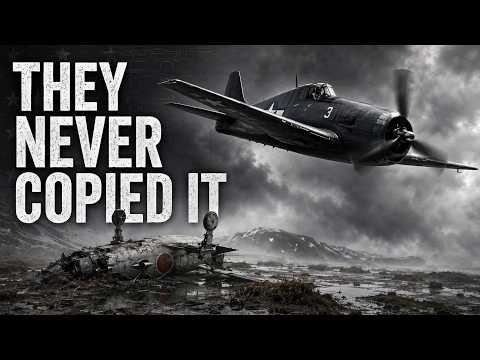
For six months after Pearl Harbor, no American flying a Wildcat could beat a Zero in a fair fight—and everyone in the cockpit knew it. So a company nicknamed “Iron Works” decided to stop fighting fair.
Four men and a factory manager walked the decks of carriers, asking dying men what they needed. A structural engineer obsessed with building things twice as strong as required. A test pilot who flew every prototype himself before risking anyone else’s life. Together they built a machine on a philosophy that was the exact opposite of everything the Zero stood for.
What they created wouldn’t just level the playing field. It would turn the sky into a slaughterhouse at a rate of 19 kills for every loss.
In the previous video, we told the story of Jiro Horikoshi and the Mitsubishi Zero—a fighter so light and agile that for six months after Pearl Harbor, no Allied pilot who met it in the air could expect to survive a fair fight. Horikoshi had built a masterpiece of subtraction. No armor behind the pilot. No self-sealing fuel tanks around the engine. Every gram he removed added speed and turning radius. And every gram he removed was a gram of protection the man in the cockpit would never have.
That was the trade. For six months, it worked. The Zero racked up a kill ratio Allied pilots still struggle to believe—close to 12 to 1—and dominated every front it entered.
By mid-1942, the U.S. Navy understood both sides of the dilemma. They knew the Zero outclimbed, outturned, and outspeeded anything they had in the air. They also knew it couldn’t take a punch. A Wildcat pilot who landed a solid burst on a Zero often watched it come apart in the sky or burst into flames before the Japanese pilot could bail out. The Zero was magnificent, but it was fragile.
The F4F Wildcat was what America had at the start of the war, and it was never designed to win dogfights. It was short, wide, slow to climb, and ungraceful. It carried six .50-caliber machine guns, armor behind the pilot, and self-sealing fuel tanks. It wasn’t fast. It wasn’t nimble. It was a Grumman. And it was built around one unglamorous idea: the only real job of this machine is to bring the pilot home alive.
When the Japanese attacked Pearl Harbor on December 7, 1941, the Wildcat became the Navy’s primary carrier fighter overnight. Within weeks, it was fighting Zeros across a Pacific the size of a continent. The results confirmed everything American pilots already feared. In a traditional turning fight, the Zero won almost every time.
But the Wildcat had one thing the Zero didn’t: the ability to take hits and keep flying. Lieutenant Commander John Thach watched the pattern long enough to build a tactic around it. A weaving, two-plane maneuver where one Wildcat turned into an attacking Zero while the other opened fire from the side. It refused to fight the Zero on its own terms—and it worked.
At the Battle of the Coral Sea in May 1942, Wildcats downed 14 Zeros against 10 Japanese losses. Midway followed, then Guadalcanal, where a six-month war of attrition over Henderson Field bled Japanese pilot experience faster than Japan could train replacements. By the end of that campaign, the kill ratio had climbed to nearly 7 to 1.
But the improvement wasn’t really about the plane. It was about the slow death of Japan’s veteran pilots, one by one, with no fast way to replace twenty years of flying experience. Attrition was invisible from a distance, but lethal up close—and every U.S. Navy commander knew it couldn’t last. Winning by killing more of the enemy’s best pilots than he kills of yours isn’t a strategy. It’s a countdown.
The company that would end that countdown started from nothing.
On December 5, 1929—six weeks after the Wall Street crash wiped out fortunes across the country—Grumman Aircraft Engineering Corporation was formally incorporated by five men who refused to leave New York when their previous employer moved to Pennsylvania. On January 2, 1930, they opened for business in an abandoned auto garage in Baldwin, New York. Broken windows. Dead leaves from several autumns scattered across the floor. The rent was cheap, and that was the only thing worth recommending about the place.
They were led by Leroy Randle Grumman. Born in Huntington, New York, in 1895, he studied mechanical engineering at Cornell. He joined the Navy in World War I but failed the flight physical because of flat feet—yet a clerical error sent him to pilot training at MIT anyway, and he spent the next decade studying how aircraft survive the harshest environment in aviation: the deck of a ship at sea. Grumman understood something that would define every aircraft his company ever built: a Navy fighter is measured not by its speed, but by its ability to bring the pilot home.
Grumman mortgaged his house for $16,875 to help found the company. Leon Albert “Jake” Swirbul, the second founder, was the son of Lithuanian immigrants who grew up on Long Island and served in the Marine Corps. Where Grumman was quiet and reflective, Swirbul was loud, energetic, and relentless—a factory man who understood business, supply chains, and the brutal mechanics of turning raw metal into aircraft on schedule. He ran Grumman’s production line for the next thirty years, and his management, more than any single design decision, turned blueprints into 12,000 aircraft in three years.
William Schwendler was the structural genius—the son of a German immigrant and one of the first aeronautical engineering graduates from NYU in 1924. Schwendler understood loads and stresses, the invisible forces that break an aircraft on a hard landing or a violent maneuver. At Grumman, he became the guardian of a rule that would outlive all the founders: build every structural component twice as strong as the specification requires. Not because the Navy asked for it, but because Navy paperwork never captured what actually happens to a fighter in combat or on a failed night landing on a carrier deck in a rough sea.
The three men kept the company alive through the worst years of the Depression by repairing old amphibious aircraft, welding aluminum truck frames, and building boat floats for other manufacturers. Grumman himself invented a retractable landing gear and demonstrated it to Navy officials using only a bent paperclip and a pencil eraser. It worked—and it won the company one contract, then another. In 1931, the Grumman FF-1 became the first Navy fighter with retractable wheels and the fastest naval fighter in the world at nearly 200 miles per hour.
The company moved twice more before settling permanently in 1937 on farmland in Bethpage, Long Island, where it built a factory with its own airstrip. In 1934, Grumman told his partners that 250 employees should be the company’s maximum. His accountant told him the payroll had already passed that number. Grumman accepted the fact, but never the principle behind it. War would overwhelm everything within a decade.
The fourth man arrived in Bethpage in 1936, and he was different from the other three in one essential way. Robert Leicester Hall didn’t just design aircraft—he flew them first, before anyone else was allowed to risk their life in the cockpit.
Born in Massachusetts in 1905, Hall graduated from the University of Michigan with a degree in mechanical engineering and went straight into the world of high-speed racing aircraft, joining the Granville Brothers Aircraft company in Springfield, Massachusetts, as a designer, then chief engineer, then test pilot. There, he built the GB Model Z—a short, barrel-shaped racer that observers said looked like a piece of sewer pipe that had sprouted wings. It was astonishingly fast and dangerously unstable at the same time. Jimmy Doolittle called it the most thrilling aircraft he ever flew.
At the 1931 National Air Races, Hall’s designs won five first-place trophies and shattered speed records that stood for years. The same short, unstable airframe that made the GBZ so fast also killed more than one pilot. When Granville Brothers went bankrupt in 1934, Hall had absorbed both lessons: speed sells tickets, and an aircraft that won’t forgive its pilot will eventually kill him.
At Grumman, Hall became chief engineer and chief test pilot, and the partnership he formed with William Schwendler produced the most important family of naval aircraft in American history. Schwendler brought structural discipline—a refusal to sacrifice any margin of safety for a single pound of weight. Hall brought the intuition for how an aircraft behaves in the air, and the willingness to test it himself in the cockpit before handing the controls to a nineteen-year-old with three weeks of training.
Hall made the first flight of the Wildcat, and he would make the first flight of the aircraft that followed it.
By the late 1930s, the Navy itself had begun calling the Grumman plant “the Iron Works.” The nickname had nothing to do with elegance. It referred to a hard, simple fact: Grumman aircraft came home. That was the company. And that was the aircraft that flew over the Solomons in early 1943, holding its own against a Zero that could still outfly it in any even fight.
The Wildcat had proven the Iron Works philosophy right. It had also proven its limits. Grinding down Japan’s veteran pilots, squadron by squadron, was not a strategy for winning a war that spanned an entire ocean. Jake Swirbul understood this better than almost anyone in Navy leadership, because he was the one who traveled to the carriers himself, walked their decks in his shirtsleeves, sat with the pilots who had just watched their squadron mates ditch in the water, and asked them the only question that mattered: what do you need that you don’t have?
The answers he carried back to Bethpage that year would become the founding blueprint for the most dominant fighter in the history of the Iron Works. A machine designed from the first line to do one job better than any other aircraft in the Pacific. Kill the Zero. Bring its pilot home.
The story most people know about the aircraft that appeared next is dramatic, satisfying, and badly wrong. The popular version goes like this: the United States recovered a crashed Japanese Zero, studied its secrets, and built a fighter specifically to exploit its weaknesses. It’s a perfect story—the kind that compresses into a single sentence and gets repeated in documentary after documentary because it feels true.
But it’s impossible, and the dates prove it beyond any doubt.
On June 3, 1942, during a diversionary Japanese raid on the Aleutian Islands, a nineteen-year-old pilot named Tadayoshi Koga took ground fire that severed his aircraft’s oil line. He tried to land his Zero on Kiska Island—a remote stretch of tundra and fog thousands of miles from Tokyo, one of the cruelest and most forgotten corners of the Pacific theater, where the weather itself was deadlier than any enemy pilot. The wheels caught in soft marsh, and the Zero flipped violently onto its back. Koga was killed instantly, his life taken by an aircraft designed to save weight everywhere except around the pilot. Remarkably, his fighter survived almost intact, inverted in the mud for weeks while fog covered the island and no one came looking.
American forces didn’t find the wreckage until a month later. They didn’t begin repairing it until later that summer, and test flights of the rebuilt Zero didn’t begin in San Diego until late September 1942—about four months after Koga died.
But by then, the aircraft designed to destroy the Zero was already flying.
Grumman’s design specifications for what it called the XF6F-1 were dated February 24, 1941—ten months before Pearl Harbor and more than a year before Koga’s crash. The Navy signed the development contract on June 30, 1941. The first prototype flew on June 26, 1942, under Bob Hall. Just three weeks after the diversionary raid, and months before the Zero wreck was pulled from the mud, Hall flew the first prototype for twenty-five minutes over Bethpage. A second prototype flew a month later. The first production model made its maiden flight on October 4, 1942—just two weeks after the rebuilt Zero began its test flights on the other side of the country.
The timeline leaves no room for the myth. This aircraft wasn’t born from a dead man’s wreckage. It was born from the words of men who lived.
And the most important of those pilots was Butch O’Hare.
By spring 1942, O’Hare was already one of America’s most famous pilots—a Medal of Honor recipient who had single-handedly attacked nine Japanese bombers to save the Lexington. He had felt Zero fire tear through his cockpit and lived to describe exactly what it felt like.
On April 22, 1942, O’Hare visited Grumman’s Bethpage plant and sat face to face with Bob Hall, William Schwendler, and the engineering team. He told them precisely what the Wildcat lacked. Then he told them something more valuable: what the Zero couldn’t do.
It couldn’t absorb a hit. It couldn’t dive hard without its wings tearing. Above 200 knots, its controls went stiff and useless. Every weakness he described became a specification. The engineers wrote his words directly into the aircraft they were already building.
The Navy pushed further: raise the cockpit for visibility, and swap the weak Wright engine for Pratt & Whitney’s 2,000-horsepower R-2800 Double Wasp. Schwendler tore up approved drawings and recalculated stress loads from scratch. Hall flew every prototype himself.
When the rebuilt Akutan Zero finally became available that autumn, its data confirmed what Bethpage already believed. It didn’t create the aircraft. The aircraft already existed—shaped by the testimony of pilots who survived, not by the wreckage of a boy who didn’t.
What emerged was Schwendler’s philosophy made metal: where Horikoshi removed weight for speed, Schwendler added weight for survival. Armor plate. Self-sealing tanks. Six .50-caliber guns. A fighter that could take punishment and keep flying.
They called it the F6F. The Navy called it the Hellcat. At first it sounded like a joke—until pilots flew it into combat and stopped laughing.
But the aircraft was only half the story. The other half was happening on the factory floor, where Jake Swirbul was fighting a different war—one measured not in kills, but in units per hour.
Before the war, Grumman employed roughly 700 people. By 1943, Bethpage held 25,500 workers. Annual sales exploded from $4 million in 1940 to $400 million three years later. Swirbul walked the lines in his shirtsleeves, knew workers by name, and built training programs from nothing for thousands who had never touched a rivet gun before Pearl Harbor.
Women flooded in by the thousands, building wings and assembling engines beside men, proving that patience and precision mattered more than brute strength. Test pilots Elizabeth Hooker and Teddy Kenyon flew completed Hellcats and Avengers off the Bethpage runway before crowds of journalists—climbing into cockpits built for men twice their size.
At peak, Bethpage completed one Hellcat every hour, around the clock. When the Navy asked Grumman to cap production at 500 a month, Swirbul told them he could build 700 instead. In March 1945, the plant produced 664 Hellcats in a single month.
The Hellcat’s combat debut came on August 31, 1943. The real test arrived over Tarawa that November: rookie pilots destroyed 30 Zeros for the loss of one Hellcat. Over Rabaul, Hellcats and Corsairs claimed more than 50 enemy aircraft. The new Grumman wasn’t an improvement on the Wildcat—it belonged to an entirely different class of weapon.
Tactics evolved from the same intelligence that built the plane. Dive from altitude. Use speed to close. Fire a massive burst from six heavy guns. Get out before the Zero could exploit its turning radius. If the Zero tried to follow in a dive, its wings risked tearing. If it climbed, the Hellcat’s 2,000-horsepower engine closed the gap anyway.
It all culminated on June 19, 1944—the Battle of the Philippine Sea. Japan launched four massive carrier air attacks. 480 Hellcats rose to meet them. In the first wave alone, 42 of 69 Japanese aircraft were shot down before reaching the fleet. In the second, over 100 of 128 fell. By sunset, Japan’s naval air arm had lost roughly 350 aircraft. American losses were negligible.
The pilots gave it a name that stuck in the history books: the Great Marianas Turkey Shoot.
Honesty requires saying this clearly: the lopsided result wasn’t the Hellcat’s doing alone. Japan’s pilot training system had been collapsing for two years. Since Guadalcanal and Rabaul bled away the veterans who had outflown Wildcats with a decade of experience, their replacements received abbreviated training and a fraction of the flight hours. What the Hellcat did was make that gap lethal in a way no previous American fighter could.
By war’s end, the F6F was credited with 5,163 aerial victories against just 270 Hellcats lost in air combat—a kill ratio of roughly 19 to 1. Hellcats alone accounted for about 75% of all U.S. Navy air victories in the Pacific, and 306 pilots became aces. The most successful, Captain David McCampbell, shot down 34 Japanese aircraft—more than any other American pilot on any front.
On October 24, 1944, during the Battle of Leyte Gulf, McCampbell and wingman Roy Rushing intercepted a formation of 60 Japanese aircraft—just the two of them. McCampbell downed nine himself; Rushing claimed six more. The formation scattered before reaching the American ships it had been sent to destroy. McCampbell received the Medal of Honor. Two men and two aircraft standing between sixty enemy planes and a fleet full of sailors who never knew how close the sky came to falling.
The Hellcat wasn’t the fastest fighter in the Pacific—the Corsair was. It wasn’t the most advanced—the P-51 Mustang, built for a different war over Europe, was more elegant in many ways. It wasn’t even the most agile fighter it faced, by a wide margin. What it was, unmistakably, was the most effective. It arrived at exactly the right moment, in exactly the right numbers, with exactly the capabilities the moment demanded. And it accomplished the single mission it had been designed for from the first line of the first blueprint.
The four men who built it went their separate ways after the fighting ended. Jake Swirbul managed Grumman’s painful postwar contraction with the same ferocious energy he’d brought to its wartime expansion—so efficiently that Grumman was the only American aircraft manufacturer to turn a profit in 1946, a year when most of the industry hemorrhaged losses as military orders evaporated overnight. He died of colon cancer on June 28, 1960, at 62—never living to see the company he built help put men on the Moon.
William Schwendler stayed to lead Grumman’s engineering division, rising eventually to executive vice president and chairman. His founding principle—build every structural component twice as strong as any specification requires—carried into every aircraft the company produced after the war, from the F9F Panther jet to the F-14 Tomcat decades later. He died on January 15, 1978, in Farmingdale, New York, at 73.
Robert Hall rose to vice president and personally oversaw the design of Grumman’s first jets, the F9F Panther and F9F Cougar. The same man who had flown the fastest, most dangerous racing planes of the 1930s—who tested the Hellcat himself before any other pilot touched it—helped steer the entire company into the jet age. He died in 1991 at 85.
Leroy Grumman retired as chairman on May 19, 1966, and was named honorary chairman for life. He kept visiting the Bethpage plant regularly for years afterward, until diabetes took the last of his sight in the early 1980s. On October 4, 1982, he died at North Shore University Hospital in Manhasset, Long Island, at 87. Before his death, he watched the company he founded in an abandoned garage build the Lunar Module that carried Neil Armstrong and Buzz Aldrin to the Moon’s surface on July 20, 1969—built in the very Bethpage plant that had once produced a Hellcat every hour. Grumman built 13 Lunar Modules in all. Every one performed flawlessly when Apollo 13’s service module exploded in 1970. It was Grumman’s Lunar Module that served as a lifeboat, keeping its three-man crew alive for four days until they returned safely to Earth.
In 1994, twelve years after Leroy Grumman’s death, Northrop acquired the company for $2.1 billion, beating Martin Marietta’s $1.9 billion offer. The merged company took the name Northrop Grumman. The Bethpage plant—which produced Wildcats, Hellcats, Avengers, Tomcats, and the Lunar Module—eventually closed. Its buildings became office parks and housing developments. The company that employed tens of thousands of Long Islanders through most of the Cold War, and never recorded a financial loss across 64 years as an independent company, ceased to exist as an independent entity. The Grumman name survives today inside Northrop Grumman, the way a fossil survives in stone. Its shape is still clear to anyone who knows where to look. It is no longer the living creature it once was.
Jiro Horikoshi built the Zero almost alone. One brilliant engineer answered a nearly impossible specification by stripping weight until his aircraft weighed less than the laws of physics seemed to allow. The result was a blade without a handle to protect the hand that held it—deadly and dazzling as long as no one learned to stop fencing with it and simply overpower it.
The Hellcat wasn’t built by one man. It was built by four men and a pilot, sitting in a Bethpage conference room, telling the truth about what it felt like to be about to die behind the stick of an inferior aircraft. Grumman’s philosophy was that every aircraft must bring its pilot home. Swirbul gathered the testimony of men who died in Wildcats and carried their words precisely to the designers. Schwendler built a structure strong enough to withstand cruelty the specifications never imagined. Hall drew the aircraft and flew it himself first, every time, so no other pilot would discover a fatal flaw before he did.
The Zero was a masterpiece of subtractive engineering—everything unnecessary for winning a fight was removed. The Hellcat was a masterpiece of additive engineering—everything the Zero lacked was added. Raw power versus lightness. Weight where the Zero gambled everything on agility. The result was never elegance. The result was a kill ratio of 19 to 1. 5,163 victories and 75% of every air victory the U.S. Navy recorded in the entire Pacific War. Built at a rate of one complete aircraft every hour by a workforce that grew from 700 people to 25,500 in just three years.
The Iron Works didn’t build the most beautiful fighter of World War II. It built the aircraft that did its job and brought its pilot home.
So here’s the question worth sitting with: if you had to choose between a machine that wins every fair fight and a machine that wins the war—which one would you strap yourself into?
Report this article
Select a reason for reporting:






