They say walls can’t talk. But in Hollywood, some walls whisper secrets louder than red carpet rumors. These mansions aren’t just odd—they’re the secret diaries of fame, filled with hidden tunnels, forbidden rooms, wild obsessions, and tragedies no tabloid ever revealed. Why did so many stars go to such strange extremes to guard their privacy? Step inside these bizarre celebrity homes and discover the shocking Hollywood scandals that were never meant to leave the front door.
Are you ready to see what even the stars were afraid to show? Let’s explore together—if you dare.
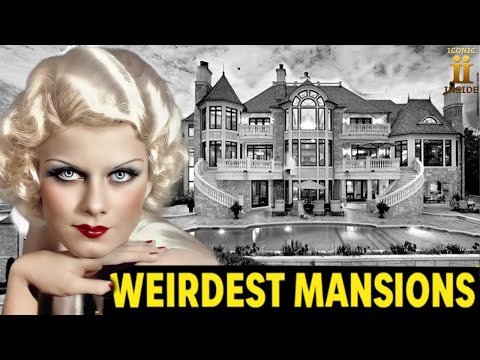
Long before John F. Kennedy entered the White House, his father, Joseph P. Kennedy Sr., was rumored to have conducted a secret love affair with Hollywood icon Gloria Swanson. Their whispered rendezvous inside a now-demolished Spanish Moorish estate known as Casa del Sol—tucked away in Beverly Hills—wasn’t just a shrine to old Hollywood excess. According to some biographers, it was the setting for a high-stakes relationship that blended passion, power, and scandal.
Built in the 1920s, Casa del Sol was a masterpiece of arched doorways, vibrant tile work, and opulent detail, including a private chapel and a hidden passage leading to a secluded room. Former staff claimed Swanson used the space for confidential meetings—some of them with Kennedy himself. Their relationship, kept out of the public eye, was far from casual. Kennedy financed one of Swanson’s films and allegedly tried to leverage his political connections to revive her slipping stardom.
Beyond secret affairs, the house itself was a marvel. Swanson filled it with rare artifacts from her global travels: Egyptian statues, antique tapestries, and exotic treasures that were later auctioned off after her death. Her parties were so extravagant that they became legend, with guest lists filled with moguls, stars, and silent whispers of studio backroom deals.
But fame is fleeting. When Swanson’s career declined in the era of talkies, the grand estate became a burden. She sold it under financial pressure, and eventually the house was torn down. Some say the workers who demolished it uncovered strange etchings and sealed compartments—ghostly remnants of a Hollywood dream turned secret sanctuary.
From the outside, Charlie Chaplin’s 1920s Beverly Hills home looked almost too modest for one of the most recognizable faces in cinema history. But beneath the property ran a hidden tunnel, confirmed by estate records. It allegedly led to a private wine cellar—and perhaps more. Some claim these tunnels were his secret escape from reporters, while others believe they helped him evade government surveillance during darker times.
Because here’s the twist: In 1952, while Chaplin was on a trip to Europe, the US government revoked his re-entry permit due to suspicions of communist sympathies. He would never return to live in America again. His Beverly Hills home, once a creative sanctuary, became a silent casualty of Cold War paranoia.
Declassified FBI files even reveal that agents monitored activity at the estate during the McCarthy era, suspecting subversive gatherings behind its unassuming walls. The garden held a miniature stage where Chaplin rehearsed gags in secret, sometimes emerging from tunnels to surprise his guests with theatrical flair. Even at home, he was always performing.
Chaplin refused to modernize the interior, keeping the original 1920s decor—a quiet nod to the working-class beginnings he never truly left behind. After Chaplin’s exile from America, the mansion gained a mythic reputation. Locals whispered that late at night, mysterious visitors would sneak inside, hunting for lost treasures or unfinished scripts rumored to be hidden deep in the tunnels or cellar.
Years later, new owners claimed to discover strange props, cryptic handwritten notes, and even sketches for films Chaplin never made—turning the house itself into a living archive of Hollywood’s wildest dreams and secrets.
Legend has it that hidden inside Errol Flynn’s Hollywood mansion was a two-way mirror so he could watch his guests without them ever knowing. But this wasn’t just a party trick. According to former staff and archived estate records, Flynn designed Mulholland Farm like a playground for a man torn between fame, paranoia, and thrill-seeking indulgence.
Tucked in the Hollywood Hills, the 1940s estate featured hidden passageways, a secret bedroom, a pistol range, and a private bar that once fueled the wildest parties of old Hollywood. Flynn, famous for his swashbuckling bravado in Captain Blood and The Adventures of Robin Hood, was equally infamous offscreen for womanizing scandals and rumored intelligence ties during World War II. In fact, declassified FBI files later revealed the government kept an eye on him due to his international contacts and erratic behavior.
Some believe his home wasn’t just built for mischief, but for evasion. Inside Mulholland Farm, Flynn could disappear through a passage, spy on guests through that mirror, or duck out the back when creditors came calling. His pistol range wasn’t just for sport—close friends said he trained there obsessively, sometimes while intoxicated, hinting at a darker descent into control and paranoia.
As Flynn’s career declined in the 1950s, plagued by lawsuits, health issues, and financial ruin, his once-glamorous estate fell into disrepair. Over time, the home was sold and eventually demolished. But its legend endures. Old Hollywood buffs still whisper about the secret rooms, raucous gatherings, and the actor who watched from behind the glass.
Long after her death, residents and staff in the historic Hancock Park building have reported strange happenings: whispers in the halls, the scent of her perfume drifting in empty rooms, and even sightings of a woman in white near her old apartment. Whether fact or folklore, the stories fit perfectly with Mae West’s larger-than-life persona.
Unlike her peers who vanished into Beverly Hills mansions, Mae West chose to remain in her top-floor Ravenswood apartment—a choice that itself became a quiet act of rebellion. West transformed it into a personal palace of theatrical elegance: plush white carpets, mirrored walls that shimmered like a Hollywood dream, and an atmosphere so stylized it bordered on surreal. A custom-designed seashell-shaped bed sculpted like Venus on a cloud, where West posed for private photo shoots and entertained powerful guests.
According to estate records and interviews with friends, West believed white symbolized power, purity, and eternal glamour—qualities she carefully crafted into every inch of her domain. Every corner was filled with flamboyant costumes, vintage props, and rare photographs, carefully arranged not as decor, but as artifacts in her personal museum. Visitors recalled feeling like they’d stepped into a living exhibit, one where vaudeville grit met Hollywood grandeur.
To West, her apartment was not just a retreat. It was her stage, her armor, her legacy. As the decades rolled on, new stars came and went, but Mae West stayed exactly where she was. She never traded up for a mansion she didn’t need to. Ravenswood became part of her legend—quiet on the outside, unapologetically bold within. And now, even in death, her presence is said to linger.
Few people know this, but inside John Barrymore’s sprawling Beverly Hills estate once stood a private Shakespearean stage, complete with footlights and velvet curtains, where the legendary actor would perform Hamlet for his parrot and his monkey.
Welcome to Bella Vista, one of old Hollywood’s most bizarre, beautiful, and heartbreaking homes. Built in the 1920s, this Gothic-style mansion wasn’t just a residence. It was an extension of Barrymore’s theatrical soul. A grand library lined with rare books and hidden compartments filled with manuscripts spoke to his obsession with literature. Dark wood panels, eerie lighting, and antique furnishings turned the house into something between a haunted theater and a gentleman’s club for eccentrics.
Barrymore, known as “The Great Profile,” didn’t just live here. He performed here. Friends recalled late-night recitations of Macbeth in the study and spontaneous monologues on the terrace. His exotic pets—especially the monkey, who reportedly mimicked him during scenes—only added to the surreal ambiance.
But as the 1930s wore on, Bella Vista became more than a home. It became a symbol of decline. Alcoholism, financial ruin, and failing health crushed Barrymore’s career. The stage grew dusty. The books were sold off. In the end, he was forced to abandon the house that once echoed with sonnets and laughter. Eventually, the mansion was demolished, its secrets buried with it.
After his death in 1942, Hollywood was rocked by a shocking rumor: that a group of his closest friends—allegedly including Errol Flynn and W.C. Fields—stole Barrymore’s corpse from the morgue and brought it back to Bella Vista to stage one final, grotesque performance in his honor.
What if I told you that the blueprint for Wi-Fi was born not in a tech lab, but in the secret backroom of a glamorous Hollywood home? Long before Silicon Valley, Hedy Lamarr, the legendary screen siren, was quietly developing technology that would change the world.
Hidden behind the sleek walls of her 1940s modernist home, high in the Hollywood Hills, Lamarr kept a private workshop. Most visitors never even knew it existed. While the world admired her beauty on screen, she was alone in that room, tinkering, theorizing, and ultimately co-developing frequency hopping—a concept now considered the foundation for today’s Wi-Fi, Bluetooth, and GPS.
Her house reflected the duality of her life: minimalist, sunlit, and elegant on the outside; sharp, complex, and revolutionary within. Beneath its polished facade was a sanctuary of invention where she chased intellectual curiosity in a time when Hollywood demanded silence from smart women. She rarely invited anyone inside her lab, not even close friends. Rumors swirled among studio insiders, but few dared ask what really went on behind those doors.
And when her invention was submitted to the US military during World War II, it was dismissed. She was told to stick to selling war bonds instead. Hollywood never saw the lab. America never saw the mind. Not then.
Today, Lamarr’s home no longer stands, but its legend grows. In a city obsessed with image, hers was a house that held secrets of science and resistance. Her story is a defiant reminder: intelligence can be hidden in plain sight, even behind the face of a goddess.
Few people know this, but at the height of his isolation, Howard Hughes refused to allow anyone into certain rooms of his mansion—even cleaning staff. He would leave written instructions, detailed down to how many tissues were allowed in a drawer, slipped under locked doors, fearing contamination from the outside world.
That was the reality inside Hughes’s Beverly Hills estate: a technological palace turned paranoid labyrinth. Purchased in the 1920s, the home sat behind towering walls and a fortress of dense foliage, ensuring total privacy for a man who would become one of the most brilliant, powerful, and tragically reclusive figures in Hollywood history.
Inside, the decor was a reflection of his dual identity: sleek luxury paired with cutting-edge innovation. Hughes installed his own private airstrip on the property so he could take off and land without ever interacting with the outside world. As his fears and eccentricities deepened, he added hidden rooms, false walls, and secret passageways so elaborate that staff reportedly got lost in them.
He micromanaged every element: the angle of a chair, the direction of sunlight, even the exact temperature of individual rooms. Staff whispered about how he stored his own urine in jars, refused to touch doorknobs, and watched movies on repeat for hours—sometimes naked and surrounded by Kleenex boxes.
By the 1940s and ’50s, the estate was no longer a glamorous retreat, but a self-imposed prison. And when Hughes died in 1976, the mansion was eventually demolished, but its eerie legacy lingered.
Few fans realize this, but James Dean’s infamous Porsche 550 Spyder, nicknamed “Little Bastard,” wasn’t just stored in a showroom or studio lot. It sat quietly in the modest garage of a small Sherman Oaks bungalow—the same bungalow where he spent his final nights before the crash that ended everything.
From the outside, the house looked utterly unremarkable. No red carpet, no velvet ropes—just a quiet rental home tucked away from the Hollywood spotlight. But inside, it told a different story. One of a restless genius trying to slow down. Dean, the symbol of rebellion on screen, used this space to sketch, play bongos, and read scripts in silence. Friends said it was the only place he didn’t have to perform—the only place he let the walls down.
And parked just feet from his bedroom was the 550 Spyder, a machine so sleek and dangerous it felt like a prophecy. He loved that car, called it his mechanical soulmate. Some even claim he joked it was cursed. Days later, he was dead. The car shattered. The myth born.
What’s haunting is how little has changed. The bungalow remained mostly untouched for years, a frozen portrait of youth, fame, and fatal momentum. Today, fans still drive by, imagining Dean sitting on the porch, script in hand, trying to understand who he was becoming before the world decided for him.
Did James Dean’s unassuming Sherman Oaks bungalow truly curse the “Little Bastard” Porsche? The legend refuses to die, just like the ghost of the man who once sat on that porch, script in hand.
Few know this, but when Jayne Mansfield first toured the mansion that would become the infamous Pink Palace, she didn’t ask about the number of rooms or the price. She asked, “Can we paint everything pink—even the ceilings?” Drenched in bubblegum pink paint, with velvet walls and a heart-shaped pool that spelled “I love you, Jayne” in mosaic tile, the Pink Palace was less a home and more a bold declaration: Jayne Mansfield would never be anyone’s second Marilyn.
But like many Hollywood dreams, this one didn’t last. The home fell into disrepair after her tragic death in 1967 and was eventually demolished. Today, it exists only in photos, rumors, and the vivid memories of those who saw it.
So tell us—which of these hidden Hollywood secrets shocked you the most? Was it the two-way mirror, the secret lab, or the mansion built on a lie? Drop your answer in the comments below, and don’t forget to subscribe for more secrets hiding behind Hollywood’s golden gates.
Report this article
Select a reason for reporting:






