The mansion at 700 Nimes Road stood silent, its white walls hiding decades of secrets. Elizabeth Taylor’s violet eyes had once sparkled here, but now the house waited—for demolition crews or for salvation. This was the same fate that haunted dozens of legendary Hollywood estates, each a monument to fame, heartbreak, and the relentless march of time.
From the opulent ballrooms of Pickfair to the intimate Brentwood cottage where Marilyn Monroe took her last breath, these homes were more than brick and mortar. They were witnesses. And one by one, they were vanishing.
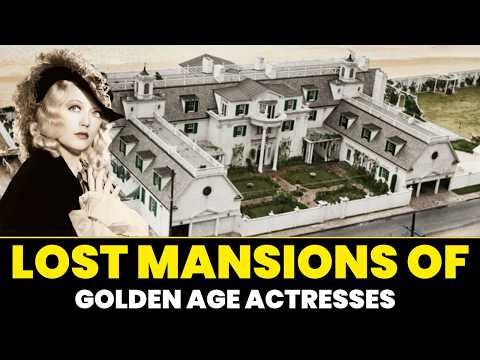
In the golden days of Hollywood, big mansions and fancy estates were symbols of fame, wealth, and the glamorous lives of the stars who lived in them. These grand homes saw the joys, sorrows, and secrets of entertainment’s most famous people. But as time went on, many faced uncertain futures—some torn down, others radically changed.
Elizabeth Taylor’s Bel-Air mansion was a sanctuary of white carpets, blue and lavender hues, and a garden that recalled her British roots. She bought it in 1982 for $2 million, filling it with Impressionist art and a bronze calf sculpted by her daughter. For nearly three decades, it was her refuge from fame. Then, after her death in 2011, a developer bought the property with plans to tear it down. Preservationists fought back, but the fate of the house remained hanging in the balance.
Marion Davies’ Santa Monica beach house was another world entirely. With over 100 rooms, a marble pool, and 5 acres of beachfront, it was the epicenter of 1920s Hollywood society. Guests like Charlie Chaplin, Greta Garbo, and Clark Gable danced under its gilded ceilings. But by 1945, taxes and war changed everything. The mansion was sold, later demolished in 1956, and the site became a parking lot—until a foundation restored part of it as a public beach house in 2009.
Marilyn Monroe’s Brentwood home was modest by comparison—a Spanish-style bungalow with beamed ceilings and a kidney-shaped pool. She paid $75,000 in 1962, the only home she ever owned. Six months later, she was dead in her bedroom. In 2024, after a legal battle, the house was designated a historic monument, saving it from demolition.
Pickfair, the 15-acre Beverly Hills estate of Mary Pickford and Douglas Fairbanks, was Hollywood’s original power palace. Its parties drew Einstein, F. Scott Fitzgerald, and even President Roosevelt. But after their divorce, the magic faded. In 1988, new owners demolished most of the mansion, citing termite damage and hauntings. The loss outraged historians—yet the legend lived on.
The Garden of Allah hotel, once Alla Nazimova’s private estate, became a bohemian haven for writers and stars. F. Scott Fitzgerald wrote parts of The Last Tycoon by its Black Sea–shaped pool. By 1959, it was torn down for a bank. Today, only memories remain.
And Betty White’s Brentwood home, where she lived for over 50 years, was demolished in 2022—but not before her yellow front door was saved by a fellow comedian. Proceeds went to animal charities, honoring her lifelong passion.
These are the stories of Hollywood’s abandoned mansions—each a silent witness to glory, loss, and the fight to remember.
But the story doesn’t end with those five homes. Across Los Angeles, other legendary estates were facing their own reckoning—some saved, some lost, and some caught in battles that would drag on for years.
Take the sprawling Beverly Hills estate known as “Grayhall,” built in 1909 by mining tycoon Charles T. Hinde. It later became the playground of actor George Hamilton’s family and, before that, a rumored hideaway for silent film star Douglas Fairbanks. By the 1970s, the mansion had fallen into disrepair, its once-grand ballroom choked with dust and cobwebs. Developers circled like vultures. But in 1976, a preservation-minded buyer stepped in and restored the home to its former glory—one of the rare happy endings in Hollywood real estate.
Then there was “The Enchanted Hill,” the 12-acre Beverly Hills compound of newspaper magnate William Randolph Hearst and his mistress, actress Marion Davies. Wait—Davies again. Her name seemed to haunt every corner of Hollywood history. After Hearst’s death in 1951, the estate passed through a series of owners, each promising to preserve it. None did. By the 1990s, the main house had been gutted, its famous terraced gardens overgrown. A billionaire bought the land in 2010 and promptly leveled what remained, replacing it with a 70,000-square-foot modern monstrosity that neighbors called “the spaceship.”
And then there was the strangest case of all: the Harold Lloyd estate, “Greenacres.” The silent comedy star built it in 1929—a 44-room mansion with a golf course, a bowling alley, and a waterfall. Lloyd’s widow stayed until her death in 2011, and the estate sold for $90 million. But instead of demolition, the new owner did something unexpected. He painstakingly restored the main house, room by room, even tracking down original furniture that had been auctioned off decades earlier. Preservationists cheered. It was proof that Hollywood’s ghosts didn’t always have to be bulldozed.
Yet for every Greenacres, there were a dozen lost causes. The Doheny mansion in Beverly Hills—once the largest home in the city—sat empty for years before being carved into luxury condos. The Rudolph Valentino estate in Whitley Heights was demolished in the 1960s for a freeway ramp. And the Buster Keaton mansion in the Hollywood Hills? Torn down in 2005 for a spec house that sat unsold for years, a ghost of a different kind.
What united all these stories was a single, uncomfortable truth: Hollywood loved its stars, but it had a habit of forgetting their homes. Fame was fleeting. Property was forever—until it wasn’t.
Back at 700 Nimes Road, the fight over Elizabeth Taylor’s Bel-Air mansion dragged on. The developer’s demolition permit had been filed. The preservationists had filed appeals. The house sat empty, its white carpets rolled up, its lavender walls stripped of art. The koi pond had gone stagnant. The bronze calf sculpted by Liza Todd had been removed for safekeeping.
Then, on a rainy Tuesday morning in early 2025, a judge issued a temporary restraining order. The demolition was paused—not stopped, but paused. “This house is not just a building,” the judge wrote in her ruling. “It is a cultural artifact, a physical record of a woman who changed American entertainment and philanthropy. The public has a legitimate interest in its survival.”
The developer vowed to appeal. The preservationists celebrated cautiously. And somewhere in the quiet of that empty mansion, if you listened closely, you could almost hear the echo of Elizabeth Taylor’s laughter—violet eyes sparkling, garden in bloom, the koi pond shimmering under the California sun.
The fight wasn’t over. Not by a long shot. But for one rainy morning, at least, the house at 700 Nimes Road had won a reprieve. And in a city that had demolished so much of its own history, a reprieve felt almost like a miracle.
But miracles in Hollywood had a way of curdling into cautionary tales. Just ask the preservationists who had fought for the Marion Davies guest house in Santa Monica—the only surviving fragment of that 100-room beach palace. In 2023, a routine inspection revealed saltwater intrusion had eaten through the foundation. Engineers warned that without a multimillion-dollar stabilization effort, the guest house could slide into the Pacific within a decade. The Annenberg Foundation, which had restored it in 2009, quietly began fundraising—but the clock was ticking, and the ocean never negotiated.
Meanwhile, a new battle was brewing over a mansion most people had forgotten: the Beverly Hills estate of silent star Norma Talmadge, built in 1922 with a ballroom modeled after Versailles. Talmadge had been one of the highest-paid actresses of her era, and her home hosted everyone from Valentino to the Prince of Wales. By the 2000s, it had been subdivided into a dozen cramped apartments, its ballroom converted into a storage unit. In 2024, a developer filed plans to demolish it and erect a five-story luxury condo tower. Neighbors protested. Historians pleaded. But the house had no celebrity champion—no Taylor, no Monroe, no White—and the city council seemed inclined to let it fall.
“We can’t save everything,” a planning commissioner told the Los Angeles Times, shrugging. “At some point, a building has to justify its own existence.”
That phrase—justify its own existence—haunted the preservation community. Because it raised a question no one wanted to answer: did a house matter only because of who slept in it? If Marilyn Monroe had never lived in that Brentwood bungalow, would anyone have fought for it? If Elizabeth Taylor had never bought the Nimes Road mansion, would a judge have paused the bulldozers?
The uncomfortable answer was almost certainly no. And that meant hundreds of other historic homes—beautiful, architecturally significant, but lacking a famous ghost—were doomed. The Doheny mansion had become condos. The Valentino estate was a freeway ramp. The Keaton mansion was a vacant spec house. Each loss was a quiet erasure, a page torn from a book no one had bothered to read.
Back at 700 Nimes Road, the developer’s appeal hearing was set for April 2025. His lawyers argued that the temporary restraining order was an unconstitutional seizure of property rights. The preservationists countered with a 400-page cultural impact report, complete with photographs of Taylor’s garden in bloom, her koi pond shimmering, her violet-eyed portrait hanging in the living room. The judge listened for six hours. Then she asked a question that silenced the courtroom: “If we tear this down, what will we have learned?”
No one answered. The hearing was continued to May. The house at 700 Nimes Road remained standing—for now—its white walls holding their breath, waiting to see whether Hollywood would remember or forget.
The May hearing arrived with the weight of a city’s memory pressing against the courtroom doors. The developer’s lawyer, a silver-haired man with a practiced smile, called the cultural impact report “sentimental fiction.” He argued that Los Angeles could not freeze in amber every home touched by fame. “Sentiment is not a zoning category,” he said, and half the room nodded.
But then the preservationists called their final witness: a seventy-eight-year-old gardener named Tomás Reyes, who had tended Elizabeth Taylor’s roses from 1985 until her death. His hands trembled as he described the mornings she joined him at dawn, pruning pansies in her nightgown, laughing about the koi. “She told me once, ‘Tomás, this garden is the only place I’m not Elizabeth Taylor. I’m just a woman with dirty hands.’” The courtroom went silent.
The judge ruled three weeks later. Her decision was narrow but decisive: the mansion could not be demolished, but the developer was permitted to build a smaller addition on the back lot—a compromise that satisfied no one entirely. Preservationists called it a half-victory. The developer called it an outrage. But the house at 700 Nimes Road would stand, its lavender walls and koi pond preserved as a cultural monument.
Across town, the news sparked a quiet chain reaction. The Norma Talmadge estate, that forgotten Versailles of silent Hollywood, suddenly found a champion in a young city councilmember who had grown up watching old movies with her grandmother. “If we can save Elizabeth Taylor’s house,” she declared, “we can save Norma Talmadge’s ballroom too.” The condo tower was blocked, at least for now.
Marion Davies’s guest house received a surprise donation from a tech billionaire who had read about the saltwater intrusion and, in a rare fit of nostalgia, wrote a check for the stabilization effort. The ocean still loomed, but the little building would last a while longer.
And in Brentwood, Marilyn Monroe’s bungalow—now a historic monument—drew crowds of tourists who stood at the gate, peering through the hedges, whispering about the girl with the platinum hair. Some left flowers. Some left lipstick kisses on the sidewalk. One left a note that read: “You were more than a house. You were a home.”
The sun set over Los Angeles, casting long shadows across the mansions that remained and the parking lots where others had stood. The city had learned something, perhaps. Or perhaps it had simply gotten lucky. Either way, the ghosts of Hollywood’s golden age could rest a little easier—their walls still standing, their stories still told.
But the bulldozers were never far away, and the next battle was already brewing. Somewhere in the hills, another forgotten mansion waited for its champion.
So here’s the question for you, dear reader: if a house could speak, which Hollywood mansion’s story would you fight to save—and why?
Report this article
Select a reason for reporting:






