The sky over Caen was a bruised purple, heavy with smoke and the distant rumble of tanks. Hans Kindle crouched in his trench, fingers trembling as he lit a cigarette—not from fear, but from exhaustion that gnawed at his bones. He had seen too much, lost too many friends, and now the enemy was coming again. This was the battle for Hill 112, a fight that would test every ounce of his humanity.
Hill 112 had changed hands so many times that the ground was soaked with the blood of both sides. Hans remembered the last assault, the way the British had slipped away in the night, leaving behind wrecked equipment and the stench of death. “It was eerie,” he muttered to himself, recalling the silence that followed. But now, the Allies were back, and this time they were determined to crush the 12th SS once and for all.
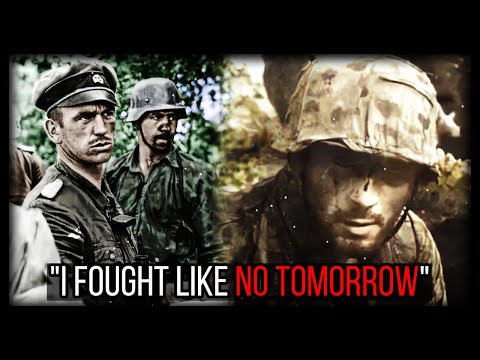
The orders from Berlin were clear: hold the line at all costs. No retreat, no surrender. Hans had seen the look in the eyes of his comrades—hollow, resigned, yet still burning with a stubborn will to survive. They had been fighting for weeks, losing men and machines at an alarming rate. Over 1,200 casualties in just six days. The numbers were staggering, but what haunted Hans more were the faces behind them—friends he had trained with, laughed with, and now buried in shallow graves.
General von Rundstedt had pleaded with Berlin to allow a retreat, to save what was left of the division. But Hitler’s response was cold and final: “Hold the line no matter what.” When von Rundstedt demanded to speak with the Führer’s chief of staff, he was sacked within hours. That was the moment Hans knew the war was lost. There would be no rational strategy, no room for regrouping. They were expected to die in the ruins of Caen.
The silence that followed the sacking of von Rundstedt was short-lived. Hans stood guard near Esquay, staring into the darkness, his ears still ringing from the artillery. He could feel the weight of exhaustion pressing down on him, but sleep was a luxury he couldn’t afford. The British were regrouping, bringing in more tanks, more men. It was only a matter of time before they struck again.
In the meantime, the division was falling apart. Panzers were down to a handful, engines overheating, ammunition low. Replacements were either too green or too broken to be of use. “Men were no longer talking about victory,” Hans recalled. “They were just talking about surviving.” Even the officers looked worn down, their faces etched with the realization that they were no longer controlling events—they were reacting, barely staying afloat.
One night, as Hans stood watch, he saw a medic sitting beside a badly wounded soldier. The man’s chest was torn open by shrapnel, his breath shallow and ragged. The medic just sat there, head down, whispering something Hans couldn’t hear. Maybe a prayer, maybe a lie about going home. Hans didn’t ask. He simply walked on, because he knew more would come, and he had to be ready.
The radio chatter increased as July wore on. British movements were intensifying, artillery maps redrawn daily. Rumors swirled of massive bombing raids, of the Allies preparing to flatten Caen completely. “Stand and fight,” the orders said. “No matter the odds, no matter the cost.” Hans looked at the men around him—ghosts, all of them, waiting to see how long they’d last. They were trapped in a nightmare of their own making, and yet they stayed. Because what else was there to do?
The night of July 7th arrived with a sky the color of iron. Hans could feel it in the air—a pressure, a stillness that made the hairs on his neck stand up. The British had been quiet all day, too quiet. Then the first bomber appeared, a speck against the darkening clouds, and the world ended.
457 bombers from RAF Bomber Command dropped over 2,300 tons of bombs on Caen. Hans was in a bunker when the first explosions hit, the ground rippling beneath him like water. The noise was beyond comprehension—a rolling thunder that shook the very earth, explosions lighting up the sky as if the sun had fallen. Fire raced down the streets, and when Hans finally crawled out, nothing looked familiar anymore.
The pathfinders had dropped their markers too far south, so most of the bombs fell on the center of the city instead of the northern edge. Shelling from the last two months had already ruined much of Caen, but this was something else. The skyline was nothing but fire and ruin. “It looked like the city had died,” Hans whispered. Buildings were just black skeletons against the glow, fires raging without control.
Yet, by some miracle, the division was mostly spared. A few tanks were hit, two flipped over completely. The third battalion suffered only a handful of casualties—seven, maybe eight. The escort company wasn’t so lucky. They took a direct hit, and the logistics columns moving through the city were caught as well, crushed in the streets or burned in their trucks. But otherwise, the damage to the troops was surprisingly light. “The front line was so thinly held, there wasn’t enough of us there for the bombs to kill,” Hans later heard an officer say. Over 2,500 tons of explosives, and in the end, it only managed to flip a few halftracks.
But the French civilians didn’t have trenches to hide in. Most had already fled the city, but many still remained, clinging to homes, to memories, to ruins. When the bombs fell on Caen that night, they were caught between the weight of the sky and the fury of the earth. Three to four hundred were killed, families buried beneath their own floors, children blown apart in the streets. That was the price they paid for being born in the wrong place at the wrong time.
After the bombing ended, a tense calm returned. The smoke was still drifting through the shattered buildings, the candles on the map table still flickering. Hans stood with Standardtenführer Meyer and the others, waiting for the attack—the storm that surely had to follow such a monstrous display of force. But it didn’t come. Not at first. No radio calls, no movement from the enemy, just silence. Meyer whispered to no one in particular that it was incomprehensible how the Allies had failed to capitalize on such devastation.
But they knew it couldn’t last. The ground they were standing on was marked for death, and they were just placeholders until the inevitable came. Hans checked his rifle, counted his ammunition, and tried not to think about the faces of the friends he’d already lost. The real battle was coming with the sunrise.
The inevitable arrived at 4:20 in the morning, about ninety minutes before the sun even thought of rising. Hans was near Galman when the first shells came. It was unlike anything he’d felt before—artillery from both land and sea came crashing down on their lines. The entire horizon lit up as if the world itself had split open. The cellar they were sheltering in shook so violently that plaster rained from the ceiling, covering the candlelit maps in gray dust.
Their own guns, mortars, howitzers, and Nebelwerfers answered the barrage, laying down protective fire to shield their positions. Fighter-bombers swooped overhead, machine guns blazing, picking off any vehicle that dared move. The bridges over the Orne were being shelled constantly, cutting off any hope of reinforcement or retreat. Then came the infantry. The British 59th Division, shoulder-to-shoulder with the 3rd Division, began their assault behind a wall of fire from 632 guns. The Canadians waited behind them, ready to follow once the initial breakthroughs were made.
At Lebisey, just east of the railway, the Luftwaffe’s 16th Field Division was the first to be hit. To the west, Hans’s own I Battalion of the 25th SS Panzer Grenadiers had fortified themselves in the open fields. They had dug in deep, linking up with the 2nd Battalion in Galman and the Luftwaffe troops along the line. The ground had been quiet for days. Now it exploded in flame.
In Galman, Hans had taken shelter in the cellar of a ruined farmhouse with what was left of his company. They had survived on rations and stale water, waiting. When the barrage lifted and rolled rearward, they knew the moment had arrived. Hans scrambled out of the rubble with the others and made for the trench lines. That’s when they saw them. Tanks, dozens of them, rolling right at them.
Their anti-tank guns had been wiped out by the earlier shelling. They were left with just a few Panzerfausts, and none of them were confident they would be enough. The earth shook with every engine that passed. Behind the tanks, they spotted the silhouettes of enemy infantry advancing, moving low and fast through the orchards and hedgerows. Then, out of nowhere, they heard the unmistakable howl of Nebelwerfer rockets.
Lieutenant König had managed to get through to the battery and called down a strike on Cambes, a village just behind the enemy’s front. The sky lit up again as the rockets tore through the air, smashing into their lines. It was supposed to be a last resort, a desperate call when they were on the edge of collapse. It came early, but it may have bought them a little time. Hans didn’t know. Everything was a blur.
The tanks in front of them were now within 300 meters. Shells exploded around their trench, sending chunks of earth flying. Hans’s ears rang constantly. He shouted, but no one could hear him. Their artillery was still firing at Le Mesnil, the wrong target, and they were cursing the delay. They were being left to fend for themselves. Then to their left, they saw the real horror.
The 5th Company was directly in the path of the main assault. The enemy tanks didn’t just fire into their trenches. They drove over them. Hans saw with his own eyes as the Shermans rotated in place on top of dugouts, crushing the men below. The enemy infantry followed behind, walking right past the twisted metal and torn bodies, checking the positions for survivors, but not bothering to occupy them.
In their sector, they were lucky. Somehow the enemy bypassed them. Perhaps they thought they had already been hit. For a few brief moments, it was quiet again. But they could still hear the fight raging just beyond the treeline. Gunfire, shouting, the constant thump of artillery. That morning, one of their bravest, Halbzugführer Thiele, the commander of 6th Company, personally destroyed three Sherman tanks with Panzerfausts. He ran from position to position like a man possessed. On his way to hit a fourth tank, he was killed. Hans didn’t see it happen, but those who did said he died like a warrior.
By midday, the survivors of I Battalion were clinging to a sunken road, their ammunition nearly gone. Hans pressed his back against the earth as another barrage walked across the field. “They’re through at Buron,” someone shouted, and the word spread like a sickness. The line was folding.
Then came the order none of them expected — a fighting withdrawal. Under cover of darkness, the remnants slipped through burning Caen, boots squelching in blood-soaked mud. Hans carried a wounded man on his shoulder for two miles before realizing the boy had already died.
At the Orne, they dug in again. A Canadian officer later called it “a masterpiece of extrication,” but Hans felt only the weight of the dead. He lit a cigarette with shaking hands and stared across the river.
They had held. They had bled. And tomorrow, it would begin again.
Was any of it worth it — or were they ghosts from the start? Tell us in the comments.
Report this article
Select a reason for reporting:






