August 11, 1939. A straight country road outside Molsheim, Alsace. Factory workers line the shoulder, holding back traffic. A long blue racing car—the same machine that won the 24 Hours of Le Mans just two months earlier—accelerates down the road. At the wheel is 30-year-old Jean Bugatti, the man who designed some of the most admired automobiles of his era and now runs his father’s factory. His father has forbidden him to race. This is not a race. It is a test.
Near the village of Duppigheim, a man on a bicycle pushes through a gap in the hedge and pedals straight into the road. Jean swerves. The car leaves the pavement and finds a tree. The cyclist survives. Jean does not. Three weeks later, Europe is at war. Eight years later, his father is dead. Within a quarter century, the family company is sold to an aircraft engine maker. But one car Jean drew by hand later changed owners for a reported 30 to 40 million dollars.
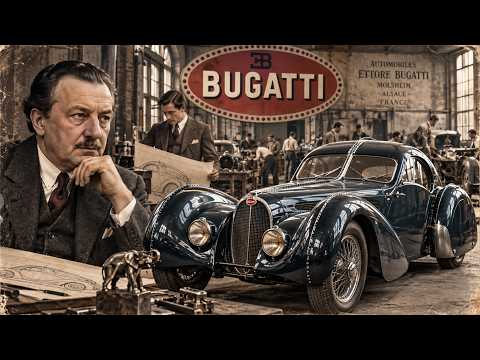
Bugatti lived by one rule: Only a Bugatti could build a Bugatti. That rule made the name immortal. It also meant one tree on one country road could kill it.
This is the story of a car company whose greatest asset was a family—and what happened when the family ran out of heirs.
Milan, 1881. The city is loud, crowded, and rich. In a workshop full of strange furniture, a man named Carlo Bugatti works in silver, paints, and designs jewelry that looks like it was carried home from a desert palace. Carlo is not an engineer. He is an artist—and not a quiet one. In the world of Italian Art Nouveau, his name means something.
On September 15, 1881, Carlo and his wife, Teresa, welcome their first son. They name him Ettore Arco Isidoro Bugatti. Three years later comes a second son: Rembrandt. A father who names his child after the greatest painter in Dutch history is not hoping for an accountant.
The Bugatti home is a place where beauty is expected. The boys grow up surrounded by sketches, plaster casts, and metal shavings. Their uncle by marriage is Giovanni Segantini, one of the most celebrated Italian painters of his generation. Ettore does not grow up thinking art is a hobby. He grows up thinking it is the family business.
So he does what a Bugatti son is supposed to do. He goes to study at the Art Academy in Milan. And there, the family story goes, he discovers something painful: his little brother is better. Rembrandt Bugatti has a gift that cannot be taught. He sculpts animals—panthers, elephants, antelopes—with a living tension in their muscles that makes people stop and stare.
Ettore could have stayed and lived in his brother’s shadow. He does not. He walks away from the studio and toward machines.
In the late 1890s, the machine is the new frontier of art. Bicycles have swept Europe. Small gasoline engines are coming out of France. Inventors in garages across Italy, Germany, and the United States are bolting motors onto anything with wheels. For a young man who loves shape, balance, and precision, an engine is a sculpture that moves.
At 17, Ettore talks his way into the machine shop of Prinetti and Stucchi, a Milan company that builds bicycles and tricycles. He is not hired as an engineer. He is an apprentice—by some accounts, not even paid. It does not matter. He has found his material.
In 1898, inside that shop, Ettore builds his first motorized vehicle: a tricycle powered by two small De Dion engines. Later his company would number it as the very first Bugatti, Type 1. He is 17 years old.
Here is what makes him different even then. Most young tinkerers of the era are satisfied if a machine runs. Ettore wants it to look right. He cares about how a part is finished, how a bolt sets against the frame, how the whole machine reads from across the room. He sees no line between engineering and art. To him, an ugly solution is a wrong solution even if it works.
That belief will build an empire. It will also make him nearly impossible to work for.
He keeps going. Before he turns 20, he designs and builds a complete four-wheeled car of his own—the machine his company would later call Type 2. He shows it in Milan and it wins awards. Older men with money, men who own factories, begin to notice the kid with the artist’s last name.
Back at home, his father watches all of this with something close to pride. Carlo has raised one son to be a sculptor and another to be, in his own way, a sculptor of steel.
Years later, when Ettore has a son of his own, he will give the boy a name stacked with that family history: Jean Oberto Carlo Rembrandt Ettore. Grandfather, uncle, and father packed into one child. The world will call him Jean. And everything the Bugatti family believes about beauty will end up resting on his shoulders.
But in 1901, that boy is still years away. Ettore is young, restless, and brilliant. And a wealthy French industrialist is about to offer him the job of a lifetime—running the engineering of an entire car company. There is only one problem. He is not yet 21. Under the law, he is too young to sign his own name to the contract.
So Carlo Bugatti signs it for him.
On July 2, 1902, the father puts his name on an employment contract with De Dietrich, a wealthy industrial family in Alsace that makes railway equipment and wants to make automobiles. The son packs up and moves north to the town of Niederbronn. He is 20 years old, and Baron De Dietrich has just put him in charge of the technology behind an entire line of cars.
The cars are sold with an unusual badge: De Dietrich licensed Bugatti. Think about how rare that is. A kid with no engineering degree, barely out of an apprenticeship in a bicycle shop, and already his last name is on the product. Ettore understands something early that most engineers of his day never do. A name can be worth more than a factory.
But the job comes with a boss, and Ettore does not do well with bosses. De Dietrich wants dependable road cars to sell to customers. Ettore wants to build race cars. He pours his time and energy into machines built for speed, and the company does not like it. The arrangement falls apart, and his contract is terminated.
He does not slow down. While at De Dietrich, he had met a young businessman from Strasbourg named Emile Mathis. In 1904, the two go into business together building cars sold under the name Mathis Hermes. And once again, the badge carries two extra words: licensed Bugatti. That partnership does not last either. Two brilliant, stubborn men, one company. It is over almost as soon as it begins.
So Ettore does something bolder. He designs a powerful car entirely on his own, with no contract and no employer behind him. Then he goes looking for a buyer.
In July 1907, he offers it to Deutz, a major engine maker in Cologne, Germany. Deutz agrees to build it under license, and they hire Ettore to run production at the factory. On paper, it is a steady job: a good salary, a respected company, a home in the Cologne district of Mülheim. He has a wife now, Barbara, and a growing family.
But at night, Ettore Bugatti goes down to the cellar.
There, in the basement of his own house, away from his employer’s machines and his employer’s opinions, he begins building the car he actually wants to build. Not a big, heavy, expensive machine like the ones Deutz sells. Something small, light, precise—a car that wins by weighing less, not by burning more. He works on it through 1908. By early 1909, it is finished. He calls it the Pur Sang, French for thoroughbred. His company will later call it Type 10.
Next to the tall, upright automobiles of that era, it looks like it has arrived from the future.
That same January, on the 15th of the month, another project is completed in that house in Cologne. Ettore and Barbara have their third child and their first son. They give him that long chain of family names, and they call him Jean.
The cellar car changes everything. Friends who drive it are stunned. Men with money take notice. One of them is Pierre de Vizcaya, from a banking family that will stay close to the Bugattis for years to come. At the end of 1909, Deutz ends Ettore’s contract and pays him a large severance. He does not use it to rest. He uses it to bet everything.
With that payout, backing from Vizcaya, and a loan from the Darmstädter Bank, Ettore goes looking for a place of his own. He finds it in Molsheim, a small town near Strasbourg in Alsace. At the time, Alsace belongs to the German Empire, which makes Molsheim a German town run by an Italian who will soon be selling cars to the French.
The building is not a factory. It is an abandoned dye works—a place where cloth used to be colored—with a large plot of open land around it. Empty rooms, old floors, a man who has not built a single car under his own name. But he has the Pur Sang. A close friend drives the little car from Cologne to Molsheim, eight hours on the roads of 1909, as if to prove what it can do before the company even exists.
Ettore names the new business Automobiles Ettore Bugatti. Not a place name, not a partner’s name. His own. Every earlier car had carried his name as a license on someone else’s badge. Now the badge is his alone. And from that day forward, the most valuable thing the company owns is not its land or its tools. It is one man’s mind and one family’s name.
That autumn, the Bugatti family moves onto the grounds at Molsheim. The children grow up among the workshops, the test cars, and the smell of oil and hot metal. Jean is less than a year old when they arrive. In a sense, he will never leave.
The first years at Molsheim are small: a handful of workers, a few machine tools, and an owner who treats every part like a piece of jewelry. Ettore does not build this alone. He brings with him a man named Ernest Friedrich, a mechanic and racing driver who had worked beside him at Mathis and at Deutz, and who had followed him into the abandoned dye works. Friedrich is the kind of man every visionary needs, and almost never thanks enough. Ettore dreams. Friedrich makes it run.
Their first production car grows directly out of the cellar machine from Cologne. It is called the Type 13—small, light, with a four-cylinder engine. It looks almost like a toy next to the giants of its day. In 1911, they take it racing at the French Grand Prix at Le Mans, against enormous machines with engines many times its size. People laugh at the little Bugatti. Seven hours later, nobody is laughing. The tiny Type 13 wins its class and finishes second overall. Most of the giants never make it to the end.
That race proves the idea Ettore nursed in his cellar. Weight is the enemy. A light car does not need a monster engine. It wears its tires more slowly, brakes harder, corners faster, and keeps going while heavier machines tear themselves apart. Orders begin to arrive. Molsheim grows.
Then in the summer of 1914, the world catches fire. The First World War puts Ettore in an impossible position—an Italian citizen living in German territory, building cars admired in France. He throws his talent into aircraft engines, and the war takes something far more painful than time and money. On January 8, 1916, Rembrandt Bugatti, the brother whose talent had pushed Ettore out of the studio and into the machine shop, takes his own life. He is 31 years old.
For Ettore, the loss is a wound that never closes. In time, the family honors him in the most Bugatti way possible. One of Rembrandt’s sculptures—a dancing elephant standing on its hind legs—will ride on the radiator cap of the most extravagant car Ettore ever builds.
When the war ends in 1918, Alsace becomes French again. Ettore returns to Molsheim and restarts production with a vengeance. In 1921 at a race for small cars in Brescia, Italy, Bugatti enters its updated four-cylinder machines. They finish first, second, third, and fourth. The customer models that follow carry the town’s name in honor of that day: Brescia Bugatti.
Molsheim becomes less a factory and more a kingdom. Ettore dresses like a country gentleman and runs the place like one. He keeps horses on the grounds. He designs his own tools and refuses to use ugly ones. Customers do not buy a Bugatti. They are permitted to own one. And in the middle of that kingdom, a boy is growing up.
Jean spends his childhood among test drivers, mechanics, wealthy buyers, and race cars warming up in the yard. He learns machines the way other children learn a language—by hearing it every day.
By 1924, Ettore is ready for the biggest stage in motor racing. He designs a new car from scratch: a pure Grand Prix machine with a straight-eight engine, a narrow body shaped like a blade, and wheels unlike anything anyone has seen. He calls it the Type 35.
On August 3, 1924, five of them line up at the Grand Prix in Lyon. A sixth stays in reserve. They have been driven all the way from Molsheim on public roads without a single mechanical problem. A crowd of roughly 100,000 people has come to watch.
The flag drops. On the very first lap, a tire on Pierre de Vizcaya’s car comes apart. Then another car loses a tire, then another. The special tires made for the Type 35 have a manufacturing defect. They have not been cured properly, and at racing speed they simply peel off the rims. One after another, the most beautiful racing cars in the field are reduced to limping, shredding, sparking machines. The best of them crawls home seventh. In front of 100,000 people, the Bugatti debut is a disaster.
But in the middle of that humiliation, the mechanics and the journalists notice something strange. The tires have failed. Something else on that car has not. Every single wheel has survived.
Look closely at a Type 35 and the wheels are the first thing you notice. Most racing cars of 1924 roll on wire-spoked wheels like oversized bicycle wheels laced with dozens of thin steel spokes. Ettore throws that idea away. He casts each wheel as one solid piece of aluminum with eight flat spokes and the brake drum built right into it.
Here is why that matters in plain language. A racing car is only as fast as it can stop. Brakes turn speed into heat, and on a long race that heat builds until the brakes fade and the driver has nothing left. Ettore’s wheel pulls the brake drum into a big piece of aluminum that soaks up heat and throws it into the passing air. It is lighter, too—and weight is always the enemy at Molsheim. Less weight spinning at every corner means the car can change direction faster and ride the bumps more cleanly.
Plenty of experts expect those cast wheels to crack under racing loads. Aluminum is not supposed to take that kind of punishment. Then comes Lyon. With the tires torn away, Bugatti drivers run lap after lap on bare rims, pounding those wheels against the road at racing speed. After the race, a leading British motoring magazine reports that the wheels have come through it all with no visible damage.
The disaster turns out to be the best test Ettore could have asked for. He changes his tire supplier and fixes the specification. Weeks later, at the Grand Prix in San Sebastian, Spain, a Type 35 takes second place and the fastest lap. From there, there is no stopping it.
Under the long, narrow hood sits a straight-eight engine of just under 2 liters—about 122 cubic inches. In its early form, it produces roughly 90 horsepower. That may not sound like much today, but consider what Americans are driving in 1924. A Ford Model T carries an engine about one and a half times larger, and it makes 20 horsepower. Ettore is getting more than four times the power out of a smaller engine.
The car itself is a lesson in restraint. The front axle is hollow to save weight without losing strength. The body is barely wider than the driver’s shoulders. Everything that does not make the car faster is left out. And everything that stays is finished like a piece of fine furniture. Even the engine is polished. Even the bolts are arranged with care. It is a race car that looks like sculpture. Carlo Bugatti’s son has finally found his medium.
And then Ettore does something clever. He does not keep the Type 35 for a factory team alone. He sells it, ready to race, to wealthy private drivers all over Europe. A gentleman racer can buy a car in Molsheim, drive it to a race, and have a real chance to win. When he wins, the headline says Bugatti. When he wins again the next weekend, it says Bugatti again. Ettore collects the glory without having to pay every driver’s bills.
The results come in like a flood. In its first two production years alone, the Type 35 family is credited with 351 victories. Over its career, counts run from more than 1,000 wins to more than 2,000, depending on who is counting and how. Bugatti’s own figure is the larger one. At the height of its popularity, by some estimates, a Type 35 is winning as many as 14 races in a single week. Bugatti takes the Grand Prix world championship in 1926. It wins the brutal Targa Florio—a race over mountain roads in Sicily that breaks men and machines—five years running. Through the late 1920s, the blue cars from Alsace become the most common sight at the front of any grid in Europe.
There is a stubborn streak in all of this, too. Ettore distrusts superchargers. A supercharger is a pump driven by the engine that forces extra air into the cylinders, and with it extra power. To Ettore, it is brute force and an elegant shortcut. He wants power to come from good design, not from cramming air into an engine. Across the Atlantic, the Duesenberg brothers feel no such hesitation. In 1924, the same year the Type 35 debuts, a supercharged Duesenberg wins the Indianapolis 500. Eventually, the competition forces Ettore’s hand. He adds a supercharger, reluctantly, and the Type 35C is born. Later comes the larger 2.3-liter supercharged Type 35B with around 140 horsepower—a beast that will carry the Bugatti name into its most famous victories.
He makes similar choices about brakes. When a customer once complains that his Bugatti does not stop well enough, Ettore is said to have answered that he builds his cars to go, not to stop. That is the man. Brilliant, proud, certain. Usually right, occasionally impossible.
Behind him, Jean is growing up fast. A teenager now, he spends his days in the drawing office and the workshops, learning how his father builds a car piece by piece and quietly forming opinions of his own. He does not just want to know how a Bugatti works. He wants to know how it should look.
By 1929, the Type 35 has beaten nearly everyone, almost everywhere. But there is one kind of race it has not yet won. That spring, a tiny principality on the Mediterranean—barely a square mile of cliffs, harbor, hotels, and casinos—decides to close its own streets and hold a Grand Prix right through the middle of town. Nobody has ever tried anything like it.
The idea belongs to a man named Anthony Noghès, an official of Monaco’s Automobile Club. Monaco is tiny. It has no room for a racetrack, no open land, no long straight roads. What it has is a harbor, a casino, a few steep hills, and streets lined with stone walls, lamp posts, curbs, and the Mediterranean Sea. Noghès looks at those streets and sees a circuit. Most experts think it is madness. Grand Prix cars are built for wide, fast roads. Monaco offers hairpin turns so tight a driver can almost touch the corner on both sides, a climb up the hill to Casino Square, a dive back down toward the water, and a tunnel running along the seafront. One mistake means hitting a wall, a building, or the harbor.
But the race is approved, and the date is set: April 14, 1929. Twenty drivers register. Sixteen come to the start. Half of them—eight cars—are Bugattis, mostly supercharged Type 35Bs and Type 35Cs. The rest of the field includes a single machine that frightens everyone: a Mercedes-Benz SSK driven by the German star Rudolf Caracciola. The SSK is the opposite of a Bugatti in almost every way. Huge, heavy, and loud, with a supercharged engine of about 7 liters—more than three times the size of the Bugatti engines around it. On a straight road, nothing can stay with it. But Monaco has almost no straight roads.
The starting positions are not earned in practice. They are drawn by lot, like numbers out of a hat. One of the Bugatti drivers, a Frenchman named Philippe Etancelin, draws the front spot. From fifth on the grid in car number 12 sits a quiet, slim man who races under the name W. Williams. His real name is William Grover Williams, the son of an English father and a French mother. He grew up in France and worked as a chauffeur before he began to race. He keeps his racing under a pseudonym, partly for privacy and partly because that is the style of the era. His Bugatti Type 35B is painted green—the color that will come to be known as British Racing Green.
The flag drops. Williams pushes his supercharged straight-eight hard into the first right-hand turn at Sainte Dévote. Within the opening laps, he works his way past the cars ahead of him. Soon he is at the front. Behind him, the big Mercedes is coming.
Caracciola has started near the back. Lap by lap, he drives his heavy machine like a man trying to prove a point, smashing up through the field. On the climb to the casino, the SSK’s enormous engine drags it past lighter cars. In the tight corners, its weight fights him, punishing its brakes and tires. Lap after lap, the gap shrinks. On lap 36, the Mercedes catches the green Bugatti and goes by. For the first time in the race, Grover Williams is looking at the back of another car. Seven liters against 2.3. Brute force against finesse. Everything Ettore Bugatti believes about building cars is suddenly on trial in front of the entire principality.
Williams does not panic. He stays close. He watches. He drives the Bugatti the way it was designed to be driven—braking late, turning cleanly, carrying speed through corners where the heavier car has to slow down. Six laps later, he takes the lead back.
Now comes the part of the race that a fan watching only the cars might miss: the pit stops. Both men have to stop for fuel. The big Mercedes drinks far more than the Bugatti, and its brutal pace has chewed through its rear tires. When Caracciola comes in, his crew has to change the rear wheels as well as fill the tank. Those extra seconds pile up. When the stops are done, the order is clear. The Bugatti is ahead, and the gap keeps growing.
Williams stretches his lead to more than a full lap. The light car that wastes nothing is beating the heavy car that wastes everything. Lap after lap, he keeps the same rhythm, never forcing it, never giving the walls a chance. Late in the race, the gap begins to close. The hours are taking their toll, and the other cars are pushing. Williams eases off just enough to protect the car.
One hundred laps—about 197 miles of curbs, corners, and stone. Nearly four hours of driving through a town that has never seen anything like it. The checkered flag comes down. William Grover Williams, Bugatti Type 35B, winner of the first Monaco Grand Prix. Second place goes to Georges Bouriano in another Bugatti. The great Mercedes of Caracciola comes home third. Williams has also set the fastest lap of the race: 2 minutes and 15 seconds. On a circuit like that, it means an average of nearly 53 miles per hour through turns where a passenger car of the day would have been crawling. It is the perfect Bugatti victory—not a car that overpowered its rivals, but one that outthought them.
Two months later, Williams wins the French Grand Prix at Le Mans, and Monaco becomes Bugatti territory. A Bugatti wins again in 1930, again in 1931, and again in 1933. Grover Williams himself will become a legend for reasons far beyond racing. In the next war, he will leave the track behind and take on dangerous work for the Allied cause, and his story will end in darkness. But on that April day in 1929, he is simply the man who tamed Monaco in a little blue-badge car from Alsace.
For Ettore, it is a crowning moment. His cars are the most celebrated racing machines in Europe. But even as his cars are conquering racetracks, his mind has already moved on. He has begun work on a machine that will never race at all. Something enormous. Something extravagant. A car built for only one kind of customer: kings.
Ettore calls it the Type 41. The world calls it the Royale.
The story behind it, as it has been passed down, begins with a challenge at a dinner party. An English lady is said to have praised Bugatti’s cars but remarked that for true luxury, one still had to buy a Rolls-Royce. Whether or not it happened exactly that way, Ettore’s answer is the same. He will build the finest automobile in the world. Not one of the finest. The finest.
He shows the first version in 1926. Nothing on the road comes close to it. The Royale stretches about 21 feet long. Its wheelbase alone measures roughly 169 inches—longer than many entire cars of the day. It rolls on wheels 24 inches across, cast in aluminum with the brake drums built in, just like a Type 35, only scaled up for a giant. Fully dressed, it weighs about three and a half tons.
Under its endless hood sits a straight-eight engine of 12.7 liters. That is nearly 780 cubic inches. Each cylinder alone displaces more than an entire Type 35 engine. The output is quoted at around 300 horsepower, delivered at such low engine speeds that the car can pull away from almost a standstill in high gear. On top of the radiator stands a small silver elephant rearing up on its hind legs. It is cast from a sculpture by Rembrandt Bugatti—the brother Ettore lost in 1916. The most extravagant car he ever built carries his brother’s art at its front.
The plan is simple and enormous. Ettore will build 25 Royales and sell them to the royal houses of Europe. The price is enormous, too. The bare chassis, without a body, costs $30,000. Owners then have to pay a coachbuilder on top of that to clothe it. A Royale costs about three times as much as the most expensive limousines from rival makers, and about ten times as much as other Bugattis.
To understand what that number means, look across the Atlantic. On December 1, 1928, at the auto show in New York, the Duesenberg brothers unveil their own answer to the question of the world’s finest car: the Model J. It carries a 420-cubic-inch straight-eight with twin overhead camshafts and four valves per cylinder, rated at 265 horsepower—roughly 100 more than Cadillac’s new 16-cylinder engine. The chassis costs $8,500. With a custom body, a finished Duesenberg can reach $20,000 at a time when a new Ford Model A sells for around $500. The Duesenberg is the most expensive American car money can buy.
Now set it beside the Royale. The Bugatti engine displaces nearly twice as much. It makes somewhat more power. And its bare chassis costs three and a half times as much as the Duesenberg’s. Two of the most ambitious luxury cars ever built, unveiled on opposite sides of the Atlantic within a few years of each other. And both are about to drive straight into a wall.
In October 1929, the American stock market collapses. The Great Depression spreads across the world. Fortunes vanish. Banks fail. Even royalty begins counting its money. The kings never come. Spain’s King Alfonso is reportedly interested, but he loses his throne in 1931. According to one widely repeated story, Ettore personally refuses to sell a Royale to King Zog of Albania because he finds the monarch’s table manners unacceptable.
In the end, not one Royale is ever sold to a king. Ettore has planned 25. Only six are built between 1929 and 1933. Just three go to outside customers, though Bugatti’s own count puts the number at four. The first customer car goes in 1932 to a Paris industrialist, Armand Esders. The rest stay with the Bugatti family. The most magnificent automobile in the world has become a magnificent problem.
Worse, Ettore has already built engines for a production run that never happened. Twenty-five of those enormous straight-eights sit waiting at Molsheim—machines with nowhere to go in a factory that badly needs money. Most manufacturers would have written them off. Ettore does something no one expects. He puts them on rails.
France’s railways at the time are still dominated by heavy steam locomotives. Ettore designs a new kind of train: a sleek, streamlined, self-propelled railcar powered by his Royale engines. The early versions use four of them for a combined output of more than 800 horsepower. He develops the design in about nine months. The driver sits in a raised cabin in the middle of the car, looking out in both directions. In early trials, a Bugatti railcar hits about 107 mph—a rail speed record at the time. On July 30, 1933, French President Albert Lebrun rides one to Cherbourg, covering some 230 miles in 3 hours and 15 minutes. In 1934, a later version sets a world record of 122 mph. Bugatti goes on to build 88 of these railcars. They stay in regular service in France until 1958. The engines that had been built for kings end up carrying ordinary passengers to the seaside, and the money from that work keeps Molsheim alive through the worst years of the Depression.
It is the Bugatti story in miniature. Only Ettore would have dared to build the Royale, and only Ettore would have thought to rescue it with a train. Everything depends on one man’s imagination, which raises the question that this whole story turns on. What happens when that man is no longer there?
Because while the father is busy building trains, his son is back at the drawing board. And Jean Bugatti is drawing something entirely different.
Jean Bugatti grew up inside his father’s dream. He has spent nearly his entire life on the grounds at Molsheim, among horses, workshops, test drivers, champions, and customers with fortunes to spend. He knows the factory the way a farm boy knows the land. By the late 1920s, still barely out of his teens, he has become an essential part of the company. But he is not a copy of his father. Ettore is an engineer who thinks like an artist. Jean is an artist who can think like an engineer. He has his father’s mechanical imagination and something of his grandfather Carlo’s eye for line, curve, and surface. What he does not have is Ettore’s stubborn resistance to change. Where the father holds on to what has already worked, the son wants to see what comes next.
Jean’s first great statement is written on his father’s biggest car. For the Royale chassis eventually sold to Armand Esders, Jean designs a two-seat roadster nearly 20 feet long, with sweeping fenders that seem to run the full length of the car. A machine built for kings, reimagined as pure sculpture. From there, his pen moves through the Bugatti lineup: bodies for the Type 46, the Type 50, the sporting Type 55. Each one lower, smoother, and more daring than what came before.
Then in 1934 comes the car that will define his career: the Type 57. Jean is the driving force behind it. He develops a 3.3-liter straight-eight with twin overhead camshafts—a significant break from his father’s earlier single-cam engines—and in standard form it produces about 135 horsepower. More important, he gives the Type 57 a family of bodies designed in-house, each named after a mountain pass or a landmark: the Galibier, the Ventoux, the Stelvio, the Atalante. It is a grand touring car for people who want to cross a continent at speed and arrive in style. Around 800 Type 57s are built before production ends—more than any other Bugatti model.
But one version stands apart from all the others. In 1935, Jean builds a prototype on Type 57 chassis number 57104. He calls it the Aérolithe. For the body he chooses a material from the aircraft industry: a magnesium alloy called Elektron, about 90 percent magnesium and 10 percent aluminum. Elektron is light and strong. It also has a dangerous flaw. It cannot be welded. The heat can set the magnesium on fire. So Jean makes the flaw into the design. Instead of hiding the joints, he rivets the body panels together along a raised seam that runs down the center of the car like a spine—from the split hood over the roof all the way down the tail. The engineering problem becomes the signature. Production versions use aluminum, which could have been welded. Jean keeps the rivets anyway.
He calls the finished car the Type 57SC Atlantic. The name honors his friend Jean Mermoz, a pioneering French aviator who disappeared over the South Atlantic in 1936. With a supercharged engine, an Atlantic has around 200 horsepower and can go well past 120 mph in an age when horse-drawn carts still use the roads. Only four are ever built between 1936 and 1938. The first goes to Lord Victor Rothschild. The third goes to a Frenchman named Jacques Holzschuh. The fourth goes to an English buyer. The second never goes to a customer at all. Jean keeps it for himself. It is black. People come to call it La Voiture Noire—the black car. It never has a registered owner. Jean drives it, and he lets only a few close friends behind the wheel, among them William Grover Williams, the man who won the first Monaco Grand Prix.
Remember that car. It will disappear.
While Jean is creating his masterpieces, the ground beneath the company is shifting. In 1936, France is swept by a wave of labor unrest, and the strikes reach Molsheim. For Ettore, who considers himself a generous employer and sees the factory almost as a family, it feels like a personal betrayal. The rift with his workforce never fully heals. He pulls back. He begins spending more and more of his time in Paris, running the railcar business in his offices there. In Molsheim, someone has to take control.
In 1936, at just 27 years old, Jean takes over the day-to-day management of the company. At the same time, the racing world is turning against Bugatti. From 1934, Germany’s state-backed teams, Mercedes-Benz and Auto Union, pour enormous money into Grand Prix racing. Their silver cars begin crushing the field. A family firm in Alsace, paying its own bills, cannot keep pace with national budgets. So the future of Bugatti comes to rest on a single pair of shoulders. Jean is now the designer, the factory chief, the development engineer, and the heir.
Ettore had built the company around one irreplaceable man: himself. Now he is handing it to a second irreplaceable man: his son. There is no one standing behind Jean. No backup. No succession plan. It seems reasonable at the time. Jean is young, gifted, and healthy. He has decades ahead of him.
There is only one thing his father will not give him. Ettore forbids Jean to race. Bugatti cars have produced champions, and Bugatti drivers have paid the price in crashes across Europe. Ettore is not willing to risk the son who will carry the name. Jean is allowed hill climbs and short sprints against the clock—in 1932 he crashes at Shelsley Walsh in England, of all things, in an experimental four-wheel-drive Bugatti—but Grand Prix racing is off-limits.
So Jean finds his speed another way. He becomes the test driver. Road cars, race cars, even the high-speed railcars. Whenever there is something to test, he volunteers. His father has forbidden him the racetrack. He has not forbidden him the road.
In June 1937, Bugatti goes back to Le Mans. Jean has developed a special racing version of the Type 57. Its body is fully enclosed—wide and smooth, covering the wheels and the driver like a shell. It looks heavy and strange next to the open race cars of the era, and people quickly give it a nickname: the Tank. It is not built to look beautiful. It is built to cut through the air down the long straights of the Sarthe circuit hour after hour, through the day and into the night.
The 1937 race is a dark one. Two drivers are killed in a single crash. But when the 24 hours are over, the blue Tank of Jean-Pierre Wimille and Robert Benoist is in front. It is Bugatti’s first victory at the 24 Hours of Le Mans, and it sets a new distance record of more than 2,000 miles. The engineering is Jean’s. The glory is the family’s.
Ettore, proud and stubborn as ever, announces that Bugatti will not come back to Le Mans until someone breaks his record. In 1938, no one does. Jean wants to go back anyway. He argues, he pushes, and finally he persuades his father. Ettore agrees—but on one condition. Only one car. One shot.
Jean builds a new version: the Type 57C, on a longer chassis, with a supercharger fitted to the straight-eight. He chooses Wimille again, paired with Pierre Veyron—a quiet, precise driver who is also a Bugatti man to the core. Keep that name in mind. Decades later, it will be painted across the most famous Bugatti of the modern age.
June 17, 1939. Forty-two cars take the start. Almost from the beginning, the single Bugatti is in trouble. Mechanical problems dog it through the first half of the race. At one point, Wimille, Veyron, and Jean himself seriously consider withdrawing the car. The team’s chief mechanic, Robert Aumaître, refuses to let them quit. They keep going. Through the night, the problems are managed. In the second half of the race, the Tank finds its rhythm. Lap after lap, it pulls clear.
When the flag falls on June 18, the lone Bugatti has won the 24 Hours of Le Mans for the second time. It has covered 248 laps—around 2,080 miles—breaking the record of 1937. Ettore’s condition has been met. His record has been beaten by his own son’s car.
It should have been the start of something. The winning car comes home to Molsheim. It is due to race again soon at a Grand Prix in the seaside town of La Baule. Jean is a perfectionist. He wants to be certain the car is ready, and he wants to check it himself. The usual test section is a long, straight stretch of public road between Molsheim and Strasbourg. Jean has used it many times. On days like this, factory workers are posted along the route to stop local traffic and keep the road clear.
August 11, 1939. The men take their positions. The road is closed. The blue Tank comes out of the factory with Jean at the wheel. He is 30 years old. He is running the company, designing its cars, testing its machines. He has been forbidden to race, and he has obeyed. This is not a race. It is a test.
He lets the car run. Near the village of Duppigheim, the road runs beside a line of trees and hedges. Somewhere along that line is a gap. Through it, onto the road, comes a man on a bicycle. Many accounts say he has been drinking. The men guarding the road never see him. The Tank arrives at full speed. Jean sees the cyclist. He hits the brakes and wrenches the wheel to avoid him. The car that has just survived 24 hours at Le Mans leaves the pavement and finds a tree.
Jean Bugatti is killed. The cyclist survives. The winning car of the greatest race in the world is destroyed on a country road a few miles from home.
Jean is buried in the Bugatti family plot in the cemetery at Dorlisheim, close to the factory where he grew up. For Ettore, the loss is beyond words. He had lost his brother to despair in 1916. Now he has lost his son, his designer, and his successor in one moment. According to one account, he cannot bear to see the wreck and has what is left of the car buried on the factory grounds. Ettore had kept Jean away from the racetrack to keep him alive. He died anyway, testing the very car that was supposed to secure the family’s future.
There is no one to take his place. There is no time to grieve, either. Three weeks later, on September 4, 1939, Germany invades Poland. Within days, France is at war, and Molsheim sits on the wrong side of the map once again—barely 20 miles from the German border.
In the autumn of 1939, Ettore Bugatti does what he had done 25 years earlier. He runs from the border. He moves what he can of the Molsheim operation west to Bordeaux, far from the German frontier. Machine tools, parts, and drawings are loaded onto trains and sent across France. In the spring of 1940, the German army sweeps through. France falls in a matter of weeks. Alsace is annexed into the Reich, and the factory at Molsheim falls under German control. Ettore is pressured into selling it to the occupiers for about half of what it is worth. The Germans put an engineer named Hans Trippel in charge. The workshops that built Grand Prix winners and cars for kings are turned over to the war machine: torpedoes, amphibious vehicles, parts for an empire that is trying to swallow Europe.
Somewhere in that chaos, something else vanishes. As the Germans close in, Jean’s personal car—La Voiture Noire, the black Atlantic—is reportedly loaded onto a train bound for Bordeaux. It never arrives. No record shows where it went. Some believe it was destroyed in the fighting. Some believe it was taken apart for parts. Others believe it is still hidden somewhere, in a barn or a sealed garage, waiting. If it survives, it would be among the most valuable automobiles on Earth. Jean’s car disappears less than a year after Jean.
Ettore spends the war years in Paris. Even now, he keeps drawing. He plans a new factory at Levallois, on the edge of the city, and sketches a new range of cars for the peace he hopes will come: a smaller four-cylinder Bugatti, the Type 73. Boats. Machines of every kind. He is in his 60s, grieving, cut off from his own factory, and still he cannot stop designing.
The war ends in 1945. When Ettore finally sees Molsheim again, there is almost nothing left. Air raids and looting have gutted the workshops. His home on the grounds stands abandoned. And not far away is the road where his son died.
Then comes a final, bitter insult. Ettore is still an Italian citizen. Italy fought on Germany’s side. And his factory produced weapons for the occupiers. After the liberation, French authorities treat him as a suspect. The state takes control of the Molsheim property. The man who served France in two world wars now has to go to court to prove he is not a collaborator.
He fights. The case drags on for more than two years. His health begins to give way under the strain. In April 1947, he falls ill with influenza. Then a blocked artery leaves him partly paralyzed. He lingers for months. On June 11, 1947, a court in Colmar rules in his favor. The Molsheim factory and property are legally returned to their founder. Ettore almost certainly never knows. He slips into a coma. On August 21, 1947, at the American Hospital in Neuilly, outside Paris, Ettore Bugatti dies. He is 65 years old. He has won back his factory. He does not live to walk through its doors.
That October, at the first Paris Motor Show after his death, the Bugatti stand displays a new Type 73 coupe. It is supposed to be the beginning of a comeback. Instead, the mood is like a funeral.
Now the family has to decide whether Bugatti will survive without a Bugatti to lead it. Ettore’s younger son, Roland, is just 25. He has never been trained the way Jean was. Beside him stands Pierre Marco, a former racing driver who has spent decades at Molsheim. Together, they try to bring the company back.
In 1951, Bugatti unveils the Type 101. Underneath, it is largely a reworked pre-war Type 57, dressed in a post-war body. In a market hungry for new ideas, it looks backward. Only around eight are built. In 1952, car production effectively comes to an end. The factory survives by doing other work: military contracts, aircraft parts. Molsheim’s skilled machinists keep the lights on, but they are no longer building Bugattis for the road.
Roland makes one final bet on the thing that made the name famous in the first place: racing. In 1956, Bugatti returns to Grand Prix racing with the Type 251, designed by the Italian engineer Gioacchino Colombo. It is radical, with its straight-eight engine mounted behind the driver—years before that layout becomes standard. At the French Grand Prix, Maurice Trintignant takes it to the start. It is not competitive. On lap 18, it retires. It is the only Formula One race the car ever runs. After that, there are sketches and one more prototype, the Type 252—a small sports car that never finds investors.
Then, in 1963, the company is sold to Hispano-Suiza, an aircraft engine maker. The family that made beautiful things no longer owns its own name.
You can read the collapse two ways. You can see a company destroyed by forces no family business could survive: a depression, a world war, an occupation, a post-war witch hunt, and the death of a son on a closed road at the worst possible moment. Or you can see a company that was never really built to last—an empire organized around one man’s genius, with no system, no deep bench, and no plan for what would happen when that genius was gone. Honest history holds both readings at once. Bugatti was broken by events it could not control, but it was vulnerable because it was built to be extraordinary. And extraordinary is very hard to inherit.
Today, the road near Dorlisheim looks like any other country road in Alsace: a straight line of pavement, fields, a line of trees. No blue car comes down it anymore. The family is gone. The factory has been sold. In 1963, the name Bugatti seems to belong only to history books and museums. But that name has a strange habit of refusing to stay dead.
In 1952, in northern Italy, a 20-year-old named Romano Artioli hears the news that Bugatti has stopped building cars. He makes himself a promise: someday, he will bring the name back. It takes him 35 years. Artioli builds a fortune selling cars, including Ferraris, and in 1987 he buys the rights to the Bugatti name. He founds a new company, Bugatti Automobili, and gathers engineers from Italy’s supercar heartland around Modena. He builds a gleaming new factory in the town of Campogalliano. It opens on September 15, 1990—the day Ettore Bugatti would have turned 109. Seventy-seven vintage Bugattis parade in for the ceremony. Exactly one year later, on Ettore’s 110th birthday, Artioli unveils the car in Paris. He calls it the EB 110: a 3.5-liter V12 with four turbochargers, around 560 horsepower in its first form, and a carbon-fiber chassis at a time when most supercars still used steel and aluminum. Formula 1 champion Michael Schumacher buys one. But the timing is brutal. The early 1990s bring a deep recession, and the market for exotic cars collapses. On September 23, 1995, after building about 128 cars, Artioli’s Bugatti files for bankruptcy. The name has died a second time.
In 1998, Volkswagen buys it. The group’s chairman, Ferdinand Piëch—an engineer and the grandson of Ferdinand Porsche—sees Bugatti as the perfect showcase for what his company can do. And he makes a decision that would have meant everything to Ettore. He brings Bugatti home to Molsheim.
In 2005 comes the Veyron: a 16-cylinder machine with more than 1,000 horsepower, capable of over 250 mph. It carries the name of Pierre Veyron, the quiet Bugatti driver who shared the winning car at Le Mans in 1939—the same car Jean was testing on the day he died. The Chiron follows, named after Louis Chiron, another Bugatti racing hero of the 1920s and ’30s. In 2019, for the brand’s 110th anniversary, Bugatti builds a one-off hypercar in tribute to Jean’s lost Atlantic. They call it La Voiture Noire. With taxes, its price comes to nearly $19 million, making it at the time the most expensive new car ever sold.
Today, Bugatti is part of Bugatti Rimac, led by the Croatian engineer Mate Rimac. Its newest car, the Tourbillon, pairs a naturally aspirated V16 with electric motors. Only 250 will be built, starting at 3.8 million euros each, hand-assembled at Molsheim. This year, the first customer cars are being prepared for delivery.
The original cars have become something close to holy relics. In England, the Bugatti Owners Club, founded in 1929 while Ettore was still running Molsheim, still owns the Prescott Hill Climb course in Gloucestershire. On the same estate, the Bugatti Trust preserves an archive of almost 40,000 historic documents and photographs. Bugattis that are nearly a century old still storm up that hill every season.
And the prices tell their own story. In 2021 at Gooding & Company’s Pebble Beach auction, a 1929 Type 35B Grand Prix car sells for $5,115,000. In 2024 at Gooding’s sale from the Mullin Collection, a 1938 Type 57C Aravis Special Cabriolet sells for $6,605,000—a world record for the model. And in 2010, the Atlantic once owned by Dr. Peter Williamson changes hands through Gooding in a private deal. The price is never officially disclosed. It is widely reported at between 30 and 40 million dollars—the highest figure reported for any car up to that time. Of the four Atlantics Jean built, three survive. One belongs to the collection of fashion designer Ralph Lauren. The fourth—Jean’s own black car—has never been found.
Bugatti outlived the factory, the fortune, and both men who built it. And that is the final twist of this story. For decades, the rule at Molsheim was simple: Only a Bugatti could build a Bugatti. The name depended on one family’s genius, and when that genius ran out, so did the company. Today, there is no one named Bugatti running the factory. The cars are built by engineers who never met Ettore or Jean, and the name has never been more powerful. The family could not outlive the tragedy. The idea they created could.
Maybe that is the truest measure of what Ettore and Jean built: not a company, not a fortune, but a standard so high that almost a century later, people are still trying to live up to it.
So here is the question that remains, hanging over that quiet road in Alsace. Somewhere out there—in a barn, a sealed garage, a rusting train car—could Jean Bugatti’s black Atlantic still be waiting? And if it is, what would you give to be the one who finds it?
Report this article
Select a reason for reporting:






