Shortly after 4:00 AM on June 6th, 1944, American paratrooper Malcolm Brannen stood in a French farmyard, utterly lost. His parachute had snagged in a tree hours earlier, and now he led a dozen scattered men, their radios gone, their assembly points swallowed by darkness. Desperate for directions, he knocked on the door of the Lagouche farmhouse near Picauville. Suddenly, the roar of a car engine shattered the pre-dawn stillness. A German staff car raced toward them. Brannen stepped into the road and raised his hand. The car accelerated. The paratroopers opened fire.
The car swerved, riddled with bullets, and slammed into a stone wall. A German officer was thrown from the wreck, shouting in broken English: “Do not kill! Do not kill!” But his hand moved toward his Luger. Brannen shouted, “Stop! Stop!” The hand didn’t stop. Brannen fired. The German officer fell dead. Kneeling beside the body, Brannen saw the insignia of a general. Inside the hat was a name: Generalleutnant Wilhelm Falley.
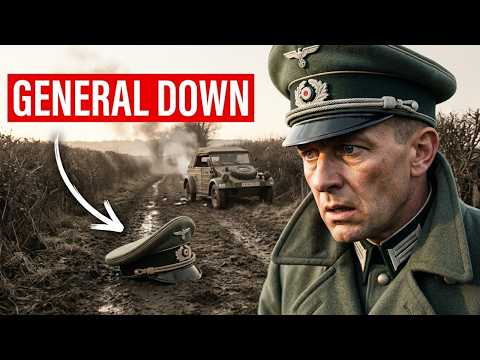
Falley was the first German general to die on D-Day. He commanded the 91st Luftlande Infantry Division, the unit specifically positioned to destroy the American airborne landings in the Cotentin. His death was not just a lucky encounter—it was the first crack in a collapse that would spread across the entire German command structure in Normandy that morning.
Across the Cotentin and beyond, German command posts were empty. Phones rang with no one to answer. Field Marshal Erwin Rommel, the commander of Army Group B, was in Germany for his wife’s 50th birthday, convinced by Luftwaffe meteorologists that the weather precluded invasion. Adolf Hitler was asleep at the Berghof, and the powerful Panzer divisions Rommel had begged to position near the beaches were held in reserve, awaiting his personal permission. The most powerful armored force in Western France sat motionless because one man was sleeping and everyone was afraid to wake him.
And then there was the war game. Generaloberst Friedrich Dollmann, commander of the German 7th Army, had scheduled a Kriegspiel—a map exercise—in Rennes for June 6th. Its purpose: to rehearse the German response to an Allied landing in Normandy. The scenario was, in essence, the one about to unfold in reality. To attend, corps and division commanders from across the Cotentin left their headquarters on the night of June 5th. The very officers whose job it was to fight the invasion were 100 miles away when it began.
Wilhelm Falley was among them. When reports of parachute landings crackled across the radio nets, he immediately ordered his driver to race back to his headquarters at the Château de Bernaville. He never made it. His death left the 91st Division without its commanding general, without several senior staff officers, and facing the full weight of two American airborne divisions.
The 91st was not elite. Formed in January 1944, it was a conventional infantry division, poorly equipped, with two Grenadier regiments and one attached elite unit: Fallschirmjäger Regiment 6, led by Oberst Friedrich von der Heydte. The contrast between Falley and von der Heydte defines the story. One was 100 miles away because the system summoned him to a meeting. The other was at his post because his rank kept him there.
Von der Heydte, a baron and law professor, was exactly where he was supposed to be. His paratroopers, many of them 17-year-old volunteers, were the first German unit to identify the American airborne landings. Because he was present, his regiment reacted faster and more effectively than any other German unit in the Cotentin that morning.
But the 91st’s counterattack, planned to crush the scattered Americans before they could organize, required coordination. And the coordinator was lying dead beside a wrecked staff car. The regiments attacked piecemeal. Grenadier Regiment 1058 pushed toward Sainte-Mère-Église but stalled against the dug-in 505th Parachute Infantry. Grenadier Regiment 1057 tried to cross the Merderet River at La Fière, but three obsolete French tanks were knocked out on the causeway, blocking the advance. American paratroopers, dropped by error behind the German assembly areas, attacked from the rear. The regiment fought in both directions, squeezed and leaderless.
By the time a replacement commander arrived, the moment had passed. The Americans had consolidated, linked up with Utah Beach, and begun their drive across the peninsula. The 91st would be ground to pieces in a fighting retreat it was never equipped to survive.
Within 12 days of D-Day, five German generals in Normandy were dead. The German officer corps was being decapitated, and unlike the American system, it had no mechanism to regenerate what it lost. Every time a general fell, his division experienced confusion while a successor was identified. Regiments fought on their own initiative, but coordination stalled. The American system had built redundancy into every level; the German system concentrated authority in the commanding general. His loss was a system failure.
The question at the heart of this story is: How did the army that invented Auftragstaktik—mission-type tactics based on decentralized initiative—become so brittle that losing one general could paralyze a division? The answer lies in a transformation between 1933 and 1944, as Hitler dismantled the tradition of operational freedom piece by piece. By 1944, a reserve army training document stated the philosophy bluntly: “Deviation from the order, 5%. Adherence to it, 95%.” The system that had been built on trust had been rebuilt on obedience.
And an army built on obedience needs its officers alive, because the men below them have been trained to wait for instructions. This is why Falley’s death mattered so much. Not because he was irreplaceable as a tactical mind, but because in a system where authority had been concentrated upward, the commanding general was the one man whose word could set the entire division in motion.
Now, remember von der Heydte—the man who stayed. While the 91st Division’s headquarters struggled without its general, von der Heydte was fighting. His paratroopers conducted a fighting withdrawal toward Carentan that was a masterpiece of small-unit defensive tactics. They used flooded marshland to channel the American advance into narrow causeways, turning each into a killing zone. When the 101st Airborne finally assaulted Carentan, von der Heydte’s outnumbered men held the town in brutal house-to-house fighting until their ammunition was nearly exhausted. On the evening of June 12th, he ordered a withdrawal under cover of darkness—exactly the kind of decision that the old Prussian tradition empowered a field commander to make. The American paratroopers called his men the Lions of Carentan.
Von der Heydte’s performance proved that the German military tradition, when its leaders were present and empowered, was still capable of extraordinary tactical excellence. The problem was not the quality of the officers. The problem was a system that had pulled them away from their commands and stripped them of the authority to act without permission from above.
The 91st Division did not survive the summer. By July 10th, its front-line infantry strength was reduced to roughly 700 men. Total losses exceeded 8,000. On August 10th, 1944, it was formally dissolved. It had existed for less than seven months.
Its story is not about one unlucky general killed in an ambush. It is about what happens when a system designed for trust is rebuilt for control. The Prussian tradition that created Auftragstaktik understood that war is chaos, that plans dissolve on contact with the enemy, and that the only way to win in chaos is to put thinking, empowered leaders at every level and trust them to act. By 1944, that tradition had been hollowed out from above. Hitler’s insistence on centralized control turned the most tactically flexible army in Europe into a machine that could not function when its senior officers were removed.
The Americans who fought in the Cotentin faced their own chaos. They were scattered across the countryside, far from their drop zones, in units so scrambled that sergeants led men they had never met. But the American system had been designed to operate in exactly that condition. Its sergeants had been trained to take command, assess the ground, and move toward the objective without waiting for orders. Where a German unit that lost its commander might hold its position and wait, American squads continued to attack. Both sides faced chaos. Both sides lost leaders. But the American chaos produced improvisation. The German chaos produced paralysis.
Falley was not a bad general. Had he been at his headquarters on the morning of June 6th, the 91st’s counterattack might have been coordinated, might have changed the battle for the Cotentin. We cannot know. What we can know is that the system that should have put him at his command post instead put him on a road at 4:00 AM, racing back from a war game that rehearsed the very disaster unfolding in real time.
And the system that should have ensured his division could function without him for a few critical hours had, by 1944, been so thoroughly stripped of distributed authority that it could not. German soldiers who survived the war often remarked that the Americans did not seem to need their officers. The 91st Luftlande Division proved the other half of that observation. It proved that by 1944, the German army needed its officers desperately—not because its soldiers could not fight without them, but because the system no longer allowed them to.
That is what the 91st Luftlande Division reported after losing its general on D-Day. It reported failed counterattacks that arrived too late and hit too weakly. It reported regiments fighting without coordination. It reported a chain of command that could not reassemble itself fast enough to matter. And buried beneath those reports, in the space between the lines, it reported the cost of a military tradition that had been turned against itself—an army that had invented initiative and then made initiative a crime.
Falley lies at Orglandes, in block 10, row two, grave 207, among more than 10,000 German soldiers who died in the Cotentin. Brannen lies at Arlington. Von der Heydte, who outlived them both by decades, rests in a cemetery in Germany.
The farm at La Minoterie still stands near Picauville. The wall Falley’s car struck has long since been repaired. The road looks the same as it did that morning—quiet, narrow, ordinary. The kind of road where nothing important should ever happen.
But on that road, at dawn on June 6th, 1944, a paratrooper who was exactly where chaos had dropped him killed a general who was exactly where a failing system had sent him. In that single moment, everything the German army had built and everything it had lost collided in the dark.
Falley was not the last to fall victim to that system. Von der Heydte would meet it again in the frozen forests of the Ardennes, handed a mission he knew was hopeless and an army of strangers he had never trained. The system that emptied the command posts on D-Day had not been repaired—it had only grown more desperate.
What remains is a question that echoes across every military institution since: when a system stops trusting the men on the ground, how long before it breaks at the moment it matters most?
If someone in your family served in the Second World War, on any side, in any theater, tell me about them in the comments. Their stories deserve to be heard—and it is how we make sure they are not forgotten.
Report this article
Select a reason for reporting:






