The jungle was silent—too silent. Four men lay motionless in the undergrowth, their hearts pounding against their ribs. They had been in the field for eleven days, deep inside enemy territory, and they hadn’t spoken above a whisper, hadn’t fired a shot. They were ghosts. But now, eight Viet Cong soldiers were walking straight toward them, talking and smoking, oblivious to the eyes watching through the crosshairs. The patrol commander’s hand came up. Four men froze. The Vietnamese voices were close—30 meters, maybe less. The pointman could smell the fish sauce. He could hear the metallic click of AK-47 safeties coming off. And he knew what would happen in the next 90 seconds would end with no prisoners, no wounded, no survivors on the other side.
This was January 1969, Phuoc Tuy Province. A four-man Australian SAS patrol, six kilometers inside enemy territory. They had not bathed, had not spoken, had not fired a weapon. They were ghosts. And the Viet Cong were walking straight toward them.
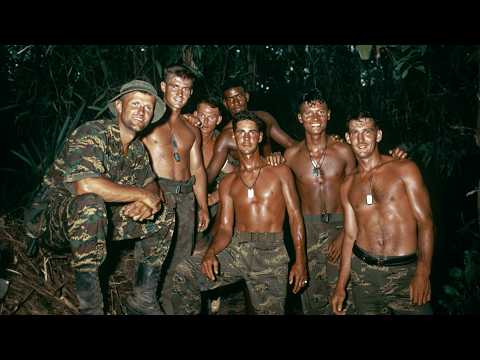
The patrol commander counted down: 1, 2, 3… His finger moved to the trigger. 4, 5, 6… The enemy was 15 meters out. 7, 8… All targets identified. He squeezed. The jungle erupted. Ninety seconds of continuous fire. Then silence. Then the smell of cordite mixing with blood. Then the patrol commander’s voice, barely above a whisper: “Check them.” All eight confirmed dead. No wounded. No prisoners. The patrol melted back into the jungle. They were 12 kilometers away before the North Vietnamese Army found the bodies.
When the NVA commander saw the kill pattern—tight groupings, professional spacing, not a single wasted round—he wrote in his after-action report a phrase that would appear in captured documents throughout the war: “Australian ghosts do not pursue.” The Americans found that report six months later. A US Army intelligence officer read it, translated it, and then asked his Australian counterpart a question that had been eating at him for months: “How many prisoners has your squadron taken this year?” The Australian looked at him. “This year? None.” “How many last year?” “Three.” “Three total?” “Three total.” The American officer leaned back. He was quiet for a moment. Then he said something that would later appear in a classified Pentagon assessment of Allied operations in Vietnam: “You terrify them. And honestly, you terrify us, too.”
This is the story the official histories don’t tell. The story that makes American military planners uncomfortable even now, 55 years later. The story of why US commanders loved having Australian SAS patrols operating in their area of operations—and simultaneously feared what those patrols represented about the nature of modern warfare. Because here’s what the sanitized versions won’t say: The Australians fighting in Vietnam had a prisoner capture rate so low it bordered on statistical impossibility. Between 1966 and 1971, Australian SAS squadrons conducted thousands of patrols deep into enemy-controlled territory. They killed hundreds of Viet Cong and NVA soldiers and brought back almost no prisoners. Not because they were executing prisoners, not because they were committing war crimes, but because their entire operational doctrine—the methods that made them the most effective reconnaissance force in the entire theater—created a tactical reality where enemy contact almost never resulted in prisoners. And the Americans, who were under constant pressure to capture prisoners for intelligence purposes, couldn’t decide if they should study this approach or condemn it.
Stay with me, because what you’re about to learn will rewrite everything you thought you knew about the Vietnam War, about Australian military doctrine, and about the dark mathematics of small unit operations in hostile territory.
The year was 1966. The Americans had been in Vietnam for 18 months in force. They’d brought 400,000 troops, armored cavalry, chemical defoliants, psychological operations, and vast quantities of artillery. And they were losing. Not on the battlefield—the Americans won almost every conventional engagement. But wars are not won on battlefields when the enemy refuses to fight conventionally. The Viet Cong and NVA were fighting a different war. A war of ambush, infiltration, terror, and patience. They would strike, kill, and vanish. They used the jungle the way a swimmer uses water.
The American approach was firepower—massive firepower. Search and destroy. Find the enemy and obliterate them with artillery, air strikes, and overwhelming force. But you can’t obliterate an enemy you can’t find. And the Americans were having trouble finding them. Intelligence was the problem. The Americans needed to know where the enemy was staging, where they were moving, what their intentions were. They needed prisoners for interrogation. They needed captured documents. They needed actionable intelligence that could turn reactive sweeps into offensive operations. The Americans were capturing prisoners—plenty of them. But the intelligence was often outdated by the time it was extracted and analyzed. By the time American units moved on captured intelligence, the enemy had already relocated.
What the Americans needed was real-time reconnaissance deep in enemy territory. Small patrols that could stay out for weeks, watch enemy movements, identify base camps, and call in strikes before the enemy dispersed. They needed an intelligence-gathering method that was faster than their current approach. The problem was that this kind of reconnaissance was extraordinarily dangerous. Small patrols operating deep in enemy territory with no quick reaction force, no artillery support within range, no immediate extraction capability. The Americans tried it. They lost patrols. They lost good men. The risk-to-reward calculation was not favorable.
And then the Australians arrived. Not in massive numbers. The Australians sent one battalion—1,000 men. A rounding error in the American order of battle. The US command barely noticed them until the intelligence reports started coming in. Reports of enemy base camps located. Reports of supply caches destroyed. Reports of ambushes executed with surgical precision. Reports of patrols that spent weeks in the jungle and came back with detailed intelligence on enemy movements. And reports—this is what made American commanders take notice—of combat efficiency that seemed impossible. A four-man Australian patrol would make contact with a 12-man Viet Cong squad and kill 11 of them without taking a single casualty. A six-man Australian patrol would ambush a 30-man NVA platoon and inflict 23 confirmed kills before withdrawing without losing a man. The numbers didn’t make sense. Not in conventional terms.
American commanders wanted to know how. They visited the Australian base at Nui Dat in Phuoc Tuy Province. They observed patrol preparations. They read after-action reports. They interviewed Australian officers. And slowly they began to understand that the Australians were not fighting the same war the Americans were fighting. The Americans were fighting a war of force. The Australians were fighting a war of method. And the method produced results that were statistically extraordinary and morally complicated.
Phuoc Tuy Province was 1,800 square kilometers of rubber plantations, jungle, and rice paddies, 60 kilometers east of Saigon. The Viet Cong had controlled it for years. They used it as a staging area for attacks on the capital. They recruited from the villages. They collected taxes. They ran the night. When the Australians arrived in 1966, they were assigned this province as their area of operations. One battalion—1,000 men—responsible for 1,800 square kilometers of enemy-controlled territory. The Americans thought it was a suicide mission.
The Australians approached it differently. They didn’t try to control the entire province. They established a base at Nui Dat and began sending out patrols. Small patrols—four men, five men, six men maximum. They went out for 10 days, 12 days, 14 days. They moved slowly. They lived in the jungle. They watched. And when they found the enemy, they killed them quickly, professionally, completely.
The patrol commander was Sergeant David Walker. He was 26. He’d grown up on a cattle station in Queensland. He’d joined the army at 18. He’d done selection for the SAS on his first attempt. He’d spent three years learning to track, to navigate, to survive in hostile territory. He’d learned to shoot with the kind of accuracy that most men never achieve, even after decades of practice. Walker could put 30 rounds into a man-sized target at 400 meters in less than 15 seconds. He could navigate by dead reckoning through triple-canopy jungle with accuracy to within 50 meters. He could identify enemy by the sound of their equipment, the smell of their cigarettes, the pattern of their movement. He’d been in Vietnam for four months. He’d led 16 patrols. He’d made contact with the enemy on 11 of them. He’d lost zero men. He’d captured zero prisoners.
Not because he didn’t want prisoners. Prisoners were valuable. But Walker understood something that took American commanders months to grasp: You cannot safely capture prisoners when your four men are operating six kilometers inside enemy territory with no quick reaction force and no secure extraction point. Think about the mathematics. Four men deep in the jungle. They’ve located an enemy base camp. They’re observing it. They’re gathering intelligence. Then they’re spotted. They make contact. They engage. They kill six enemy. Two enemy are wounded. Now what? In American doctrine, you secure the wounded. You call for a medevac. You extract prisoners for interrogation. You have the resources to do this. You have platoon, companies, battalions. You have helicopters on standby. You have firebase artillery that can provide covering fire. You have the manpower to both secure prisoners and maintain security.
A four-man Australian patrol has none of this. They’re too far from base for helicopter extraction. They can’t call in artillery. They have no quick reaction force. If they try to secure wounded prisoners, they’re stuck in place. Stuck in place means the enemy has time to bring reinforcements. Reinforcements mean the patrol is surrounded, outnumbered, and dead. So Australian doctrine was simple: If you make contact, you finish it completely. You engage at maximum effective range. You kill everyone who presents a threat. You withdraw immediately. You’re gone before enemy reinforcements arrive. You’re ghosts again.
This wasn’t murder. This wasn’t execution. This was the tactical reality of small unit deep reconnaissance operations. The patrol’s survival depended on maintaining mobility and operational security. You cannot maintain either if you’re trying to extract unwilling prisoners through hostile jungle. Walker explained it to an American major who asked him directly: “Sir, if we take prisoners, we die. It’s that simple. We’re four men, six kilometers out. If we try to bring back a prisoner who doesn’t want to come, who’s going to slow us down, who might call out, who might resist, we lose our mobility, we lose our stealth. The enemy finds us. They bring a company. We’re dead. So we don’t take prisoners unless the tactical situation allows it—which is almost never.”
The major understood the logic. He didn’t like it, but he understood it. The American major’s name was Robert Kingsley. He was 32. He’d graduated from West Point. He’d commanded a rifle company in the 1st Cavalry Division. He’d seen combat. He’d lost men. He’d captured prisoners. He believed in the intelligence value of prisoners. He believed in the moral imperative of taking prisoners when possible. He believed in the Geneva Conventions. But he’d also seen his own reconnaissance patrols get shredded trying to extract prisoners from hostile territory. He’d seen good men die because they’d been trained to secure prisoners even when the tactical situation made it suicidal. And he was starting to understand that the Australian approach, while uncomfortable, was producing results his division couldn’t match.
Kingsley started attending Australian patrol briefings. He started reading their after-action reports. He started mapping their contact locations and analyzing their engagement patterns. What he found was a level of operational effectiveness that seemed impossible. Australian patrols were making contact with the enemy at an average distance of 150 meters. American patrols were making contact at an average distance of 30 meters. That 120-meter difference was the difference between ambush and firefight. The difference between controlled engagement and chaos. The difference between coming home and dying in the jungle. Australian patrols had a kill ratio of approximately 17 to 1. For every Australian killed in a patrol contact, 17 enemy died. American patrols had a kill ratio of approximately 3 to 1. The Americans were brave. They were well trained. But their doctrine prioritized different things. Australian patrols spent an average of 11 days in the field. American patrols spent an average of three days. The Australians lived in the jungle. The Americans visited it. That difference in field time translated directly into intelligence quality and prisoner numbers.
Australian patrols across the entire war captured fewer than 50 prisoners total from patrol contacts. American patrols captured thousands. But the Australian intelligence from observation and captured documents was often more valuable than prisoner interrogations because it was real-time. The Australians would observe enemy movements, identify patterns, call in air strikes on base camps that were still occupied. By the time American prisoners were interrogated, the intelligence was often outdated.
Kingsley wrote a classified memo to his commanding officer. The memo was later included in a Pentagon study. The memo said: “The Australian reconnaissance doctrine is the most effective intelligence-gathering method we’ve observed in theater. It produces actionable intelligence faster than any other method. However, it comes with a moral cost that American commanders need to understand. The Australians are not capturing prisoners because their operational methods make prisoner capture tactically infeasible in most contact situations. We need to decide if we can accept this trade-off or if we want to continue accepting higher casualties in our own reconnaissance operations.”
The Pentagon never formally responded to that memo, but Australian patrol operations continued and American commanders continued to request Australian patrols in their areas of operations. The results spoke for themselves.
The point man was Corporal James Hutcherson, 23, from Darwin—a tracker who could follow a trail three days cold and smell fish sauce 200 meters downwind. He walked point because his job was to see the enemy first. “Silence is how you survive,” he said years later. “Silence is how you kill.” Behind him walked Walker, then Denning, then Cross—four men, 68 kilograms each, no artillery, no air cover, no quick reaction force.
They had covered 43 kilometers in eleven days, observed two base camps, called in two air strikes, and never fired a shot. They were ghosts—until Hutcherson’s hand came up.
Walker counted down. Three. Two. One. The jungle disappeared in muzzle flash. Ninety seconds. 127 rounds. Eight dead. Not one returned fire. They were 400 meters away in three minutes, across a river before the NVA quick reaction force arrived.
The NVA commander found the bodies and wrote: “Australian ghosts do not pursue.” A US intelligence officer later asked an Australian how many prisoners his squadron had taken. “None.” The American leaned back. “You terrify them. And honestly, you terrify us, too.”
Walker finished three tours, 87 patrols, two men lost, three prisoners taken. He bought a cattle station and rarely spoke of the war. Asked if he felt guilt, he said: “They were trying to kill me. We chose to live. That’s all.”
Zero prisoners. Maximum effectiveness. The jungle remembers the silence. But you—would you have made the same choice?
Report this article
Select a reason for reporting:






