On August 6, 1945, at 8:15 AM, the Enola Gay opened its bomb bay doors over Hiroshima, and the world that existed before that moment vanished. You might assume that a plane of such historical weight would have been enshrined immediately, preserved as a sacred relic of the war that ended all wars. But that’s not what happened. Instead, the Enola Gay embarked on a strange, decades-long odyssey that few history books mention—a journey through neglect, controversy, and near-oblivion.
After Hiroshima, the plane was stationed in Roswell, New Mexico, baked under the Arizona sun, and parked at a small airfield in Illinois that is now one of the busiest airports on the planet. It sat outdoors for nearly seven years in Maryland, unlocked, where souvenir hunters stripped it of parts and birds built nests inside. It was disassembled and left in pieces for 43 years. Its sister ship, the B-29 that bombed Nagasaki, has been on public display in Ohio since 1961. The Enola Gay didn’t stand on its own wheels before the public until 2003. And on the day it finally appeared, a protester on a walkway above threw a bottle of red paint at its side.
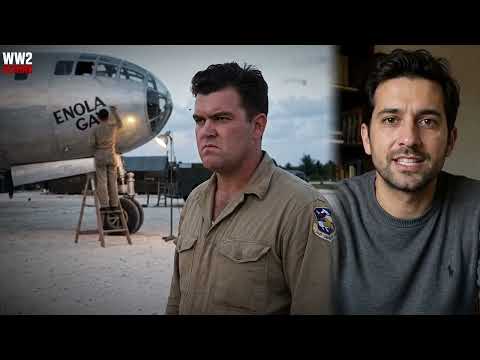
Why did the country that built the most famous aircraft of the 20th century spend half a century unsure of what to do with it? How did one exhibit about it end with the museum director’s resignation? And what happened to the twelve men who were inside it that morning? Stay with me until the end, because one piece of that morning still exists on a remote Pacific island under a glass plate, and almost no one visits it.
It all begins on an assembly line in Nebraska, at a time when the Enola Gay didn’t even have a name yet. It was just a number. In the spring of 1945, the Glenn L. Martin Company was building B-29 Superfortresses in a massive bomber plant south of Omaha. The B-29 was the most expensive weapons program of the entire war—more costly than the Manhattan Project that produced the atomic bomb. Nearly 4,000 were manufactured. Most flew to the Pacific and disappeared into the anonymity of aerial warfare.
On May 9, a young colonel walked the production line at the Martin plant and chose one of them. Its serial number was 44-86292. On paper, it was an ordinary plane. But it wasn’t. It belonged to a secret batch the Army called “Silverplate.” All guns except the tail cannon were removed, along with most armor. It had fuel-injected engines, reversible propellers, and pneumatic bomb bay doors that could open and close in an instant. The bomb bay itself was rebuilt to carry one thing: a weapon weighing nearly five tons.
The colonel was Paul Tibbets, who had been dropping things from airplanes since he was twelve years old. As a boy in Florida, he rode a biplane in a promotional show, flying low over a racetrack near Miami while tossing Baby Ruth candy bars with tiny parachutes to the crowds below. His father wanted him to be a doctor. Tibbets dropped out of medical school, joined the Army Air Corps in 1937, and by 1942 was piloting B-17s in some of the first heavy American air raids over occupied Europe. He flew General Eisenhower to Gibraltar before the invasion of North Africa. Then he was brought home to test the B-29, a bomber whose engines had a troubling habit of catching fire.
In September 1944, a general met him in Colorado Springs and told him about a weapon that didn’t exist yet. Tibbets had to build from scratch the unit that would deliver it. Stationed at the remote Wendover Field on the salt flats bordering Utah and Nevada, he trained his crews in a maneuver none of them understood. Fly high, drop a single bomb, then push the heavy bomber into a sharp turn of over 150 degrees and get away as fast as possible. No one was told why. Rumors at the base said that anyone who talked too much in town would soon be transferred somewhere very cold and very far away. That unit became known as the 509th Composite Group.
In June 1945, the new bomber from Omaha joined them, flown to Utah by a crew led by a captain named Robert Lewis. Lewis was a talented, reckless, and proud pilot, and as far as he was concerned, this plane was his. Keep that in mind.
From Utah, the 509th moved to Tinian, a small island in the Northern Mariana Islands, about 1,500 miles south of Tokyo. American forces had captured it the previous summer, and by 1945, Navy construction crews had turned it into the busiest airport on the face of the earth. The island was shaped a bit like Manhattan, so engineers named its roads after Manhattan streets—Broadway, 42nd Street. North Field alone had four parallel runways, each over a mile and a half long. On big nights, B-29s took off one after another as part of raids that might include hundreds of bombers, heading north to burn Japanese cities.
The 509th didn’t fit in. Its men lived in a fenced compound with their own guards, and they flew short, strange missions. A handful of planes, one bomb each, a sharp turn, then home. The crews who flew the long, brutal firebombing raids over Japan considered the new group a pampered joke, and a mocking poem about the secret outfit that didn’t seem to be fighting spread across the island. The 509th couldn’t respond. They weren’t allowed to say anything.
What they were actually doing was training, dropping fat orange practice bombs on Japanese cities, shaped like a new weapon none of them had seen. The crews called them “pumpkins,” and while they trained, the real weapon was crossing the Pacific.
On the morning of July 16, 1945—the same morning as the first atomic test—a patrol plane spotted them by chance. In the end, only 316 men survived. Their captain, Charles McVay, was among them. He was court-martialed for failing to take a zigzag course, the only American captain in the war tried for losing his ship to enemy action. In 1968, he took his own life. Congress finally voted to exonerate his name in 2000.
The ship that carried the bomb’s uranium lay at the bottom of the ocean before the bomb was even used, and remained lost there, more than three miles down, until a search team found the wreckage in 2017. We remember the Indianapolis largely because of what she carried. Without that cargo, her story might have stayed locked away with the families of the men aboard—and most of that war was like this. One crossing among thousands, one camp among hundreds. The same story repeating itself in places where no one carried a camera.
Over the years, I’ve told a number of these stories on this channel. I’ve removed eleven of them myself, so you can’t watch them here or anywhere else anymore. The only place they still exist is an audio collection called Behind the Wire, containing all eleven stories in full—about six hours of narration with a companion booklet to browse while you listen. If you want more about the war that happened away from the cameras, the link is in the description.
Meanwhile, on the island of Tinian, the uranium that ship had carried was already sealed inside a ten-foot steel casing, and the bomb was waiting only for better weather. The weather improved on August 5. That evening, the bomb was lowered into a pit dug at North Field. A B-29 was pushed into position over the pit, and the weapon was hoisted into the bomb bay. Remember that pit well. It is still there.
By then, Tibbets had decided to fly the mission himself in the plane Robert Lewis considered his own, moving Lewis to the co-pilot’s seat. That evening, he decided the plane needed a name. He thought of his mother. When he told his family he was leaving medicine to become a pilot, his father was fiercely opposed. His mother told him he would be fine. Her name was Enola Gay Tibbets. She was named after a heroine from a nineteenth-century novel, and there is something about that first name people only notice later. Read it backwards, and it becomes “alone.”
That evening, a painter lettered her name on the nose of the plane. When Lewis saw it, he was furious. Nevertheless, he flew her. There was another detail on that plane. A few days earlier, ground crews had painted over the 509th’s insignia on the tail and replaced it with a large black R inside a circle—the emblem of a different bomb group on the island. That way, no one watching the 509th’s planes could identify this one. Its number was changed to 82 as well. Keep that camouflage in mind too.
Around midnight, the final briefing came, followed by a chaplain’s prayer. As the crew walked toward the plane, they found it bathed in floodlights and surrounded by photographers and news cameras—a scene Tibbets later compared to a Hollywood premiere. Twelve men climbed aboard. Tibbets and Lewis in the cockpit. Bombardier Tom Ferebee in the glass nose. Navigator Dutch Van Kirk. Jacob Beser handling radar countermeasures. Flight engineer Wyatt Duzenbury and his assistant Robert Shumard. Joe Stiborik on radar. Richard Nelson, the youngest man aboard, on radio. Navy commander William Parsons in charge of the bomb, with his assistant Morris Jeppson. And in the tail, sitting alone, Bob Caron, the rear gunner.
Parsons was worried about something no one wanted to think about. He had seen B-29s crash and burn on takeoff from Tinian’s runways. If this plane went down carrying an armed atomic bomb, it could destroy a large part of the island. So the bomb would leave the ground unarmed, and Parsons would complete the arming in flight. He spent the afternoon bent over in the bomb bay practicing the steps until his hands were smeared with grease and cut.
At 2:45 AM, the Enola Gay began to move. She was loaded with fuel and cargo so heavy that she used almost the entire runway before Tibbets lifted her off. Fifteen minutes later, Parsons and Jeppson climbed down into the cramped bomb bay with a flashlight and a small tool kit. In less than half an hour, the job was done.
Over Iwo Jima, two other B-29s joined them. The Great Artiste, carrying blast measurement instruments to drop by parachute, and a photography plane later named Necessary Evil. Far ahead, three weather reconnaissance planes were scanning the skies over three possible targets. The one flying over Hiroshima was called Straight Flush.
At about 7:30, Jeppson returned to the bomb bay and replaced three green safety plugs with three red ones. From that moment, the bomb was ready to detonate. Shortly after, the coded weather report came in from Straight Flush. The clouds over Hiroshima were thin. The recommendation was: bomb the primary target.
Tibbets pressed the intercom and told the crew it was Hiroshima. Hiroshima was a coastal city and army headquarters, home to about a third of a million people, including soldiers and war workers. It had been spared firebombing, partly so the effects of a single new weapon could be measured precisely. It was a Monday. People were on their way to work. Thousands of children had been sent into the city center to help clear firebreaks.
From about 31,000 feet, Ferebee identified his aiming point—the T-shaped bridge in the heart of the city. The bombardier took control of the plane through the Norden bombsight. At 8:15 and 17 seconds, the bomb bay doors snapped open and Little Boy fell away.
Tibbets immediately pushed the bomber into that sharp, violent turn he had drilled into his crews for months—the maneuver that would save them from the blast they had just unleashed. Forty-three seconds later, the world below disappeared into a pillar of fire. Bob Caron, alone in the tail, described it as a giant mushroom cloud rising toward them, boiling with purple and gray and fire.
The crew sat in stunned silence. Some asked if the war was really over now. “It’s over,” someone said. “Just a matter of time.” No one cheered.
They returned to Tinian and were greeted by cheering officers and reporters. The twelve men slipped away quietly. Most never spoke publicly about what they saw. Some carried it silently to their graves.
Today, that one piece of the morning still sits on a remote Pacific island under a glass plate—the pit at North Field, waiting for visitors who rarely come. So here is my question for you: if you could stand beneath the Enola Gay today, what would you feel—pride, sorrow, or something harder to name? Tell me in the comments.
Report this article
Select a reason for reporting:






