At 3:30 in the morning on June 17th, 1944, a Marine captain named Rowland pressed a field telephone to his ear and heard the sound that would decide the fate of thousands. Through the static, he could make out the grinding roar of tanks—a whole column of them—rumbling out of the darkness toward his company, Japanese infantry riding on the engine decks. It was the largest armored attack Japan would ever throw at the United States Marines in the Pacific, and it was aimed at the thinnest stretch of a beachhead the Americans had held for less than two days. Rowland’s men had no tanks of their own in reach, only what they could carry in their hands. By sunrise, one of those two forces had been all but wiped out. The question is, which one?
The answer began with a decision made 18 hours before the first shot—a decision that would haunt the men who made it.
Two days earlier, the beach had been the problem. On June 15th, two Marine divisions came ashore on the southwest coast of Saipan. The 2nd Marine Division on the left, the 4th on the right. It was the opening move of Operation Forager, the drive into the Mariana Islands, and it was the deepest punch the Americans had yet thrown into Japan’s inner ring of defenses.
The landing cost them immediately. By the end of the second day, the two divisions had taken around 3,500 casualties. In places, they held less than a mile of ground. Behind them was the ocean. Above them, on the ridges and slopes of Mount Tapochau, Japanese artillery observers looked straight down into the beachhead and called fire onto anything that moved.
And the Marines knew what was coming next. They had been warned. Before the landings, their intelligence officers had flagged it plainly: “Expect a tank-supported counterattack, probably at night.” Japanese doctrine on these islands was simple and old. Hit the invader fast, hit him at night, drive him back into the surf before he can get his heavy weapons ashore.
The commander on Saipan, Lieutenant General Yoshitsugu Saito of the 43rd Division, intended to do exactly that. And he had something most island garrisons did not: he had tanks. A full regiment of them.
On the first day, he spent some of them badly. A company of light tanks was thrown piecemeal at the beaches and shot to pieces in the open, burning in the sand before they ever reached the Marine line. It was a preview nobody read correctly. The armor that mattered was still back in the hills, waiting for the main blow.
That blow was aimed at a radio station. A transmitting station sat about 400 yards behind the Marine front, and Saito’s order told the tanks to charge straight for it, break through, and throw the beachhead into chaos. Past the radio station lay the airstrip and the sea. If they got that far, it would have been a disaster. The 2nd Division’s command post and most of its artillery sat only about 500 yards behind the line. There was almost nothing between the guns and the tanks except infantry in holes.
So who were they, these men rolling down out of the dark? They were the 9th Tank Regiment, and on paper, they were the best armored force Japan had in the Central Pacific. The regiment had been raised in Manchuria in 1939 and trained for years on the open plains, drilling for the kind of fast, sweeping tank war they expected to fight against the Soviet Union. These were not green conscripts. They were professional tankers who knew their machines and knew how to maneuver.
In the spring of 1944, they were split up and shipped out to defend the Marianas, and the bulk of the regiment landed on Saipan under Colonel Goto. The trouble was the machines themselves. The regiment rolled on two main types: the Type 95 Ha-Go, a light tank with a 37-mm gun and a single man cranking the turret by hand, and the Type 97 Chi-Ha, a medium tank, some fitted with a newer, high-velocity 47-mm gun that was the best weapon the regiment owned.
Here is what those numbers meant in a fight. The thickest armor on a Chi-Ha was about an inch. The Ha-Go was thinner than that. These were designs from the late 1930s, built for a war against other light tanks and infantry, and by 1944, they were badly out of date. American armor-piercing rounds sometimes punched clean through a Japanese tank and out the other side without even stopping to explode. On Saipan, Sherman crews would learn to switch to high-explosive shells because the solid shot was passing straight through.
Colonel Goto understood that problem better than anyone. And on the morning of the 16th, he made an argument to his own superiors that would decide the fate of his entire regiment. What he said, and what they said back to him, is why this story ends the way it does. We will come back to it. Hold the thought.
For now, know only this: the tanks did not move on the 16th. They waited. And every hour they waited, the Marines on the beach dug deeper and dragged more ashore. Because the thing the Marines were bringing ashore, the thing the Japanese plan never accounted for, was already in the ground and waiting.
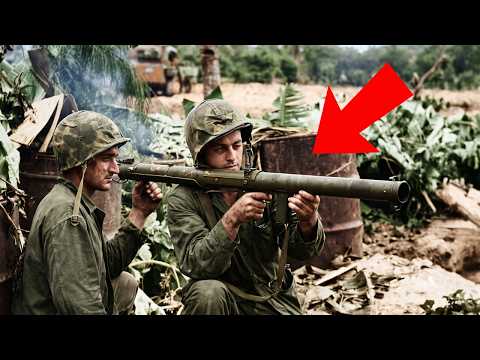
It was called the bazooka.
Officially, it was a 2.36-inch rocket launcher. The troops named it after a goofy homemade musical instrument a radio comedian played, because that is what the long tube looked like slung over a man’s shoulder. It took two men to work. A gunner, who aimed the tube and fired, and a loader, who slid a rocket in the back, wired it, and tapped the gunner to say it was ready.
The rocket did the thing that mattered. It carried a shaped charge, a cone of explosive that focused all its force into one narrow jet of superheated metal. When it hit armor plate, it did not need brute speed to get through. It burned a hole and sprayed that jet of metal into the crew compartment and anything inside. Men, ammunition, fuel—all of it was in its path.
The round could cut through about three inches of armor. Three inches. The thickest plate on the tanks coming for them was about one. On paper, the bazooka could punch through a Japanese tank three times over.
But paper is not a cane field at night. The rocket was slow, and it was only accurate out to a few hundred yards in daylight. At night, firing at a shape lit by a flare meant letting the tank come close—very close, tens of yards. Close enough to hear the engine and smell the exhaust. Close enough that if you missed, you would not get a calm second try.
So the real question was not what the weapon could do on a test range. It was whether two men in a hole could actually stop a tank in the dark against a whole regiment of them. Nobody on that line knew the answer yet.
On the night of June 16th, the bazooka teams of Company B, First Battalion, Sixth Marines were moved forward into the main line of resistance, out front where the tanks would come. They settled into their holes in the dark and they waited. They did not have to wait long.
Early in the evening, the Marines on the line began to hear them. Engines far off. Voices somewhere out in the cane fields—Japanese soldiers were singing, and the sound of it drifted across the no man’s land in the dark. The war correspondent Robert Sherrod watched part of it and never forgot the strangeness. The tanks would stop. Men would climb out and shout and wave swords and sing. Then a bugle would sound and they would scramble back inside and come on again.
And the Marines in the foxholes would let them come, and then open up on them with the bazooka.
At 3:30 in the morning, the captain commanding Company B got on the telephone to his battalion. Tanks and infantry, he reported, moving toward him out of the hill and the valley to his direct front. He asked for everything at once. Star shells to light them up, the artillery to drop its planned fire, a tank company nearby to man its guns, a destroyer offshore to stand by.
Keep the shape of it in your head. Two forces in the dark: a tank regiment grinding forward, and a thin line of men with whatever they could carry. By the time the sun came up, one of them would be gone.
Up and down the line the requests went out, and then the first wave came into the Company B sector and there was no more time for telephones. They came in groups of four and five. The squeak and rattle of their tracks could be heard all the way back at the regimental command post. Infantry rode on the engine decks and clung to the handrails on the turrets. Some tanks had machine guns bolted to the hull with men firing them as they rolled.
The Marines took the infantry apart first. Four heavy machine guns in the forward line of Company B opened on the men riding the tanks and the men running behind them, and the fire scythed them off the decks and out of the cane. One machine gun from the neighboring company fired 40 belts that night, something near 10,000 rounds through a single gun. The tanks kept coming, but the infantry meant to protect them was dying in the open, and a tank without its infantry, in the dark, among dug-in men with rockets, is a blind animal.
Then the bazookas started. The executive officer of the battalion, Major James Donovan, was there, and years later he described it in a single phrase that beats anything a narrator could invent. It became, he said, “a madhouse of noise, tracers, and flashing lights.” As the first tanks were hit and caught fire, they lit up the field, and every burning tank threw light on the next one coming out of the shadows or already on top of the Marine squads. Some tanks, their commanders dead in the open hatches, their infantry gone, simply began to turn in slow, aimless circles until they bogged down in the soft marsh ground or stalled dead in their own ruts. Others pressed straight on toward the guns.
And this is where the man from the hook comes in. His name was Herbert Hodges, a private first class in a bazooka team, Company B, 1st Battalion, 6th Marines. When the tanks came into his sector, Hodges did not stay down in his hole and wait for a safe shot. He got up and moved out to meet them. He fired and reloaded and fired again, working the tube with his loader in the dark, picking tanks out of the firelight and the flares, putting a rocket into each one. Seven times he fired. Seven tanks stopped. Seven rockets, seven kills. The Navy Cross they gave him said it plainly: he put seven hostile tanks out of action while firing only seven rounds of ammunition. No wasted shots.
A few holes over, Private Robert Reed worked his launcher until he had knocked out four separate tanks. Then he ran out of rockets. A fifth tank was still coming. Reed climbed up onto it, pulled the pin on an incendiary grenade, and dropped it through the turret hatch. Two more men from Company B, Horace Narvaez and John Klunk, fed their rockets into the charge and between them scored hits on three tanks with four shots.
The killing was not all bazookas, and the honest version of this night says so. A machine gun squad leader named Alex Smith watched his bullets bounce harmlessly off the hulls, so he grabbed a rifle grenade launcher, clipped grenades onto the muzzle, and knocked out three tanks that way. A sergeant named Dean Squires shot a tank commander standing in his hatch, then finished the tank with a demolition charge. A corporal named Clyde Simmons led his bazooka section across open fields in total darkness to reinforce the line, and when three tanks bore down on his position at once, he picked up the launcher of one of his own wounded men and hit all three.
While the bazooka teams and the riflemen fought it out at arm’s length, the weight of the division came down on the attack from behind. The artillery had been waiting with its guns already laid on the ground in front of the Marines. When the call came, the howitzers of one battalion alone fired around 800 rounds in a little over an hour, straight onto pre-registered ground, walking high explosive through the cane fields where the tanks and infantry were massing. Out at sea, the destroyers fired star shells, and the whole battlefield came and went in that harsh swinging chemical light that turned the night into a flickering false daylight.
From 4:00 in the morning, a fresh company moved up through the shattered remains of Company B to relieve them and hold the line. And as the sky began to gray toward dawn, the last piece of the Marine machine arrived. The regiment’s half-tracks, each mounting a 75-mm gun, had set off before dawn and spent the whole fight clawing across soft ground and irrigation ditches to get forward. Now, in the first light, they rolled up to the line and went to work on the tanks that were still running and still firing. Against a 75 on a moving mount in daylight, the thin-skinned Japanese tanks had nothing left.
By about 7:00 in the morning, it was effectively over. One last tank made a run for it, grinding back up the road toward the high ground and the foothills of Mount Tapochau. A naval gunfire officer brought the fleet down on it. Around 20 salvos of 5-inch shells walked up the road, and the tank threw up a column of oily smoke and burned for the rest of the day. At 7:30, the 6th Marines got up out of their holes and attacked on schedule, as if the night had never happened.
When the light came up fully, the Marines could finally see what they had done. The ground in front of the line was a junkyard of dead armor. Somewhere between two dozen and 31 burned-out and smoldering tanks sat scattered across the cane fields and bogged in the marsh, hatches open, some still burning, crews dead inside or sprawled around them. The 9th Tank Regiment, the pride of Japan’s armor in the Central Pacific, had been gutted in a single hour.
Which brings us back to the decision from the start. On the morning of the 16th, Colonel Goto had wanted to attack right then, alone. Send the tanks in fast, while the beachhead was still crowded and confused, and very few American tanks and anti-tank weapons were ashore. Hit the Marines while they were raw. He was overruled. The 43rd Division’s chief of staff insisted the tanks wait and go in together with the infantry in a coordinated night assault. So they waited. And every hour of that delay had let the Marines land more weapons and dig in deeper. By the time the regiment finally rolled, the holes it was driving into were full of men with rockets.
The chief of staff who had overruled Goto admitted the core of it afterward. “The moment his night attack went forward,” he said, “the enemy lit the whole field with those big star shells and turned night into day. And after that, maneuvering was almost impossible.” The men inside the tanks were brave, and they were skilled, and none of that saved them. They had been thrown away by a plan that sent obsolete machines in a frontal charge late into a prepared and illuminated position held by men with the one weapon their armor could not stop.
It was not a clean victory, and the Marines never pretended it was. The reinforced battalion that caught the main weight of the attack took 78 casualties in that one night. Company F, fighting on the flank, lost 19 more. These were men who had been ashore for less than 48 hours holding a line in the dark against tanks, and some of them did not see the sun come up. But they held.
And the thing they proved that night reached a long way past Saipan. This was the first major tank attack a Marine unit had ever received in the Pacific War, and the Marines had stopped it cold—not with their own tanks, not with help from the Navy alone, but with the weapons and infantry battalion carried as a matter of course. Rockets, grenades, machine guns, and nerve. After that night, the lesson was burned in. Japan never again massed its armor like that against the Marines.
Saipan itself was the hinge of the Pacific War. The island was declared secure on July 9th. More than 24,000 Japanese military dead. More than 3,000 Americans killed or missing, with thousands more wounded. But what the Americans bought with that was the island itself. The airfields on Saipan were rebuilt and lengthened, and from them, that November, the new B-29 bombers began flying all the way to Tokyo. For the first time in the war, the Japanese home islands were under sustained attack from land-based American aircraft. When Saipan fell, the government in Tokyo fell with it. Within days, the war cabinet of Prime Minister Hideki Tojo resigned. One senior Japanese admiral put it as flatly as it can be put: “Our war was lost with the loss of Saipan.”
Two of the 9th Tank Regiment’s machines survived all of it. Years after the war, a veteran of the regiment worked to recover them and bring them home. Today, they sit in Japan as memorials, the only tanks of their kind preserved in the country. Quiet, rusted, still. The last of the armor that rolled into the cane fields that night.
Go back to those foxholes one more time. Picture the men in them in the last hour of darkness on June 17th. Dug in less than two days, no tanks of their own in reach, listening to the singing and the engines and the squeal of tracks coming closer in the dark. Two men to a hole, one tube between them, a handful of rockets. The tankers grinding down toward them were professionals and the pride of their regiment, and they thought they were about to overrun a few tired riflemen and reach the sea. They never knew what was waiting for them in the ground.
So here is the question that night leaves behind: when the next crisis comes and the experts insist on waiting for the perfect plan, will you remember Colonel Goto—and what did his one hour of delay actually cost?
Report this article
Select a reason for reporting:






