The heat in Shanghai was stifling, a suffocating embrace that clung to the skin like a second layer of clothing. Through the lens of my camera, I framed my first visions of China—a kaleidoscope of colors, sounds, and smells that assaulted the senses. Rickshaws darted through crowded streets, their bells a constant jingle, while the cries of street traders and the pungent aroma of ripe fruit hung heavy in the air. This was not the France I had left behind four weeks ago, nor the Madagascar I had known. This was something entirely different—a world on the brink.
I had left Toulon without fanfare, without a white handkerchief waving me off. Since the death of my wife, Marie-Louise, only my brother Pierre connected me to France. I was hungry for fresh horizons, for something to fill the void she had left behind. Little did I know that China would consume me entirely.
Shanghai was a symbol of the Chinese Empire’s decadence, a city carved up by foreign concessions after the Opium Wars. The Bund, with its grand boulevards, reminded me of Marseille or Genoa, but the masses of people, the sheer movement and money that abounded, made me giddy. I was a stranger here, yet hidden behind my camera, I seemed invisible. The Chinese took no notice of me as I photographed their streets, their lives, their struggles.
On the 4th of May, 1905, I boarded a ship bound for Chongqing, the headquarters of the French Concession in Sichuan. The Yangtze River, the longest in Asia, stretched before me like a palpitating artery of life. From Shanghai to Hankou, it was congested with junks of all sizes, and further upstream, huge timber rafts lined the banks. I had hundreds of glass plates in my luggage, ready to document every moment of this journey.
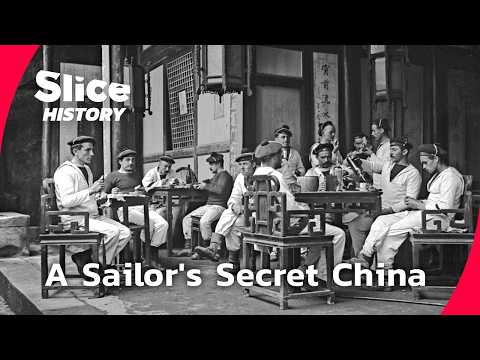
But it was not just the landscape that captivated me. It was the people—the traders, the missionaries, the sailors, and the Chinese themselves, living their lives under the shadow of foreign domination. One of them, a man named Antoine Giraud, seemed pleasant enough. He spoke only of business, but his camera around his neck suggested a kindred spirit. Together, we explored the towns along the river, photographing everything from pharmacists selling powdered monkey bones to men having their hair cut in the open street.
“What is France up to?” Giraud railed one morning as we crossed paths with the Vaterland, a German gunboat. “May our flag fly here as it does in Indochina?” His words echoed my own thoughts. The Europeans were all here, fighting for a share in the riches of this suffocating empire—Great Britain, Germany, France, Russia, and Japan. The Yangtze was a strategic objective, and I was determined to do my part.
After 28 days of travel, I finally arrived in Chongqing. The French flag flew from the top of the French Navy Bastille, and Commander Groyer welcomed me with a warm handshake. His wife, dressed in the latest Paris fashion, was a genuine parakeet in the deepest depths of China. The small French community had assembled to greet me, including Father Gibescu, who ran the Catholic mission, and Officer Aspirant Luciani, a strapping 27-year-old from Nice, the same age as my brother Pierre.
But it was Cornell Plant who intrigued me most. An Englishman who had joined the French Navy seven years ago, he was a legend—the best pilot for traveling up the river’s rapids. With a conspiratorial air, he handed me a package: an opium pipe. Behind the facade of a distinguished Englishman, Plant was quite a rogue. He lived with his wife, Alice, on a Chinese junk and worked for us even though the British were our rivals on the Yangtze.
The quaysides of Chongqing were bubbling with activity. I finally discovered the Olary, our gunship—a tub unworthy of France. How could we assure our supremacy on the Yangtze with such a vessel? Plant seemed unhappy about me taking his picture, perhaps ashamed of the boat. But I liked him. He was the archetypal eccentric Englishman, an enigma I was determined to unravel.
On the 9th of June, Commander Grillier handed me the captaincy of the Olary and ordered me to mount the Yangtze. I was to explore its tributaries, to come as close as possible to Chengdu, the capital of Sichuan. Affirming French presence in the region—now there was an important mission. As the sailors awaited my orders, I cried out, “Cast off!” The Chinese took in the spectacle, and I was eager to outdo our European rivals, starting with the English.
“It will be a bit rocky,” shouted Cornell Plant as we approached the first rapid. On the other bank, British officers aimed their cameras at us, ready to immortalize the false maneuver which would sink the Olary. Perfidious Albion. With a dreadful din, I called for full steam ahead. The Olary spat out black smoke, and Cucheran informed me that last year the boiler had exploded, killing three sailors. Frequently, to overcome the current or a narrow channel, it was necessary to be towed. Dozens of coolies dragged the vessel along, meter by meter. Plant told me that it was not unknown for one of them to perish in the waters of the Yangtze without causing the slightest emotion. Here, people risked their lives for a bowl of rice.
We stopped off at Hok Yang, where the local dive, the Red Dragon, greeted Plant like a regular. Opium smokers and brothels—all sailors have their vices. Mine was looking through a lens. Before setting sail the next day, I visited Father Gibescu, who had been running the Jesuit mission for 15 years. He told me of the atrocities committed against Westerners during the Boxer Rebellion, a popular uprising manipulated by the Empress Dowager Cixi. Many missionaries were assassinated, and Western repression was pitiless. The Chinese empire had capitulated to foreign forces and was humiliated when the conflict ended.
After seven days sailing, we arrived in Luchow, the tobacco and salt warehouse of Sichuan. Immediately upon mooring, Luciani placed his phonograph on the deck. The Chinese could not believe their ears. In town, the crew of the Olary invaded the only establishment serving alcohol. Undoubtedly, the month’s wages would be spent before sunrise. Cornell Plant took me to a pagoda where the Ghosts’ Festival was celebrated. The Chinese pitied these wandering souls, and Plant stood there as impenetrable as a Buddha. This man was an enigma.
Our stay in Luchow ended tragically. Luciani, overcome with fever, was found dead in his bed one morning. I had no idea he had malaria. I had lost the only compatriot with whom I liked to talk. To die at 27, so far from home. The Olary remained at its mooring as we continued the journey in a flat-bottomed junk. I told Plant to raise the French flag, and our boat entered the River Ho, a tributary of the Yangtze. Our objective: the canals of the Chengdu Plain, the capital of Sichuan. Plant regularly questioned villagers to find navigable tributaries, and we were often obliged to backtrack.
On the 14th of July, 1905, mission accomplished. Plant took my photograph surrounded by the villagers of Sichou. No European boat had ever reached this region before us. But the triumph was short-lived. By February 1906, I was back in Shanghai, a turbulent city that stifled me. While the Olary’s boiler was being repaired, we celebrated the success of our mission—France the conqueror. In a house of ill repute, we were all rather drunk. I immortalized the exploits of Ralian and his friend. France the conqueror was sturdy. I joined the melee, the rounded backside of prostitutes brushing away my last scruples. I set down my camera and abandoned myself.
On the 19th of March, 1906, I was back in Chongqing. The atmosphere was very tense. We feared a riot. On returning from Shanghai, we discovered carnage at the Catholic mission in Nanchang. I took photos after the drama. It was the murder of a local mandarin in troubling circumstances that set everything off. The villagers blindly took vengeance. Eleven missionaries were massacred, then thrown in the lake. The French consul demanded an explanation from Peking, but the government played a double game. Here, each foreigner was now seen as a threat.
Today, the Taotai, the Chinese deputy prefect, was on an official visit. He was to speak with Commander Grillier about the massacre of the Christian missionaries. There was an excessive amount of bowing, with everyone deploring the situation and pretending to want to take measures. In the end, the Taotai told Grillier and the consul that he had had certain elements presumed dangerous arrested. He invited us to their execution tomorrow. What atrocious hypocrisy. This morning, I traipsed around waiting for the execution. Everyone knew that innocent people were going to be punished, just as a token gesture to Europeans. This is why I hate politics. The victims arrived, resigned to injustice. I took to the alleyways and came across Plant, who dragged me into a very somber building. A mat awaited me. The ball of opium crackled. I inhaled deeply. Shapes became blurred, and reality faded.
On the 7th of May, 1906, I wrote to Pierre from my cabin aboard the Olary. The Yangtze was still wonderful, but after a year in China, I had not managed to conquer my solitude. As for the country, I realized it was at the end of its rope, and we Westerners only worsened the situation. I became a sailor to fight and act, not to serve who knows what commercial interests. Consequently, I decided to ask to be assigned to France. In the meantime, I was determined to spend more time on my passion: photography.
In March 1908, I left the country. In November, the Empress Dowager Cixi died, and the Qing Empire collapsed. It was the last one that China was to know. For many years, the country was weakened by civil wars and nationalist struggles. Victor Bermann, upon his return to France, found a publisher. About 30 of his photos became postcards. To this day, they still bear witness to the last years of Imperial China.
Looking back, I see now that my journey was not just about mapping rivers or claiming territory. It was about capturing a world on the edge of oblivion. Each photograph I took—of coolies straining against the current, of missionaries at their prayers, of children playing in the dust—was a fragment of a dying era. And I, a widower seeking solace, found it in the click of a shutter, in the silent testimony of glass plates.
What became of Cornell Plant, I never learned. Perhaps he still pilots the rapids, an Englishman in a Chinese world. As for me, I returned to France, but China never left me. The Yangtze flows through my dreams, a blue river of memory. And I wonder: did I merely document history, or did I become a part of it?
Now, dear reader, I ask you: what would you have done, standing on that deck, camera in hand, as an empire crumbled before your eyes?
Report this article
Select a reason for reporting:






