Captain Ryan Pruett had three seconds left before he would watch a man die in front of him. His finger was already inside the trigger guard, the safety already off, his mind already rehearsing the justifications he would present later. Then a hand closed over the barrel of his rifle and pushed it toward the dirt. “Put that gun down.” The words came from a soldier who was outranked, out of place, and utterly certain.
What Pruett didn’t know—what he couldn’t have known—was that the man kneeling in the dust with his hands raised was a farmer named Rahim, who had walked eleven kilometers that morning to buy diesel for his irrigation pump. He didn’t know that the soldier beside him, a corporal in the Australian Special Air Service Regiment who had spoken fewer than a dozen words to him in three weeks, had made calculations that Pruett’s training had never equipped him to make.
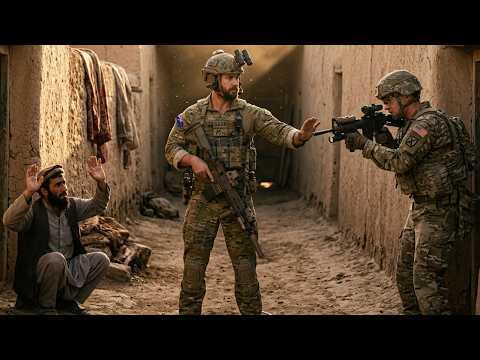
All Pruett knew was that the man with raised hands had also, half a second earlier, made a movement that every course he’d ever taken told him was a threat. His finger was already inside the trigger guard. The safety was already off. Then a hand clamped over the muzzle of his rifle and shoved it toward the ground. And a voice with an accent that still sounded foreign after three weeks spoke the four words that ended the moment before it became something neither of them could take back.
Nineteen minutes later, that same corporal was the one pulling Rahim’s twelve-year-old son from a collapsed grain storage building two residential compounds away. He worked with his bare hands until his knuckles cracked, because the boy had been trapped for six hours and no one else had thought to check.
By the end of that day, Pruett realized he had misunderstood almost everything about the man standing beside him. The four words that had felt like the greatest insult of his professional life were, in fact, the only thing that stood between him and a mistake he would have carried for the rest of his life.
Pruett had come to Oruzgan Province with a resume that made him, theoretically, one of the most qualified American officers in the joint task force. Twelve years in the infantry, two combat tours in Iraq, a Ranger tab, and a reputation among his peers for a methodical nature that bordered on stubbornness. He believed in the rules of engagement the way other men believed in scripture—not because he was rigid by nature, but because he had seen, early in his career, what happened to units that treated those rules as optional.
He had watched a platoon leader in Ramadi make a split-second decision that turned out to be wrong, and he had watched that man carry the weight of it until it broke something inside him that never fully healed. Pruett’s response to that memory was discipline. Follow the procedures. Trust the training. Don’t let instinct override the framework that had been built specifically because instinct under pressure is unreliable.
That philosophy had kept him and every soldier under his command alive for over a decade. And he had no reason, walking into Forward Operating Base Ripley in the spring of 2011, to believe that Oruzgan Province would be different.
The Australians attached to his group for joint patrols didn’t fit any category his experience had prepared him for. They were, on the surface, undisciplined in ways that offended his officer’s instincts. Rank meant almost nothing in ordinary conversation. A soldier openly disagreed with an officer’s assessment during a briefing, and no one in the room treated it as insubordination. Equipment varied from individual to individual based on what each fighter had personally decided he needed for a given mission, rather than a standard kit approved by a supply officer.
And yet, the numbers told a story Pruett couldn’t reconcile with his first impressions. In the six months before his arrival, Australian forces operating from FOB Ripley had conducted forty-one direct action missions with a positive identification success rate exceeding 80 percent and zero civilian casualties. American units conducting similar missions from the same base—with more aircraft, more signals intelligence, and budgets that dwarfed anything the Australians had—had eleven civilian casualties.
Pruett requested the incident reports personally. He read all eleven. In every case, the American units involved had followed procedures exactly as written. And in every case, the result was still a dead civilian. The math didn’t make sense, and Pruett—a man who trusted math more than he trusted people—found himself unable to look away from the contradiction.
He eventually learned the corporal’s name was Callum Reid. Though for the first two weeks of the deployment, Pruett knew him only by his call sign: “Whisper.” A name the other Australians used with a mixture of affection and something closer to reverence.
Reid was on his fourth deployment to Oruzgan. He spoke enough Pashto to hold a real conversation—not the transactional phrases most coalition soldiers learned for checkpoints and searches, but enough to discuss a man’s family, his crops, his grievances against the government in Kabul. He carried a small notebook in a waterproof case inside his kit, filled with names, family relationships, and compound layouts for three villages that Pruett’s intelligence cell had never mapped at that level of detail.
When Pruett asked him early on why an operator would keep that kind of information personally rather than pushing it through the usual intelligence channels, Reid’s answer was so simple it was almost dismissive. He said that by the time information passed through the usual channels, it was usually too old to be useful. And that the only intelligence he trusted completely was the kind he had gathered with his own eyes and through a conversation he remembered.
The tension between the two men and their two ways of war reached its peak three days before the incident that would define Pruett’s entire deployment. A joint patrol was tasked with clearing a cluster of compounds near the village of Chenarto, based on signals intelligence indicating the presence of a mid-level Taliban coordinator responsible for orchestrating roadside bomb attacks along the main supply route.
The mission brief, drafted by Pruett’s own intelligence section, called for a standard cordon-and-search operation with standard engagement rules for a suspected high-value target. Reid, reviewing the same brief during the planning session, asked one question that Pruett would remember for years afterward. He asked who had confirmed the coordinator was actually inside the compound at the time of the planned operation, rather than merely being associated with it through phone metadata.
When the intelligence officer admitted the confirmation was three days old, Reid recommended delaying the operation for twenty-four hours to allow his team to conduct a low-visibility reconnaissance of the compound first. Pruett refused. The mission window, set by higher command and tied to the operational tempo across the province, did not permit a twenty-four-hour delay.
Reid didn’t argue further. He simply nodded, made a note in his own notebook, and began preparing his team for an operation he had already told Pruett, quite plainly, he did not fully trust.
The compound in Chenarto turned out to be exactly what Reid had expected. A family home with no connection to the coordinator, except for the fact that one of the sons had once repaired a motorcycle belonging to a man later identified as a Taliban courier. The operation went clean. No shots fired, no injuries. But Pruett noticed a change in Reid’s behavior over the following days that he didn’t fully understand until much later.
Reid had been right, and being right had cost him nothing tangible. No reprimand, no consequences, because the operation had ended cleanly. But Pruett began to notice that Reid approached each subsequent mission brief with a kind of quiet skepticism that Pruett initially read as arrogance. It wasn’t arrogance. It was the accumulated weight of a man who had watched, across four deployments, how the gap between confirmed intelligence and ground truth often produced outcomes that could not be undone once the trigger was pulled.
Reid wasn’t questioning Pruett’s competence. He was questioning the entire trust structure on which American operations were built—a structure that assumed information gathered days earlier by people who had never set foot in the village in question could substitute for a conversation held that same morning with a man who lived there.
The mission that would lead to the moment described at the beginning of this story began as a direct follow-on to the Chenarto reconnaissance. A joint patrol to the neighboring village of Dai Rawal to conduct what the operations order called a “local leader engagement”—a euphemism for a search operation aimed at locating a weapons cache that local informants had described in vague terms three separate times over the previous month.
Pruett led the American element, six soldiers from his platoon supported by a squad of Afghan National Army troops. Reid led four Australian special forces operators tasked with providing overwatch and, if the cache was found, technical exploitation of any documents or electronic devices recovered.
The patrol left FOB Ripley at four-thirty in the morning. They moved on foot for nearly two hours across terrain that ranged from open wheat fields to the narrow, walled alleys that formed the residential core of the village. They reached the target compound as the sun was beginning to crest the ridgeline to the east.
The compound belonging to Rahim’s family, the farmer at the center of this story, was not the primary target. It sat adjacent to the actual objective, a larger walled property belonging to a man named Hajji Sardar, whose name had appeared in three separate intelligence reports as a possible facilitator for weapons. The search of Sardar’s compound went without major incident, though it yielded nothing of intelligence value beyond a collection of hunting rifles that every family in the area owned for the same reasons rural families in America owned them.
It was during the search of the adjacent property—conducted as a precaution because the two compounds shared a single wall with an internal gate connecting them—that the confrontation occurred.
Rahim was inside his own compound when the American search team entered, along with his wife, his elderly mother, and his twelve-year-old son. He raised his hands immediately, as every man in the region had learned to do by that stage of the war. An automatic, universally understood gesture that had become a kind of implicit treaty between occupying forces and the civilians who lived under their patrols.
What happened next took approximately four seconds, and would be described slightly differently by every man present in the after-action interviews that followed.
Rahim, according to the most agreed-upon account, lowered one hand briefly—not to reach for a weapon, but to brace himself against a low mud wall as he knelt down at the instruction of the American soldier. A physical necessity for a man whose knee had been badly injured years earlier in a farming accident, and who could not kneel with both hands raised simultaneously without support.
To the young soldier closest to him—a soldier on his first deployment who had spent the previous six months absorbing training scenarios in which precisely this kind of unexpected hand movement preceded an attack—the motion registered as a reach for something. He raised his weapon.
Pruett, standing four meters away, responding to the sudden shift in the young soldier’s posture rather than to anything he had himself observed about Rahim, raised his rifle and began moving his finger toward the trigger. His mind was already running through the justifications he would need to present later, and he was certain, in the adrenaline-charged and accelerated logic of that moment, that he was watching a threat materialize exactly as his training had told him it would.
In that instant, Corporal Reid—standing near the internal gate connecting the two compounds, with a clear view of Rahim’s face rather than only his hands—covered the four meters between them in under two seconds, placed his hand directly on the barrel of Pruett’s weapon, pushed it toward the ground, and spoke the four words Pruett would still be repeating to himself years later: “Put that gun down.”
There was no time in that moment for explanation. Reid didn’t argue about tactics or cite regulations. He simply removed the immediate physical possibility of a bullet being fired.
In the half-second of confusion that followed, Rahim’s twelve-year-old son—who had been standing beside his father throughout the confrontation—began speaking rapidly in Pashto, his voice rising toward panic, repeating a single word that neither Pruett nor the young soldier understood, but which Reid recognized immediately. The boy was saying that his father’s leg did not work properly. He was saying that his father needed to hold the wall or he would fall.
The four seconds that followed the lowering of the weapon stretched in Pruett’s memory into something that felt much longer. Rahim remained kneeling, both hands raised again, his face carrying an expression Pruett later described not as fear exactly, but as a kind of exhausted resignation. The look of a man who had lived through too many years of war to fully register how close he had just come to dying over a misunderstanding about his knee.
The young soldier lowered his weapon slowly, his hands visibly shaking. The adrenaline that had flooded his system in preparation for a threat that never materialized had nowhere to go. Reid knelt beside Rahim, spoke to him in Pashto in a low, calm voice, and helped him sit back against the wall he had been trying to reach in the first place. All while the search of the compound continued around them as if nothing had happened, because to the other soldiers present, nothing had. A weapon had been raised and lowered. No shots had been fired.
In the calculus of a war where such incidents occurred and were resolved in silence dozens of times a week across the province, this one would have passed without significance, forgotten by lunch. If not for what happened nineteen minutes later.
The search of the two compounds continued for another quarter hour without incident, yielding nothing beyond the hunting rifles already logged at Sardar’s property. As the patrol prepared to depart, a woman from a third, more distant compound arrived at a run, begging for help. A grain storage building had partially collapsed that morning, she explained, and a boy was trapped inside—Rahim’s ten-year-old nephew.
Reid reached the site first. Without waiting for a structural assessment or a formal decision on whether the mission’s rules of engagement covered this kind of civilian assistance, he began pulling away the collapsed timber and packed earth with his bare hands. He worked alone for two full minutes before Pruett and two others joined him.
They found the boy alive. Reid carried him out himself, refusing to hand him to anyone else until they were clear of the debris. Pruett noticed his hands—both of them—only when the boy was in his mother’s arms. His knuckles were split in several places, blood mixing with the pale dust of the collapsed store.
That evening at FOB Ripley, Reid sat on an ammunition crate outside the operations tent, cleaning and bandaging his hands with the same matter-of-fact practicality he had shown all day. Pruett finally asked the question that had been circling him since the moment his barrel was pushed toward the dirt. How had Reid known, in the half-second before the young soldier raised his weapon, that Rahim was reaching for the wall and not for a gun?
Reid’s answer was not what Pruett expected. He said he hadn’t known—not with certainty. He had simply been watching the man’s face rather than his hands. Because a man about to attack you, in his experience across four deployments, rarely looked calm in the second before he moved. And Rahim’s face had shown nothing but the strained concentration of a man in physical pain trying to complete a task his body could no longer manage easily.
The difference between his reading of the situation and the young soldier’s, Reid said, wasn’t intuition or courage. It was simply where each of them had chosen to direct their attention in the half-second available.
That conversation marked the beginning of what Pruett would later describe in his personal journals as a slow dismantling of every assumption he had carried into Oruzgan Province about what competence in combat actually meant. He had believed, throughout his career, that discipline meant adherence to procedure. That procedures existed to remove the unreliable variable of individual judgment from moments too dangerous to be left to instinct.
What he watched Reid do—in the four seconds beside the compound wall, and in the two minutes of digging before anyone else reached the collapsed grain store—was neither procedure nor pure instinct. It was a kind of trained judgment that operated faster than conscious thought, yet was still the product of years of deliberate practice.
Over the following weeks, Pruett began paying closer attention to how the Australian forces around him actually operated. Their selection process, as Reid described it in fragments across several conversations, was designed not to produce men who followed orders under pressure, but to identify and develop men who could be trusted to make the right decision when there were no orders, when communications failed, and when the situation on the ground diverged so completely from the plan that adherence to the plan became the greatest risk.
Their training—particularly the long, brutal selection courses conducted in the harsh terrain of Western Australia—deliberately stripped candidates of every external support structure a soldier might rely on, forcing them to depend entirely on their own judgment under conditions of extreme fatigue and uncertainty. The theory being that judgment developed under those conditions would remain reliable when the stakes shifted from a training exercise to a compound wall in Dai Rawal with a farmer’s hand raised in the balance.
The cost of that approach, Pruett began to understand, was measured not only in the physical toll of the selection process itself, but in something harder to quantify. A kind of accumulated psychological weight that the fighters around him carried with a steadiness he had initially read as mere hardness, but eventually recognized as closer to suppressed grief.
Reid had seen two men he trained with since selection killed during his four deployments. He had, on quiet evenings near the end of his tour, made the deliberate decision not to fire in situations where a slower or more procedurally rigid reaction could have cost an Australian life. Calculations he had gotten right every time. But decisions that required him to hold constant awareness of how close each of those calculations had come to failing.
He didn’t speak of it with any visible bitterness. He spoke of it the way a surgeon might speak of a difficult case—with a weary clarity and a directness that belonged to a man who had made peace with the fact that his work required him to carry burdens most people would never be asked to bear, and had decided at some point during his four deployments that carrying them correctly mattered more than appearing to carry them easily.
The final weeks of Pruett’s deployment brought a second incident, in some ways more revealing. A joint operation against a compound believed to house a bomb-making cell responsible for at least three roadside attacks on the highway linking Tarin Kowt to Kandahar. The intelligence picture this time was far stronger—multiple confirmed sources, recent signals intercepts, a pattern of vehicle movement consistent with the transfer of explosive materials.
Pruett, having learned from Chenarto, requested that Reid’s team conduct a low-visibility reconnaissance before the main assault. The request was approved this time, partly because the operational tempo allowed it, and partly because Pruett had, by this stage of the deployment, arrived at a trust in Reid’s judgment he would not have believed possible three months earlier.
Reid’s reconnaissance, conducted over eighteen hours of static observation from a position roughly four hundred meters from the target compound, confirmed the suspected cell—but also identified something the American intelligence picture had entirely missed. The presence of at least two women and three children living inside the same compound, family members of the suspected bomb-makers, who had not been factored into the operational planning at any level.
That discovery forced a complete redesign of the assault plan in far less time than anyone would have preferred. What had been intended as a dynamic breach supported by suppressing fire became a slower, more deliberate approach designed to separate the family members from the suspects before any direct confrontation occurred. A plan that required the assault team to accept significantly higher personal risk in exchange for a dramatically reduced chance of civilian casualties.
Pruett, when he briefed his command on the revised plan, met resistance from officers who considered the additional risk to American and Australian personnel unjustified given the operational tempo requirements driving the broader campaign. It was Reid, attending the briefing at Pruett’s request, who provided the argument that ultimately settled the matter—not by appealing to regulations or moral arguments, but through a simple, direct observation that Pruett would remember as clearly as the four words spoken beside the compound wall weeks earlier.
Reid said that every civilian casualty in that valley over the past two years had produced, within a measurable and frustratingly consistent timeframe, a documented increase in local support for the network they were trying to dismantle. And that the fastest way to ensure a bomb-making cell lived to build another device was to kill or injure the family members living inside the same walls. A result that would turn a tactical victory into a strategic defeat within a news cycle measured in days rather than weeks.
The operation went according to the revised plan. It took four hours longer than the original assault would have required. It involved a static overwatch position that placed two Australian operators within visual range of the target for the entire duration without in-extremis air support. And it ultimately resulted in the successful separation of the family from the suspects, the capture of three men later confirmed through forensic analysis to have been directly responsible for building at least two of the IEDs that had killed American soldiers earlier that year, and zero civilian casualties.
Pruett’s own after-action report, submitted through official channels, described the revised planning process in precise procedural language that captured almost nothing of what he had actually witnessed. The four hours of exhausted uncertainty, the moment when Reid’s team reported movement near the rear wall of the compound that nearly triggered an early engagement, the silence in the operations tent while everyone waited to learn whether the additional risk they had accepted would be justified by the outcome or would instead produce the kind of catastrophic failure that ends careers—and, more importantly, ends lives.
By the time Pruett left Oruzgan Province at the end of his deployment, he had arrived at a conclusion that would shape the rest of his military career in ways he could not have anticipated when he arrived. The four words Reid had spoken beside the compound wall—the words that had felt, in the moment he heard them, like a profound insult to his competence and his authority—had actually been an act of a kind of courage the American military doctrine rarely trained for and rarely rewarded. The courage to act on a correct judgment that directly contradicted a superior officer’s direction within half a second, with no time for explanation and no guarantee that the judgment would be believed or forgiven if it turned out to be wrong.
Pruett realized, by the end of his tour, that Reid had not been questioning his authority in that moment. He had been exercising a form of authority that existed entirely apart from military rank. An authority earned through years of accumulated judgments under conditions that tested that judgment relentlessly, and refined it through a combination of training, temperament, and simple survival into something Pruett’s own institution had never learned to trust in itself.
When Pruett returned to the United States, he eventually requested and received an assignment as an instructor at the officer training school responsible for preparing junior officers for exactly the kind of split-second decisions he had watched Reid make with such apparent ease. And he built, over the following years, a section of his curriculum around case studies drawn directly from his deployment—though he was careful in every version of the material he taught to remove any identifying details that might expose Reid or the other Australian operators he had served alongside to unwanted attention. A courtesy he felt he owed to men who had never sought recognition for what they did, and who he suspected would have been genuinely uncomfortable to learn that their actions had become teaching material for a generation of American officers.
He never learned what became of Reid after that mission. Whether he completed additional tours or was eventually rotated out of field service. Whether the accumulated weight of those years in Oruzgan Province became too heavy to carry, or whether he found, as some operators do, a way to set it down without losing the parts of himself that had made him effective in the first place.
Pruett thought about him often—especially in the moments when a young officer under his instruction pushed back against a lesson plan built around trusting individual judgment rather than rigid procedure. Moments that reminded him, every time, of his own resistance to that very idea in the weeks before a farmer named Rahim knelt beside a mud wall with one hand lowered to brace an injured knee, and a corporal he barely knew reached across four meters of dust and consequence to push the barrel of a rifle toward the ground before either of them had to live with what would have happened if he hadn’t.
Years later, long after his retirement from active training, Pruett received a letter forwarded through a veterans’ correspondence network—unsigned, postmarked from a town in Western Australia he had never heard of. The letter did not identify its author, and Pruett never sought to confirm what he already suspected about who had written it. It described, in plain and direct language, a version of that same afternoon in Dai Rawal told from the other side of the confrontation. The perspective of a man who had spent four seconds deciding whether an American officer’s split-second judgment would cost an innocent farmer his life—and who had made that decision not out of contempt for the man holding the weapon, but out of a clear-eyed understanding of how narrow the margin between them truly was.
The letter asked for nothing. It offered no absolution or reassurance. It simply confirmed, in a few direct sentences, something Pruett had already begun to believe but had never heard stated so plainly: that the moment beside the compound wall had unsettled Reid almost as much as it had unsettled Pruett himself. That the four words had not come from confidence, but from a narrow window of clarity that sometimes opens in the heart of chaos. And that both of them had spent the intervening years carrying a version of the same burden—one from the perspective of the man who had almost pulled the trigger, the other from the perspective of the man who had to decide, in less time than it takes to draw a deep breath, whether stopping him was worth the risk of being wrong.
Pruett kept the letter in the same drawer where he kept the folded, water-stained page from his service journal describing the collapse of the grain store. And on the rare occasions when a former student asked him directly what had truly changed his mind about the relationship between rank and judgment, he would take out both documents and read them again before answering. Not because he needed reminding of what had happened, but because some lessons he had come to believe in deserved to be learned deliberately, on purpose, again and again—rather than trusted to memory alone to preserve them with the weight they deserved.
The war in Oruzgan Province continued for years after Pruett’s deployment ended. Through rotation cycles and changing command climates and the slow accumulation of the same kind of statistics that had first drawn his attention to the Australians sharing his forward operating base. Pruett never returned to that valley. He never learned with certainty what became of the boy pulled from the collapsed grain store, or the farmer who knelt before a mud wall on the worst afternoon of his life.
What he carried with him instead—into every classroom and every briefing room he stood in for the rest of his career—was the understanding that the four words spoken beside that wall had not been an act of defiance at all. They had been, in the truest sense available to either man in that moment, an act of trust that spanned a gap of rank, nationality, and training that should have made such trust impossible. And that was honored, in the years that followed, by two men who never needed to speak of it again to know exactly what it had cost them—and what it had saved.
But here is the question that lingers: if you had been standing four meters away with your finger inside the trigger guard, would you have had the humility to let another man’s judgment override your own—or would you have needed to learn that lesson the way Pruett did, by nearly living with a mistake that could never be undone?
Report this article
Select a reason for reporting:






