For twelve long years, from 1933 to 1945, Adolf Hitler was Lord and Master of Germany. The outcome was a world war, a genocide, and 50 million dead. As the war came to an end, the Nazis were rendered harmless. Not all of them, though. Thus began the tracking down of Nazis—a pursuit that would span decades and continents.
Among the hunted were notorious figures like Liska from the Paris Gestapo and Barbie from the Lyon Gestapo. They were pursued by exceptional individuals: Simon Wiesenthal, an Austrian survivor of the camps; Beate Klarsfeld, a young German woman who refused to accept oblivion; and her French husband, Serge Klarsfeld, another Jewish survivor. All of them acted alone with unyielding, obstinate courage in a forgetful world, despite constant threats and murder attempts. For 60 years, they have tracked down Nazi criminals in the name of justice and memory.
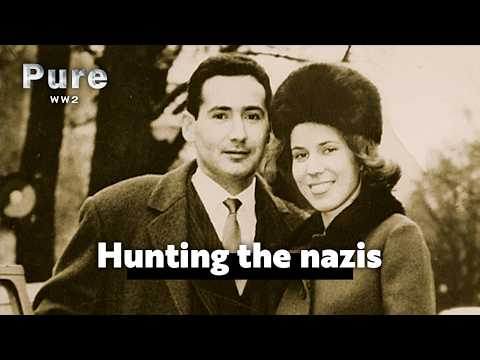
At the turn of the 60s, Germany recovered its sovereignty. It had made peace with France and set out on the path to Europe. The Cold War led to Germany’s rearmament. The ex-officers of the Third Reich formed the new army and would not be blamed for their past. Obviously very isolated, Wiesenthal had no other task to attend to other than his stamp collection. Yet an amazing piece of luck would revive his endeavor.
A collector friend showed him a rare stamp from South America on an envelope with an address that put him on Eichmann’s track. He was in Argentina. The net of former deportees now located him in Buenos Aires. But Wiesenthal would not transmit the news to the Germans—they might do nothing. The address was sent to the Mossad, Israel’s secret services. Israel wanted Eichmann alive.
The Mossad set up an operation. The head of the Mossad himself, Isser Harel, led a commando that would abduct Eichmann on May 11th, 1960. The secret agents carted him off and served him a kosher meal to comfort him.
That same day, May 11th, 1960, was also a great day for Beate, who was in Paris as an au pair girl. That day, she met Serge Klarsfeld, a student at the political sciences school. He was Jewish. His father had let himself be deported to save his family. He died at Auschwitz.
The Eichmann trial would contribute to Beate’s awareness. It would be the first great televised trial, a Jewish Nuremberg. But the simile goes further. Eichmann’s defense attorney was Mr. Robert Servatius, one of the lawyers at Nuremberg. The SS Adolf Eichmann in the hands of his worst enemies. Eichmann in his glass box of the special court in Jerusalem.
The Eichmann trial would last six months and arouse the entire world’s acute interest—and that was its actual aim: to awaken international awareness against the Jewish people, crimes against humanity, and war crimes. Eichmann sputtered an answer. He attacked the president of the Zionist World Organization back in ’39. Dr. Eichmann was out of his depth. The audience was disappointed. He was not the monster reckoned on, nor the arrogant SS boasting of having had more and more Jews killed. In fact, it was his line of defense. He claimed he was merely a small cog in an infernal machinery. “Oh no,” said the prosecutor. He personally made much worse the most criminal measures.
Eichmann would be sentenced to death on June 1st, 1962. Israel would furnish neither films nor photos of an execution which closed a trial that was a very important step in the hunting down of Nazi criminals. Since Eichmann, no prominent Nazi in South America sleeps longer than four weeks in the same bed.
This would also concern Mengele, now permanently on the run. Mengele, the Auschwitz physician who practiced selection on the deportees arriving at the camp. He chose those who would die at once and those who would live for a time. In May 1960, the Mossad almost succeeded in getting him on the same plane as Eichmann, but Mengele managed to escape to Paraguay, then to Brazil. He was now the most wanted man in the world.
He survived because his family was wealthy and powerful and because local South American governments had reasons to protect him. Wiesenthal persisted in his tracking down of Nazis, particularly those from his native Austria. One of them was the police officer who in 1944 arrested Anne Frank in Amsterdam. Carl Silberbauer was sentenced to a mere 15 months in jail for having belonged to the Gestapo.
During a wedding party, Anne Frank is here watching normal people who have the chance at the time of not being Jewish. This is the only existing film where she appears. She would then hide in her attic where she would write for two years a masterpiece published after the war, The Diary of Anne Frank. Denounced, she was arrested with her family and deported. Anne Frank died at Bergen-Belsen in March 1945 when she was 16 because she was Jewish. She has become the symbolic figure of persecution. Every year Amsterdam freezes to attention in remembrance of her.
Beate married Serge, who was now a lawyer. She wrote an au pair guide and worked for the Franco-German Youth Office. But she also kept scouring Germany’s recent past with Serge. Ludwigsburg’s research center in South Germany would represent the first official effort to safeguard what has been saved from destruction during the final weeks of war. Thus, trials such as the trial of Auschwitz guards, having previously avoided punishment, could be resumed. They would be heavily sentenced. This would be one of the greatest post-war trials in Germany. It would open the eyes of a generation who now feels guilty, as this prosecutor or this lady onlooker do.
“Have you formed any conclusions in your mind as to how it happened?” a journalist asked the prosecutor, a man whose face carried the weight of every file he had ever opened. “Well, this leads to, in a way, philosophical ideas,” he replied slowly. “But I think there is a certain inhumanity in the German—within the German people—and this might be the reason for what had happened.”
Beside him, a lady onlooker nodded, her eyes fixed on the defendants. “Somehow I feel we all are responsible—every one of us—because it has happened in Germany and we all are Germans, and we somehow have to carry what had happened in history.”
That burden of history was not abstract for Beate and Serge. It was a daily companion, a shadow that followed them through the corridors of the Franco-German Youth Office and into the quiet evenings of their Paris apartment. They read every document, every trial transcript, every name that surfaced from the murk of the past.
And one name kept surfacing more than any other. Klaus Barbie. The Butcher of Lyon. The man who had personally tortured Jean Moulin, the hero of the French Resistance, and sent thousands to their deaths. After the war, Barbie had vanished—smuggled out of Europe along a ratline that led through Italy and into South America. He had been living openly in Bolivia for years, under the name Klaus Altmann, a businessman with friends in high places.
Serge had first heard the name in whispers from fellow survivors. Beate had seen it in declassified files, half-redacted, buried in the archives of the French intelligence services. They had known where he was. They had protected him. And no one had been held accountable.
In 1971, a new lead emerged. A former resistance fighter living in La Paz wrote to Serge with a photograph—a grainy image of a man at a reception, raising a glass, smiling. The face was older, heavier, but the eyes were unmistakable. It was Klaus Barbie.
Beate and Serge knew what they had to do. They could not rely on governments. They could not rely on the courts of Bolivia, a country that had granted Altmann citizenship and refused all extradition requests. They would have to force the world to look. They would have to make so much noise that the silence could no longer protect him.
Beate began writing letters—to newspapers, to politicians, to anyone who would listen. She contacted survivors in Lyon, gathering testimonies that had been buried for decades. Serge compiled a dossier, meticulously documented, cross-referenced, undeniable. They were building a case not in a courtroom, but in the court of public opinion.
Their first major breakthrough came in 1972, when a French magazine published their findings. The article caused an uproar. The French government, embarrassed and cornered, was forced to acknowledge that Barbie had indeed been in Bolivia. But still, they did nothing. The Cold War had its own priorities, and hunting an old Nazi was not one of them.
Beate would not be deterred. She traveled to Bolivia herself in 1972, armed with photographs and a fierce determination. She walked the streets of La Paz, asking questions, showing the picture. The locals were wary. Some knew exactly who she was looking for. Others genuinely did not. But she persisted.
One afternoon, she found herself outside a modest office building. The sign on the door read “Altmann & Co.” She pushed it open. A secretary looked up, startled. “I am here to see Señor Altmann,” Beate said, her voice steady. “Tell him it is about the past. He will know what I mean.”
The secretary disappeared into a back room. Minutes passed. Then the door opened again, and a man stepped out—older, grayer, but with the same cold, calculating eyes. He looked at Beate and smiled a thin, humorless smile. “I have nothing to say to you,” he said in German. “You are wasting your time.”
But Beate had not come to hear him speak. She had come to make him visible. She had brought a photographer, and before Barbie could retreat, the flash went off. The photograph of Klaus Barbie—the Butcher of Lyon—standing in his Bolivian office would appear on the front pages of newspapers around the world.
The photograph changed everything. The world could no longer pretend that Klaus Altmann was simply a prosperous businessman with a taste for fine suits and high society. He was Klaus Barbie, the Gestapo chief who had personally ordered the deportation of forty-four Jewish children from the Izieu orphanage—children whose only crime was being born. The image burned itself into the public conscience.
But Bolivia still refused to extradite. Barbie had friends in the military government, and money, and the quiet protection of men who had their own reasons to keep the past buried. Beate and Serge understood that the fight had only begun. They returned to France and began a campaign that would last more than a decade.
Serge tracked down survivors and witnesses, recording their testimonies before they passed away. Beate organized protests, wrote articles, and confronted politicians in public forums. They were called obsessed, hysterical, even dangerous. But they refused to be silenced.
In 1983, a new government came to power in Bolivia and finally allowed Barbie to be extradited to France. He arrived in Lyon in February 1983, not as Klaus Altmann, but as Klaus Barbie—charged with crimes against humanity. The trial opened in 1987. Beate and Serge sat in the courtroom every day, watching as survivors testified, their voices trembling but defiant.
On July 4th, 1987, the verdict came: guilty. Life imprisonment. For the first time in French history, a Nazi was convicted of crimes against humanity. Barbie died in prison four years later, unrepentant to the end.
But the Klarsfelds did not stop. There were more names, more files, more trials. They had learned that justice is not a moment but a movement—relentless, exhausting, and necessary.
And so we return to the question that has haunted every generation since the war: when the world forgets, who will remember?
Report this article
Select a reason for reporting:






