The moment we stepped onto the Air Koryo plane, we knew there was no turning back. We had signed the forms, accepted the absurd restrictions—no Bibles, no political slogans, no books about North Korea, and above all, no journalists. We had erased our online presence, become invisible, and now we were flying into one of the most restricted countries on the planet. The flight attendants smiled mechanically, and the screens looped propaganda videos praising the Great Leader’s latest missile tests. This was not a vacation; this was a plunge into the unknown.
After an hour and a half, Pyongyang appeared below us, a city of stark contrasts. Modern skyscrapers rose alongside Soviet-era blocks, a testament to Kim Jong-un’s ambitious construction projects. But the air was thick with tension. As soon as we landed, our cameras drew suspicious glances. We were part of a group of twenty tourists, all nationalities except South Korean—the regime’s sworn enemies. For the next ten days, we would be guided, monitored, and never left alone.
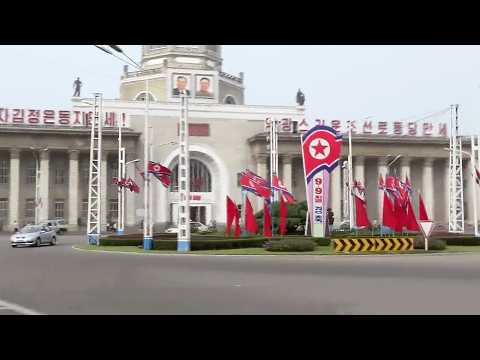
Our guides were ever-present, their smiles never reaching their eyes. Mr. Kang, the head guide, laid down the rules: no photos of military installations, no disrespect to the leaders’ images, and absolutely no wandering off. “If you tear or burn a picture of our leaders, that’s an insult to the Korean people,” he warned. We nodded, but the weight of his words hung in the air. This was a country where a single misstep could lead to arrest—or worse.
Our hotel, the only one that welcomes foreigners, held its own dark history. It was here that American student Otto Warmbier was arrested in 2016 for allegedly stealing a propaganda poster. Two months later, he appeared in court, terrorized, begging for forgiveness. He was sent home in a coma and died shortly after. His crime? Disobeying the guides. The message was clear: we were not immune.
The next morning, we were taken to the Mansudae Grand Monument, where giant statues of Kim Il-sung and Kim Jong-il towered over the plaza. We were forced to buy flowers and bow before them—an obligatory ritual for tourists. Our guides watched closely, ensuring we didn’t take photos until after the bow. The air was thick with reverence and fear. Every day, thousands of North Koreans come here to pay tribute, their faces a mask of devotion.
But behind the choreographed smiles, there was another reality. We were forbidden from talking to ordinary North Koreans, but we could hear the propaganda blasted from loudspeakers in the streets. “We succeeded in launching the H-bomb,” a voice declared, followed by threats against the United States. It was a constant drumbeat of war, preparing the population for a conflict they were told was inevitable.
At a primary school, we watched children perform flawless dance routines and sing English songs. Their smiles were perfect, their movements precise. But the walls were adorned with posters of missiles, and in the science classroom, models of satellites looked suspiciously like ballistic missiles. “The children learn to hate the American army from a young age,” our guide explained. It was indoctrination, pure and simple.
The Museum of American War Atrocities was even more chilling. Graphic images of torture and murder were displayed, accompanied by dramatic music and the sound of children crying. “The US army raped and killed our people,” our guide said, her voice trembling with practiced emotion. When we asked if the claims were verified, she bristled. “I hate them,” she spat. “Still today, the US army is our biggest enemy.”
As we left the museum, the rain began to fall. “The sky is crying,” our guide said softly. We drove to the DMZ, the heavily fortified border between North and South. “If the US provokes us again, we will smash them,” our guide declared. “We have nuclear weapons, H-bombs. We are not scared.”
But were they really ready for war? Or was this all part of the elaborate performance? We had seen only what the regime wanted us to see. The real North Korea remained hidden, a mystery we were determined to unravel.
Back in Seoul, we met with Andrei Lankov, the Russian historian who has spent decades studying the Kim dynasty. He dismissed the idea of Kim Jong-un as an irrational madman. “He is very smart, realistic, extremely pragmatic,” Lankov told us. “Probably the greatest Machiavellian currently in operation.” According to him, the nuclear program wasn’t a bluff—it was a survival strategy. Kim had watched what happened to Libya’s Gaddafi and Iraq’s Saddam, and he understood that only nuclear weapons could guarantee his regime’s survival.
But survival wasn’t the only thing on Kim’s mind. We traveled to Malaysia, to the very airport where his half-brother, Kim Jong-nam, was assassinated in February 2017. The journalist Timothy Achariam walked us through the surveillance footage. Two women approached Nam from behind, one smearing VX nerve agent across his face. He died within twenty minutes. The women claimed they thought they were participating in a prank video. Four North Korean suspects were seen leaving the terminal immediately after the attack and were never caught.
We met with Axel Hwang, a friend of the victim, at a café in Kuala Lumpur. He explained that Nam had once been protected by bodyguards, but after Kim Jong-un executed his own uncle, Jang Song-thaek, the money pipeline dried up. “No more money meant no more bodyguards,” Hwang said. “Kim Jong-nam became an easy target.” The message was unmistakable: Kim Jong-un would eliminate anyone with a claim to the Kim legacy, even his own blood.
On our final day in North Korea, we were taken to the subway in Pyongyang. We were allowed to film only if we didn’t speak to anyone. The carriages were filled with passengers wearing pins bearing the faces of the leaders. Portraits of Kim Il-sung and Kim Jong-il stared down from every wall. The doors closed, and for a few brief moments, we were surrounded by ordinary North Koreans—yet completely isolated from them.
That evening, we witnessed the grand finale: a mass dance in the central square. Thousands of citizens moved in perfect synchronization, their smiles fixed, their movements mechanical. “It was Kim Jong-un himself who developed tourism,” our guide explained proudly. “He wants two million foreigners to visit each year.” The music blared, the colors blurred, and for a moment it was almost beautiful—until the music stopped and the square emptied in seconds. The citizens were probably just actors.
As we boarded our flight home, I thought about everything we had seen. The missiles, the statues, the children singing about their hatred for America. Kim Jong-un had shown us exactly what he wanted us to see. But the real North Korea—the one where people starved, where dissenters vanished, where a single wrong word could destroy a family—remained hidden behind the curtain of propaganda.
We had come looking for answers. Instead, we left with only more questions—and the unsettling feeling that somewhere beneath the choreographed smiles, a country was waiting, watching, and preparing for a war it might one day decide to start.
But the story of Kim Jong-un’s Korea doesn’t end at the border. It continues in the shadows, in the lives of those who managed to escape and those who didn’t. We traveled to Seoul to meet Choi Su-young, a 26-year-old defector who had secretly fled Pyongyang in 2014, two years after Kim Jong-un took power. She had appeared on several South Korean television shows, mocking the regime and its young dictator.
“I believed in him at first,” she told us, her voice barely above a whisper. “He seemed different. He had been educated in Europe. He liked Western culture. I thought maybe things would change.” She paused, staring at the coffee cup in her hands. “They didn’t.”
Su-young described a life of constant surveillance, where neighbors were encouraged to inform on each other and where the wrong word could land an entire family in a labor camp. She had escaped through China, a journey that took months and nearly cost her her life. “In North Korea, we are taught that South Korea is a puppet of the Americans, that people here are starving and miserable,” she said. “But when I arrived, I saw supermarkets full of food, people with smartphones, freedom.”
Her story was a stark reminder of what the regime was hiding. But it also raised a troubling question: if life was so unbearable, why didn’t more people flee? The answer, according to Su-young, was fear. “If you try to escape and fail, they punish not just you but your entire family,” she explained. “Three generations. Your parents, your children. Everyone.”
The next day, we met Lee Min-bok, a North Korean refugee who had escaped over twenty years ago. He now lives in hiding, with a price on his head. His crime? He sends balloons filled with anti-regime leaflets and Bible pages across the border into North Korea.
We followed him to a remote location, two hours from Seoul, where the North Korean border was within reach. His wife helped prepare the delivery: plastic bags filled with leaflets, each attached to an alarm clock that would open the bag mid-air. “When the alarm goes off, the bag opens, and the wind carries them over,” Lee explained. “It’s simple, but it works.”
Two South Korean police officers accompanied us, a reminder that Lee’s work was dangerous and controversial. He inflated a dozen balloons and released them into the sky. “Most of them will land in North Korea,” he said, watching them drift north. “Maybe someone will read them. Maybe it will change something.”
But did it? The regime had warned that anyone caught with these leaflets would face severe punishment. “It’s a risk,” Lee admitted. “But it’s a risk worth taking.” His work was financed by an evangelical South Korean mission, and he believed that spreading the word of God and democracy could one day crack the regime’s iron grip.
As the balloons disappeared into the distance, I couldn’t help but wonder: what would happen to the people who found them? Would they be inspired to resist, or would they be terrified and turn them in? In North Korea, even hope was dangerous.
We returned to Seoul with more questions than answers. The balloons had vanished into the northern sky, carrying Bibles and leaflets into a land where both were forbidden. “Maybe one person will read it,” Lee had said. “One person is enough.”
But the regime had an answer for everything. A few weeks after our visit, North Korea announced another missile test—this one capable of reaching the American mainland. Kim Jong-un posed for photos, smiling, a cigarette in his hand. The world condemned him. The sanctions tightened. Nothing changed.
Andrei Lankov’s words echoed in my mind: “He is a survivor. A master of survival.” Kim had eliminated his uncle, his half-brother, and anyone else who dared to challenge him. He had built missiles while his people starved. He had turned a nation into a stage, and we—the tourists, the journalists, the world—were merely the audience.
As our plane lifted off from Incheon, I looked out the window toward the north. Somewhere beyond the DMZ, the loudspeakers were still blaring. The children were still singing. The statues were still watching. And Kim Jong-un was still there, waiting.
We had come to understand the man. Instead, we had only glimpsed the machine he had built—a machine that ran on fear, propaganda, and the silence of those who could not speak. The real North Korea remained a mystery, hidden behind a curtain we were never allowed to pull back.
But what if that curtain is already fraying? What if, somewhere in the dark, a single reader is holding a forbidden leaflet—and wondering if there is more to life than this?
Report this article
Select a reason for reporting:






