The air was thick with the acrid stench of gunpowder and the desperate cries of men. On the Pacific island of Saipan, the battle had reached a fever pitch. Sergeant Thomas Alexander Baker, a young soldier from the 105th Infantry Regiment, lay wounded against a tree, his body riddled with shrapnel and bullets. Around him, the remnants of his unit were in full retreat, overrun by a ferocious Japanese counterattack of 5,000 soldiers. Baker had only eight bullets left in his .45 caliber pistol. He knew what he had to do.
“Leave me here,” he ordered his comrades. “I’ll hold them off.” They protested, but Baker was resolute. He would not let them risk their lives for his. As they reluctantly withdrew, Baker propped himself up, his finger on the trigger, ready to face the oncoming tide alone.
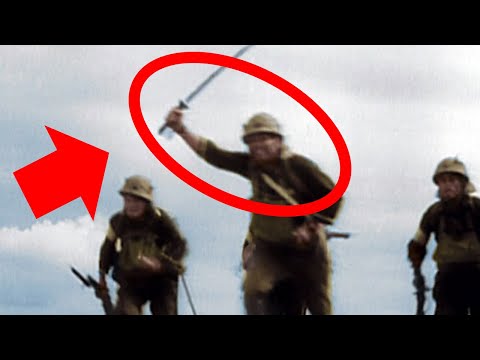
The Battle of Saipan was one of the most pivotal campaigns of World War II in the Pacific. The island, part of the Mariana Islands, was considered Japanese homeland territory, and its capture would give the United States a crucial airbase from which to launch B-29 bomber raids directly on Japan. The Japanese defenders, indoctrinated with the Bushido code of never surrender, fought with a ferocity that stunned even the most battle-hardened Marines.
For the Americans, the stakes were equally high. The island-hopping campaign had been brutal, each victory costing precious lives. Saipan was the gateway to the Japanese home islands, and both sides knew it. The Japanese had fortified the island with bunkers, pillboxes, and trenches, turning it into a fortress. The Americans threw everything they had into the assault, with over 800 ships and 127,000 troops. The fighting was savage, often hand-to-hand, in dense jungles and rugged terrain.
Baker’s journey to that fateful moment had been marked by extraordinary bravery. On June 19, 1944, he single-handedly took out a Japanese pillbox with a bazooka, then cleared enemy soldiers from a hidden position, saving his unit from ambush. His actions earned him a reputation as a soldier who would go above and beyond the call of duty. But nothing could prepare him for the final stand that would make him a legend.
As the Japanese charge began, Baker’s position was surrounded on three sides. He fought with a ferocity that matched the enemy’s, his pistol barking until it ran dry. Then, he grabbed his carbine and used it as a club, swinging with primal rage. He felled a dozen soldiers before a bullet struck him in the stomach. Even then, he refused to be evacuated, insisting that others be saved instead.
Left alone with his eight bullets, Baker waited. The enemy came, and he met them with steady hands and a steady heart. He did not flinch. He did not surrender. He fought until his last breath.
But this is just the beginning of the story. The Battle of Saipan would rage on for weeks, and the island would become a crucial stepping stone to victory. The heroism of men like Baker would inspire a nation, and the sacrifices made on that distant shore would echo through history. Yet, amid the chaos and carnage, one question remained: How did a single soldier with eight bullets change the course of the battle? The answer lies in the untold details of that desperate last stand, and the extraordinary courage that defined a generation.
To understand the answer, one must first understand the ground on which Baker fought. Saipan was not merely a dot on a map; it was a symbol. For three decades, Japan had poured its heart into the island, building schools, Shinto shrines, and sugar plantations. Japanese families had settled there, raising children who spoke Japanese as their first language. To the soldiers defending it, Saipan was not a colony—it was home.
That sense of ownership fueled their ferocity. When the Americans landed on June 15, 1944, they expected a hard fight, but what they found was something else entirely. The Japanese did not retreat. They did not surrender. They fought with a desperate, almost suicidal resolve, and the beaches became a slaughterhouse.
By the time Baker made his stand on July 7, the battle had already claimed thousands of lives. The 105th Infantry Regiment had been through hell. They had crossed Death Valley, scaled Purple Heart Ridge, and watched friends fall to sniper fire from caves that seemed to breathe bullets. Baker himself had already been wounded twice, but he refused to leave the line.
When the final banzai charge came, it was unlike anything the Americans had seen. Over 5,000 Japanese soldiers, many of them wounded, many of them armed only with bayonets and grenades, surged forward in a human wave. They screamed, they charged, and they died—but they took countless Americans with them.
Baker’s foxhole was in the path of that wave. His comrades fell back, but Baker stayed. He had eight bullets, and he made them count. Each shot found its mark. When the pistol was empty, he used it as a club. When that broke, he used his fists. The Japanese soldiers, perhaps stunned by the ferocity of a single wounded man, hesitated—and that hesitation bought precious seconds for the retreating Americans.
Those seconds mattered. They allowed the survivors of the 105th to regroup, to dig in, and to hold the line. By the time the sun rose on July 8, the banzai charge had been broken. The Japanese lost over 4,000 men in that single night. The Americans lost hundreds, but they did not lose the island.
Baker was found the next morning, barely alive, propped against the tree where he had made his stand. Around him lay the bodies of enemy soldiers—more than a dozen—and the shattered remains of his pistol. He had done the unthinkable. He had held back the tide.
But the battle was not over. As the Americans pushed north, the Japanese retreated to the cliffs of Marpi Point. There, in the final days of the battle, one of the war’s most tragic episodes unfolded. Thousands of Japanese civilians, convinced by propaganda that the Americans would torture and kill them, leapt from the cliffs to their deaths. Mothers threw their children over the edge before jumping themselves. The Americans, horrified, used loudspeakers to beg them to stop, but the fear was too deep.
It was a stark reminder of what was at stake. Saipan was not just a military objective; it was a psychological battleground. The Japanese had convinced their people that surrender meant annihilation. The Americans had to prove them wrong, even as the bodies piled up on the rocks below.
In the aftermath of the banzai charge, the 105th Infantry Regiment was a shadow of its former self. The men who survived moved like ghosts through the shattered landscape, their eyes hollow, their movements mechanical. They had held the line, but the cost was etched into every face.
Baker was evacuated to a field hospital, where surgeons fought to save his life. His wounds were severe—the bullet that had struck his stomach had torn through muscle and intestine, and infection was a constant threat. For days, he hovered between life and death, delirious with fever, reliving the charge in his nightmares.
But Baker was not done fighting. Even as he lay recovering, news of his stand spread through the ranks. Soldiers who had never met him spoke his name with reverence. He became a symbol of the grit that defined the Pacific campaign—a reminder that even in the darkest hours, one man could make a difference.
Meanwhile, the battle for Saipan entered its final, brutal phase. The Japanese had been pushed back to the northern tip of the island, where the terrain was a maze of coral cliffs and hidden caves. The fighting became a deadly game of cat and mouse, with American soldiers clearing each cave one by one, often at the cost of their own lives.
It was during this phase that the tragedy of Marpi Point unfolded. Thousands of Japanese civilians, driven by fear and propaganda, began to jump from the cliffs. The Americans watched in horror as mothers clutched their children and leapt into the void. Some soldiers tried to stop them, risking their own lives to pull people back from the edge, but the panic was too great.
The scenes were seared into the memory of every soldier who witnessed them. It was a stark illustration of the war’s dehumanizing power—a conflict that turned ordinary people into desperate souls willing to embrace death rather than surrender.
For the Japanese military, the loss of Saipan was a catastrophe. General Saito, the island’s commander, had taken his own life in a cave, and the remaining forces were shattered. Yet even in defeat, some refused to give up. Captain Sakae Oba, known as ‘the Fox,’ led a band of guerrillas into the jungle, where they would continue to fight for months, a stubborn reminder that the war was not yet over.
Back in the hospital, Baker slowly began to recover. His body was broken, but his spirit remained unyielding. He asked for news from the front, and when he learned that Saipan had been declared secure, he closed his eyes and whispered a prayer for the men who had not made it back.
He would never fully recover from his wounds, but he would live to see the end of the war. His actions on that July night would earn him the Medal of Honor, but to the men who served with him, the medal was just a symbol of something they already knew: Thomas Baker was a hero in the truest sense.
As the war moved on, Saipan became a bustling base, its airfields humming with B-29 bombers. The island that had been a Japanese homeland became an American fortress, a launching pad for the final assault on Japan. The irony was not lost on the soldiers who had fought there.
Yet the story of Saipan is not just one of battles and bombs. It is a story of human endurance, of men like Baker who faced impossible odds and refused to break. It is a story of a people who fought for their home and lost everything. And it is a story that reminds us that even in the midst of war, there are moments of grace—moments when the human spirit shines through the darkness.
The war in the Pacific would continue for another year, with more battles, more sacrifices, and more heroes. But Saipan was a turning point. It was the first time the Americans had captured a piece of Japanese homeland, and it sent a clear message: the Empire of the Rising Sun was not invincible.
As the sun set over the island, casting long shadows across the beaches where so many had fallen, the soldiers who remained knew they had been part of something historic. They had fought for each other, for their country, and for a future they might never see. And in the end, that was enough.
The war moved on, but Saipan never left the men who fought there. Baker’s Medal of Honor arrived in 1945, presented to his family after he finally succumbed to his wounds—a hero to the last.
Captain Oba’s ‘Fox’ guerrillas surrendered on December 1, 1945, months after Japan’s formal capitulation, emerging from the jungle with dignity intact.
The airfields they had died to capture became the launchpads for the B-29 raids that finally brought the war home. In the end, both sides had fought for something they believed in—and both had paid a terrible price.
What does Baker’s stand with eight bullets teach us about the true cost of duty and sacrifice?
Report this article
Select a reason for reporting:






