Their romance was fire wrapped in silk—irresistible, dangerous, and doomed from the start. When Errol Flynn married French actress Lily Damita on June 19, 1935, in Yuma, Arizona, it looked like a perfect match. He was the daring newcomer with danger in his grin; she, the elegant European star who had conquered Paris and was dazzling Hollywood. Together, they looked like a dream sculpted from champagne and light—thrilling and a little too good to last.
But behind the flashbulbs, sparks turned to flames. Both were proud and volatile, too alike to surrender. As Flynn’s fame exploded with Captain Blood (1935) and The Adventures of Robin Hood (1938), rumors of affairs and late-night escapades followed him everywhere. Lily, jealous and fiercely possessive, met gossip with fury. Words became weapons. Their Beverly Hills home, a battleground of pride and passion.
By the early 1940s, their quarrels had become a Hollywood spectacle. Gossip columns thrived on their fights, while Warner Brothers worried that Flynn’s scandals would tarnish his heroic image. Lily filed for divorce in 1942, citing cruel treatment and grievous mental anguish. What followed was a long and bitter legal battle over alimony and property, one that dragged through the courts as Flynn’s fame continued to climb. Their divorce was finalized in 1943, leaving both exhausted—richer in notoriety, poorer in peace. Lily withdrew from film to raise their son Shaun Flynn, born May 31, 1941, while Errol sailed on toward new fame, new loves, and new chaos. Their marriage became one of Hollywood’s most vivid warnings: passion can make a star blaze brighter or burn out just as fast.
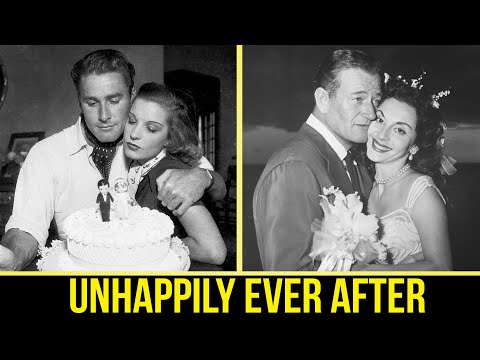
Before John Wayne became the unshakable symbol of American masculinity, he lived through one of Hollywood’s most turbulent marriages. He met Esperanza Baur, a fiery young Mexican actress, in 1941 while visiting Mexico. Their attraction was instant—passionate, volatile, and shadowed by tension. They married in Long Beach on January 17, 1946. To the public, it looked like a cross-cultural fairy tale: the rugged American hero and the glamorous Latin beauty. But to those close to them, it was clear this was no calm union. Their love felt more like a standoff than a romance.
Jealousy and alcohol soon took center stage. Esperanza was convinced Wayne was having affairs, especially with his Angel and the Badman (1947) co-star Gail Russell. Both denied it, but gossip wouldn’t relent. Wayne’s heavy drinking and prolonged absences fueled her suspicions. Her volatile temper turned minor disagreements into full-blown storms. Then came the incident that made them tabloid legends. After a studio party, Wayne returned home late and reportedly drunk. Esperanza confronted him with a pistol. She later claimed she almost shot him by mistake. Whether exactly true or exaggerated, the story splashed across front pages. From then on, they were Hollywood’s cautionary tale of pride, passion, and danger.
They separated in May 1952. Their divorce, loaded with accusations of infidelity and cruelty, was finally finalized on November 1, 1954. Both walked away scarred and silent. For Wayne, it became a harsh lesson in restraint—proof that even Hollywood’s toughest cowboy could be wounded by love.
He was America’s favorite boy. She was the woman every man noticed. When Mickey Rooney married Ava Gardner on January 10, 1942, in Ballard, California, Hollywood treated it like a fairy tale. MGM’s biggest young star, uniting with the studio’s most dazzling new discovery. Publicity photos flooded fan magazines, selling the image of a perfect Hollywood romance. Offscreen, it was anything but perfect. Mickey was still the mischievous teenager the public adored—impulsive, restless, addicted to attention. Ava, only 19, was shy and still learning how to survive under the glare of fame. He craved nightlife and excitement. She wanted something steadier, more real. Their worlds never met.
Within months, the cracks appeared. Rooney’s ego and constant affairs turned the marriage into tabloid fuel. Studio handlers staged public outings to keep up appearances while Ava played along, later admitting she felt like a decorative extra in his one-man show. By May 1943, it was over. Ava filed for divorce, officially citing mental cruelty, though privately she blamed his gambling and infidelity. The court granted the divorce on May 21, 1943, ending a union that had lasted barely 16 months. Years later, Ava summed it up with her trademark wit: “He loved everything in life except me and moderation.” It was a short marriage, but a loud one—the perfect opening act for a woman who would come to embody Hollywood’s enduring mix of beauty, humor, and heartbreak.
Even by Hollywood standards, Lana Turner’s love life was a saga—glamorous, chaotic, and impossible to ignore. In 1942, at just 21, she met Steve Crane, a handsome restaurateur and occasional actor. Their whirlwind romance filled gossip pages, the kind of passionate affair Hollywood adored. But beneath the glitter, trouble was already brewing. They married on July 17, 1942, only for Lana to discover soon after that Crane’s previous divorce had not yet been finalized. The revelation hit MGM like a bomb. To avoid scandal, the studio quickly announced that Turner was on vacation while lawyers rushed to annul the marriage. The press devoured every rumor, and MGM’s publicists worked overtime to protect their star.
When Crane’s divorce was officially completed, Lana, ever the romantic, forgave him. They remarried on March 14, 1943, in Tijuana, Mexico, determined to rebuild their reputation and their relationship. That same summer, on July 25, 1943, their daughter, Cheryl Crane, was born. But trust never truly returned. Jealousy, arguments, and relentless tabloid attention poisoned their fragile peace. By August 1944, the marriage ended for good, leaving Lana a single mother—wounded, but far from defeated. The press called it a scandal. Audiences saw it as tragedy. Yet, true to form, Turner turned heartbreak into strength. Her career soared, and she became the face of Hollywood resilience: beautiful, wounded, and unstoppable. A woman undone by love yet empowered by survival, Lana Turner never stopped playing the leading lady, even when life refused her a happy ending.
Few Hollywood marriages were as combustible or as closely watched as that of Joan Crawford and Franchot Tone. They met in the early 1930s while working together at MGM, appearing in several films, including Today We Live (1933) and Sadie McKee (1934). When they married on October 11, 1935, the press hailed it as the perfect union of sophistication and ambition. But harmony in public was a duel in private. Crawford’s relentless drive and Tone’s artistic pride soon clashed. He wanted intimacy and freedom. She thrived on control and adoration. Their home, full of glittering parties and widening silences, became a battleground, while MGM’s publicity machine maintained the royal facade.
By the late 1930s, rumors of jealousy, distance, and heavy drinking surfaced. Friends saw Tone as frustrated by his wife’s fame, while Crawford’s obsession with image left little room for peace. Biographers later described emotional cruelty on both sides—two strong wills grinding each other down. Crawford filed for divorce in 1939, and it was granted on April 11, 1939. The headlines turned private heartbreak into public spectacle. She kept the name that made her a legend and moved on. Tone returned to the stage and later admitted that he had never truly escaped her shadow. Their story endures as one of old Hollywood’s clearest lessons: when love collides with ego and ambition, even beauty and talent can’t save what’s already burning within.
When Bette Davis married artist William Grant Sherry on November 30, 1945, it was her third marriage, and she hoped it would be a quiet chapter after years of public and studio battles. But calm was never part of her story. Sherry, a proud painter with a stubborn streak, soon clashed with Davis’s formidable drive and fame. She was a force of nature—disciplined, outspoken, commanding—and he struggled to live in her shadow. Biographers later described their Beverly Hills home as tense, not peaceful. Davis’s devotion to her work left little room for compromise, while Sherry’s pride prevented him from truly playing a supporting role. Gossip columns hinted at shouting matches and jealousy, and the couple did little to deny it.
In May 1947, Davis gave birth to their daughter, Barbara Davis Sherry. For a while, motherhood seemed to calm the storm, but her relentless ambition gradually consumed the marriage. She later admitted she’d been married to her work—and Sherry, sidelined, frustrated, couldn’t compete with Hollywood’s demands. By July 3, 1950, the union had collapsed and the divorce was finalized. Just 25 days later, on July 28, 1950, Davis married her All About Eve co-star Gary Merrill, who adopted B.D. The speed of her remarriage only deepened public fascination, ensuring the story of Davis and Sherry lingered for decades. Years later, the wounds reopened when B.D. published My Mother’s Keeper (1985), portraying Davis as controlling and volatile. Whatever the truth, the marriage to Sherry mirrored Davis herself—bold, defiant, and incapable of living quietly. Another battlefield in a life that never found the peace she sought.
When Goddess met Genius, sparks were inevitable—and ultimately destructive. Rita Hayworth married Orson Welles on September 7, 1943, at the height of her fame. She, the radiant Columbia star, embodying wartime glamour. He, the audacious creator of Citizen Kane, already hailed as Hollywood’s prodigy. Their union looked like destiny—beauty and brilliance intertwined. But real life was no fairy tale. Welles, restless and consumed by ideas, chased projects across continents, while Hayworth longed for steadiness and affection. She wanted presence. He needed freedom. Between his constant travels and her studio demands, they rarely shared the same city. Even the birth of their daughter Rebecca on December 17, 1944, couldn’t anchor them. Ambition proved stronger than love.
Friends recalled Rita waiting by the phone while Orson vanished into editing rooms. He adored her, yet felt confined by domestic life. Their marriage became a paradox: two extraordinary people who could inspire each other’s art, but not each other’s peace. By 1947, the tension quietly broke. Rita filed for divorce, granted on November 10, 1947. Afterwards, she delivered one of Hollywood’s most famous lines: “Men go to bed with Gilda, but wake up with me.” Welles later spoke of her with melancholy rather than regret, reportedly saying, “If that was happiness, imagine what the rest of her life had been.” Their love burned brilliantly and briefly—one of Hollywood’s most haunting collisions of genius, desire, and the cost of being larger than life.
They looked like a dream. Young, radiant, and made for Hollywood. When Natalie Wood and Robert Wagner married on December 28, 1957, in Scottsdale, Arizona, the press hailed it as the perfect studio romance. She was 19, already acclaimed for Rebel Without a Cause (1955) and Marjorie Morningstar (1958). He was the handsome leading man studios hoped would become the next matinee idol. Together, they embodied everything mid-century America adored: youth, beauty, and promise. But perfection rarely lasts. As Natalie’s career soared with Splendor in the Grass and West Side Story (both 1961), Wagner’s slowed. Friends recalled his frustration as offers dwindled while she was constantly in demand. The imbalance created quiet cracks—jealousy, pride, and loneliness that neither could mend. Behind the glamour, their home was filled with silence and unspoken hurt.
Their first marriage ended with a divorce finalized on April 27, 1962. The public was stunned. Magazines had crowned them Hollywood’s happiest couple. But the truth was simpler: two young stars crushed by the same spotlight that once made them shine. A decade later, time softened what youth had broken. On July 16, 1972, they remarried, older and steadier, building a blended family and trying to reclaim the peace they’d lost. Yet the shadow of that first heartbreak lingered—proof that even the most perfect love story can falter beneath the weight of fame. In a town built on illusion, theirs became a quiet truth: sometimes the hardest role to play is yourself.
They weren’t just movie stars. They were Hollywood itself. When Douglas Fairbanks married Mary Pickford on March 28, 1920, it was the coronation of America’s first royal couple of film. Together, they founded United Artists and built Pickfair, where kings and stars gathered. But even royalty grows weary of the crown. Fairbanks chased travel and applause; she longed for calm. When they divorced on January 10, 1936, the public felt the golden age itself had dimmed.
Spencer Tracy married Louise Treadwell in 1923, bound by faith that promised permanence. When their son John was diagnosed deaf, Louise founded the John Tracy Clinic—her life’s work. But fame and guilt consumed him. Divorce was forbidden, so he simply walked away—into 26 years with Katharine Hepburn. When Tracy died in 1967, Hepburn stayed away from the funeral out of respect. Louise was there to say goodbye, still the one who bore his name. Not a divorce on paper—perhaps the most painful kind of all.
In the end, Hollywood built its legends on love stories never meant to last. Behind every spotlight, someone’s heart was breaking in the dark. Which of these tragic romances moved you the most—and do you think any of them could have survived without the glare of fame?
Report this article
Select a reason for reporting:






