In the shadowy world of special operations, where secrecy is paramount and legends are forged in silence, one unit has remained almost invisible—until now. The Special Boat Squadron, or SBS, is arguably Britain’s most secretive military force, a unit whose exploits rival those of the famed SAS yet whose name rarely graces headlines. For decades, they have operated in the murky waters of covert warfare, their missions cloaked in anonymity, their identities hidden even from their own government’s public records.
But in September 1999, a flicker of their existence leaked into the public eye. On the troubled island of East Timor, as violence erupted over independence, a small contingent of around 20 British troops disembarked from a Royal Australian Air Force C-130 Hercules. Captured briefly by a news crew, these men in their modified Land Rover Defenders offered the British public one of the first real glimpses of a force that had operated in the shadows since World War II. This was the SBS—a unit so clandestine that even their own countrymen knew little of their existence.
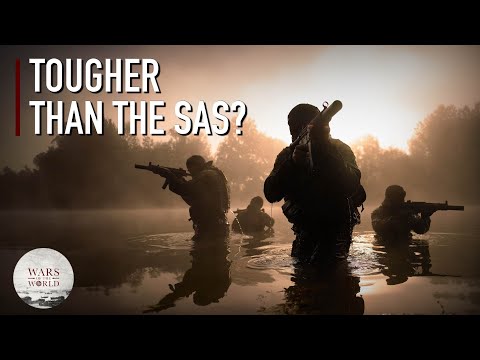
While the SAS basked in the glow of high-profile victories—from the Iranian Embassy siege to the Falklands and Gulf Wars—the SBS remained beneath the radar, their maritime-oriented missions often overlooked. Yet their history is every bit as extraordinary, a tale of daring raids, unconventional tactics, and men who thrived in the fog of war. Their story begins not with grand strategy, but with a quirky former bank clerk named Roger Courtney, a man whose unorthodox ideas would lay the foundation for one of the world’s most lethal special forces units.
Courtney’s journey to becoming the father of the SBS was anything but conventional. Bored with clerical life, he sought adventure in Africa as a big game hunter, even pulling off a famous hoax at Loch Ness using a hippopotamus foot to fake monster tracks. When war broke out, he returned to England and joined the Commandos, but his restless mind soon conceived a radical idea: using collapsible kayaks to infiltrate enemy coastlines undetected.
His superiors scoffed, convinced that kayaks would be easy targets for machine gun fire. Undeterred, Courtney staged an unauthorized demonstration that left them speechless. Under cover of darkness, he paddled out to the anchored HMS Glenearn, climbed aboard undetected, and stole the cover from one of its deck guns. Bursting into a meeting of Royal Navy officers, soaking wet and triumphant, he proved that his concept could work—and that he had the audacity to see it through.
Promoted to captain, Courtney was given permission to raise a unit of 12 men. He found them among the “washouts” of the Commando course—men who had been dismissed but were tough, motivated, and eager to prove themselves. Together with his second-in-command, Lieutenant Robert Wilson, known as “Tug,” Courtney put them through a brutal training regime that included paddling over 140 miles across the Firth of Clyde and surviving on foraged food behind “enemy” lines.
By early 1941, the unit—now dubbed the Special Boat Section—was ready for action. Deployed to Egypt, Courtney teamed up with Royal Navy Lieutenant Commander Nigel Clogstoun-Willmott, a meticulous planner who complemented Courtney’s improvisational style. Their first mission was a reconnaissance of Rhodes, where they paddled silently at night to gather intelligence on potential landing zones. Despite a near-disaster when Courtney suffered crippling cramps and was almost discovered, the mission was a success, earning both men decorations.
But the SBS’s real trial by fire came in the Mediterranean, where they launched a series of daring raids against Italian and German targets. In one audacious operation, Tug Wilson and Royal Marine Wy Hughes paddled into a Sicilian harbor, planted explosives on a railway tunnel, and slipped away undetected—watching from a submarine as a train erupted in a ball of fire.
Their exploits continued, but the cost was high. In September 1942, Wilson was captured in Italy and spent the rest of the war as a prisoner, despite two escape attempts. The SBS pressed on, but their small numbers made them vulnerable. Operation Anglo, a raid on Rhodes to destroy aircraft, saw only two survivors out of the entire force. The unit was eventually absorbed into the SAS, though their maritime expertise lived on.
Willmott, meanwhile, had departed to establish the Combined Operations Pilotage Parties, a unit dedicated to covert beach reconnaissance that would prove indispensable for Allied amphibious invasions. Similarly, the Royal Marines formed the Boom Patrol Detachment, whose most famous exploit—Operation Frankton—saw six folding kayaks launch a daring raid against German shipping in Bordeaux. These men would be immortalized as the Cockleshell Heroes, their story a testament to the courage that defined this breed of warrior.
As the war in Europe ended, the SBS’s focus shifted to the Far East. Number 2 SBS supported American landings in North Africa before joining Southeast Asia Command’s Small Operations Group, operating against Japanese forces on the Chindwin and Irrawaddy rivers and in the Arakan during the Burma campaign. Their kayaks and canoes, once designed for European coastlines, now navigated the dense jungles and swollen rivers of Burma, proving the versatility of Courtney’s original concept.
With the defeat of the Axis powers in 1945, Britain began demobilization, and the SBS was disbanded. But its skills were too valuable to lose. The School of Combined Operations Beach and Boat Sections—known as SCOBS—was established at Fremington in Devon, eventually leading to the formation of the Royal Marines Special Boat Sections. These new units adopted the roles of the wartime SBS, the Boom Patrol Detachment, and Willmott’s COPP, ensuring that the maritime special forces legacy would endure.
Sadly, Roger Courtney did not live to see this rebirth. He passed away on February 15, 1946, from pneumonia in Hargeisa, Somaliland, aged just 46. His legacy, however, would live on in the men who followed—men who would operate in the shadows, just as he had taught them.
The new Royal Marines SBS was soon in action in Palestine during the birth of Israel, and then in the Korean War. Over time, like the SAS, their roles evolved to include security and counterterrorism missions: guarding North Sea oil rigs, protecting British maritime outposts overseas, and countering Irish Republican terrorism. In one of their more unusual operations, they sailed on the ocean liner QE2 posing as tourists to provide protection for Israeli citizens returning home following the horrific Munich Olympics massacre in 1972.
The SBS played significant roles in both the 1982 Falklands War against Argentina and the 1991 Gulf War against Iraq, their designation changing to Special Boat Squadron in 1987. In more recent years, they have inevitably served as part of the UK Special Forces Group in Afghanistan and Iraq, and have been heavily involved in anti-piracy operations around the Horn of Africa and hostage rescue missions in Libya and Nigeria.
While not as celebrated as their SAS comrades in the news, books, and fiction, that is precisely how the SBS prefers it. They remain one of the most lethal, effective, adaptive, and above all secret tier one special forces units in the world—a shadowy brotherhood whose exploits are whispered about in the corridors of power, but rarely spoken aloud.
Back on the sun-baked streets of East Timor in 1999, the small British contingent went about their work with quiet professionalism. Their brief appearance on the news reel was a rare slip, a momentary chink in the veil of secrecy that has shrouded the SBS for over half a century. For the men of the Special Boat Squadron, anonymity is not a burden—it is a weapon, one they wield as deftly as their kayaks once slipped through enemy waters.
As the situation in East Timor stabilized and the referendum paved the way for independence, the SBS contingent withdrew as quietly as they had arrived. Their mission was complete, their presence barely acknowledged. But for those who knew where to look, the sight of those Land Rover Defenders and the men in civilian clothes was a reminder that Britain’s most secretive soldiers were still out there, still watching, still ready.
Yet the story of the SBS is not merely one of past glories. As the new millennium dawned, the unit found itself at the forefront of a new kind of war—one fought not on beaches and coastlines, but in the deserts, mountains, and cities of the Middle East. The attacks of September 11, 2001, would propel the SBS into the most sustained period of operational activity in its history.
In the aftermath of 9/11, the SBS deployed to Afghanistan as part of the coalition effort to dismantle al-Qaeda and the Taliban. Operating alongside their American counterparts and the SAS, SBS operators conducted long-range reconnaissance missions deep behind enemy lines, often spending weeks in the rugged Afghan terrain with little more than what they could carry on their backs.
Their maritime expertise proved unexpectedly valuable in a landlocked country. The SBS’s skills in covert insertion and small-team operations translated seamlessly to the mountains and caves of Tora Bora and beyond, where they hunted high-value targets and disrupted enemy supply lines.
Then came Iraq. In the chaotic days of the 2003 invasion, the SBS played a critical role in securing oil platforms and coastal infrastructure in the Persian Gulf. In one of the largest maritime operations since the Falklands, SBS operators seized key installations before they could be sabotaged, preventing an environmental and economic catastrophe.
But it was in the years that followed—during the grinding insurgencies in Iraq and Afghanistan—that the SBS truly came into its own. Their counterterrorism expertise, honed in Northern Ireland and London, was now applied to the hunt for insurgent leaders and bomb-makers. The unit’s operators, often working in small teams with local forces, became experts in the dark arts of intelligence gathering, targeted raids, and hostage rescue.
In 2011, the world’s attention turned to Libya, where a popular uprising against Muammar Gaddafi had descended into civil war. The SBS was there, conducting covert reconnaissance and coordinating with rebel forces. When the British government needed to extract citizens and diplomats from Tripoli, it was SBS operators who secured the landing zones and provided protection on the ground.
Their involvement in Libya was a reminder that the SBS’s traditional role—operating in the littoral, the gray zone between sea and land—remained as relevant as ever. Whether evacuating civilians from a war zone or hunting terrorists in the desert, the unit’s ability to adapt and improvise, a legacy of Roger Courtney’s unorthodox spirit, proved decisive.
As the second decade of the twenty-first century progressed, the SBS found itself increasingly drawn into the murky world of hostage rescue and counter-piracy. Off the coast of Somalia, SBS operators conducted daring night raids on pirate skiffs and mother ships, often boarding vessels from the sea in conditions that would make lesser men blanch.
In Nigeria, they advised and assisted local forces in the fight against Boko Haram, including high-risk rescue missions for kidnapped schoolgirls. In the Mediterranean, they tracked and disrupted human trafficking networks. The SBS had become a global force, capable of projecting British power and influence in the most hostile environments on Earth.
Yet for all their operational tempo, the unit remained almost invisible to the public. No books were written by former SBS operators, no Hollywood films celebrated their exploits. The men who served in the squadron simply disappeared into the shadows, their identities protected by a wall of official secrecy that even the most determined journalists could not breach.
This anonymity was not accidental. It was a deliberate policy, one that dated back to Courtney’s original concept. The SBS had always understood that secrecy was their greatest weapon—and their greatest protection. In a world of increasing surveillance and media scrutiny, the ability to operate unseen was more valuable than ever.
As the war on terror evolved, so did the SBS. In the chaos of Syria and Iraq, where ISIS declared a caliphate, SBS operators were reportedly among the first Western troops on the ground, guiding airstrikes and training local fighters. Their ability to blend into the local population, honed by decades of covert operations, made them invaluable in the fight against a shadowy enemy.
In 2019, a new generation of SBS operators faced a different kind of threat—the murky waters of the Persian Gulf, where tensions with Iran threatened to boil over. Once again, the SBS was there, protecting British shipping and deterring aggression.
But the story of the SBS is not just one of war. In recent years, they have been at the forefront of humanitarian missions, from disaster relief in the Caribbean to evacuations during the COVID-19 pandemic. The same skills that allowed them to slip undetected onto enemy beaches now saved lives in the most desperate of circumstances.
As the sun set on another operation, the men of the Special Boat Squadron slipped back into the shadows, their deeds known only to a select few. They remain the silent sentinels of Britain’s defense, a brotherhood bound by secrecy and steel.
What do you think—should the SBS finally step into the light, or is their anonymity the truest measure of their strength? Share your thoughts in the comments below.
Report this article
Select a reason for reporting:






