On the morning of August 14, 1945, two American fighter pilots crossed the Japanese coast with orders to attack an airfield near Tokyo. They didn’t know the war was about to end. The password that was supposed to recall them never arrived. By the time their guns fell silent, the fighting had been over for hours. Only one of them returned.
They were flying the most famous fighter America ever built, the P-51 Mustang—the plane that swept the German Luftwaffe from the skies over Europe. But in the war against Japan, the Mustang was a late arrival. More than two years before it reached Tokyo, another American fighter had been battling the Japanese almost every day.
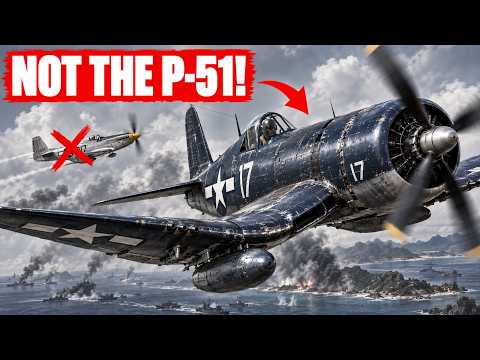
A big blue plane with gull-like wings, the Navy once refused to keep it on its carriers. Two great fighters, two very different wars. One arrived at the end and flew farther than any other fighter ever had. The other was there almost from the beginning and never left. When the war finally ended, only one could truly be called America’s most powerful weapon against Japan.
The answer begins on a muddy island with a Marine who started his career not as an officer, not as a pilot, but as an enlisted man. His name was Kenneth Walsh. Born in Brooklyn, New York, in 1916, he grew up with little money and few prospects. In 1933, at the height of the Great Depression, he joined the U.S. Marine Corps as a private. He was 17 years old.
The Marines made him an aviation mechanic. He spent his days with his hands inside engines, learning how aircraft worked from the inside out. He listened to the pilots talk. He watched them take off and return, and he decided that one day he would be one of them.
It wasn’t supposed to happen. Flying was a job for officers, college men with rank. But the Navy and Marines had a small program that allowed a few enlisted men to train as pilots. Walsh fought with everything he had to get into it. In 1937, he earned his wings as an enlisted pilot, a sergeant who could fly.
By the time Japan attacked Pearl Harbor, he had years of flying experience. He was steady, patient, and careful. He didn’t like showboating. He didn’t brag, but he knew aircraft the way a farmer knows the weather.
In late 1942, the Marines handed him a plane almost no one trusted. It was the Vought F4U Corsair. On paper, it was a marvel. Designed for the Navy around America’s most powerful engine, the Pratt & Whitney R-2800 Double Wasp—18 cylinders, about 2,000 horsepower. To harness all that power, the designers gave it a huge propeller over 13 feet in diameter and bent the wings downward and then upward, so the landing gear could stay short and strong. From the front, it looked like a gull with its wings spread.
In 1940, the prototype became the first American single-engine fighter to exceed 400 miles per hour. But speed wasn’t the problem—landing was. The Corsair’s cockpit sat far back behind a long nose that blocked almost everything in front of the pilot. Approaching a carrier at low altitude and slow speed, he could barely see the deck. The landing gear was stiff, and in a rough landing, the plane could bounce. At low speed, one wing could stop lifting before the other, making the big fighter drop and spin without warning.
The Navy looked at all this and made a decision. The Corsair was not ready for carrier operations. It would go to the Marines instead, to fly from land bases in the Solomon Islands. To many, it seemed like a rejection. A big, dangerous plane with a bad reputation, handed to the Marines because the Navy didn’t want it.
Walsh’s squadron was VMF-124. They were the first Marine squadron to take the Corsair into combat. In February 1943, they arrived at Guadalcanal. The island had changed since the desperate months of 1942. The Japanese Army had been driven out, but the air war over the Solomons was not over. Japanese bases still stretched north through the island chain to Munda, to Kahili on Bougainville, and beyond to the great fortress of Rabaul. From those bases came bombers. And with the bombers came the Zeros.
To understand the Corsair’s value, you have to understand what the Zero did. During the first year of the Pacific War, the Mitsubishi Zero was a legend. It was light, nimble, and long-ranged. It could turn tighter than any American fighter, climb faster at low speed, and cover distances that amazed Allied planners. Its pilots in 1942 included some of the most experienced airmen in the world, men who had fought in China for years.
American pilots learned to defeat it with tactics. Never turn with a Zero. Never slow down. Attack from above, fire, and dive away. But they did this in planes that were barely equal to it. Every fight was a gamble. For the young American pilots who arrived in the Solomons, the Zero was not just an airplane. It was a legend told in tents at night, a ghost that appeared in nightmares. Men who had seen it fight spoke of it with a kind of grim respect. Those who hadn’t yet wondered how they would fare when they faced it.
The Corsair changed the balance of power. It was much faster than the Zero. It could dive away at speed to escape anything the Japanese had. It carried six .50-caliber machine guns in its wings, armor behind the pilot, and self-sealing fuel tanks. The Zero had almost none of that protection. The Corsair could take hits that would tear a Zero apart, and one good burst from its guns could destroy a Zero in seconds.
But the plane was new, and the men who flew it were learning on the job. Their first major escort mission in mid-February went badly. Zeros jumped a mixed formation of American bombers and fighters over Bougainville, and the Americans lost several planes, including Corsairs. Walsh was flying, watching, and thinking. He was not a reckless pilot. He studied battles the way a mechanic studies a broken engine. What worked? What failed? And why did good men die?
He talked with the other pilots in their tents late into the night, while the rain drummed on the canvas and mosquitoes hummed in the darkness. Little by little, the squadron found the answer. Use speed, use altitude, attack and climb. Never let a Zero drag you into its kind of fight.
In the spring of 1943, Walsh scored his first victories. Then, on May 13, east of the Russell Islands, he shot down three more Zeros. He became the first Corsair pilot in history to be credited with five victories. He was the first ace on the Corsair, a former enlisted man from Brooklyn.
There were no celebrations on the island. A man who achieved five victories got a handshake, maybe a drink if one was available, and a place on the mission schedule the next morning. At home, newspapers began printing his name, but on Guadalcanal, nothing changed. Heat, rain, mud, malaria, long flights over the Slot, and long flights back. The empty bunks of men who didn’t return.
By the summer of 1943, the fighting moved north. American forces landed on New Georgia and fought for the Japanese airfield at Munda. Corsairs flew to cover the beaches, escorted bombers, and clashed with Japanese formations almost daily. Walsh’s score continued to rise. On August 15 over Vella Lavella, he dove on a Japanese formation attacking American ships and shot down more enemy planes. His Corsair was badly damaged. He struggled to fly it back to base.
Two weeks later came the mission that would make him famous. On August 30, 1943, Walsh was flying an escort mission for American bombers heading to the Japanese airfield at Kahili, at the southern tip of Bougainville. It was one of the most heavily fortified targets in the Solomons. On the way, his engine began to fail. Any other pilot would have turned back. That was the rational move. A fighter with a sick engine is a liability, not an asset.
Instead, Walsh landed at the newly captured Munda airfield, found another Corsair, climbed in, and took off again alone to catch the bombers. By the time he reached Kahili, the battle had already begun. He arrived to find the American bombers under attack by a squadron of Japanese fighters. The Medal of Honor citation later described the enemy force as including about 50 Zeros.
Kenneth Walsh, alone, dove straight into them. He fired, climbed, and dove again. A Zero fell, then another. He kept attacking, breaking up the Japanese attacks on the bombers and drawing the fighters away from them toward himself. By the end of the fight, he was credited with destroying four Zeros. But the Japanese found him too. Cannon shells tore into his Corsair. The engine was dying. He couldn’t make it home. He ditched his damaged plane in the sea off Vella Lavella. The impact threw his body forward against his harness. Water rushed over the long nose and poured into the cockpit. He unbuckled, pushed himself out, and floated in the warm, oily sea as the heavy fighter slid beneath the surface behind him. For a while, there was nothing but waves, sun, and the distant sound of engines fading north. He was rescued and returned to his squadron.
In February 1944, at the White House, President Franklin Roosevelt placed the Medal of Honor around his neck. By then, the reign of the Zero over the Solomons was nearing its end. The Corsair, the plane the Navy didn’t want, was one of the main reasons why.
And on the other side of the world, the fighter that would become America’s most famous had not fired a single shot against Japan.
Born for a different war, the North American P-51 Mustang was ordered by the British in 1940. Sleek, clean, and efficient, it first flew later that year. With its Allison engine, it was fast at low altitude with excellent range, but it lost power up high. The British used it mostly for low-level reconnaissance and ground attack. It was good, but not yet great.
Then in 1942, British engineers tried something new. They mated the Mustang to the Rolls-Royce Merlin, the engine that powered the Spitfire. In America, Packard was already building Merlins under license. The result was stunning. The Merlin Mustang could fly high, fast, and very far. In 1944, it became the answer to America’s biggest problem in the air war over Europe: escorting bombers all the way to Germany and back. Nearly every Mustang built in 1943 and early 1944 went to England or Italy. The war against Germany had priority. The war against Japan would have to wait.
So in the summer of 1943, while Kenneth Walsh fought 50 Zeros over Kahili, the Mustang was nowhere in the Pacific. The Corsair had a massive head start. The question was whether the Mustang, when it finally arrived, could catch up.
When the Mustang finally came to fight Japan, it didn’t reach the Pacific islands. It reached China. For years, American pilots in China had fought at the end of the world’s longest supply line. Everything they used—every gallon of fuel, every bullet, every spare part—had to be flown over the Himalayas from India. The pilots called that route “The Hump.” So many transports crashed there that men said you could find your way across the mountains by following the trail of wreckage. At the end of that line was the Fourteenth Air Force, commanded by General Claire Chennault, the former leader of the Flying Tigers. His pilots in the 23rd Fighter Group had inherited shark-mouthed P-40 Warhawks and a fighting spirit. They were outnumbered, starved of everything, and flying planes that grew more obsolete by the month.
For a long time, Chennault begged for better fighters. In the spring of 1944, his wish began to come true. The first Mustangs reached the 23rd Fighter Group in China around May 1944. The difference was enormous. The new fighter could fly much faster than the Warhawk and go twice the distance. Targets that had been impossible were suddenly in range. Japanese airfields deep in occupied China, railroads, river traffic, and supply depots hundreds of miles from American bases. Imagine being a Warhawk pilot who had spent a year fighting in a tired plane, nursing it through every mission, then climbing into a brand-new Mustang. The cockpit still smelled of new paint. The engine ran with a smooth, deep power. The plane climbed and climbed and kept climbing. For the first time, the men in China felt they were flying something the Japanese should fear. And the Japanese had already noticed.
In China, Mustangs escorted bombers, strafed airfields, and fought Japanese fighters across a front hundreds of miles wide. The ground crews felt it too. They had spent years patching tired Warhawks with whatever parts they could find, sometimes cannibalizing wrecked planes to keep others flying. Now they had new machines to care for, with clean engines and new guns. They worked on them in the open under the blazing Chinese summer sun, and later in the bitter winter cold, on crushed-rock airstrips laid by thousands of Chinese laborers by hand.
But China was a sideshow to most Americans. The great battles of the Pacific were fought at sea and among the islands, and there the Mustang was still absent. But the Corsair was not.
By 1944, the big gull-winged fighter had matured. Engineers raised the cockpit so the pilot could see better. They softened the landing gear so it didn’t bounce so violently. A small strip on the wing’s edge gave the pilot more warning before a stall. The plane that had terrified the Navy was being tamed, one modification at a time. The British Royal Navy was already flying Corsairs from its carriers. Its pilots learned to approach the carrier deck in a long, curved turn, keeping the ship in view beside the plane’s nose until the last moment. In 1944, the U.S. Navy finally decided the Corsair was ready for its carriers. The timing could not have been more important.
In October 1944, during the battles around the Philippines, the Japanese began a terrible new kind of attack. Pilots flew their bomb-laden planes directly into American ships. They were called kamikaze, after the divine wind of Japanese legend. The U.S. fleet needed fighters that could climb fast and intercept the attackers before they reached the ships. The Corsair could climb faster than the Navy’s Hellcats. In the last days of 1944, Marine Corsair squadrons went aboard American carriers for the first time. Other Navy and Marine squadrons followed. The plane that had been banished from the carriers returned to defend them.
By then, the Mustang was finally preparing to enter the Pacific War in full force. It needed only one thing: a base to fly from. From airfields in the Mariana Islands, massive B-29 Superfortresses were already raiding Japan. But the Marianas were about 1,500 miles from Tokyo. No single-engine fighter could make that round trip. So the bombers went alone. Japanese fighters rose to meet them, and over the cities of Japan, B-29s were shot down and their crews lost.
Halfway between the Marianas and Japan lies a small, ugly island of black volcanic sand. It was called Iwo Jima. On February 19, 1945, Marines landed on Iwo Jima. What followed was one of the bloodiest battles in Marine Corps history. Japanese defenders turned the island into a maze of tunnels, caves, and bunkers. They fought almost to the last man. For more than a month, Marines clawed their way across the island, yard by yard, with their blood. Above them flew Corsairs. From carriers offshore, Navy and Marine Corsairs dropped bombs, fired rockets, and strafed Japanese positions, sometimes only yards from advancing Marines.
And while the battle still raged, the first Mustangs arrived. On March 6, 1945, a P-51 landed on an Iwo Jima runway still within range of Japanese guns. More followed soon. Mustangs of the 15th and then the 21st Fighter Groups began flying from the island. At first, they attacked Japanese positions on Iwo Jima itself, firing rockets and dropping bombs on caves only minutes from their runway. The war on the island was close and brutal. Mustang pilots took off over the heads of Marines still fighting among the rocks. They could see the smoke of battle from the cockpit before their wheels left the ground.
Life for the pilots on Iwo Jima was harsh. Volcanic grit got into everything. Engines, guns, food, and tents. The ground was warm in places from the volcano beneath it. The smell of sulfur hung over the island, and bodies were everywhere, American and Japanese, as the battle went on. On the night of March 26, a few hundred Japanese soldiers who had survived in the caves launched a final surprise attack. They hit the tents where fighter pilots and ground crews slept. In the dark and confusion, pilots fought hand-to-hand with Japanese soldiers among their tents. Some pilots who had come to fly over Tokyo died on Iwo Jima before their real mission began.
By the end of that day, the island was secure and the Mustangs were ready to do what no American fighter had done before. On April 7, 1945, more than 100 Mustangs took off from Iwo Jima to escort B-29s all the way to Tokyo. The target was the Nakajima aircraft engine factory on the western edge of the city. It was one of the most important factories in Japan. The trip was over 600 miles each way, almost all of it over open ocean. A single-engine fighter has no navigator, no radio operator, no second pilot. So the Mustangs flew in formation with the B-29s, which acted as their guides. The big bombers led the fighters north across the sea to a rendezvous point off the Japanese coast where the Mustangs joined the bomber stream.
For the Mustang pilots, those first hours were an endurance test before the fighting even began. They sat strapped in narrow seats above a parachute and a life raft for hours on end. They could barely move. Their legs went numb. Their backs ached. The engine’s drone went on and on, and every pilot listened to it the way a man listens to his own heartbeat. If that engine failed over the ocean, there was nothing below but water.
Then, ahead, the coast of Japan rose out of the haze. Mount Fuji stood above the clouds, white and massive. Japanese fighters climbed to meet the bombers. They were used to attacking B-29s flying without escort. This time they found Mustangs waiting for them. Among the American pilots that day was Major James Tapp of the 78th Fighter Squadron. As the Japanese fighters headed for the bombers, Tapp went for them. He was credited with several Japanese fighters destroyed on that single mission, and he would become a skilled ace in the skies over Japan.
The Japanese pilots were stunned. American fighters were over Tokyo itself. The home islands, which had seemed so far from the war, were no longer safe even from fighter planes. For a few minutes, the sky over Tokyo was full of combat. The bombers droned on through bursts of flak. Japanese fighters broke through the formations. Mustangs dove behind them, guns blazing, then climbed and came back toward the bombers. Below, the great city stretched to the horizon, gray and massive, its rivers and rail lines glinting in the spring light. Few young Americans in those cockpits had ever imagined they would see it with their own eyes.
The flight home was as dangerous as the fight. With fuel low and formations scattered across the sky, the Mustangs had to find their bombers again for the long ride back to Iwo Jima. When they finally saw the small island rise from the sea, the pilots had been in the air for about seven hours. It was an extraordinary feat. The fighters had escorted bombers over the capital of Japan. The Mustang had reached the Pacific War, and it had arrived in the most dramatic way possible.
But even as the Mustangs began their long missions to Japan, the most important air battle of the Pacific War was being fought elsewhere. Over Okinawa.
On April 1, 1945, American forces landed on Okinawa, only a few hundred miles from the southern islands of Japan. The battle lasted nearly three months, and kamikaze attacks reached their deadliest peak. Wave after wave of Japanese aircraft flew south toward the American fleet. Many were piloted by young men with very little training, sent with orders to die. Some flew modern fighters. Others flew old, slow planes pulled from training schools. They all had the same target: the ships.
Sailors of the fleet lived in a kind of open nightmare. Every morning, they went to their battle stations and waited. Radar showed the incoming raids. The guns began to fire. Then a single plane might fall, trailing smoke, screaming out of the sky to smash into a ship in a ball of fire. The worst place of all was the forward picket line. Destroyers and smaller ships were stationed far from Okinawa in a ring around the island to give early warning of incoming raids with their radars. They were the first ships the Japanese pilots saw, and so they were often the first ships attacked. Some picket ships were hit again and again in a single afternoon. Their crews fought fires, cared for the wounded, and kept their guns firing, knowing another wave might appear on the radar at any moment.
Between the kamikazes and the ships stood the fighters. And over Okinawa, the most important of those fighters was the Corsair. Navy and Marine Corsairs flew from carriers. Marine Corsairs also flew from captured airfields on Okinawa itself, at Yontan and Kadena, sometimes within range of Japanese artillery. They flew combat air patrols from dawn to dusk, circling over the forward radar ships and over the beaches, waiting for the call that the enemy was coming.
When the call came, they dove on the attackers. Sometimes they were few. Sometimes they were dozens. And on May 10, 1945, one Marine Corsair pilot did what seemed impossible. His name was First Lieutenant Robert Klingman. He was flying with Marine Squadron 312, which operated from Kadena airfield on Okinawa. That morning, Klingman was flying as wingman to Captain Kenneth Roser on a patrol near the small island of Ie Shima. Their unit was sent to chase a Japanese twin-engine reconnaissance plane flying very high above American forces, where it could watch the movements of the fleet and troops below. Those scout planes were dangerous. They were the eyes of the kamikaze attacks. A plane that could see the fleet could tell the attackers where to go.
The Corsairs began to climb. They climbed high into the thin, freezing air, as far as their engines could take them. The Japanese plane kept climbing too. The cold was bitter. Frost formed on the inside of the cockpit. The pilots’ breathing came short and fast through their oxygen masks. Their engines strained in the thin air. Finally, the Corsairs caught the Japanese plane. Roser opened fire and hit the enemy plane, but his ammunition ran out before he could bring it down. Then it was Klingman’s turn. He pulled in behind the Japanese plane and squeezed the trigger. Nothing happened. At that altitude and in that cold, his guns had frozen.
Klingman had a choice. He could pull away and let the reconnaissance plane escape with everything it had seen for the Japanese commanders. Or he could find another way to bring it down. He chose the other way. He brought his big fighter close behind the Japanese plane until the tips of his propeller almost touched its tail. Then he surged forward into it. The huge propeller blades of the Corsair chewed into the enemy’s tail. Pieces of rudder flew off and passed by Klingman’s cockpit. He backed off, lined up, and attacked again. On the second pass, he cut away more of the tail. On the third, he hit the tail again, and the Japanese plane lost control. It fell spinning toward the sea. Klingman and his flight leader watched its wings break apart before it struck the water.
But Klingman’s ordeal was not over. His propeller had been damaged in the collision. Pieces of the Japanese plane had struck his Corsair. And after the long climb and chase, his fuel was nearly gone. He turned back toward Okinawa, losing altitude as his engine weakened. Before he reached the field, his fuel ran out completely. The powerful engine went silent and still. Klingman glided the rest of the way in. With no power and no second chance, he landed the heavy Corsair on Kadena’s runway in a crash landing. When the ground crews reached the plane, they found pieces of the Japanese aircraft still stuck in it. The tips of the propeller blades were bent and torn. Robert Klingman was awarded the Navy Cross. His story was extraordinary, but in its essence, it expressed the nature of the Corsair itself. It was a solid, powerful plane built to take punishment and keep flying. Few fighters of the war could have survived what his plane endured that day.
The Corsair was proving itself over Okinawa in every way possible. As an interceptor against the kamikaze, as a fighter against Japanese escorts, and as a bomber diving on Japanese positions on the island, dropping bombs and napalm, and firing rockets into the caves where Japanese soldiers fought to the end. Marines on the ground learned to call Corsairs on the radio. They marked the target with smoke, and the bent-wing fighters came in low, so low that the men could feel the concussion of the explosions. For the soldiers and Marines fighting on the hills of Okinawa, the sound of a Corsair engine overhead meant help had arrived.
Meanwhile, the Mustangs on Iwo Jima kept flying north. Through April and May, they escorted bombers over Japan and attacked Japanese airfields on their own. Every mission meant seven or eight hours in the cockpit. Every mission meant hundreds of miles over the ocean each way. And soon the Mustang pilots learned that their most dangerous enemy over Japan was not the Japanese. It was the weather.
Between Iwo Jima and Japan, huge weather fronts formed over the ocean without warning. Clouds rose from the sea surface to thousands of feet. Rain, turbulence, and total darkness inside them. For a single-engine fighter pilot with no navigator and only basic instruments, flying into one of those fronts could be fatal. On June 1, 1945, about 150 Mustangs took off from Iwo Jima to escort B-29s on a major raid against the city of Osaka. Hundreds of miles north of Iwo Jima, they flew straight into a massive weather front. Inside the cloud, the world around them vanished. The pilots could no longer see the planes beside them. They could not see the sea below or the sky above. Violent winds threw the fighters in every direction like leaves. Rain hammered on their canopies. Pilots flying in close formation suddenly found themselves alone in a roaring gray fog.
A pilot in that situation had only his instruments to tell him which way was up. A needle and ball, an artificial horizon, an airspeed indicator, and an altimeter. Every instinct in his body told him something different from what the instruments said. His inner ear might tell him he was flying straight and level when he was actually in a steep turn. If he trusted his body instead of his instruments, he would spiral into the sea before he knew what had happened. Some Mustangs collided inside the clouds. Others were thrown out of control by the turbulence and fell toward the sea. Pilots lost their sense of direction and flew into the ocean without ever seeing it. Over the radio came broken calls. Pilots trying to find their leaders. Pilots trying to find a way out. Pilots calling for help that could not reach them.
When the survivors returned to Iwo Jima at last, the losses were counted. Twenty-seven Mustangs were missing. Most of their pilots were never seen again. Among the missing was the commander of the 506th Fighter Group, the newest Mustang group on the island, which had been in service only a few weeks. None of those planes had been shot down by a Japanese fighter. The sky itself had killed them. The men who survived that day never forgot it. The empty tents, the lockers that would never be cleared out by their owners, the silence that hung over the airfield that evening. In a single morning, the weather did more damage to the Mustang groups than the Japanese Air Force had done in weeks. That was the hidden cost of the Mustang’s war against Japan. It could reach farther than any other American fighter, but reaching that far meant flying over an ocean that was always waiting to swallow a single-engine fighter and the man inside it.
The Corsair pilots over Okinawa faced their own dangers. Anti-aircraft fire, Japanese fighters, accidents on crowded carrier decks, and muddy island airstrips. But when their patrols ended, the ships and airfields were usually close by. The Mustang pilots on Iwo Jima had to cross hundreds of miles of empty sea to reach the fight, and the same distance to return. For the men who flew the Corsair, the pressure was different. It was the pressure of being needed every single day. Pilots flew mission after mission, sometimes two or three in a day, until they fell asleep in their seats while eating. Ground crews worked all night by flashlight to ready the planes by dawn, and every pilot knew that any enemy plane that got past him might kill men on the ships below.
By the summer of 1945, both fighters were fighting at the doorstep of Japan, Corsairs from Okinawa and the carriers, Mustangs from Iwo Jima. The war was entering its final weeks, and the last great question was still waiting for an answer. When the guns finally fell silent, which of them would have done more to defeat Japan?
In the last summer of the war, the skies over Japan belonged to the Americans. The Japanese air force had been bled to the bone. Its best pilots were dead. Its factories had been bombed into rubble. Fuel was so scarce that training flights had almost stopped. Many of the planes that remained were kept back, hidden in caves and under trees, saved for a final desperate defense against the invasion everyone expected.
From the decks of the U.S. fleet’s carriers, Navy and Marine Corsairs launched attacks on airfields, ports, and ships along the coasts of the Japanese home islands. From Okinawa, Marine Corsairs flew north toward Kyushu. From Iwo Jima, Mustangs made their long missions over Honshu, attacking airfields and anything else that moved. For the Japanese people below, the sound of American engines became part of daily life. Fighters flew over villages and train stations at treetop height. Air raid sirens wailed day and night. Entire neighborhoods in major cities had already burned. The war that had once seemed so far away, fought on distant islands with strange names, was now in the sky above their own rooftops.
And somewhere in that crowded sky, Kenneth Walsh returned. The former enlisted man from Brooklyn, the first Corsair ace, the Medal of Honor recipient from Kahili, came back to the Pacific with a new Marine squadron. In June 1945, while flying a Corsair over Okinawa, he shot down another Japanese plane. It was his twenty-first victory of the war. Two years earlier, he had helped break the Zero’s grip on the Solomons. Now he was fighting within sight of Japan itself. The war had reached its farthest north, and the Corsair had been there every mile of the way.
In early August, the world changed. On August 6, 1945, an American B-29 dropped an atomic bomb on the city of Hiroshima. Three days later, a second bomb fell on Nagasaki. On the eighth of the month, the Soviet Union declared war on Japan. Inside the Japanese government, a bitter struggle began over surrender. The days passed. The bombing continued, and the fighter pilots kept flying.
On Iwo Jima, the Mustang pilots of the 78th Squadron heard the rumors. Peace was coming. Maybe tomorrow, maybe today. They were told that if Japan surrendered while they were in the air, they would hear a password over the radio and would turn back immediately.
And on the morning of August 14, orders came for a Mustang mission against airfields near Tokyo. Among the pilots was Captain Jerry Yellin. He was 21 years old and had been flying combat missions from Iwo Jima since the spring. He had seen friends die in the air and on the ground. He had flown through the battles over Japan and survived. He had every reason to believe he would live to go home. His wingman that day was Second Lieutenant Phil Schlamberg. He was 19 years old. He was one of the new pilots in the squadron. Before the mission, Schlamberg told Yellin he was afraid. He said he had a feeling he would not return. Yellin tried to reassure him. He told the young pilot to stay close and they would get through it together.
They took off and flew north with the rest of the formation across the long stretch of ocean toward Japan. They listened for the password. It never came. Over Japan, they dropped down to attack. They strafed the airfield, their guns chewing up buildings and aircraft on the ground. Anti-aircraft fire rose to meet them. The Mustangs climbed, turned, and attacked again. Then they climbed away toward home. Ahead of them was a bank of clouds. Yellin flew into it and came out the other side. When he looked for his wingman, the sky beside him was empty.
He called on the radio. There was no answer. He circled and searched as long as his fuel allowed. There was no sign of Phil Schlamberg, no parachute, no smoke, no wreckage, only the clouds and the sea and the silence. Yellin made the long flight back to Iwo Jima alone. Hour after hour, there was only the drone of the engine and the endless gray ocean below. He kept looking to his right, at the empty space where the other Mustang should have been. He kept hoping, somehow, to see it again.
When he landed, he learned the truth. Japan had accepted the surrender while they were still in the air. The war had been over for hours by the time he and Schlamberg strafed that airfield. Phil Schlamberg is believed to have been among the last Americans killed in combat in World War II. Jerry Yellin would carry the memory of that morning for the rest of his life. He lived to be 93. He never forgot the young wingman who flew into that cloud and never came out.
The Mustang’s war against Japan ended there, in that cloud off the coast of Japan. It had lasted at full strength only a few months. From the first long mission to Tokyo in April to the last mission in August. Before that, there were Mustangs in China fighting a hard, lonely war at the end of the world’s longest supply line. And there were Mustangs over the Philippines and Burma. But in the war against Japan, the Mustang was always a late arrival, called in to do one specific job once the right airfield was secured. It did that job brilliantly. It flew farther than any single-seat fighter had ever been asked to fly in combat over an ocean that killed as readily as any enemy. It brought the war to the skies over Tokyo, and its pilots paid a heavy price to do it. But that is not the same as winning the war.
On Iwo Jima, ground crews waited for the Mustang squadrons through months of missions like that one. They stood on the flight line counting the fighters as they came back across the sea. They learned to recognize each plane by its number and markings, and to dread the moment when one did not appear.
Now look at the Corsair. It had been fighting the Japanese since the early months of 1943 over Guadalcanal and the Solomons, over Bougainville and Rabaul, over the Marshalls, the Philippines, Iwo Jima, and Okinawa. From muddy island runways and from carrier decks, against veteran Japanese pilots at the start of the war and against desperate kamikazes at the end. By the end of the war, the Corsair had flown about 64,000 combat sorties. Only a small fraction were from carriers. The rest came from island bases where the Marines made it their own.
In air combat, the Corsair was credited with destroying more than 2,100 Japanese aircraft. Navy figures gave the Corsair a ratio of about 11 enemy planes destroyed for every Corsair lost in air combat. Like all wartime claims, those numbers were somewhat inflated. In the confusion of aerial combat, two pilots might claim the same kill, or a damaged plane might be counted as destroyed. This was true for every air force and every fighter on both sides. But even allowing for that, the Corsair’s air record was outstanding.
And air-to-air combat was only half its story in the war. The Corsair also became one of the most important bombers of the Pacific War. By one reliable count, it dropped about 70 percent of all the bombs delivered by American fighters in the war. Bombs on Japanese airfields, bombs on Japanese ships, and bombs, rockets, and napalm on the caves and bunkers where Japanese soldiers fought to the death. Ask a Marine on Okinawa what the Corsair meant to him, and he won’t talk about kill ratios. He’ll talk about the moment he called for help on the radio, and a few minutes later the bent-wing fighters came roaring low over his head.
When the war ended, the Mustang and the Corsair took different paths. Both would fight again five years later in Korea. But the Corsair stayed in production long after the war, and in Korea it was again one of the most important ground-attack planes in the American arsenal, flying from carriers and airfields just as it had against Japan. It was one of the last propeller-driven fighters built in America.
So which was the better American weapon against Japan? The Mustang was the more famous plane. It was faster at high altitude and more elegant in the air. It was the fighter that won the war over Germany. And in the war against Japan, it gave America something no other fighter could: the range to escort bombers from Iwo Jima to Tokyo and back. But a weapon is measured by what it actually accomplishes. And against Japan, the Corsair accomplished more. It was there earlier. It fought longer. It fought in more places, against more of the enemy, and in more roles than the Mustang did in the Pacific. It broke the Zero’s hold on the Solomons. It helped destroy Japanese air power at Rabaul. It defended the fleet against the kamikazes. And it carried the bombs that supported the Marines from island to island, all the way to the doorstep of Japan.
The Mustang came to the war against Japan as a long arm reaching across the ocean in the final stage. The Corsair was the fist that fought the whole way through.
And when you remember the air war against Japan, you remember the men who flew them both. Kenneth Walsh, the enlisted man who became the first Corsair ace and lived to see peace. Robert Klingman, who shot down an enemy plane with his propeller and flew home on an empty tank. The Mustang pilots who were lost in the clouds on June 1, and Phil Schlamberg, nineteen years old, who flew into a bank of clouds on the last morning of the war and was never seen again.
The Mustang was the fighter America remembers. But the plane the Navy once banished from its carriers was the one Japan could never escape.
So here is the question for you: if you had to choose one of these two legendary fighters to go to war in, knowing everything you now know about their strengths, their flaws, and the very different wars they fought—which one would you trust to bring you home?
Report this article
Select a reason for reporting:






