Charles Upham didn’t just fight in World War II—he redefined the meaning of courage. On the blood-soaked battlefields of Crete and North Africa, he did the unthinkable: he earned the Victoria Cross twice. Only two other men in history have achieved that feat, and both were medics. Upham was a combat soldier, a sheep farmer from New Zealand who charged into machine-gun fire with nothing but grenades and grit. His story is one of almost unbelievable bravery, laced with a humility that made him a legend.
But Upham’s heroism wasn’t just on the battlefield. Captured by the enemy, he launched escape attempt after escape attempt, driving his captors to the brink of madness. He jumped from moving trains, scaled double fences in broad daylight, and even lit a cigarette while a German rifle pointed at his head. This is the story of a man who simply would not be broken.
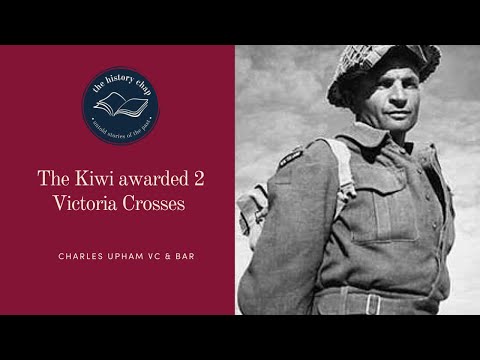
Born in Christchurch, New Zealand, in 1908, Charles Hazlitt Upham was a man of the land. After studying at Canterbury Agricultural College, he became a sheep farmer and later a land valuer. In 1938, he got engaged to Molly McTamney, a distant relative of another double VC recipient, Noel Chavasse. But before they could marry, war broke out. Upham, already a reservist, enlisted immediately, joining the 20th Battalion of the New Zealand Expeditionary Force. Despite having risen to sergeant, he insisted on enlisting as a private—a humble beginning that foreshadowed his modest nature throughout his life.
His leadership skills were quickly recognized, and he was promoted to sergeant within three months. Persuaded to attend officer training, he became a second lieutenant and returned to his battalion. In March 1941, the New Zealanders were deployed to Greece to counter the German invasion. The campaign was short-lived; the Allies were swept aside, and 50,000 troops had to be evacuated. Just over a third of them were sent to Crete, including Upham.
On May 20, 1941, German paratroopers landed on Crete. For the next 11 days, British, New Zealand, and Greek troops fought a bitter battle for the island. The day after the landing, Upham’s company counterattacked to retake the airfield at Maleme. Upham led a platoon against several German machine-gun posts, advancing 3,000 yards under fire with no artillery support. His men took out the first machine gun with grenades and pistols. Upham himself crept up to a house where another machine gun was based and tossed in grenades to end their resistance. A third machine gun opened up, and Upham crawled to within 15 yards of the Germans, lobbing grenades into the enemy position.
Despite his successes, the Allied counterattack failed due to German air superiority, and they were forced to withdraw. As they retreated under fire, Upham carried a wounded man to safety and encouraged several of his men to do likewise. It then transpired that one company had not received the withdrawal order and was isolated behind German lines. Upham, accompanied by a corporal, ran 600 yards through enemy lines, killing two Germans on the way, and successfully brought the company back to safety.
The battle for Crete was becoming a desperate retreat towards the south of the island, hoping for another evacuation. It was brutal and bloody, and Upham was in the thick of it. Despite receiving a shrapnel wound to his shoulder and, three days later, a bullet wound to his foot, he stayed with his men. On May 25, at Galatas, he and his men ambushed the advancing Germans, killing 40 and forcing the rest to retreat. Each time the Allies tried to hold a line, the Germans broke through. In one fast-moving situation, Upham left his platoon to retreat under his sergeant while he went forward to warn another company they were about to be left behind. Suddenly, he ran into two Germans who opened fire. Falling to the ground, Upham pretended to be dead. As the Germans came close, he opened fire, killing both. The second German fell onto the muzzle of Upham’s rifle. Having survived that brush with death, he proceeded to the company and once more brought them back to Allied lines.
For his actions in the Battle of Crete, his commanding officer, Lieutenant Colonel Howard Kippenberger, recommended Upham for the Victoria Cross. Upham was totally against the award, modestly feeling it was undeserved. Eventually, his commanding officer convinced him that it was for his bravery and service to the whole unit. He was gazetted for the VC in October 1941. By then, Upham had been evacuated to Egypt. He was one of the lucky ones: of the 18,000-strong British and Commonwealth Army in Crete, 3,500 had been killed and 12,000 captured.
Promoted to captain, Upham and the rest of the 2nd New Zealand Expeditionary Force now formed part of the British Eighth Army in Egypt. In late June 1942, the New Zealanders were in danger of being cut off as Rommel swept into Egypt. On the night of June 27, they made a desperate break for British lines. The ensuing battle saw Captain Upham’s company in fierce hand-to-hand fighting. Once more, Upham was in the thick of it, using grenades to lethal effect. He threw them at such short range that he was injured in both arms by shrapnel from his own grenades.
The breakout was a success, and the New Zealand Division was moved into the defensive line at El Alamein. Positioned south of the town, they were ordered to take the high ground at the El Ruweisat Ridge. The attack began at 11 p.m. on July 14. Along the ridge, they met fierce resistance. Upham’s company faced four machine-gun nests and several tanks holding the high ground. Once more, Upham inspired his men to press home their attack, and once more, grenades were key. Upham was credited with personally destroying several machine-gun posts and a tank. In the process, he was shot in the elbow by a machine gun. Refusing to leave the battlefield, he got his wounds dressed at a regimental aid post and then returned to his men.
The following day, the Germans and Italians launched a furious counterattack. Upham was hit in the leg by shrapnel. Unable to move, he and the remaining six men of his company were captured along with about a thousand fellow New Zealanders. For his gallantry in this battle, he was to receive a bar to his Victoria Cross—a second award. But that was in the future. In the meantime, Charles Upham found himself in an Italian military hospital where a surgeon recommended that his damaged arm needed amputation. It won’t surprise you to learn that he refused.
Nor will it surprise you that Captain Charles Upham VC didn’t take being a prisoner of war lying down. He tried to escape on numerous occasions and would be sent to the most notorious POW camp of them all. While he felt it would be morally wrong to escape while he was in hospital, immediately after leaving, the gloves came off. Even before he arrived at his first prison camp in Italy, he made his first bid for freedom. As the lorry transporting him slowed down to negotiate a bend, Upham leapt out and started running. He managed to run 400 yards before the guards caught him. It transpired he had broken his ankle in the jump—running 400 yards on a broken ankle was pretty impressive.
He was incarcerated in a POW camp near Modena. When the Italians surrendered to the Allies in September 1943, any hopes of freedom were dashed as the Germans conducted Operation Axis, occupying Italy. The war on the peninsula would continue for another 20 months. With Italy under their control but the Allies landing in the south, the Germans decided to move their newly acquired POWs north. On this journey, Upham unsuccessfully tried to saw a hole through the bottom of the truck with a kitchen knife he had managed to get hold of. At his next camp, he boldly tried to scale the double fence in broad daylight. Once more, his efforts didn’t succeed; he fell down between the two fences with an irate German pointing his rifle at his head and shouting that he’d shoot him. The New Zealander coolly sat up and lit a cigarette. He was put in solitary confinement. His only release from this monotony was a short walk around the exercise yard with a German machine gunner following his every step.
Amazingly, Captain Upham nevertheless made yet another bid for freedom. As he walked past the German guard’s barracks in the exercise yard, he leapt through the door and sprinted out the other end. The machine gunner later said he didn’t have the heart to shoot him because from his vantage point he could see what Charlie Upham couldn’t: marching towards the barracks was a platoon of German soldiers, and our escaping hero ran straight into them.
The Germans had had enough of Charles Upham. He was a pain in the butt. They decided there was only one place left for him: the most secure and infamous POW camp of them all—Oflag IV-C, otherwise known as Colditz. On route to the forbidding castle in Germany, Upham found time for one final escape attempt. Marked as a highly dangerous and disruptive prisoner, the Germans were conscious that he could use any opportunity to escape. From the train, where other men might simply go to the toilet, the Germans knew that being alone in a cubicle was just inviting Upham to try to escape. Therefore, they introduced a cunning plan: he could only go to the toilet when the train was traveling at high speed so he couldn’t jump off. But we are talking about a Kiwi sheep farmer who had been awarded the Victoria Cross. Do you think he was daunted about jumping from a high-speed train? Of course not. Despite the speed, Charles Upham wiggled through the toilet window and dropped down the side of the train. The impact of hitting the ground knocked him out, but when he came to, he took off into the countryside and remained at liberty for 12 hours before the Germans tracked him down.
That was October 1943. He was to remain at Colditz until the castle was liberated by advancing US troops in April 1945. Whilst most prisoners were happy to head off home, Upham asked to join the Americans in their advance. It was only when he received specific orders forbidding him to do so that his war finally came to an end.
On May 11, 1945, just three days after Germany surrendered, Charles Upham received his first Victoria Cross from King George VI at Buckingham Palace. While in Britain, he was reunited with Molly, who was serving as a nurse in Hampshire. In June 1945, they were married in the Catholic church in New Milton. They would remain married for nearly 50 years and have three daughters.
In September 1945, he was awarded his second Victoria Cross for his actions at Ruweisat Ridge. He is one of only three men ever to have been awarded the VC twice, and the only combat soldier to achieve this feat. He returned to New Zealand a hero, but this status was something he truly disliked. He turned down an offer from the New Zealand government of £10,000 to buy him a farm. Instead, he asked for the money to be used to establish a fund to help educate ex-servicemen.
Throughout the long years after the war, he maintained that others had done just as much as him but without the reward. This modest man used his own money to buy a farm about 100 miles north of Christchurch in the Hundalee area of South Island. He remained on the farm until the early 1990s when age and his wartime injuries began to catch up with him.
Charles Upham VC and Bar died in 1994 at the age of 86. Molly outlived him by six years. His funeral, with full military honours, was held at Christchurch Cathedral. He remained modest and publicity-shy to the very end and was buried in a simple grave in a suburb of the city. He remains the last British or Commonwealth serviceman to have been awarded the Victoria Cross twice.
What does Charles Upham’s story teach us about the true nature of courage and humility? Share your thoughts in the comments below.
Report this article
Select a reason for reporting:






