Most countries have a founding myth—a story they tell themselves about how their nation was born. For the United States, it’s Washington crossing the Delaware. For France, the storming of the Bastille. But for Mexico, the founding story is far stranger, far bloodier, and far more tragic. Because Mexico didn’t just fight for its independence. It crowned an emperor, and then it killed him. And then four decades later, it imported another emperor from Europe. And then it killed him, too.
And the families caught in the middle of all this—the so-called royal families of Mexico—they didn’t just disappear into the dustbin of history. Their stories stretched across continents, across centuries, across wars and revolutions and political upheavals that most people have completely forgotten about. One branch ended up teaching languages at an American university. Another ended up as a stockbroker in Australia. And one former empress spent 60 years locked inside a Belgian castle, slowly losing her mind, whispering the name of a country she would never see again.
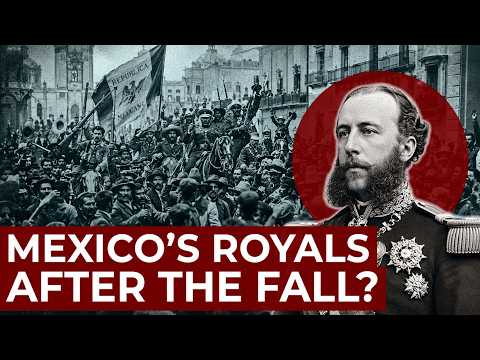
This is the story of what happened to Mexico’s royal family after the empire fell. And trust me, it is one of the strangest, most heartbreaking, and most overlooked stories in the entire Western Hemisphere.
To understand what happened after the empire, we first need to understand how the empire began. And to do that, we need to go back to the early 1800s, when Mexico was not yet a country at all, but a colony of the Spanish crown known as New Spain. For three centuries, Spain had ruled Mexico with an iron fist. The colonial system was designed to extract wealth—silver, mostly—and funnel it back across the Atlantic to Madrid. At the top of the social hierarchy sat the peninsulares, Spaniards born in Spain. Below them were the criollos, people of Spanish blood born in the Americas. And below them, in descending order, were the mestizos, the indigenous populations, and the enslaved. It was a rigid, brutal system that left the vast majority of the population in grinding poverty while a tiny elite lived in splendor.
By 1808, however, something extraordinary was happening back in Europe. Napoleon Bonaparte had invaded Spain, deposed King Ferdinand VII, and placed his own brother, Joseph, on the Spanish throne. This sent shockwaves across the Atlantic. If the king of Spain had been removed, then who exactly was in charge of New Spain? The legitimacy of the entire colonial order had been thrown into question overnight.
In 1810, a parish priest named Miguel Hidalgo rang the bell of his church in the small town of Dolores and issued what became known as the Grito de Dolores—the Cry of Dolores—calling on the people of Mexico to rise up against their Spanish rulers. The Mexican War of Independence had begun. But it would take more than a decade of brutal fighting, shifting alliances, and betrayals before Mexico would finally break free. And the man who ultimately delivered that independence was one of the most contradictory figures in all of Mexican history. His name was Agustín de Iturbide.
Born in 1783 into a wealthy criollo family in the city of Valladolid, Iturbide was no revolutionary. In fact, for the first decade of the independence war, he fought on the side of the Spanish crown. He was a royalist officer—and a highly effective one at that. He crushed rebel forces again and again, earning a reputation for both military brilliance and ruthlessness. He was even responsible for the capture and execution of José María Morelos, one of the most important leaders of the independence movement.
But by 1820, the ground had shifted beneath everyone’s feet. Back in Spain, a liberal revolt forced King Ferdinand VII to reinstate the Constitution of 1812—a document that imposed liberal reforms, limited the power of the Catholic Church, and threatened the privileges of Mexico’s conservative elite. Suddenly, the very people who had spent a decade fighting to keep Mexico under Spanish control found themselves horrified by the direction Spain itself was heading. Independence, which they had resisted for years, now looked like the only way to preserve the social order they depended on.
And so, Iturbide, the royalist general, made his great pivot. In 1821, he reached out to Vicente Guerrero, one of the last remaining rebel commanders, and together they hammered out the Plan de Iguala. The plan promised three guarantees: independence from Spain, the supremacy of the Roman Catholic Church, and equality between criollos and peninsulares. Leading what became known as the Army of the Three Guarantees, Iturbide marched into Mexico City on September 27th, 1821, and the deed was done. Mexico was free.
But free to do what exactly? That was the question that would consume the country for the rest of the century. The Plan de Iguala had actually envisioned inviting a European prince to come and serve as Mexico’s constitutional monarch. But when no European royal was willing to take the job, Iturbide’s supporters took matters into their own hands. On the night of May 18th, 1822, a sergeant named Pío Marcha led a group of soldiers through the streets of Mexico City, chanting Iturbide’s name and demanding that he be crowned emperor. Whether Iturbide himself had orchestrated this display or whether it was genuinely spontaneous is something historians still argue about. But the result was clear. On July 21st, 1822, Agustín de Iturbide was formally crowned as Agustín I, Constitutional Emperor of Mexico.
The coronation was lavish. The cathedral was packed. The regalia was magnificent. But beneath the spectacle, the new empire was already rotting from the inside. Iturbide had inherited a country that was bankrupt, divided, and exhausted by war. The treasury was empty. The military was restless. And the Republican faction in Congress despised the very idea of a monarchy on American soil. Iturbide responded to opposition the way many new rulers do: he dissolved Congress. He imprisoned political opponents. He tried to rule by decree. And in doing so, he alienated virtually every faction in the country.
Within 10 months of his coronation, a young general named Antonio López de Santa Anna—yes, the same Santa Anna who would later become famous for the Alamo—declared against Iturbide. Other military commanders followed. By March of 1823, the emperor was finished. He was forced to abdicate, and the Mexican Congress offered him a deal: he would receive a pension of 25,000 pesos per year, and in exchange, he would leave the country and never return. Iturbide accepted.
On May 11th, 1823, the former emperor boarded a British ship called the Rawlins along with his wife, his children, and a handful of servants, and sailed for Italy. They settled near the port city of Livorno in the Grand Duchy of Tuscany, where Iturbide rented a small country house and began writing his memoirs. But exile was no paradise. Spain pressured the Tuscan government to expel the former emperor, and the Iturbide family was forced to move again—this time to England.
It was in England that things took a fateful turn. Iturbide began receiving letters from supporters back in Mexico telling him that the country was descending into chaos, that a Spanish invasion was imminent, and that the people were crying out for his return. What these supporters didn’t tell him—or what he chose to ignore—was that the Mexican Congress had already declared him a traitor and an outlaw. A decree had been passed stating that if Iturbide ever set foot on Mexican soil again, he would be executed on sight.
Believing himself to be the savior his country needed, Iturbide took his two oldest sons and sailed for Mexico in May of 1824. He landed at the port of Soto la Marina on the coast of the present-day state of Tamaulipas on July 14th. At first, the local population seemed to welcome him, but within hours, soldiers arrived. General Felipe de la Garza, the local military commander, arrested him and escorted him to the nearby village of Padilla. The local legislature held a hasty trial. The outcome was never in doubt. Iturbide was sentenced to death.
On July 19th, 1824, barely five days after setting foot in Mexico, the former emperor stood before a firing squad. According to witnesses, his last words were these: “Mexicans, I die with honor, not as a traitor. Do not leave the stain on my children and my legacy. I am not a traitor.” Three bullets struck him. One was fatal. Agustín de Iturbide, the man who had delivered Mexico its independence, was dead at the age of 40. They buried him in Padilla in a simple grave—in a town that would eventually be submerged beneath the waters of a reservoir. It would be nearly a decade before his remains were exhumed and brought back to Mexico City with full honors under the presidency of Anastasio Bustamante, who in 1838 recognized him as the father of the nation.
But what happened to his family? What happened to the wife, the children, the extended dynasty that had briefly worn the crown of the largest nation in North America? This is where the story becomes truly extraordinary.
Iturbide’s wife, Ana María Huarte, was left a widow in a foreign land with a family of young children and virtually no resources. The Mexican government had promised her husband a pension during his exile, but after his execution, those payments became unreliable at best. The family scattered. Some stayed in the United States. Others moved between Europe and Latin America, living in a kind of genteel poverty that was far removed from the imperial splendor they had once known.
Iturbide had fathered at least ten children, and their fates varied wildly. His eldest son, Agustín Jerónimo, had been designated crown prince and given the title Prince Imperial during the brief months of the empire. After his father’s execution, Agustín Jerónimo lived in exile, moving between the United States and Mexico, never able to reclaim the position that had been promised to him. He died in 1866, having spent most of his adult life as a man without a country.
His second son, Ángel María de Iturbide, would play a far more dramatic role in the family’s later history. Ángel eventually settled in the United States in the Georgetown neighborhood of Washington, DC, where he attended Georgetown University and married an American woman named Alice Green. Alice was no ordinary American. She was the granddaughter of Uriah Forrest, a general in the American Revolutionary War and a former United States Congressman, and the great-great-granddaughter of George Plater, the governor of Maryland. Through Alice, the bloodline of Mexico’s first imperial family became intertwined with the bloodline of America’s founding generation.
But the most dramatic chapter in the Iturbide family’s post-imperial saga was yet to come. Because four decades after the first empire collapsed, Mexico would get a second emperor. And this time, the Iturbide name would be dragged back onto the stage of history in the most unexpected way imaginable.
By the late 1850s, Mexico was tearing itself apart. The War of the Reform—a brutal civil conflict between liberal reformers and conservative defenders of the old order—had left the country exhausted and bankrupt. When the liberal side, led by Benito Juárez, a Zapotec indigenous lawyer from Oaxaca who had risen to become president, took power in 1861, he was forced to suspend payments on Mexico’s foreign debts. This gave three European powers—Britain, Spain, and France—the pretext they needed to intervene.
Britain and Spain eventually negotiated and withdrew their forces. But Napoleon III, the emperor of France, had much grander ambitions. He saw Mexico as a golden opportunity to establish a French-backed empire in the Americas—a Catholic counterweight to the increasingly powerful and Protestant United States. The timing seemed perfect. The United States was consumed by its own civil war and in no position to enforce the Monroe Doctrine, which had warned European powers to stay out of the Western Hemisphere.
In the winter of 1861, French forces stormed the port of Veracruz and began pushing inland. They suffered a famous setback on May 5th, 1862, when Mexican forces under General Ignacio Zaragoza defeated them at the Battle of Puebla—the origin of the Cinco de Mayo holiday. But it was only a temporary victory. French reinforcements arrived, and by June of 1863, Mexico City had fallen to the invaders.
Now Napoleon III needed a figurehead. He needed a European prince willing to sit on the Mexican throne and lend an air of legitimacy to what was in reality a military occupation. His choice fell on Archduke Ferdinand Maximilian of Habsburg, the younger brother of Emperor Franz Joseph of Austria. Maximilian was 31 years old—tall, blonde, idealistic, and utterly naive about the realities of Mexican politics. He was also deeply unhappy in his current role as governor of the Lombardo-Venetian Kingdom, a position that gave him a taste of power but no real authority.
When the Mexican delegation arrived at his castle of Miramare overlooking the Adriatic Sea near Trieste and offered him the crown, Maximilian was intrigued. His wife, Princess Charlotte of Belgium—known in Mexico as Carlota—was even more enthusiastic. Charlotte was the daughter of King Leopold I of Belgium, a woman of fierce intelligence and burning ambition who had chafed under the limitations placed on royal women. The prospect of becoming an empress—of actually ruling a country—consumed her. She urged Maximilian to accept.
And so, on April 10th, 1864, Maximilian formally accepted the crown. He and Carlota sailed for Mexico, arriving at Veracruz on May 28th. From the very beginning, the signs were ominous. The port was sweltering, disease-ridden, and virtually deserted. The expected cheering crowds had not materialized. As the imperial couple made their way inland toward Mexico City, they discovered that their so-called empire was really just a patchwork of territory held together by French bayonets. Outside the areas controlled by French troops, Juárez’s republican government continued to function, and guerrilla resistance was constant.
But Maximilian pressed on—and here is where the story of the Iturbide family re-enters the picture in the most surprising way. Maximilian and Carlota were unable to have children. The exact reasons remain a subject of historical speculation, but the fact was undeniable: they had no heir, and for a monarchy, no heir means no future. Maximilian knew he needed to solve this problem, and he devised a solution that was both politically shrewd and deeply cruel. He turned to the Iturbide family. Specifically, he turned to Ángel María de Iturbide, the second son of the first emperor, who was living in Mexico City with his American wife Alice and their young son, also named Agustín.
The child, Agustín de Iturbide y Green, was born on April 2nd, 1863, in Mexico City. He was a toddler—barely two years old—when Maximilian approached the family with a proposition. He wanted to adopt the boy and raise him as his own heir. The logic from Maximilian’s perspective was straightforward. By adopting the grandson of Mexico’s first emperor, he could link his own Austrian-imposed monarchy to the indigenous tradition of Mexican imperialism. It would give his regime a veneer of Mexican legitimacy that it desperately lacked.
Ángel María agreed with enthusiasm. His wife Alice did not. By most accounts, Alice was reluctant—even anguished—at the prospect of handing over her only son to a foreign monarch. But the pressure was immense. The family was offered a pension and the promise that young Agustín would be raised as a prince. In the end, Alice relented. On September 16th, 1865, Maximilian issued an imperial decree granting the title of Prince of Iturbide with the style of Highness to both young Agustín and his 16-year-old cousin, Salvador de Iturbide y Marzán. The two boys were ranked immediately after the reigning family in the order of precedence.
Maximilian appeared to be grooming young Agustín as a potential heir to the throne. But even this arrangement was more complicated than it appeared. Privately, Maximilian had reservations about the Iturbide family. He believed they were not of sufficiently royal blood to truly inherit a European-style monarchy. The adoption was in many ways a temporary political maneuver—a way to buy legitimacy. While Maximilian hoped for a more permanent solution, that permanent solution never came. Because Maximilian’s empire was already dying.
By 1866, the situation had become desperate. The American Civil War had ended, and the reunited United States was now openly hostile to the French presence in Mexico. Washington began supplying Juárez’s forces with weapons and diplomatic support and pressured Napoleon III to withdraw his troops. Facing the growing threat of a confrontation with Prussia in Europe, Napoleon agreed. He told Maximilian that France would pull its army out of Mexico.
Carlota was frantic. She sailed for Europe in a last-ditch effort to save the empire, going first to Paris to beg Napoleon for help and then to Rome to plead with Pope Pius IX. Neither man could—or would—help her. And it was during this desperate mission that something broke inside Carlota’s mind. She began exhibiting signs of severe mental illness: paranoia, delusions, and an irrational fear that she was being poisoned. During her audience with the Pope, she reportedly refused to eat or drink anything that hadn’t been prepared in her presence. She dipped her fingers into a cup of hot chocolate and licked them because she was starving but terrified of being poisoned. She refused to leave the Vatican, becoming reportedly the first and only woman to sleep overnight in the papal apartments.
Her brother, Prince Philippe, Count of Flanders, eventually came to collect her. Carlota was taken back to Miramare Castle and placed under the care of doctors who diagnosed her with what they described as persecution mania. She would never recover. For the next 60 years—60 years—Carlota lived in seclusion, first at Miramare and then at the Château of Bouchout near Brussels. Dynasties fell, republics rose, the automobile was invented, airplanes took flight, the First World War came and went, and through all of it, the former empress of Mexico sat in her castle, lost in a world that no longer existed, reportedly still believing she was waiting for her husband to return.
Her nurses discovered that the only thing that could calm her during her most agitated moments was the sound of La Paloma, a popular Mexican song. Even in the depths of her madness, Mexico still lived somewhere inside her. Carlota died on January 19th, 1927, at the age of 86. She had outlived her husband by exactly 60 years.
And what of Maximilian himself? He refused to abandon Mexico even after the French withdrawal—whether this was courage, stubbornness, or simple inability to face reality, historians have debated for over a century and a half. With a dwindling force of Mexican conservative loyalists, he retreated to the city of Querétaro in early 1867. The Republican forces, led by General Mariano Escobedo, laid siege to the city. On May 15th, Querétaro fell. Maximilian was captured on the Cerro de las Campanas—the Hill of the Bells.
Benito Juárez, a man who had spent years fighting for the survival of the Mexican Republic, was in no mood for mercy. Despite personal appeals from heads of state across Europe—including the emperor of Austria, the king of Prussia, and even Queen Victoria—Juárez ordered that Maximilian be tried by a military court. The verdict was death.
On the morning of June 19th, 1867, Maximilian stood before a firing squad on the same Hill of the Bells where he had been captured. According to multiple witnesses, Maximilian’s last words, spoken in Spanish, were these: “I forgive everyone, and I ask everyone to forgive me. May my blood, which is about to be shed, be for the good of the country. Long live Mexico! Long live independence!” The soldiers fired. Maximilian fell. The Second Mexican Empire was over.
His body was embalmed and put on display in Mexico. It was not until January of 1868 that an Austrian admiral arrived to transport the remains back to Vienna, where they were interred in the Imperial Crypt alongside generations of Habsburg rulers.
Now, with both emperors dead, with Carlota locked away in a Belgian castle, with the republic restored under Juárez, the question became: what happened to the family that had been caught in between? What happened to the Iturbide children—to the adopted prince—to the scattered descendants of Mexico’s brief, bloody experiment with monarchy? The answer is both simpler and stranger than you might expect.
When it became clear that Maximilian’s regime was collapsing, the emperor sent young Agustín de Iturbide y Green—the toddler he had adopted—to Havana, Cuba, to be reunited with his biological parents. Alice Green finally had her son back. The family eventually returned to the United States, settling in Washington, DC, where Ángel María took a position at the Mexican embassy. Ángel died in 1872, leaving Alice to raise young Agustín on her own. She did so at Rosedale, the Georgetown estate that had been in her family for generations—built by her great-grandfather, General Uriah Forrest.
And so, the grandson of Mexico’s first emperor and the adopted heir of Mexico’s second emperor grew up not in a palace, but in a comfortable American house in the Georgetown neighborhood of the American capital. He attended Georgetown University, where he earned a degree, and later enrolled briefly in a Mexican military academy. Young Agustín harbored dreams of restoring the monarchy. He returned to Mexico during the long dictatorship of Porfirio Díaz, hoping to advance the monarchist cause. But Díaz, who had fought against Maximilian as a Republican general, had no interest in sharing power with a pretender to a throne that no longer existed. When Agustín began criticizing the regime, Díaz had him expelled from the country around 1890.
And so, the last prince of Mexico returned to Georgetown. He took a position as a professor of Spanish and French at his alma mater, Georgetown University, where he taught for years. He married twice—first to Lucy Eleanor Jackson in 1894, and later to Mary Louise Kearney in 1915. He had no children from either marriage. He died of tuberculosis on March 3rd, 1925, in Washington, DC, at the age of 61. He was buried at the Roman Catholic Church of St. John the Evangelist in Philadelphia. And with his death, the direct male line of the adopted imperial princes went silent.
But the broader Iturbide family did not disappear. Young Agustín’s cousin, Salvador de Iturbide y Marzán—the other boy who had been granted the title of Prince of Iturbide by Maximilian—had also survived the fall of the Second Empire. Salvador lived a long life, dying in 1921, and through his descendants, the family line continued. Salvador’s granddaughter, María Josefa Sofía de Iturbide, eventually became the head of the House of Iturbide. She married an Austrian count named Baron von Gudenus, and through their descendants, the family lineage continued into the 20th century and beyond—though through the female line rather than the male one.
Today, the current head of the Imperial House of Mexico is a man named Maximilian von Götzen-Iturbide. Born in 1944, his story is almost comically far removed from the drama and bloodshed of his ancestors. After the Second World War, the family settled in South America. Maximilian’s father died in 1956 in Caracas, Venezuela. His mother remarried, and the family eventually moved to Australia. Maximilian was educated at Hawtreys, a preparatory school in England. He worked as a stockbroker. He has real estate interests in the Mexican cities of Morelia and Guadalajara. Around 2010, he retired to Spain.
As a direct descendant of Emperor Agustín, Maximilian von Götzen-Iturbide is, technically speaking, the rightful head of Mexico’s former imperial house. But he does not pursue any claim to the throne. He does not use his Mexican royal title. He has stated publicly that his only political interest is the legacy and reputation of his ancestor Agustín de Iturbide—the liberator of Mexico. Maximilian has two children. His son, Fernando Leopoldo—known casually as Freddy—was born in 1992. His daughter, Emanuela Isabella, was born in 1997. Fernando holds the historical titles of Imperial Prince of Mexico and Count von Götzen, but these titles carry no legal recognition whatsoever in modern Mexico. They are historical curiosities—relics of a world that vanished more than a century and a half ago.
And yet—and yet—there are people in Mexico who care about these things. There is a small but persistent monarchist movement that keeps one eye on the Iturbide descendants, particularly on the young and photogenic Fernando. They maintain websites and social media accounts. They argue that Mexico would be better served by a constitutional monarchy than by the republic it has had for the past two centuries. They point to the corruption, the instability, the drug violence, and they ask whether a different form of government might produce different results. Whether this is a serious political movement or merely a historical hobby is debatable. But the fact that it exists at all tells you something about the enduring power of the monarchical idea—even in a country that has violently rejected it twice.
What makes the story of Mexico’s royal family so compelling is not just the drama of it—though the drama is considerable. It is the way the story illuminates larger questions about power, legitimacy, and identity that Mexico is still grappling with today. Think about it. Mexico has had two empires, dozens of revolutions, a 71-year-long one-party state, and a transition to multi-party democracy that is still very much a work in progress. The country’s relationship with its own history is deeply complicated. Iturbide is simultaneously celebrated as the father of Mexican independence and condemned as a power-hungry tyrant who dissolved Congress and tried to make himself king. Maximilian is both the foreign interloper who violated Mexican sovereignty and the well-meaning idealist who tried to implement liberal reforms—like land redistribution and religious freedom—that angered his own conservative supporters. And then there is Carlota. Poor, brilliant, ambitious Carlota. A woman who believed she could be an empress, who worked tirelessly to improve agricultural conditions and indigenous affairs, who wrote passionately about the failures of previous Mexican governments to serve their own people, and who was rewarded for all of it with 60 years of madness in a Belgian castle.
Her nurses said that toward the end, the only thing that could soothe her was the sound of a Mexican melody. The country had broken her, but she could never let it go.
The Iturbide Palace itself still stands in the heart of Mexico City on Madero Street. It is no longer a royal residence. Today, it functions as a cultural center, housing exhibitions on Mexican art and history. Tourists walk through its grand halls, take photographs of its ornate facade, and most of them have no idea that the building was once home to the man who freed Mexico from Spain—and then lost everything.
The story of Mexico’s royal family is, in many ways, the story of Mexico itself. A country that has always been caught between competing visions of what it should be. Indigenous or European. Monarchist or republican. Conservative or liberal. Traditional or modern. Every generation has fought over these questions, and every generation has paid a price for the answers. The Iturbide family paid more than most. They went from the heights of imperial power to exile, execution, poverty, and obscurity in the space of a single generation. Their descendants were scattered across four continents. Their titles became meaningless. Their palaces became museums. But the family survived—through wars and revolutions, through exile and adoption, through madness and tragedy, through the slow erosion of relevance that comes with the passage of time.
The descendants of Mexico’s royal house are still here. A stockbroker in Spain. A young man called Freddy with a title that exists only in history books. A castle in Belgium where an empress once sat alone, humming La Paloma to herself in the dark.
There is a final irony to this whole story that is worth sitting with. When Agustín de Iturbide stood before the firing squad in 1824, his last words were a plea: “Do not leave this stain on my children and my legacy.” He was asking Mexico to remember him as a patriot, not a traitor. And for a long time, Mexico chose traitor. It took 14 years for his remains to be brought back to the capital with honors. It took even longer for his role in independence to be officially acknowledged. Today, Iturbide occupies a strange and uncomfortable place in Mexico’s national memory. He is not ignored, exactly, but he is not celebrated the way Hidalgo or Morelos or Juárez are celebrated. His name is inscribed in gold letters in the Mexican Congress alongside the other heroes of independence. But his legacy is forever complicated by the fact that he tried to make himself king.
And that, perhaps, is the most Mexican thing about this entire story. A hero who was also a villain. A liberator who was also a tyrant. A family that was given everything and then had it all taken away. A country that still has not quite decided what to make of its own past.
So here is the question I leave with you: If Mexico’s forgotten royals returned tomorrow—not to rule, but simply to be remembered—would the country welcome them home, or would it reach once more for the firing squad? Let me know your thoughts in the comments below.
Report this article
Select a reason for reporting:






