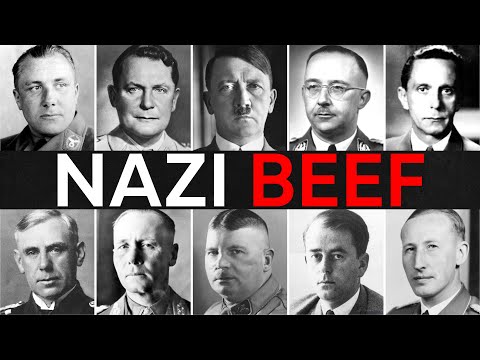
Power didn’t unite the Nazis—it devoured them. Behind every staged parade and stiff-armed salute, a knife was already angled at someone’s back. Generals sneered at ideologues, ministers plotted against murderers, and all of them clawed for the Führer’s ear while the war burned around them. These weren’t petty squabbles. They were catastrophic rivalries that twisted strategy, shattered alliances, and helped doom the regime from within.
This is the untold story of 33 feuds that shaped and sabotaged Nazi Germany. And no, the real enemy was never just the Allies. It was each other.
Adolf Hitler didn’t trust professionals, especially not the kind with medals and maps. As soon as he consolidated power, he began carving up the Wehrmacht like a Sunday roast, keeping the juiciest cuts for himself. The generals—old-school, Prussian, and annoyingly competent—were slowly pushed aside for yes-men in tailored uniforms. Hitler’s obsession with total control led to disastrous decisions: from the halted tanks at Dunkirk to the frozen corpses outside Moscow. The generals fumed in silence, scribbling frustrations into diaries they hoped wouldn’t be discovered. But Hitler didn’t just want victory. He wanted obedience—and he got it, even if it cost him the war.
Of course, if Hitler distrusted the Wehrmacht, wait until you see how he handled the man who built his own secret empire within the regime.
Heinrich Himmler and Hermann Göring. Two men, two empires, one dictator. Göring had the Luftwaffe, the Four-Year Plan, and an ego bigger than his velvet train car. Himmler had the SS, a personal police state, and a talent for bureaucratic backstabbing. Their feud was less a cold war than a slap fight in slow motion. Göring saw Himmler as a jumped-up chicken farmer. Himmler saw Göring as a drugged-up buffoon. They both saw Hitler as a god, which made their war for his affection all the more pathetic—and dangerous.
Göring tried to block Himmler’s rise through ridicule. Himmler responded with dossiers and quiet eliminations. And in the middle of it all, a man with a limp, a sneer, and an intelligence network sharper than either of theirs.
Wild that this all happened inside the same regime, right? And we’re only getting started.
Joseph Goebbels versus Hermann Göring. Göring fancied himself untouchable until Goebbels turned public morale into a weapon. After the Luftwaffe failed to stop the Allied bombings, Goebbels used propaganda to paint Göring as the bloated failure behind it all. Göring in turn dismissed Goebbels as a club-footed gossip merchant who never fired a shot. But words can bleed more than bullets. Goebbels controlled the narrative, and Göring’s reputation crumbled under it. Their sniping wasn’t just personal—it was structural. While cities burned, they argued over headlines. The real casualty was coordination.
But Goebbels had more enemies than just Göring. One of them sat across the table at SS headquarters, smiling too hard.
Heinrich Himmler versus Reinhard Heydrich. Himmler built the SS, but Heydrich made it terrifying. Cold, brilliant, and disturbingly efficient, Heydrich became the sharp end of Himmler’s empire. And that was the problem. Himmler wasn’t used to being outshone. He watched Heydrich climb, gaining control over the SD, foreign intelligence, and eventually the reins of occupied Bohemia. Too fast, too competent, too ambitious. Himmler responded like any insecure bureaucrat: by plotting. He kept Heydrich close, praised him publicly, and quietly trimmed his wings behind closed doors. It was a slow war of sabotage waged with memos and half-hearted praise. Heydrich wasn’t fooled—but then again, neither was his next rival, an old-school spy who didn’t play by SS rules.
Reinhard Heydrich versus Wilhelm Canaris. This wasn’t a feud. It was a shadow war. Heydrich led the SS’s intelligence wing. Canaris ran the military’s Abwehr. They were supposed to work together. Instead, they sabotaged each other’s agents, forged dossiers, and fed Hitler conflicting reports. Canaris, cultured and subtle, loathed the SS’s brutality. Heydrich, cold and calculating, saw Canaris as a traitor in tweed. Their rivalry derailed real intelligence efforts, blurred battle lines, and endangered countless operations. Eventually, Heydrich tried to absorb the Abwehr altogether. Canaris resisted and started playing a much riskier game: quiet sabotage. But Heydrich wouldn’t live long enough to win this war. And once he was gone, the knives turned inward toward the one man who thought his position was unshakable.
Adolf Hitler versus Hermann Göring. By 1945, Hitler had no illusions left about Göring. The Luftwaffe was a smoking wreck. The Allied bombers were flying unopposed. And Göring, once his golden boy, was lounging in palaces, gobbling morphine and venison. As Berlin collapsed, Göring made a fateful move. He suggested taking over leadership, citing Hitler’s incapacity. Hitler exploded. Accusations of treason flew, and Göring was stripped of all titles. Once heir apparent, now a disgraced exile. The final insult: he wasn’t even worth executing. Hitler’s trust had become a weapon, bestowed and revoked like oxygen.
And as Göring fell, another rival moved in to dismantle what remained of his legacy, one spreadsheet at a time.
Göring versus Albert Speer. Albert Speer didn’t need a uniform to wage war. He wore suits. He talked like an architect, but he knew how to destroy a rival. Göring, bloated with privilege and failure, made for an easy target. Speer exposed his corruption, mocked his lavish spending, and ruthlessly audited the Luftwaffe’s mismanagement. Göring retaliated by cutting Speer out of key war economy discussions, blocking access to materials, and accusing him of overreach. But by then, Speer had already secured Hitler’s trust. He promised results: efficiency, armaments delivered on time. Hitler listened because at least Speer could get trains to run and tanks to move.
Their feud turned logistical coordination into bureaucratic sabotage. Factories lacked steel because two offices hoarded it from each other. Production targets fell short while Göring and Speer gave conflicting orders. The war machine limped on, crippled not by Allied bombing, but by infighting between two men who hated losing more than they hated each other.
And while they fought over steel and oil, another war brewed closer to Hitler’s ear—a silent one fought with memos, whispers, and proximity. It was the battle for the Führer’s soul.
Himmler versus Martin Bormann. One built a secret police empire. The other built Hitler’s schedule. And yet, in the final years of the Reich, Martin Bormann—not Heinrich Himmler—was the man closest to Hitler’s inner circle. It wasn’t because Bormann was charismatic. It was because he was always there, always whispering, always watching. Himmler hated him, despised his power, but he couldn’t prove anything. Bormann worked in shadows, feeding Hitler doubts about the SS’s growing independence, blocking Himmler’s requests, undermining his policies with administrative sabotage. To the world, Himmler controlled half of Europe. But in Berlin, Bormann controlled the doors to Hitler’s office.
Their feud destabilized everything. Orders were delayed or reversed. Appointments were cancelled or reshuffled. One man commanded the Gestapo. The other commanded Hitler’s attention. Guess which one mattered more in a dictatorship fueled by paranoia. As Himmler fumed in silence, Bormann’s influence only grew—until eventually Göring wasn’t the only one being edged out. Himmler would soon find himself alone as everyone else closed in. And the man sharpening the knife wasn’t wearing a uniform at all.
Martin Bormann versus Hermann Göring. There’s a saying: if you control the calendar, you control the kingdom. Martin Bormann didn’t wear medals. He didn’t command armies. And he didn’t scream in speeches. But he did control who saw Hitler and for how long. And slowly, methodically, he used that access to dismantle Hermann Göring. To Bormann, Göring was the embodiment of everything wrong with the regime’s upper crust: decadent, lazy, and dangerously independent. Bormann worked behind the curtain. He fed Hitler a steady drip of whispers about Göring’s opulence, his failures, his vanishing relevance. And Hitler, ever paranoid, started to believe them.
While Göring was entertaining foreign diplomats or inspecting imaginary Luftwaffe projects, Bormann was erasing him. One policy, one conversation, one office memo at a time. Göring found himself isolated from strategy meetings, dismissed in planning discussions, and increasingly irrelevant. This wasn’t just a feud. It was a quiet assassination of influence. By 1945, Göring had become a ceremonial figure—puffed up with titles and stripped of power. All thanks to a man who never raised his voice, never raised a gun, and never let Göring into the room where it happened.
And Bormann wasn’t done. Next up on his bureaucratic chopping block: the regime’s self-proclaimed philosopher and chief.
Joseph Goebbels versus Alfred Rosenberg. At first glance, Joseph Goebbels and Alfred Rosenberg were ideological allies. Both believed in the Nazi racial mythos. Both were intellectuals of a kind, and both sought to define what the Reich should think. But the overlap was the problem. Goebbels wanted to control propaganda. Rosenberg wanted to control ideology—and neither could stand sharing. Rosenberg saw himself as the deeper thinker, the high priest of Nazi metaphysics. Goebbels saw Rosenberg as a bore with a book fetish and zero political instinct. When Rosenberg published his ponderous tome, The Myth of the Twentieth Century, Goebbels privately mocked it, then publicly outmaneuvered him by dominating the airwaves and the newspapers.
Their feud escalated over the East. Rosenberg was appointed to manage the occupied territories. Goebbels accused him of being too soft, too idealistic, too slow. Rosenberg shot back that Goebbels was undermining his policies through sensationalist propaganda that inflamed unrest. The result: a bureaucratic tug-of-war that left entire regions in chaos. Ideological clarity was supposed to be the Nazi regime’s selling point. But with Goebbels and Rosenberg locked in academic warfare, even that collapsed into contradiction.
And while they argued over theory, one man was turning battlefield victories into public legend.
Hermann Göring versus Erwin Rommel. Rommel was a general. Göring was a politician playing dress-up. That alone would have been enough for friction. But the real problem was this: Rommel won battles. And Göring, especially by the early 1940s, had mostly lost them. Rommel, commanding the Afrika Korps, became a media sensation—daring maneuvers, charismatic leadership, tactical brilliance. And while Goebbels turned him into a myth, Göring saw a threat. Rommel’s popularity eclipsed his own. The Desert Fox was what Göring once was: admired, decisive, and effective.
Behind the scenes, Göring seethed. He delayed air support for Rommel’s North Africa campaign. Resources were mysteriously diverted. Requests were ignored. Rommel’s supply lines, already stretched thin, collapsed further—compromised not just by geography, but by Göring’s quiet sabotage. Rommel, ever the soldier, kept his complaints measured. But his disdain was real. He saw Göring as corrupt, self-serving, and strategically useless. Their silent feud didn’t just hurt their reputations. It crippled the war in Africa. And Rommel’s enemies weren’t just British. They were inside his own command chain.
But his battles weren’t limited to Göring. Even within the army, Rommel’s style put him at odds with another towering figure.
Erwin Rommel versus Gerd von Rundstedt. Rommel moved fast; Rundstedt didn’t. One was bold, instinctive, and media-savvy. The other was old-school, deliberate, and allergic to drama. Both were tasked with defending Western Europe from Allied invasion, but agreed on almost nothing. Rommel believed the Allies had to be stopped at the beach immediately, aggressively, with everything the Germans had. Rundstedt thought that was reckless. He wanted to lure them inland, then counterattack with reserve forces. Their clashing philosophies turned into clashing egos. Meetings became arguments. Plans stalled. Hitler, indecisive as always, refused to pick a side.
The result was the defense of France in 1944: a patchwork of contradictory strategies compromised by internal bickering. When D-Day came, chaos reigned. Orders were delayed. Units were mispositioned. And while Rommel tried to salvage the disaster, Rundstedt issued bitter reports blaming everyone but himself. Their feud wasn’t about terrain. It was about control. And it left the Atlantic Wall with cracks wide enough for history to walk through.
But Rommel wasn’t the only general Hitler didn’t trust. There was another—more cerebral, more dangerous in his mind—and their clashes would change how tanks rolled across Europe.
Adolf Hitler versus Heinz Guderian. Guderian invented Blitzkrieg—at least the parts that worked. He was a tank visionary, a motorized warfare evangelist, and a general who thought speed was the key to everything. But Hitler didn’t like speed. He liked control. As the war dragged on, Guderian’s frankness made him a problem. He criticized decisions. He demanded flexibility. He asked dangerous questions like, “What if we retreat instead of die gloriously?” Hitler didn’t take that well.
Their arguments grew louder, more personal, more public. Guderian was made chief of the general staff in 1944—too late, too limited, and only because Hitler was running out of options. But even then, they clashed over everything: strategy, logistics, priorities. Hitler saw every retreat as betrayal. Guderian saw them as survival. Eventually, Guderian was dismissed again, and the tank divisions he once led were fragmented, misused, and ground into dust. The man who’d built the Blitzkrieg was now an enemy of the very system it empowered.
And where Guderian used speed, the next man tried something even more dangerous: independent thought.
Hitler versus Franz Halder. Franz Halder was everything Hitler wasn’t: measured, rational, and terminally allergic to theatrics. As chief of the army general staff, Halder tried to impose order on Hitler’s increasingly erratic military fantasies. It didn’t go well. The more Halder questioned, the more Hitler raged, and what began as policy disagreement quickly spiraled into ideological warfare. Halder kept detailed diaries where he recorded the growing madness in the Führer’s strategy. He clashed with Hitler over Operation Barbarossa, criticized unrealistic troop deployments, and openly doubted Hitler’s numbers. Eventually, his intellectual defiance sealed his fate. In 1942, after one clash too many, Hitler dismissed him.
The loss was more than personal. With Halder gone, the Wehrmacht lost its last real strategic planner. What followed was a chain of yes-men, echoing Hitler’s fantasies instead of challenging them. The machine kept running—but with no one steering it.
And while Halder was forced into obscurity, another internal feud was dragging the entire Navy into the depths.
Adolf Hitler versus Admiral Dönitz versus Admiral Raeder. Nazi Germany never quite figured out what it wanted the Kriegsmarine to be—because its admirals couldn’t stop fighting each other. Erich Raeder wanted a traditional surface fleet: battleships, cruisers, prestige. Karl Dönitz wanted U-boats: stealth, disruption, chaos. And Hitler? He wanted results and had little patience for naval nuance. Raeder pushed for grandiose shipbuilding projects, most of which never reached completion. Dönitz argued for a lean, aggressive U-boat campaign to starve Britain into submission. Hitler oscillated between the two, siding with whoever sounded more promising at the time.
But beneath it all, the feud between Dönitz and Raeder tore the Navy in two. Raeder saw Dönitz as reckless. Dönitz saw Raeder as outdated. The result: wasted resources, conflicting strategies, and delayed operations. Eventually, Raeder was pushed out. Dönitz took command. But by then, the U-boat war had peaked, and Allied countermeasures were already turning the tide. The Kriegsmarine became a ship adrift—not because it lacked hardware, but because its leaders couldn’t row in the same direction.
Meanwhile, another power struggle was igniting on dry land between two of the regime’s most ideological fanatics.
Heinrich Himmler versus Alfred Rosenberg. Rosenberg had the vision. Himmler had the guns. The feud between the SS chief and the Nazi Party’s chief ideologue was less about personality and more about territory—specifically, the ideological and administrative control over the conquered East. Rosenberg, as Reich Minister for the Occupied Eastern Territories, wanted to implement a grand civilizational overhaul: Germanic settlements, local puppet governments, and a bizarre fusion of racial theory and governance. Himmler wanted none of that. He wanted total SS control. His plan was simple: dominate, colonize, and rule through terror.
The two constantly undercut each other. Rosenberg issued decrees. Himmler ignored them. Himmler made arrests. Rosenberg protested. SS commanders operated outside Rosenberg’s chain of command, leaving the East a chaotic mess of overlapping fiefs. It was an ideological turf war—and the turf was an entire continent. Neither man won, but the local populations lost everything in the resulting vacuum.
And while Rosenberg wrote long treatises, another rivalry was about to make its impact felt right at the heart of Nazi Germany: Berlin.
Göring versus Goebbels over Berlin. Berlin was more than just a city. It was a symbol. And Goebbels, the master of symbols, wanted full control. As Gauleiter of Berlin, he envisioned the capital as a fortress of propaganda and resistance. Göring, however, wasn’t interested in sharing. He still wielded influence through his positions and refused to yield administrative control. Goebbels accused Göring of neglecting Berlin’s defense, of hoarding resources, of treating the capital like an afterthought. Göring retaliated by stalling Goebbels’s projects, redirecting supplies, and ridiculing his increasingly apocalyptic speeches.
Their feud came to a head as Allied bombs flattened the city. Instead of working together to fortify Berlin or manage its population, they fought over narratives, logistics, and ego. Goebbels tried to inspire resistance. Göring tried to preserve what little power he had left. Their failure to cooperate directly impacted Berlin’s fall.
And as the city burned, another power struggle intensified—this time between two men who each claimed to be Hitler’s most loyal disciple.
Himmler versus Goebbels. It was a loyalty contest with no prize. Both Heinrich Himmler and Joseph Goebbels styled themselves as Hitler’s most faithful follower. But loyalty in the Third Reich wasn’t measured in devotion. It was measured in access, control, and whose whispers Hitler believed most. Goebbels had the microphone. Himmler had the manpower. Each tried to undermine the other. Goebbels painted Himmler as a cold administrator disconnected from the people. Himmler portrayed Goebbels as a manipulator who distorted Hitler’s vision. They jockeyed for Hitler’s attention like squabbling courtiers in a decaying palace.
Their rivalry grew toxic. Orders conflicted. Messages contradicted. Coordination collapsed. Even in Hitler’s final months, they were still competing. Goebbels with grand speeches about martyrdom. Himmler with secret negotiations behind Hitler’s back. Ironically, both men claimed to serve the same master, but their feud ensured that the regime they served would fall apart from the inside long before the Allies finished it from the outside.
And when Goebbels faded into fanaticism, another man stepped up—not to save the Reich, but to outlast it.
Hitler versus Speer. Albert Speer, Hitler’s so-called architect of the apocalypse, wasn’t supposed to become the adult in the room. But by the final years of the war, he was one of the few still capable of rational thought. As Minister of Armaments, Speer prioritized efficiency, logistics, and infrastructure—even as the world around him collapsed. And that, in Hitler’s eyes, made him dangerous. Their feud came to a head over the infamous Nero Decree—Hitler’s plan to destroy all German infrastructure to prevent Allied use. Speer resisted, argued, stalled. He secretly instructed officials to ignore the order. This wasn’t mercy. It was pragmatism. Speer believed that if Germany was to have any future, something had to survive.
Hitler saw this as betrayal. Speer saw it as damage control. They clashed bitterly in their final meetings, trading cold stares and colder words. Speer, once a golden boy, had become a reluctant saboteur of Hitler’s vision. The war wasn’t just lost on the battlefield. It was lost in those final conversations where even Hitler’s most competent loyalists stopped believing.
But the cracks weren’t limited to ministerial feuds. The army itself had become a contested ground—and the SS wanted it all.
Himmler versus the Wehrmacht leadership. The Wehrmacht and the SS were never meant to coexist peacefully. One was the professional military establishment. The other was a fanatical paramilitary force loyal only to Himmler. And as the war dragged on, their rivalry turned into a full-blown civil war inside the Nazi war machine. Himmler constantly sought to undermine Wehrmacht authority. He created parallel SS units, often better funded and fanatically loyal. In the field, SS commanders refused to take orders from army generals. On paper, it was coordination. In practice, it was sabotage. Campaigns were misaligned, supplies misallocated, and operations compromised.
The Wehrmacht leadership, already struggling with Hitler’s interference, now had to deal with a rival military structure that played by different rules and answered to a different master. Himmler’s ambitions weren’t just administrative. He wanted to turn the SS into the dominant force in Germany—militarily, ideologically, spiritually. The result was chaos: fractured command, strategic incoherence, and growing resentment within the officer corps.
And while generals argued with SS officers, another quieter feud was undermining the Nazi propaganda machine itself.
Goebbels versus the Wehrmacht propaganda office. Goebbels wanted a monopoly on the truth—or at least the illusion of it. As Minister of Propaganda, he believed that all media, messaging, and morale belonged under his control. But the Wehrmacht had its own propaganda office, staffed by officers, photographers, and writers embedded at the front. They didn’t take orders from Goebbels, and that drove him mad. The feud was bureaucratic at first: requests denied, messages altered, stories contradicted. But as the war turned against Germany, Goebbels became more aggressive. He accused the military office of defeatism, of undermining morale, of spreading reports that contradicted his carefully curated narratives. The Wehrmacht’s office, for its part, saw Goebbels as a meddling outsider with no respect for battlefield realities. Their footage showed retreats. Goebbels wanted victories. Their reports mentioned casualties. Goebbels wanted triumph.
The result was a surreal media landscape where different parts of the same regime contradicted each other—sometimes in the same broadcast. But the damage wasn’t just informational. It was institutional. Because if propaganda couldn’t coordinate, who could?
And speaking of coordination, Himmler had his own problems keeping his house in order.
Himmler versus SS generals—notably Kurt Daluege. Heinrich Himmler built the SS like a Gothic cathedral: cold, hierarchical, absolute. But inside its stone walls, cracks began to form. Some of the cracks had names—like Kurt Daluege, head of the Ordnungspolizei, who resented Himmler’s centralization of power. Others were nameless tensions, turf wars, operational disputes, ideological schisms. Daluege had his own ambitions. He commanded a massive police apparatus and viewed himself as more than just a subordinate. When Himmler began pulling authority away, merging units, restructuring chains of command, Daluege pushed back. Not openly, of course. This was the SS. Rebellion came wrapped in memos and protocol.
Himmler responded with typical coldness. He reassigned rivals, promoted loyalists, and quietly isolated those who questioned his supremacy. But the infighting slowed everything. Orders became convoluted. Jurisdictions overlapped. Internal politics trumped efficiency. Even in a system built for terror, ego got in the way.
And while Himmler policed his own empire, another leader found himself at war with everyone around him—including the men who were supposed to fly for him.
Göring versus the Luftwaffe generals—Kesselring, Milch. Göring wanted loyalty. His Luftwaffe generals wanted functionality. And that contradiction tore the German air force apart. Men like Albert Kesselring, Erhard Milch, and Hans Jeschonnek were professionals: ambitious, opinionated, and increasingly frustrated with Göring’s vanity-driven decisions. Göring micromanaged campaigns, inflated reports, and blamed failures on his subordinates. When the Luftwaffe failed in the Battle of Britain, he scapegoated his own generals while still dressing like Napoleon at a costume party. Jeschonnek, one of his closest advisers, bore the brunt of the blame and the pressure. Milch tried to implement reforms, streamline production, and centralize aircraft development. Göring blocked him, fearing any success would outshine his own legacy. Kesselring, a brilliant tactician, was often sidelined or second-guessed.
Internal trust eroded. Strategy collapsed. The Luftwaffe’s failures weren’t just due to Allied strength. They were the result of broken leadership, internal rivalries, and an unspoken civil war within its own ranks. And the man trying to fix that from the outside was none other than Speer. But their next clash wasn’t about tactics. It was about who would control the very machinery of war.
Göring versus Speer over resources. By 1943, Nazi Germany wasn’t just losing territory. It was losing metal, oil, and time. That made resources the new battlefield—and two men prepared to fight over it: Hermann Göring, commander of the bloated and crumbling Four-Year Plan, and Albert Speer, technocrat and chief of Nazi industry. One clung to chaos, the other sold efficiency, and neither could stand the other’s style. Speer had numbers, schedules, flowcharts. Göring had whims and warehouses full of misallocated scrap. Speer streamlined factories, centralized production, and made cold decisions based on output. Göring threw tantrums, diverted supplies, and micromanaged industries he didn’t understand. Speer saw Göring as a relic from a carnival. Göring saw Speer as a glorified accountant with delusions of power.
Their rivalry choked the war economy. Factories lacked steel because Göring’s ministries hoarded it. Speer’s production plans collapsed when Göring rerouted coal shipments. Even Hitler, increasingly dependent on Speer’s results, refused to fully cut Göring off, allowing both men to wage an administrative war in the shadows. As German tanks stalled and planes rusted on the ground, the real battle wasn’t with the Allies. It was between a bureaucrat with a vision and a warlord with a title.
And they weren’t the only ones treating occupied territory like a personal chessboard.
Rosenberg versus Hans Frank. In the Nazi East, every man wanted to be king of the ruins. Alfred Rosenberg, as Reich Minister for the Occupied Eastern Territories, and Hans Frank, Governor-General of Poland, were two such men. Both intellectual, both territorial, both convinced they were more important than the other. Rosenberg believed in ideological colonization: a long-term transformation of the East into a racial utopia—read: dictatorship. Frank, meanwhile, ruled Poland like a personal plantation. He wanted administrative control, legal authority, and full autonomy to do what he pleased. Their visions clashed. Their paperwork clashed. Their egos collided. Frank accused Rosenberg of meddling in his jurisdiction. Rosenberg accused Frank of being undisciplined and self-serving. Neither could pull rank because both reported directly to Hitler, who was too distracted—or too entertained—to intervene.
The result: conflicting policies, overlapping claims, and total confusion among the local Nazi administrators. Their feud may not have changed battlefronts, but it revealed something darker: even when given total power, Nazi officials couldn’t cooperate. They competed. And sometimes they outright stole from each other. Case in point:
Göring versus Himmler over the Gestapo. The Gestapo began under Göring’s watch in Prussia—a modernized state police with a dark future. But once Himmler saw its potential, he moved in quietly, legally, systematically. By the late 1930s, he had outmaneuvered Göring and taken it all. Göring never forgot, and he never forgave. What began as a turf war over police jurisdiction turned into a personal cold war between two of Hitler’s most ambitious lieutenants. Göring saw the Gestapo as his brainchild. Himmler saw it as destiny. When Himmler merged it into the RSHA under SS control, Göring was furious. He protested. He appealed to Hitler. He lost.
From then on, their relationship was poisoned. Göring tried to claw back influence by launching rival intelligence efforts and hoarding political leverage. Himmler, in contrast, expanded the Gestapo’s reach until it became his sharpest tool of control. Their feud turned the Nazi security apparatus into a hydra: multiple heads, competing agendas, no coordination. It wasn’t just paranoia. It was institutionalized infighting.
And if anyone knew the price of being outmaneuvered, it was Ernst Röhm.
Himmler versus Ernst Röhm before 1934. In the early days, before the uniforms turned black and the Reich became a machine, Ernst Röhm commanded the SA—the brown-shirted street brawlers who muscled the Nazi Party into power. Röhm wanted more than just a paramilitary force. He wanted revolution. And Himmler wanted him gone. Röhm envisioned the SA replacing the army—a people’s army rooted in loyalty to him, not the old Prussian generals. Himmler, still rising through the ranks of the SS, saw this as a threat—not just to Hitler’s fragile relationship with the Wehrmacht, but to his own dream of SS supremacy.
The tension simmered until 1934. Himmler whispered. Bormann maneuvered. Göring aligned. And when Hitler finally turned on Röhm, it was Himmler who moved in with quiet precision. Röhm was arrested. The SA was purged. And the SS, once a fringe bodyguard unit, rose from the shadows. The Night of the Long Knives wasn’t just about eliminating Röhm. It was about clearing the board.
And as Himmler took power, Hitler cemented his own place at the top by turning on the very man who helped build his army.
Hitler versus Ernst Röhm. Röhm was not a subtle man. He wanted the Wehrmacht dismantled, the SA elevated, and himself at the center of Germany’s future military order. To Hitler, who had just secured the army’s loyalty, Röhm’s ambition became untenable. Worse, Röhm was openly defiant. He thought he was untouchable. Hitler delayed. He hesitated. He even tried to negotiate. But Röhm wouldn’t back down. Eventually, the army itself demanded action. Loyalty had a price. Hitler chose power over friendship.
In 1934, under the pretext of suppressing a conspiracy, Röhm was arrested along with hundreds of SA leaders. The army got its promise. The SA was crushed. And Hitler emerged stronger—praised by conservatives for preserving order and cheered by radicals for decisive action. But the truth was more cynical. Hitler didn’t destroy Röhm for ideology or loyalty. He did it because he needed to. Because someone else was waiting to take Röhm’s place. Because Bormann, Himmler, and Göring had all sharpened their knives first. And because the Führer’s court had no room for equals.
But not even that purge could quiet the internal whisper campaign building against the regime’s second man—one who had worn too many medals for too long.
Göring versus Hitler’s personal staff. By 1943, Göring’s enemies weren’t on the battlefield. They were inside Hitler’s bunker, sharpening their knives. The Reichsmarschall had grown arrogant, out of touch, and—worst of all—easy to ridicule. His flamboyant lifestyle and erratic behavior made him a liability. And Hitler’s inner circle—Bormann, Speer, even Goebbels—decided it was time to take him down. They didn’t attack openly. They did what bureaucrats do best: whisper, delay, document. Bormann controlled Hitler’s schedule and quietly erased Göring from it. Speer undermined his economic credibility. Goebbels began shaping public perception, portraying Göring as a joke in everything but name.
When Göring finally tried to assert his claim to succession in 1945, the groundwork had already been laid. Hitler no longer trusted him. And when the moment came, Hitler didn’t hesitate. He declared Göring a traitor. Years of sabotage had worked. Göring’s empire collapsed—not with a bang, but with a signature.
And just outside the bunker, another feud was brewing—not over loyalty to Hitler, but over who really controlled Nazi diplomacy.
Himmler versus the Foreign Office—Ribbentrop. Heinrich Himmler and Joachim von Ribbentrop were both obsessed with control, but in different currencies. Ribbentrop dealt in embassies, treaties, and delusions of global respect. Himmler dealt in informants, colonies, and quiet domination. When it came to occupied Europe, they collided like tectonic plates—slowly, but with catastrophic force. Ribbentrop’s Foreign Office wanted to shape diplomatic policy even in conquered lands. Himmler saw these territories as SS domains—places for resettlement, racial engineering, and total control. They issued contradictory orders. They built overlapping bureaucracies. Local officials didn’t know who to obey—and feared both.
Their feud turned administration into chaos. Civil governors were undermined by SS field officers. Ambassadors negotiated policies that Himmler simply ignored. Neither man respected the other. Ribbentrop saw Himmler as uncultured and crude. Himmler saw Ribbentrop as a pompous fool playing dress-up with treaties while the real work happened in the shadows. The result was a foreign policy disaster. But it was also a symptom. The Nazi regime wasn’t a machine. It was a battlefield of egos—each empire colliding with the next.
And even within Hitler’s bunker, the rivalries never stopped.
Goebbels versus Hitler’s army aides. Joseph Goebbels didn’t trust anyone who had Hitler’s ear before him. And that included the Führer’s personal military aides. These were the officers who delivered battlefield updates, filtered bad news, and sometimes shielded Hitler from reality. To Goebbels, that made them obstacles—gatekeepers, maybe even enemies. He accused them of sugarcoating failures and minimizing the importance of morale, something he considered his own domain. They, in turn, saw Goebbels as an outsider meddling in military matters—a man who twisted facts to fit a collapsing narrative. The tension was sharp but quiet. Resentment disguised as professionalism.
Goebbels lobbied for direct access to Hitler, bypassing traditional military channels. He claimed the aides were soft, indecisive, too hesitant to give Hitler the hard truths. Ironically, Goebbels himself was famous for sculpting truth into propaganda—yet insisted he was the only one brave enough to speak plainly. In reality, it wasn’t about truth. It was about proximity to power. The closer one was to Hitler, the more dangerous they became.
And few understood this better than Wilhelm Canaris.
Canaris versus Hitler. Admiral Wilhelm Canaris, head of the Abwehr military intelligence, wore discretion like armor. He smiled often, spoke little, and played the long game. Outwardly loyal, inwardly skeptical, Canaris was never fully on board with Hitler’s vision—and Hitler knew it. Their relationship began with cautious respect. Canaris provided useful intelligence early in the war. But as time passed, Hitler grew suspicious. Canaris was too vague, too independent, and too unwilling to toe the ideological line. More alarmingly, intelligence failures piled up—and Hitler, always hunting for traitors, found Canaris a convenient target.
Behind the scenes, Canaris was doing more than hesitating. He was quietly working to blunt the Nazi war machine—sabotaging plans, shielding resistance figures, and feeding misinformation. It wasn’t enough to stop the war, but it was enough to get noticed. Eventually, Himmler’s agents uncovered too much, and Canaris was arrested. Even in his downfall, he didn’t beg or confess. His silence spoke louder than any speech. In a regime built on shouting, Canaris simply whispered.
And while he faded into history, another man attempted a final, desperate betrayal—one that would make him the most hated name in Hitler’s last circle.
Himmler versus Hitler’s inner circle—Bunker, 1945. In the final days, as Berlin crumbled and the bunker walls echoed with defeat, Heinrich Himmler made his move. He tried to negotiate peace with the Western Allies behind Hitler’s back. It was a quiet coup attempt dressed up as diplomacy—and it detonated whatever trust remained inside the Nazi high command. When the news reached Hitler, the reaction was instant and absolute. Himmler was branded a traitor. His name was scrubbed from bunker conversation. His photos were removed. His orders were ignored. Even his closest allies turned their backs on him.
Martin Bormann, Goebbels, Speer—each had played their own political games. But Himmler’s betrayal crossed a line. This wasn’t mere positioning. This was desertion. After years of loyalty, brutality, and ambition, Himmler chose self-preservation. And in doing so, he lost everything. There was no redemption, no return—just silence. As the man who once commanded half of Europe found himself exiled from the last remaining room of power, the circle closed, the war ended, and the legacy of these feuds—each rooted in ego, fear, and ambition—outlived the regime that fed them.
So which of these 33 feuds do you think did the most damage—and which one would you have wanted to see play out on a courtroom floor? Let us know in the comments.
Report this article
Select a reason for reporting:






