In the shadowy world of wartime espionage, one man’s brilliance was so profound that it remained hidden for decades. Dudley Clarke was not a battlefield hero, yet his ideas shaped entire campaigns and altered the course of World War II in ways that were almost entirely invisible. While pop culture paints him as an eccentric figure, the real Clarke was a methodical genius—a conceptual thinker who built the intellectual and bureaucratic foundation for Britain’s most elite forces.
Born in Johannesburg in 1899, Clarke’s early life was steeped in imperial adventure and controversy. His father had been involved in the Jameson Raid, and the family endured the turbulence of the Second Boer War, including the Siege of Ladysmith when Clarke was just an infant. Returning to England, he was captivated by the glamour of the Royal Flying Corps at Charterhouse School, igniting a lifelong desire to be at the center of power, war, and history.
When World War I erupted, Clarke was still a teenager, but his eagerness to serve was absolute. He entered the Officers’ Training Corps while underage and passed the Army Entrance Exam earlier than expected, attending the Royal Military Academy at Woolwich in 1916. Commissioned into the Royal Artillery at just 17, he was frustrated when his unit deployed to France without him due to his age. Rather than accept a passive role, he transferred to the Royal Flying Corps, learning to fly in Reading and later in Egypt. Although he never saw combat in the air, the war shaped his worldview—ideas that would later underpin his work in deception.
After the war, despite holding Royal Flying Corps wings, he returned to the Royal Artillery, proudly wearing them against regulation—a small but telling sign of his willingness to bend rules quietly rather than openly challenge authority. Clarke served across the Middle East, including Mesopotamia during the Iraqi Revolt of 1920, where he helped evacuate civilians under pressure. In 1922, while on leave in Turkey during the Chanak Crisis, he volunteered to assist British forces by feeding misinformation to Turkish nationalists. This was his first real experience with deception as an operational tool rather than a tactical trick, and it left a lasting impression.
Through the 1920s and early 1930s, he combined soldiering with journalism, theater, and intelligence work. He reported on the Rif War and cultivated a reputation as a charming, theatrical, and intellectually unorthodox man. In 1936, he was posted to Palestine during the Arab uprising, where he worked closely with John Dill and later Archibald Wavell. Faced with guerrilla war, limited resources, and political sensitivity, Clarke helped coordinate intelligence, communications, and counterinsurgency measures. Wavell recognized in him an originality and flexibility shared by few officers.
When World War II began, Clarke’s career accelerated dramatically. After early intelligence assignments in Norway, Ireland, and France, he was serving as a military assistant to John Dill at the War Office when Britain faced disaster after Dunkirk. In this moment of crisis, Clarke conceived the idea of small aggressive raiding forces to strike occupied Europe. He outlined what would become the British Commandos, and his proposal was approved almost immediately by Churchill. Clarke was tasked with creating the machinery to make it real. His presence on the first Commando raid, where he was wounded in the air, became part of his legend. But his influence soon moved away from direct action and towards something far more consequential.
In late 1940, Wavell summoned Clarke to Cairo to create a dedicated deception organization. What began as a one-man operation working out of a converted bathroom evolved into Advanced Headquarters A Force, the most sophisticated deception unit of the war. Clarke understood that deception was not about tricking the enemy for its own sake, but about shaping enemy decisions. His first major deception, Operation Camilla, failed in its intended effect, but it taught him a foundational lesson: deception must make the enemy act, not merely believe. From this point forward, his thinking matured rapidly.
One of Clarke’s most enduring contributions was the creation of Phantom Forces in early 1941. He invented a fictional airborne formation called the First Special Air Service Brigade—a notional unit that existed only on paper. It was designed to exploit Italian fears of airborne assault. When David Stirling later proposed a small raiding force to operate behind enemy lines, Clarke immediately saw the utility of linking it to his fictional formation. L Detachment Special Air Service was named partly to reinforce the illusion of a much larger airborne capability. Clarke’s deception needs were instrumental in the naming, protection, and early survival of the SAS. Without the cover provided by A Force, Stirling’s unit might have never been approved or sustained.
As the war progressed, Clarke continued to refine his deception tactics. Operation Cascade created an entirely fictional Allied order of battle, adding divisions, brigades, and units that did not exist. Axis intelligence not only believed these formations were real but incorporated them into their own planning for years. By the time of Alamein, Clarke’s principles were fully formed. He coordinated with camouflage experts, signals units, and intelligence officers to support operations like Bertram, which misled Rommel about the timing and direction of the British attack. His work arguably saved tens of thousands of lives by shaping enemy expectations before the battle was even fought.
His influence extended beyond North Africa into the Mediterranean and eventually into the planning of Allied deception for Sicily, Italy, and even Normandy, where his ideas formed the intellectual foundation of Operation Bodyguard. Yet, despite his monumental contributions, Clarke’s story remains largely unknown—until now.
But the road to that legacy was never smooth. In 1941, Clarke found himself in Madrid, where a personal indiscretion threatened to unravel everything he had built. Arrested by Spanish police while wearing women’s clothing—at a time when homosexuality was criminalized—Clarke faced a scandal that could have destroyed his career and compromised British intelligence operations. The episode was quietly resolved through diplomatic channels because Clarke was considered too valuable to lose. It was a moment that revealed both his vulnerability and the extraordinary protection his work afforded him.
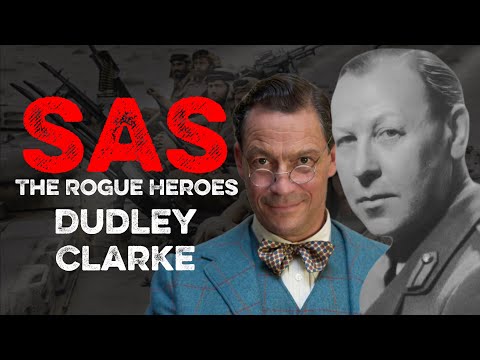
Modern portrayals like SAS: Rogue Heroes seize on this incident, using it as the audience’s first introduction to Clarke—framing him immediately as eccentric and unconventional. But the series takes considerable creative liberties. In Rogue Heroes, Clarke is often portrayed as being at odds with David Stirling, when in reality the two men were on good terms. Clarke was an early supporter of unconventional warfare, helping create the intellectual and institutional space that allowed Stirling’s ideas to be taken seriously at all.
The show also suggests that Clarke deliberately left identifying serial numbers off the SAS lorry as part of a calculated deception, reinforcing the image of him as a shadowy puppet master. There is no solid evidence that this was a real intentional act. Perhaps the most misleading choice is tying much of Clarke’s personal story to the character of Eve—a romantic and emotional anchor who does not appear to have existed in real life. This fictional relationship gives the audience a human lens through which to view Clarke, but it does so at the cost of historical accuracy.
What the dramatizations miss is the sheer scale of Clarke’s analytical mind. He was not merely a trickster but a system-builder. His deception organization, A Force, became a model for psychological warfare that would be studied for generations. He understood that the most effective deceptions were not those that simply misled, but those that compelled the enemy to commit resources, troops, and attention to phantom threats. Every fictional division he conjured on paper forced Axis commanders to divert real divisions to counter them.
By 1943, Clarke’s influence had spread across the Mediterranean theater. He worked closely with planners for the invasion of Sicily, where Operation Mincemeat—the famous deception involving a corpse dressed as a British officer—bore the fingerprints of his methodology. Though Clarke did not devise that particular operation, the principles he had championed made it possible. Deception had become an institutionalized weapon of war, and Clarke was its chief architect.
As the Allies prepared for Normandy, Clarke’s ideas formed the intellectual foundation of Operation Bodyguard—the sprawling deception plan designed to convince Hitler that the invasion would come at Calais rather than Normandy. The plan involved fictional armies, fake radio traffic, and double agents, all orchestrated to shape German expectations. Clarke’s work arguably saved tens of thousands of lives by shaping enemy expectations before the battle was even fought.
Yet for all his influence, Clarke remained a background figure. He was not a household name, not a celebrated hero. He was a planner, a thinker, a man whose greatest victories were invisible—measured not in territory gained but in enemy mistakes made. When the war ended, much of his work remained classified, denying him any public recognition.
After the war, Clarke retired quietly in 1947. He wrote histories and worked for the Conservative Party, living out his years in relative obscurity. When he died in 1974, only a handful of insiders understood the scale of his contribution. Later historians would describe him as the master of military deception, a man who shaped modern psychological warfare almost from nothing.
He never sought the spotlight, and history initially denied it to him. The files stayed locked, the operations unspoken, the phantom armies dissolved into footnotes. For decades, the man who invented the SAS’s cover story was himself covered by silence.
But declassified records eventually revealed the truth. Dudley Clarke had not merely supported the rise of special forces or dabbled in trickery. He had built an entire system that convinced enemy commanders to fight battles that only existed in their minds. From a converted bathroom in Cairo, he had reached into the minds of Axis generals and made them see divisions that were never there.
Compared to his depiction in SAS: Rogue Heroes, the real Clarke was less chaotic and far more profound. He was not a puppet master pulling strings for drama, but a patient architect laying bricks of illusion that held entire armies in place. In a war defined by firepower and attrition, he proved that ideas—carefully planted and patiently cultivated—could be as decisive as any army in battle.
Today, his methods are taught in military academies. His principles echo in every psychological operation, every feint, every carefully constructed lie that saves lives. Dudley Clarke did not win glory. He won wars before the first shot was fired.
So the next time you watch a dramatized version of history, remember the quiet man behind the curtain. Sometimes history doesn’t need a rewrite—it just needs to be told properly.
What other unsung architects of history do you think deserve their story told?
Report this article
Select a reason for reporting:






