Imagine an island nation with no oil, no rubber, no iron ore—a nation that had watched Western powers carve up the world and vowed never to be carved up itself. By the morning of December 7, 1941, Japan had been strangled economically for years. Its oil reserves were evaporating. Its military planners had run the numbers and reached a cold conclusion: at current consumption rates, the Imperial Navy would run dry within two years. In wartime, far sooner. The attack on Pearl Harbor was not the opening move of a war. It was the desperate counterstrike of a nation that had already lost the peace and was willing to gamble everything on one violent morning in Hawaii.
To understand how that moment was reached, you have to go back—not to 1941, not even to 1937, but to 1868 and a transformation so rapid and total that the world has rarely seen anything like it.
In the mid-19th century, Japan was a feudal state sealed off from the outside world for over 260 years. Then, in 1853, four American warships arrived in Tokyo Bay under Commodore Matthew Perry and politely, with guns very much visible, demanded that Japan open itself to trade. The message was unmistakable: modernize or be dominated.
Japan chose to modernize. The Meiji Restoration of 1868 set in motion the most rapid national transformation of any major country in recorded history. Within a single generation, Japan dismantled its feudal class system, built railways, established a European-style banking system, created a conscript army, and sent thousands of students abroad to learn from the West. The national slogan was Fukoku Kyohei—enrich the country, strengthen the army. It was a program of frantic self-reinvention driven by one core fear: that the fate of China, being carved apart by Western imperial powers, would become Japan’s fate too.
By the early 1900s, the program was working. Japan defeated China in 1895, then shocked the world by defeating Russia in 1905—the first Asian nation in the modern era to defeat a European great power in open warfare. The lesson in Tokyo’s halls of power was clear: a nation without a colonial empire was a nation without security. Resources meant power. Territory meant resources.
But Japan was geologically ill-equipped for the industrial age it had embraced. By the late 1930s, it produced only around 7% of the oil it consumed. Every torpedo, every warship, every aircraft burned fuel that had to come from somewhere else. And 90% of that fuel came from one place: the United States.
In Washington, this was understood. In Tokyo, it was understood that Washington understood it. The mutual awareness of this dependency shaped everything that followed. Japan knew its most dangerous vulnerability was the lifeline it depended on most. American policymakers knew that if they ever chose to pull that lifeline, Japan would face an impossible choice.
The pressure began building long before anyone thought of Pearl Harbor. Japan’s invasion of Manchuria in September 1931 was the first large rupture. The Kwantung Army staged a false-flag bombing of a Japanese-owned railway near Mukden and used it as a pretext to sweep through the resource-rich Chinese province. The puppet state of Manchukuo was declared. The world objected. The League of Nations produced reports and resolutions. Japan responded by withdrawing from the League in 1933 and proceeding as planned.
The United States, gripped by the Great Depression and deeply reluctant to commit to any foreign entanglement, did little beyond issuing the Stimson Doctrine—a formal declaration that America would not recognize territorial changes achieved by force. It was a strong statement. It changed nothing on the ground. But it established a moral framework in Washington, a starting position from which American policy would harden over the next decade.
Then came July 1937 and the Marco Polo Bridge incident near Beijing. What began as a confused exchange of fire escalated within weeks into a full-scale invasion. Japan launched massive offensives across the Chinese coast, seizing Shanghai after brutal fighting, then pushing toward Nanking. By December, Nanking had fallen, and what followed was one of the worst atrocities of the 20th century. Japanese troops killed somewhere between 200,000 and 300,000 Chinese civilians in what became known as the Rape of Nanking. The accounts of Western witnesses still living in the city during those weeks are almost unbearable to read.
The news reached the American public with a visceral, stomach-turning impact. Whatever ambivalence existed in Washington about the Chinese conflict began curdling into something harder. Japan had crossed a line not merely of geopolitics, but of basic human decency. The American missionary presence in China meant that personal accounts and eyewitness testimonies were flowing into American newspapers and living rooms. Japan, in the minds of the American public, was transforming from a rival power into something more disturbing.
President Franklin Roosevelt, constrained by powerful isolationist sentiment at home and a public with no appetite for another foreign war, still began quietly looking for ways to apply pressure short of military action. In December 1937, Japanese aircraft sank the USS Panay, an American gunboat on the Yangtze River. The incident was almost certainly deliberate. Japan apologized and paid an indemnity, but the message to American naval planners was received clearly: Japan was willing to use force against American assets when it felt necessary.
The first economic measures were cautious and carefully framed to avoid the appearance of deliberate provocation. In the summer of 1939, Roosevelt imposed what was called a moral embargo on the sale of aircraft and aircraft components. It was a public statement of disapproval more than a binding legal mechanism, and Japan found ways around it. But it established a pattern that would escalate relentlessly over the next two years.
In January 1940, Japan allowed the existing commercial treaty with the United States to expire without renewing it. This was a significant move. The treaty had governed bilateral trade for decades. Its expiration meant that the Roosevelt administration could now legally restrict exports to Japan without violating treaty obligations. The gloves were coming off on both sides. Tokyo had made clear it was unwilling to be bound by agreements that constrained its ambitions. Washington now had the legal latitude to respond.
In the summer of 1940, events in Europe dramatically accelerated the crisis in the Pacific. Nazi Germany’s blitzkrieg swept through Western Europe with terrifying speed. France fell in June. The Netherlands was occupied. This mattered enormously to Japan because the Dutch East Indies, with their vast oil fields, were now colonies of a government that no longer existed in any meaningful sense. Japan moved quickly to capitalize on this European collapse. In September 1940, Japanese forces occupied the northern portion of French Indochina, securing airbases from which they could further threaten the region. And on September 27, Japan formalized its alignment with the Axis powers by signing the Tripartite Pact with Germany and Italy.
Roosevelt responded immediately. He invoked the Export Control Act, passed just months earlier, which gave the president broad authority to restrict exports on national security grounds. The justification offered publicly was that America needed to conserve materials for its own rearmament program. The actual target was Japan. An embargo on scrap iron and steel took effect in September 1940. Aviation gasoline and lubricants were also restricted, but critically, the flow of regular oil and crude petroleum to Japan continued. This was a deliberate calculation. The American ambassador in Tokyo, Joseph Grew, had warned years earlier that a full oil cutoff would likely drive Japan to seize the Dutch East Indies. The administration understood that oil was the tripwire. Cut it completely, and you might force Japan’s hand into a war America was not yet ready to fight.
Japan, reading the escalating pressure with increasing alarm, tried to secure its oil supply through other channels. In the autumn of 1940, Japanese negotiators approached the Netherlands government in exile and requested 3.15 million barrels of oil from the Dutch East Indies. The Dutch, under enormous pressure, offered a counteroffer of only 1.35 million barrels. Japan’s oil planners looked at those numbers and understood what they meant. The alternative pipelines were closing. The dependency on American oil was not a choice. It was a geological and geopolitical fact, and that fact was now being weaponized against them.
Through late 1940 and into 1941, Japan applied what diplomatic pressure it could. It signed a neutrality pact with the Soviet Union in April 1941, securing its northern border and freeing the army to focus southward. It began stockpiling raw materials as fast as it could acquire them, knowing that the window might be closing. It continued secret negotiations with the Dutch East Indies, trying to secure longer-term supply agreements. None of it was sufficient to close the gap between what Japan needed and what it could obtain.
In June 1941, Hitler launched Operation Barbarossa, the invasion of the Soviet Union. This enormous event reshaped Japan’s strategic options. It confirmed that Germany and Russia were now at war, relieving some of Japan’s northern pressure. But it also consumed the attention of the American and British governments in ways that Japan hoped might reduce their focus on the Pacific. The opposite turned out to be true. The Roosevelt administration saw the Axis powers, now spread across Europe and Asia, as a unified global threat. Anything that weakened one Axis power weakened all of them. Supporting China against Japan, and eventually confronting Japan directly, was now seen in Washington as part of the same strategic contest being fought in Europe.
And then came the final trigger. In late July 1941, Japanese forces moved into the southern portion of French Indochina, capturing key airbases and ports. This was qualitatively different from the earlier occupation of the north. From the south, Japanese forces were in striking distance of British Malaya, the Dutch East Indies, and the Philippines. The strategic implications were unmistakable. Japan was positioning itself to move on the oil fields it desperately needed.
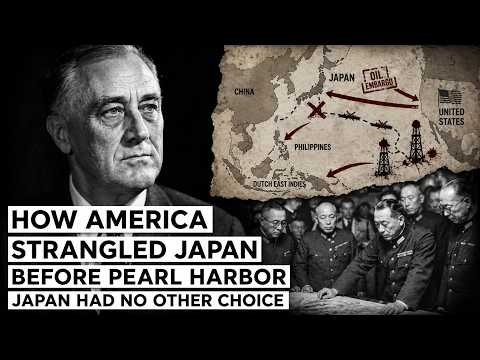
The Roosevelt administration’s response was immediate and total. On July 26, 1941, President Roosevelt signed an executive order freezing all Japanese assets in the United States. Britain and the Dutch East Indies followed within days. The effect was shattering. Japan lost access to roughly three-quarters of its overseas trade and, crucially, 88% of its imported oil. The administration had initially intended to use the licensing system as a pressure valve and negotiating lever, but the political climate in Washington had hardened to the point where no licenses were actually issued. Treasury officials and hardliners within the administration were determined to deny Japan every dollar it needed to sustain either its military operations or its broader economy. The oil cutoff was now complete in practice, if not in initial design.
At this point, imagine you’re sitting in the Imperial Navy’s planning rooms in Tokyo. You know the numbers. Your oil reserves, carefully stockpiled over years of foresight, can sustain peacetime operations for perhaps three years. But this is wartime already, or as good as. The Navy’s combat operations burn fuel at a rate that cuts that estimate roughly in half. Eighteen months, perhaps less, and the clock is ticking with every day that the embargo holds. Every patrol sortie, every training exercise, every ship movement is drawing down the tanks that cannot be refilled.
There was a phrase that circulated in those rooms, reportedly drawn from an assessment by one of Japan’s leading strategic planners. It went something like this: “From now on, the clock and the oil gauge stand side by side.” It was not poetry. It was a precise description of the strategic trap Japan now found itself in. Every week of diplomacy was a week of military capacity draining away.
If Japan chose to negotiate and comply with American demands, it would have to abandon years of conquest in China, pull back from Indochina, and accept what would amount to permanent American supervision of its foreign policy. The military, which had largely captured the Japanese government by this point, found that option politically and culturally unacceptable. The army had fought and died in China for years. The idea of surrendering those gains under American economic pressure was a humiliation that powerful factions in Tokyo would not accept.
The alternative was seizing the oil fields in the Dutch East Indies by force. This had been war-gamed in the Imperial Navy’s planning rooms for years. It was achievable militarily. The Dutch and British forces in the region were neither numerous nor well-equipped. A rapid southward offensive could, in theory, give Japan control of the oil and rubber and tin it needed to sustain its empire indefinitely. The problem was the American Pacific Fleet, anchored in Pearl Harbor, Hawaii. If Japan struck south, it could not ignore the possibility that the United States would respond by attacking Japanese supply lines or even Japan itself. The Philippines, then an American territory, sat directly across Japan’s intended route of advance. Any serious campaign to the south required securing the flanks, and that meant dealing with American military power.
It was Admiral Isoroku Yamamoto who conceived the answer. Yamamoto was in many ways the most sophisticated strategic thinker in the Imperial Navy. He’d studied in the United States, spent time at Harvard, and understood America’s industrial capacity in a way that most of his peers did not. He was not an optimist about Japan’s long-term chances in a full war against the United States. He reportedly said that he could promise Japan’s leaders six months of stunning victories, after which he could make no guarantees. But given the choice between slow strangulation and a violent gamble, he chose the gamble. If Japan was going to go to war with America anyway by striking south, better to strike first and cripple the Pacific Fleet in harbor before it could interfere.
The attack plan for Pearl Harbor had been circulating in various forms since early 1941. By summer, it had been approved in principle. By the autumn Imperial Conference of November 5, it had received formal authorization, contingent on whether diplomacy could produce an acceptable solution. And there was diplomacy—intense, last-ditch, ultimately futile diplomacy. Japanese Ambassador Kichisaburo Nomura, a genial retired admiral chosen partly for his personal rapport with American officials, had been in Washington for most of 1941 holding exhausting conversations with Secretary of State Cordell Hull. Through the summer and autumn, two countries were simultaneously negotiating and preparing for war, each aware the other was doing the same. American cryptanalysts had broken Japan’s diplomatic code. The administration knew Japanese messages were referencing hard deadlines, after which, in the carefully opaque language of diplomatic cables, things were going to happen automatically.
Japan made two formal proposals in November. The first, Proposal A, offered a partial withdrawal of troops from China and a general settlement of the Sino-Japanese conflict, while preserving Japan’s core strategic position. Washington stalled and rejected it on November 14. The second, Proposal B, offered to freeze military movements in Southeast Asia and pull Japanese forces back from southern Indochina if the United States lifted its sanctions and stopped supporting Nationalist China. It was a substantial concession by Japan’s standards, though far short of what Washington required. For a brief moment, some officials in the Roosevelt administration considered a modus vivendi, a temporary partial agreement that would ease the oil embargo slightly in exchange for Japanese concessions in Indochina, buying time for further negotiation. It was ultimately not pursued. China’s Nationalist government protested fiercely that any relaxation of pressure on Japan would betray their cause. British Prime Minister Churchill was skeptical, and within Washington itself, the hawks had the momentum. Whatever chance existed for a diplomatic pause was allowed to pass.
On November 26, 1941, Secretary Hull presented the Japanese ambassador with the document that history calls the Hull Note. Its formal title was the Outline of Proposed Basis for Agreement Between the United States and Japan. Its contents were a comprehensive rejection of Japan’s position. It demanded the complete and unconditional withdrawal of all Japanese military forces from both China and French Indochina. It demanded that Japan effectively abandon its alliance with Germany and Italy under the Tripartite Pact. It demanded Japanese recognition of Chiang Kai-shek’s Nationalist government as the sole legitimate government of China, which would mean abandoning the puppet state of Manchukuo and years of installed governance. In exchange, America offered to lift the embargo and normalize trade relations.
When Japanese Prime Minister Hideki Tojo read the Hull Note to his cabinet, he said simply, “This is an ultimatum.” His reading was not unreasonable. The note demanded that Japan surrender virtually everything it had fought for over the previous decade in exchange for the lifting of sanctions that had been imposed specifically to pressure it into that surrender. There was no timeline stated, but there did not need to be. Both sides understood that the oil gauge and the clock were still standing side by side, and time was running out.
What makes the Hull Note particularly significant historically is the debate that has surrounded it ever since. Most accounts treat it as straightforward American policy, but some historians, including those who have examined the Treasury Department’s internal records from that period, have argued that the note’s most unyielding demands were shaped in part by Treasury official Harry Dexter White, a committed anti-fascist who believed that no compromise with Japan was acceptable, and who drafted the language that made the demands effectively non-negotiable. Whether Roosevelt fully intended the note to be as final as it appeared, or whether he was hoping Japan might still find something to negotiate within it, is a question that historians still argue about. What is not in dispute is the Japanese reaction.
The strike force that would attack Pearl Harbor had set sail from Hitokappu Bay in the Kuril Islands on November 26, the same day the Hull Note was delivered in Washington. Japan time was behind Washington time, meaning the fleet departed before the note was received in Tokyo, but the decision to launch had already been made at the Imperial Conference of November 5. The fleet was heading east across the North Pacific in strict radio silence, its commanders waiting for a signal that would either turn them back or send them forward. That signal came on December 2, a terse coded message that translated roughly as “Climb Mount Niitaka.” It meant proceed with the attack.
At 6:02 in the morning on December 7, 1941, the first wave of Japanese aircraft launched from six aircraft carriers 400 kilometers north of Oahu. They reached Pearl Harbor at 7:55 local time. Within two hours, the United States Pacific Fleet had lost eight battleships, three cruisers, four destroyers, and 188 aircraft. 2,403 Americans were killed. The date, as Franklin Roosevelt would say the next day before a joint session of Congress, would live in infamy.
What Roosevelt did not say, and what has been argued in various forms ever since, is that the attack was in significant measure the product of the economic campaign America itself had waged. Not that Japan bore no responsibility. Japan’s invasion of China, its documented atrocities, its alignment with Nazi Germany and Fascist Italy, its deliberate military expansionism across the Pacific—none of that can be excused or minimized. Japan’s leaders made choices, moral as well as strategic, for which they bear genuine responsibility. The Nanjing Massacre alone was an act of organized savagery that demands historical accountability.
But at the same time, the 48 hours before the bombs fell on Pearl Harbor require honest examination. Japan’s military planners, looking at the oil gauge, had concluded that their nation faced the choice between submission and war. And submission, in their framing, meant abandoning the empire entirely, withdrawing from ten years of conquest, and accepting a future in which America had an effective veto over Japanese foreign policy forever. That is not to say their calculation was correct or their response justified. It is to say that the attack on Pearl Harbor was not, in any meaningful sense, without context or without cause.
There’s a phrase in American strategic thinking that has circulated ever since: that economic sanctions can be a powerful weapon, but only if the sanctioned party has somewhere to go. If you back a nation with no alternatives into an absolute corner, you may get compliance, or you may get war. Japan, in the autumn of 1941, had nowhere to go. Its gold reserves were frozen, its trade was blocked, its oil was cut off. Its military, shaped by decades of samurai-derived warrior culture that regarded retreat as a form of death, was psychologically and institutionally incapable of the kind of complete surrender the Hull Note demanded.
The admiral who planned Pearl Harbor understood this. Yamamoto’s famous prediction that Japan could promise six months of victories, after which he could guarantee nothing, was not defeatism. It was a precise actuarial assessment of what happens when an industrially inferior nation picks a fight with the largest industrial economy in the world. He knew. He calculated it and went ahead anyway, because the alternative, from where he stood, was a kind of slow execution. A nation running out of oil in the middle of a war it could not stop. Aircraft that could not fly, warships that could not move, an empire that would simply wind down like a clock with no spring left.
What followed Pearl Harbor confirmed Yamamoto’s math. Japan achieved its stunning initial victories. It swept through Southeast Asia with terrifying speed in the first months of 1942, seizing the Dutch East Indies, British Malaya, Singapore, the Philippines, Burma. The oil fields Japan needed were captured, but moving that oil back to Japan required shipping, and American submarines systematically destroyed that shipping. By the final year of the war, despite controlling the largest oil-producing region in Asia, Japan was importing into the home islands less than one million kiloliters of crude oil per year. This compared to over five million kiloliters imported commercially in 1940. The conquered oil fields had been nearly useless because the means to move the oil home had been sunk. Japan ended the war with essentially no oil at all. The gamble had failed.
And what of the broader lessons? The story of Japan and the oil embargo has been revisited repeatedly by historians and strategists every time a major power reaches for economic sanctions as a tool of foreign policy. The parallels are not hard to find. A nation dependent on imported energy, facing escalating restrictions from a dominant economic power, calculating its options with increasing desperation, and eventually arriving at a decision point where the choice seems to be between slow strangulation and violent action. The details change. The underlying architecture of the dilemma tends to recur. What the Japan case illustrates with painful clarity is that economic warfare is not a bloodless alternative to military warfare. It is warfare conducted through different means, and if pushed to its extreme against a nation with a military capable of responding, it may not avoid conflict at all. It may simply determine when and how the conflict begins.
Roosevelt’s advisers understood this risk in general terms. Ambassador Grew warned explicitly, years before the embargo, that cutting off Japan’s oil could provoke exactly the kind of southward move that eventually happened. The warning was noted, and the embargo happened anyway, partly because the alternative—allowing Japan to continue its conquest of China fueled by American oil—was morally and strategically untenable. There’s no clean answer here. The question of whether the embargo was justified does not yield to a simple verdict. Japan’s aggression in China was real and documented and horrifying. America’s interest in resisting that aggression was genuine, if also entangled with its own economic interests in Asia. The oil embargo was a weapon of economic war wielded against a nation that had done genuinely terrible things, and it contributed directly to a military attack that killed thousands of Americans in a single morning, and dragged the United States into a global conflict it had tried desperately to avoid.
The standard narrative of Pearl Harbor treats December 7 as an origin point. In truth, it was a culmination. A decade of Japanese imperial expansion, three years of escalating American economic pressure, a final ultimatum that asked Japan to erase the previous ten years of its foreign policy, six weeks of a carrier fleet moving silently across the cold North Pacific, and then the bombs. The attack was not inevitable in any absolute sense. History rarely is. At dozens of moments between 1931 and 1941, different decisions by different people in Tokyo or Washington or Nanjing or The Hague might have produced different outcomes. But it was not random, either. It did not come from nowhere. It came from the oil gauge and the clock, standing side by side, both running out, in a government planning room in Tokyo in the autumn of 1941. That is the story behind the story. The slow, quiet, bureaucratic war that preceded the loud and terrible one. The story of a nation that had no oil and no options, and one admiral who concluded, with cold mathematical precision, that the only remaining move was the one that changed the world forever.
Yamamoto’s six months of victories arrived exactly on schedule, and then the tide turned with equal precision. Midway gutted the carrier force he had gambled everything to protect. The oil fields of the Indies fell into Japanese hands, but the tankers that carried their crude home were hunted down one by one by American submarines. By 1945, Japan was importing less than a fifth of the oil it had burned in peacetime, and its warships sat immobile in harbors, drained of the fuel that had once defined their power.
The clock and the oil gauge had run out together, just as the planners in Tokyo had feared. The nation that struck Pearl Harbor to avoid slow strangulation instead achieved a faster, more total form of it—ending in fire, surrender, and a world remade.
So here is the question that refuses to die: when a great power squeezes a desperate nation with sanctions, does it prevent war—or simply choose the date? Was Pearl Harbor a surprise attack, or the predictable end of a countdown America itself had started? Tell me where you land in the comments below.
Report this article
Select a reason for reporting:






