In the pre-dawn darkness of November 20, 1917, the rumble of engines shattered the silence over the rolling fields of northern France. German soldiers, entrenched along the formidable Hindenburg Line, peered into the mist with growing dread. What emerged was unlike anything they had ever seen: hundreds of armored beasts, clanking and snorting, advancing relentlessly. This was the first mass tank assault in history, and it would change warfare forever.
Among those metal monsters was D51, a Mark IV tank christened Deborah by her eight-man crew. Her commander, 24-year-old Second Lieutenant Frank Heap, was a daring young man from Blackpool who had already cheated death once in a motorcycle crash. Now, he and his men were about to face the inferno of Cambrai.
The plan was audacious: use tanks to crush the German wire, bypass the deadly artillery barrage, and break through the supposedly impregnable Hindenburg Line. Success hinged on surprise and speed. But for the men inside these early tanks, the conditions were nightmarish. Temperatures soared to 50°C, carbon monoxide fumes poisoned the air, and enemy bullets sent deadly metal splinters ricocheting around the cramped cabin.
Deborah was one of 476 tanks committed to the battle. Her crew, including gunner Joseph Chevon, who would celebrate his 20th birthday on the day of the attack, had spent days in anxious preparation. They moved under cover of darkness, hiding in Avancourt Wood, just 3,000 yards from the British front line. “We promised Joe a proper celebration after the fight,” one crewman recalled. But no one could foresee the carnage ahead.
At 6:20 a.m., the British artillery unleashed a thunderous bombardment, and the tanks rolled forward. The first wave smashed through the German outpost zone with ease, but as Deborah’s wave advanced toward the village of Flesquières, the tide turned. Hidden German artillery batteries opened fire at point-blank range, knocking out tank after tank. Within minutes, seven of the eight tanks in Deborah’s sector were destroyed.
Yet Deborah pressed on. Alone, she charged into the village, her six Lewis guns blazing. Heap and his men fought ferociously, expending over 4,000 rounds, sending German defenders fleeing in panic. For a brief, glorious moment, it seemed they might achieve the impossible.
But then, as Deborah emerged from the cover of buildings, two artillery batteries fixed her in their sights. Shells ripped through her thin armor, showering the crew with razor-sharp fragments. Fuel and ammunition ignited, turning the tank into a blazing inferno. Lance Corporal Foot and Gunner Chevon were killed instantly. Deborah’s advance was over.
Heap and two survivors managed to escape, but the battle raged on. Despite initial gains, the offensive ultimately failed, and the front lines returned to where they had begun. Deborah lay abandoned, slowly sinking into the mud, forgotten by history—until a curious rumor surfaced decades later.
In the 1990s, local historian Philippe Górinski, who had grown up on tales of the battle, began hearing whispers from elderly villagers. “There’s a tank buried in Flesquières,” they said. “Right under our feet.” Most dismissed it as folklore, but Górinski was intrigued. He dug into the archives, cross-referencing old trench maps and eyewitness accounts, and the evidence began to point to a specific spot near the village edge.
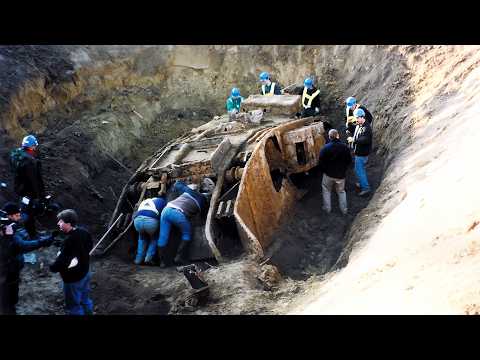
By November 1998, a dedicated team had assembled. With mechanical diggers and careful hand tools, they broke ground on a muddy field. For days, they found nothing but rusted debris and the occasional shell casing. Then, on the fourth day, metal struck metal. A track link emerged from the soil—followed by the unmistakable shape of a tank hull. The rumor was true.
What they unearthed was astonishing: a Mark IV tank, its armor scarred by battle damage, its interior a time capsule of rusted tools, spent shell casings, and personal effects. Further research confirmed the identity. This was D51—Deborah—the very tank commanded by Frank Heap. She had lain hidden for eighty years, a silent witness to one of the Great War’s most dramatic moments.
For nearly two decades after her recovery, Deborah was kept in a barn, where pilgrims to the Cambrai battlefield would stop to pay their respects. She became a local legend, a tangible link to the past. Then, in 2018, a campaign was launched to give her a proper home. Thanks to the efforts of the Association Deborah, she was moved to a new museum just yards from where she had been knocked out.
Today, Deborah takes pride of place in the center hall, her battle scars on full display. Visitors can explore her cramped interior, peer through the same vision slits the crew once used, and imagine the hellish conditions they endured. She is not just a machine; she is a memorial to the men who fought and died inside her.
But what of those men? Records tell us that three survived the shell that destroyed Deborah. One man’s name has been lost to time. Another, Lance Corporal David Marsden—possibly Deborah’s driver—was wounded for the second time that day. He returned home and lived until 1969, dying at the age of 82. And then there was Frank Heap, the daring young commander.
After escaping the burning tank, Heap led his two surviving comrades on a harrowing journey back through enemy lines. For his gallantry that day, he was awarded the Military Cross by King George V. He returned to Blackpool, ran a hotel business, and never forgot the men he lost at Flesquières. Frank Heap died on December 5, 1956, at Victoria Hospital in his hometown. He was 64 years old.
Of those who fell, four still rest in Flesquières Hill British Cemetery, just a stone’s throw from the tank in which they fought. Lance Corporal George Foot, Gunner Joe Chevon—who never saw the end of his 20th birthday—William Gway, and Fred Tipping. Four men who fought, fell, and fittingly still lie side by side.
The story of Deborah, however, does not end with her resurrection from the muddy fields of Flesquières. In the years since her recovery, she has become more than a museum piece. She has become a symbol of remembrance, a silent ambassador for all those who fought in the forgotten corners of the Great War.
Historians and enthusiasts alike have been drawn to her story, not just because of the dramatic tale of her discovery, but because of what she represents. Deborah is the only surviving Mark IV tank that saw action at Cambrai—the very battle that proved the tank could break the deadlock of trench warfare. Her presence in the village today is a tangible link to a day that changed military history.
But her legacy extends beyond the battlefield. In 2017, the centenary of the Battle of Cambrai, a series of commemorative events were held in Flesquières and beyond. Deborah was the centerpiece, with dignitaries, historians, and descendants of the crew gathering to pay tribute. Among them was a relative of Frank Heap, who spoke of the family’s pride in their ancestor’s bravery. The ceremony was a poignant reminder that the men who fought in these machines were not just soldiers, but sons, brothers, and husbands.
Yet, as with all stories of the Great War, there is a shadow. The battle itself, despite the initial success, ended in stalemate. The British had failed to capture Bourlon Wood, and the Germans counterattacked fiercely in early December. By the time the fighting ended, the front lines had barely moved, and nearly 12,000 British casualties had been suffered. The tank, for all its promise, had not yet won the war.
But the lessons learned at Cambrai were not lost. The mass use of tanks, the element of surprise, and the coordination with infantry and artillery became the blueprint for future offensives. In the summer of 1918, the Allies would use these tactics to break the German army once and for all. Deborah, though knocked out on the first day, had played her part in that evolution.
Today, as visitors stand before her, they can still see the scars of battle—the dents from shell fragments, the rusted tracks, the cramped interior where eight men once fought and died. She is a time capsule, a window into a world of mud, blood, and steel. And for those who listen closely, her story whispers of courage, sacrifice, and the enduring human spirit.
But the story of Deborah is also a story of discovery. The men who dug her out of the ground in 1998 could never have imagined the impact their find would have. Philippe Górinski, the historian who first heard the rumor, has since written extensively about the tank and the battle. His work, along with that of others, has ensured that the men of D51 are not forgotten.
In a quiet cemetery just down the road, the four men who died in Deborah still lie side by side. Their headstones are simple, bearing only their names, ranks, and dates of death. But for those who know the story, these stones are more than markers of death—they are markers of immortality. For as long as Deborah stands, their memory will live on.
And what of the survivors? Frank Heap returned to Blackpool and lived a quiet life, but he never forgot the war. In his later years, he was known to speak of his experiences, though always with a hint of sadness for the men he lost. His Military Cross, awarded for gallantry, was a testament to his leadership and courage. He died in 1956, but his legacy lives on through his family and through the tank he commanded.
Lance Corporal David Marsden, the possible driver, also survived the war. He returned to his family and lived until 1969. Little is known about his life after the war, but his survival is a testament to the toughness of the men who crewed these machines.
The third survivor, whose name is lost to history, remains a mystery. Perhaps one day, a researcher will uncover his identity, adding another piece to the puzzle. But even without a name, he is remembered as one of the lucky few who walked away from the inferno.
As the sun sets over the fields of Flesquières, casting long shadows across the museum that houses Deborah, one cannot help but feel a sense of awe. Here, in this quiet corner of France, history is not just remembered—it is felt. The rumble of engines, the smell of fuel and sweat, the fear and the courage—all of it lingers in the air around this battered old tank.
And for those who visit, the message is clear: Deborah is not just a machine; she is a voice from the past, reminding us of the cost of war and the price of freedom. Her story, like the men who fought in her, will never be forgotten.
As the centenary commemorations drew to a close in 2017, a new generation stood before Deborah’s scarred hull. Schoolchildren traced the dents left by German shells, their fingers mapping history. A veteran’s grandson laid a wreath of poppies at the cemetery, whispering thanks to men he never knew.
The museum now hosts educational programs, teaching students not just about tactics, but about the human cost. Deborah’s story has become a bridge between past and present, reminding us that behind every machine were flesh-and-blood men with dreams and fears.
In the quiet of the evening, when the visitors have gone, one can almost hear the clank of tracks and the muffled voices of the crew. Their courage echoes through time, a testament to the indomitable spirit that rises even in the darkest hours.
So what will you take from this story? Will you remember the names of those who fell, or the lessons of a battle that changed warfare? Share your thoughts below—because history lives only when we keep telling it.
Report this article
Select a reason for reporting:






