It was the summer of 1944, and the infantry of the First Canadian Army was dying by the hundreds for one reason alone: they were walking. South of Caen, the landscape opened into wide, rolling cereal plains—no cover, no trees, no hedgerows, no ditches deep enough to save a man. The fields were flat and golden and completely exposed, and the German army had turned them into killing grounds.
Machine gun nests were dug in at every tree line and farm building. The MG 42, the fastest automatic weapon on the battlefield at 1,200 rounds per minute, could sweep 400 yards of open ground in under three seconds. For the infantry walking behind the tanks, crossing those fields was not an assault. It was a sentence.
The Canadians had been fighting the same grinding battles since D-Day. They were given the most critical, most punishing task on the Allied front: to hold the weight of the German armored reserves near Caen, to absorb the panzer divisions that might otherwise crash into the Americans to the west. Every time the Canadians pushed forward, the German defenders shifted their heavy units to meet them. The 12th SS Panzer Division Hitlerjugend, some of the most fanatical soldiers in the German army, held the ground south of Caen with tanks, 88-mm guns, and an absolute ferocity that bled the Canadians white.
In late July, Operation Spring had been a disaster. The Second Canadian Infantry Division attacked across open ground and was torn apart. Hundreds of men fell in a matter of hours. Some battalions lost their commanding officers. The lessons should have been impossible to ignore—and they were not.
One man was watching, calculating, and refusing to accept that this was simply the cost of war. Lieutenant-General Guy Simonds was not a man who accepted the word impossible. He was 41 years old in the summer of 1944, one of the youngest senior commanders in the Allied forces. Montgomery himself called Simonds the best Canadian general of the war. And Montgomery was not a man who handed out compliments easily.
Simonds was meticulous, demanding, and utterly relentless in his search for new tactical solutions. He had already demonstrated in Sicily and Italy that he was willing to redesign the rule book if the rule book was getting his men killed. But now he faced a problem that was as simple as it was lethal. The infantry could not keep pace with the tanks, and the tanks could not operate without the infantry. When the armor advanced alone, it was blinded and ambushed by handheld anti-tank weapons. When the infantry advanced on foot to provide protection, they were shredded by machine gun fire before they could close the distance. The two arms of the Allied assault were working against each other because the Germans had understood, with brutal efficiency, how to use the gap between them.
Simonds needed to eliminate that gap. He needed a vehicle that could carry fully equipped infantry across open ground, keep pace with the tanks, absorb small arms fire and shell fragments, and deliver its soldiers alive to the edge of the objective. He did not have one. The American M3 half-track had been provided to British and Commonwealth forces, but supply was thin. The Americans needed those vehicles as badly as the Canadians did. And the half-track was only 12 mm of armor. It could stop a rifle bullet on a good day and nothing more. A machine gun burst at close range would tear through it. The Universal Carrier was even lighter and far too small. Neither vehicle could follow a tank across a contested field and deliver its men in a usable condition.
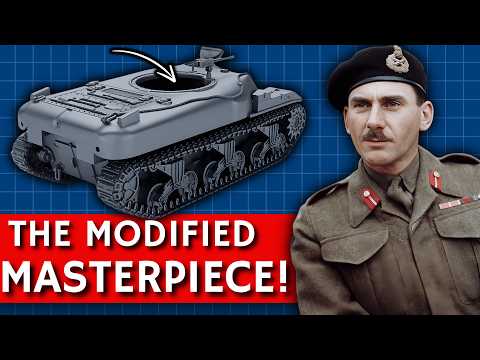
But Simonds had noticed something sitting idle in the fields behind his lines. The M7 Priest self-propelled gun was one of the most capable artillery vehicles of the war. Built on the chassis of the M3 Lee medium tank, it mounted a 105-mm howitzer in a wide open fighting compartment. The gun and its pulpit-like machine gun ring, which the British had nicknamed after a clergyman’s reading stand, had made it a fixture of Allied artillery support since El Alamein. But in July of 1944, the three Canadian field artillery regiments that had used the M7 Priest since the Normandy landings were being re-equipped. The standard towed 25-pounder howitzers were coming forward to replace them. The Priests were now redundant. Dozens of them sat waiting to be returned to American custody. They were sitting idle. They were armored. They were tracked. And they had a very large, very empty fighting compartment.
Simonds looked at the Priests and asked a question that would change the course of armored warfare forever. What if you took out the gun?
On the 2nd of August, 1944, Simonds submitted his outline for Operation Totalize, the next major Canadian push south toward Falaise. Buried inside that document was a new concept. The infantry accompanying the armor, he wrote, must go straight through with the armor. He had arranged for roughly 30 stripped Priest chassis to be available to each of the attacking infantry divisions for this purpose. The vehicles would protect the soldiers. They would carry them through the killing ground. The men would not walk.
But the conversion had not happened yet. The vehicles were still artillery pieces. What followed was one of the most remarkable engineering sprints of the entire war.
Major George Wiggan of the Royal Canadian Ordnance Corps was given the job and a brutally simple mandate: make it happen before the operation. He assembled approximately 250 men from 14 different workshop detachments, drawing from Canadian Ordnance, Canadian Electrical and Mechanical Engineers, Royal Canadian Army Service Corps units, and British Royal Electrical and Mechanical Engineers workshops. They set up what was called an advanced workshop detachment in the field, given the code name Kangaroo—the same name that would be passed to the vehicles themselves. A junior officer on site, Major Gil Pointer, had suggested the name. The troops, he said, would be going into battle protected in mommy’s pouch.
By the end of the 2nd of August, just hours after starting, 14 Priests had already been stripped of their main armament. By the afternoon of the 3rd, a prototype was ready. The 105-mm gun was removed. The gun mantlet was taken out. The ammunition storage bins were cleared. The crew seats that had served the artillery crews were gone. In their place, engineers welded steel plate across the open gap where the barrel had once protruded, sealing the forward aperture. Additional armor plate was welded to the sides, providing more protection for the soldiers who would crouch inside during the advance. When welding rods ran short, the engineers sourced material from captured German supply stocks. When armor plate ran short, they stripped steel from wrecked landing craft on the nearby beaches and packed sand between layers of sheet metal where heavier material was unavailable. The .50 caliber Browning machine gun and its ring mount at the front were kept, giving the vehicle a measure of defensive firepower.
At 2:00 in the afternoon on the 3rd of August, the prototype was driven to the headquarters of Second Canadian Corps where Simonds himself inspected it. He approved it on the spot.
The engineers worked through the nights. They worked in fields, in the open air, without proper workshop facilities. They had no jigs, no factory equipment, no purpose-built tools for this kind of conversion. They improvised every step of the way and they did it in less than six days. By 8:00 in the evening on the 5th of August, 72 Kangaroos were ready for action. The infantry had one single day to practice mounting, riding, and dismounting from them. Then the operation began.
On the evening of the 7th of August, 1944, the attacking forces assembled south of Caen under cover of darkness. Six enormous armored columns formed up, each only four vehicles wide, stretching back across the fields in long steel-tracked lines. Tanks, Kangaroo armored personnel carriers, half-tracks, self-propelled anti-tank guns, and mine flail tanks formed a new kind of weapon—a fully mechanized assault force that could punch through prepared German defenses without exposing a single infantryman to open ground.
At 11:00 that night, Royal Air Force Bomber Command opened the attack. Hundreds of heavy bombers saturated the German defensive positions on both flanks of the advance corridor, a four-mile-wide channel along the Caen-to-Falaise road. At half past 11:00, the armored columns began to move. The conditions were chaotic from the first minute. The tanks churned the dry French farmland into billowing clouds of dust that cut visibility to almost nothing. Drivers lost their bearings. Several vehicles fell into bomb craters. Multiple trucks collided in the murk.
To keep the columns oriented, Simonds had organized an extraordinary network of navigation aids. Some vehicles carried radio direction finders tuned to navigation beacons. Artillery batteries fired distinctive colored shells to mark the axis of advance. And Bofors 40-mm anti-aircraft guns fired continuous streams of tracer rounds into the sear sky pointing south, giving the drivers a glowing red arrow overhead to follow through the dust in the dark.
Inside the Kangaroos, the soldiers of the Fourth Canadian Infantry Brigade and the British 154th Highland Infantry Brigade rode in cramped, deafening, armored darkness. The vehicles bucked and jolted over the broken ground. Shell fragments rang off the steel sides. Machine gun rounds that would have found a man in the open bounced away. For the first time in the Normandy campaign, infantry was moving through a contested battlefield in something stronger than hope.
By dawn, the columns of the 51st Highland Division had reached their intended positions. The infantry dismounted from their Kangaroos within 200 yards of the objective villages of Cramesnil and Saint-Aignan-de-Cramesnil, rushed forward, and overran the German defenders before they had recovered from the bombardment. The columns from the Second Canadian Division were delayed by fog and unexpected resistance on the right flank. But by noon on the 8th of August, the Allies had captured Verrières Ridge—ground that had defied every previous assault.
And then the numbers came in—the numbers that made every senior officer in the Allied command stop what they were doing and pay close attention. The Fourth Canadian Infantry Brigade, which had advanced mounted in the Kangaroos, suffered seven men killed and 56 wounded. The Sixth Canadian Infantry Brigade, fighting on foot in a parallel advance, suffered 68 men killed and 192 wounded. Two brigades, same objective, same enemy, same ground. One rode, one walked. The brigade that rode suffered less than one-fifth the casualties of the brigade that walked.
One-fifth. That figure was not a statistical anomaly. It was a verdict. It was the battlefield delivering its judgment on a century of tactical doctrine that had assumed infantry had to advance on foot. In a single night, Simonds and his engineers had proved that assumption catastrophically wrong.
The Kangaroos went on to support Operation Tractable, the follow-up Canadian offensive in mid-August, then the costly assaults on the Channel ports of Boulogne and Le Havre. A post-war history recorded what happened at Boulogne with quiet precision. During the assault, the Kangaroos came under considerable small arms fire and heavy shelling. The casualties suffered by the infantry while they were in the Kangaroos were nil.
Nil—not low, nil. The Kangaroo had stopped being a field experiment. It had become a necessity. The worn-out Priests gave way to surplus Ram tanks, their turrets removed to seat eleven soldiers inside armor that a medium tank crew would trust. On 24 October 1944 the carrier unit became the First Canadian Armored Personnel Carrier Regiment, its emblem a kangaroo over the motto Armatos Fundit—bringing forth the armed.
Through the Netherlands, the Reichswald, and into Germany, the Kangaroos carried infantry to the fight without making them march through the killing ground. The lesson crossed the Atlantic and shaped the FV432, the M113, and eventually Israel’s towering Namer. Every tracked carrier that has shielded a soldier since was built in the image of those gutted Priests.
Guy Simonds did not invent a new vehicle. He saw one that already existed—sitting idle in a field—and asked what it could become instead of what it was. Seven dead where 68 would have died. Hundreds of families who never received a telegram.
What idle machine in your own field might be waiting for someone to ask the right question?
Report this article
Select a reason for reporting:






