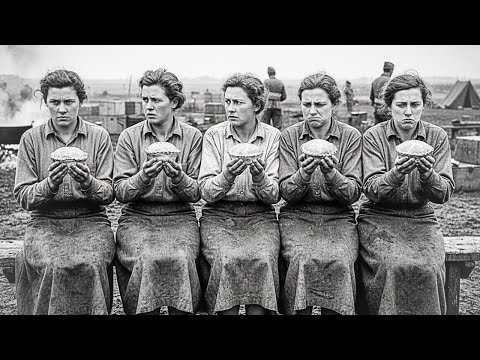
February 1946. The war was over, but Germany looked like the end of the world. In Hamburg, women clawed through mountains of broken brick, searching for anything usable. Buildings were hollow shells, windows gaping like empty eye sockets. At night, families huddled in cellars because their homes had been reduced to rubble. The government rationed a mere 1,200 calories per person per day—barely enough to survive.
Children with gaunt faces and sunken eyes stood on street corners, begging for cigarette butts to trade for a potato or a piece of moldy cheese. Factories that once built ships and planes were now twisted heaps of metal and debris. Most homes had no electricity. Water came from street pumps if you were lucky. The German mark was practically worthless; a loaf of bread cost more than most people earned in a week.
The Nazi government that promised to make Germany great had collapsed in May 1945. American, British, French, and Soviet soldiers controlled different parts of the country. Berlin, the capital, was sliced into four sectors like a pie, each ruled by a different army. Over 7.5 million German soldiers were dead or missing. No one knew where they were or if they would ever return. This left women outnumbering men—six out of every ten adults were female. Mothers, daughters, and grandmothers did all the work men once did. They cleared rubble, repaired roads, and desperately scavenged for food.
In this shattered world, a group of women waited in a cold building near Hamburg. There were over 600 of them, wearing loose, worn-out gray uniforms that hung on their thin bodies. These women had served in the German military during the war. Some were nurses who bandaged soldiers’ wounds; others operated radios and telephones, relaying messages between army units. A few had been part of the SS, the notorious Nazi police force. They ranged in age from 19 to 45, mostly from big cities like Hamburg, Berlin, and Dresden—cities bombed so repeatedly they looked like the surface of the moon.
None had seen their families in over two years. Many didn’t know if their mothers, fathers, brothers, or sisters were still alive. The women whispered to each other in the cold room, exchanging rumors and fears. They had heard horror stories about what happened to prisoners of war. The Nazi government had told them the enemy tortured captives, starved them, and worked them to death in camps. Some women thought they’d be sent to freeze in Siberia; others feared they’d be shot.
None of them expected what actually happened.
A young woman named Greta sat on a wooden bench, arms wrapped around herself for warmth. She was 24, from Hamburg. She had worked as a communications assistant in the German army, sitting at a radio set 12 hours a day, sending and receiving messages. She hadn’t eaten a full meal in eight months. Her dress hung off her shoulders like a sack. Her cheeks were hollow. Her hands trembled slightly even when she tried to hold them still.
She remembered her city before the war, when the streets were bustling and shops displayed food in their windows. She remembered her father’s bakery—the smell of fresh bread, the way powdered sugar dusted his apron. All of that was gone now. The bakery was just a hole in the ground filled with broken bricks.
The women were told they would be sent to a distant place called Australia. Most had heard little about it. They knew it was on the other side of the world, a hot land full of deserts and strange animals. One woman said her teacher had once told her Australia was where Britain sent its criminals long ago. Another whispered that it was so far from Germany they might never see home again.
Greta felt a weight in her chest like a stone. She tried not to think about her mother, but the thought kept creeping back. Was her mother still alive? Did she have food? Did she wonder where Greta was?
The journey took weeks. First, they traveled by train to a port. Then they boarded a ship that rocked on the gray ocean waves. Many of the women fell ill. The ship was crowded and smelled of sweat and fear. They sailed south through waters that grew warmer day by day.
Finally, after what felt like an eternity, they arrived at a pier in Australia. The air was hot and dry, completely different from Germany’s damp cold. Guards speaking English led them to trucks. The women stared at a strange land of brown grass and vast blue sky.
They drove for hours until they reached a place called Murchison Camp in Victoria. The camp was surrounded by wire fences, but it looked cleaner and more organized than Greta had expected. There were rows of wooden buildings with real roofs. Trees grew in some places, providing shade from the scorching sun.
Australian guards waited at the gates. Some were women in navy uniforms. They didn’t look cruel. They didn’t shout or hit anyone. They simply opened the gates and pointed the way in.
Greta felt confused. This wasn’t what she’d been told to expect. This didn’t look like a place of torture and death.
The German women were led to a large building used as a dining hall. Inside, long wooden tables stretched from end to end. The guards motioned for them to sit. Greta sat on a hard bench next to two other women. Her stomach cramped with hunger and nerves.
Then something unbelievable happened. The guards began bringing out trays of food—real food, hot food. Greta stared at her plate, unable to believe what she saw. There was something golden, like a small loaf of bread, but shinier and flakier. Steam rose from a slit in its crust. Beside it was a mound of mashed potatoes—real white potatoes with butter melting into them. There were green beans that looked fresh, not dried or rotten. A thick slice of white bread sat next to a small pat of yellow butter. A cup of tea steamed next to a small bowl of white sugar—real sugar, not the brown substitute they used in Germany. And on a small plate, slices of canned peaches swimming in sweet syrup.
Greta looked at the two women on either side of her. They stared at their plates with the same expression of shock. One woman, older with streaks of gray in her dark hair, leaned in and whispered in German: “Is this pig food? Are they mocking us?”
Another woman touched the golden pastry gently with her finger, as if it might disappear. The smell rising from the food made Greta’s mouth water so much she had to swallow. She hadn’t smelled cooked meat in so long she’d almost forgotten what it tasted like.
But fear held her back. What if this was a trick? What if the food was poisoned or spoiled? What if eating it meant something terrible?
Her hand trembled as she reached for the golden pastry. She picked it up. It was warm and left grease on her fingers. She looked around the room. Other women were picking up their food too, sniffing it, examining it with suspicious eyes. An Australian guard stood near the wall, watching them with a gentle expression. Not angry or mean—just patient.
Greta lifted the pastry to her mouth. She could see the layers of flaky crust. She took one small bite, and everything changed.
In the dining hall at Murchison Camp, Greta stared at the half-eaten meat pie on her plate, still trying to understand what had just happened. The moment her teeth broke through the golden crust, everything she thought she knew began to crumble too.
The pastry was buttery and light, crumbling into soft pieces on her tongue. Then the filling flooded her mouth with rich, dark gravy, thick with chunks of real beef. The meat was tender, seasoned with salt and pepper. The fat and juices coated her teeth and lips.
She hadn’t tasted butter in over two years. She hadn’t eaten real meat in eight months—just thin soup with maybe a small piece of gristle floating in it. This single bite was richer and more flavorful than a whole week’s meals in her homeland.
Her eyes widened. Without thinking, she took another bite, then another. The pie disappeared in less than a minute. She looked at her hands and saw the grease shining on her fingers.
Around her, the other women were eating too. Some ate slowly, savoring every bite as if it were their last. Others ate fast, frantically, as if the food might vanish if they didn’t hurry. One woman began to cry as she chewed, tears streaming down her face while she stuffed mashed potatoes into her mouth. Another whispered a prayer in German before she ate, thanking God for the food even though she didn’t understand why it was there.
Greta turned her attention to the rest of her plate. The mashed potatoes were smooth and creamy, thanks to the real butter mixed in—not the watery paste she remembered from Germany. The green beans were cooked perfectly, still crisp and bright. She spread butter on the white bread and bit into it. It was soft and fresh, not hard or stale. She sipped the tea and added sugar, watching the white crystals dissolve. Real sugar, not the metallic-tasting chemical substitute.
When she finally ate the canned peaches, their sweetness was overwhelming. She had forgotten that food could be this wonderful. She sat on the bench feeling full for the first time in a year. Her stomach felt strange, as if it were stretched and warm. She wasn’t used to this feeling.
The days that followed brought more shocks. Every morning, the women lined up in the dining hall for breakfast. They received bowls of hot porridge made with real milk and sugar. There were fried eggs—two per person, with golden yolks that broke when cut. There was toast with jam in flavors like strawberry and apricot. Tea and coffee were plentiful, and the women could eat as much as they wanted. Some guards even smiled and asked if they wanted more food.
More food! Greta couldn’t believe it.
At lunch, they ate roasted lamb or beef with vegetables. Carrots, peas, and potatoes were served in such large quantities that some women couldn’t finish them. Fresh fruit appeared on the tables—apples and oranges without bruises or rot. At dinner, there were thick stews with chunks of meat and vegetables in rich broth. For dessert, there was rice pudding with cinnamon. Crunchy, sweet biscuits were available to everyone. The camp guards told them they could have more if they were still hungry.
More! Greta did the math in her head. The total calories they consumed daily was over 3,200—nearly three times what German civilians received in their own country. This was more than she had eaten even before the war, when times were good.
But the abundance wasn’t limited to food. The camp itself seemed like another world. Each wooden building had running water piped in. When Greta turned the tap in the bathroom, hot water flowed out. Hot water! She stood under it for five full minutes the first time, letting the heat soak into her skin and hair. She hadn’t felt hot water since 1944.
The toilets flushed. You pulled a chain and clean water washed everything away. No more outhouses or buckets. Each building had electric lights that turned on with a switch. No candles, no lamps—just bright, clean light whenever you needed it. At night, Greta lay on her narrow bed in the barracks and stared at the light bulb hanging from the ceiling. These were things she had once taken for granted. Now they seemed like magic.
Every Friday evening, a truck arrived at the camp carrying crates of bottles filled with a dark, fizzy liquid. Coca-Cola, the label read. Greta had heard of it but had never tasted it. There was a small shop in the camp where prisoners could buy things with money they earned from working around the camp. The work was easy—cleaning, helping in the kitchen, or washing clothes. The pay was small, but enough to buy a bottle of Coca-Cola. Greta bought one and opened the cap. The drink was cold and sweet, and she felt a pleasant warmth in her throat from the bubbles. She couldn’t believe prisoners were allowed to buy such things.
Some women saved their money and bought chocolate bars or magazines. Once a week, a mobile cinema came to the camp. The guards set up a screen in one of the large buildings and showed Hollywood films. Greta sat on a bench with dozens of other women and watched English-language movies in vivid color. The colors amazed her more than anything else. She had never seen anything but black-and-white films before. These films showed people wearing beautiful clothes, living in furnished homes, and owning cars. The women laughed at the funny scenes even when they didn’t understand all the dialogue. After the films ended, they talked late into the night about what they had seen. Some said the films must be fake, that no one lived like that in reality. Others weren’t so sure anymore.
The medical clinic was what astonished Greta most. A German woman cut her hand badly while working in the garden, and the guards took her to the clinic immediately. Greta accompanied them to help translate. Inside, the clinic shelves were stocked with bottles and boxes of medicine. The nurse cleaned the wound and gave the woman a penicillin injection to stop infection. Penicillin! Greta knew this drug was nearly impossible to find in Germany now. People died from simple infections because there was no medicine to help them. Yet here, in a prisoner-of-war camp on the other side of the world, the medicine was displayed on shelves in neat rows. The nurse bandaged the woman’s hand with clean white wraps and gave her pills for the pain. She smiled and said the woman would be fine within a week. Greta returned to the barracks in a daze.
But the strangest thing of all was how the guards treated them. The Australians didn’t shout or hit. They didn’t call the women demeaning names or treat them like animals. They gave orders, but they were polite about it. One guard, a woman in her thirties with red hair, had learned a few German words so she could talk to the prisoners. She greeted them each morning and asked how they were. When rain turned the ground to mud, she brought extra blankets to the barracks without being asked.
A farmer’s wife from a nearby town visited the camp one day with a basket of fresh eggs. She didn’t speak German, but she smiled and handed out the eggs. Some of the women learned how to say “please” and “thank you” in English. One day, Greta found a pair of sturdy leather shoes outside her barracks door. They fit her perfectly. She never knew who left them, but she suspected it was one of the guards who had noticed her old shoes were falling apart.
At night, the women gathered in the barracks and talked in low voices. Some still clung to what they had been taught during the war. One older woman insisted this was all propaganda, a trick to make them soft and grateful so they would betray Germany. She said the Australians were fattening them up for some evil purpose, but her voice sounded less certain every day. Other women sat quietly, staring into space, thinking deeply about things they didn’t want to say out loud.
Greta lay on her bed and felt questions crowding her mind like weeds. If this was how Australians treated prisoners of war—those who had fought against them—then what did that mean about everything she had been told? She had been taught that Germany was the greatest country, that Germans were meant to rule, that others were weak or evil. But these Australians had more than Germans did. Their country hadn’t been bombed or invaded. Their factories were still running. They had enough food to give prisoners huge portions. They treated enemies with kindness and dignity.
What did that mean?
Greta drifted to sleep each night with these questions spinning in her head. The meat pie was just the beginning. Every day brought new discoveries that slowly, quietly began to change how she saw the world.
Christmas Day 1946 arrived hot and bright. The Australian summer was strange to Greta even after ten months in the camp. Christmas was supposed to be cold with snow and dark nights, not blazing sunshine and dry grass. But that morning, when the women entered the dining hall, they stopped and stared. The room had been completely transformed.
Red and green paper chains hung from the ceiling. Someone had cut stars from tinfoil and hung them on strings that twisted and sparkled in the light. A small pine tree stood in the corner, decorated with handmade ornaments. The tables were set with real cloth napkins—something Greta hadn’t seen since before the war. Australian volunteers, women from nearby towns, stood smiling near the kitchen. They wore their best dresses and had clearly spent time preparing something special.
The smell coming from the kitchen made Greta’s stomach growl, even though she had eaten breakfast only two hours earlier. The guards asked the women to sit. Greta found a place at a long table next to a young woman named Helga from Berlin. They exchanged wide-eyed glances, not knowing what to expect.
Then the food began to arrive. Roast turkey, golden and glistening with juices, came on huge metal platters. The volunteers carved thick slices and placed them on plates. Then came ham covered in a shiny, sweet glaze that smelled of honey and cloves. Roasted potatoes, perfectly crispy on the outside, filled large bowls. Carrots and peas were steamed in butter in separate dishes. Gravy, thick and rich, was poured from pitchers. White bread rolls, soft and warm, were placed in baskets.
Then came the desserts. Plum pudding, dark and moist, covered in a sauce that smelled of brandy. Fruit salad with chunks of pineapple, orange, and apple mixed with fresh cream. Countless pitchers of tea and coffee appeared. Sugar and milk were placed on every table.
Greta stared at her plate. She hadn’t seen this much food in one place since her childhood. Maybe not even then. This was more food than her entire family would have received in a week in Hamburg. She picked up her fork, but her hand was shaking. Around her, other women began to eat. Some ate slowly and carefully, as if afraid to waste a single bite. Others began to cry. One woman wept so hard that a guard approached her and gently placed a hand on her shoulder, asking in English if she was all right. The woman just shook her head and kept crying as she ate.
Then something unexpected happened. A group of people entered the hall carrying musical instruments. They were a choir from a church in a nearby town. They had come to sing for the prisoners. The choir members smiled and nodded to the women. Then they began to sing Christmas carols—but not in English. They were singing in German.
“Silent night, holy night.”
The familiar words filled the room. Greta felt something break inside her chest. Tears streamed down her face. She wasn’t crying from homesickness or sadness at being far from her family, though those feelings were there too. She was crying from shame. Deep, burning shame that made her face flush and her throat tighten.
These people—these Australians whose country had sent soldiers to fight Germany, whose men had died in battles against German forces—were singing German songs for German prisoners on Christmas Day. They had prepared a feast. They had decorated a tree. They had sacrificed their own Christmas morning to come and serve food and sing to the wives of the enemy.
And what had Germany done? What had her country done with its power and its talk of greatness? She thought of the camps she had heard whispered about—the horrifying camps where people disappeared. She thought of the cities Germany had bombed, the countries it had invaded, the brutality committed in the name of making Germany strong. And here she sat, a prisoner, treated with more kindness than she had shown anyone in years.
That night, Greta couldn’t sleep. She found some paper and a pencil a guard had given her weeks ago and began to write by the dim electric light. She wrote in German, in trembling handwriting.
We were told Australia was a backward colony full of criminals, but they have more wealth than we ever did, even before the war. We were told we were the master race, destined to rule. But here, even prisoners eat like kings. Why did we fight? What were we told to believe?
She stared at the words for a long time before folding the paper and hiding it under her thin mattress. She didn’t know if she would ever have the courage to say these things out loud.
In the days after Christmas, Greta began to pay more attention to everything around her. She started talking to the guards more, asking them questions in her broken English. One guard, named Mary, was patient and kind. She brought Greta old newspapers to practice reading. The newspapers contained stories about the war and what was happening now. Greta read about factories in Australia that had built trucks, ships, and planes during the war. She saw pictures of huge machines and assembly lines. Mary told her, “Australia sent a million soldiers overseas to fight.”
A million? For a country so far from the fighting, so far from Europe, they had sent a million men. And bombs had never touched their land. Their cities still stood. Their farms still produced food.
Even the camp library had books. Greta began reading there in the afternoons after work ended. She found history books about Germany before the Nazis came to power. She read about the Weimar Republic and how people had lived in the 1920s. She learned things she had never been taught in school. The books told a different story than the one she had grown up with. At first, she felt angry, believing the books were wrong or lying. But the more she read, the more things began to make a horrible kind of sense.
One afternoon, Mary sat with Greta on a bench outside the library. They watched other prisoners working in a nearby vegetable garden. Mary told Greta about her grandfather, who had come to Australia from Germany in the 1880s. He had been a farmer looking for land and opportunity. He had worked hard, raised a family, and loved Australia—but he had never forgotten his roots. Mary said her family still made some German foods at Christmas. She said this to help Greta understand something important. They didn’t hate Germans. They hated what Germany had become, what the Nazi government had done. There was a vast difference between a people and the evil their leaders forced them to commit.
Greta sat still, feeling those words sink into her like water into dry earth. She thought of her father’s bakery, the smell of bread, his smile for customers. She thought of her mother singing while she washed clothes. She thought of her neighbors and friends—ordinary people trying to live their lives. Then she thought of the rallies she had attended as a child, the flags and the cheering, the promises that Germany would be great and powerful. She thought of the uniform she had worn, the messages she had sent over the radio without ever asking what they meant or where they went. She had been part of it—maybe not the worst part, but part of it. She had believed.
That night, Greta took out the small swastika pin she had kept hidden among her belongings. She had kept it secret all these months, a small piece of her old life. She held it in her palm and stared at it for a long time. Then she walked to the trash bin behind the barracks and dropped it in. The sound of metal hitting the bottom of the bin was very faint, but in her mind it rang like a bell.
Greta began teaching English to other women who wanted to learn. They gathered in the evenings in one barracks, sitting on beds, sharing books and the few papers they had. She discovered she was good at it, and the language became a door to a future different from the past.
Some older women said it was a waste of time. “We’ll go back to Germany and never speak English again,” they insisted. But Greta wasn’t so sure anymore.
She wrote letters home whenever permitted, careful with every word since guards read them first. She told her mother she was healthy, that the weather was hot, that food was plentiful. She hinted cautiously: “Life here is different than I expected, and I am learning a great deal.”
At night, lying on her bed, Greta thought about dignity—the word that echoed in her mind. The Australians had treated her with dignity: enough food, clean water, medicine when sick, kindness despite her being an enemy. Dignity wasn’t about power or race or who was strongest. It was about treating people as human beings.
Power without dignity was just cruelty. Strength without kindness was just bullying. All the promises of greatness had led only to destruction and shame. But here, in this camp on the other side of the world, she found something her country had never given her: reason to hope that people could be better.
Report this article
Select a reason for reporting:






