The Wildcat wobbled off the carrier deck like a drunken seabird, its nose pitching and its wings rocking, and every sailor on the flight deck knew the dance. It wasn’t the wind. It wasn’t a bad pilot. It was a man taking his hand off the throttle to crank a handle twenty-nine or thirty times while the plane flew itself. That ungainly, underpowered machine—slower and less agile than the Zero that climbed to kill it—would end the war with a kill ratio that seemed impossible.
How did that happen? To understand the wobble, you have to realize the Wildcat was fighting the wrong enemy with the wrong tools, and every man in the cockpit knew it. In late 1941 and early 1942, the machine climbing to meet it was the Mitsubishi A6M—the Zero. It turned tighter. It climbed faster. Its range was greater than almost any single-engine fighter in the world. That wasn’t luck. The Japanese Navy had demanded a fighter that could cross vast stretches of the Pacific, find the enemy hundreds of miles away, fight, and come home. Its designer, Jiro Horikoshi, found only one way to hit those numbers: strip weight until there was nothing left to strip. No armor for the pilot, no fuel protection, a structural skeleton pared to the bone. The Zero’s fragility wasn’t a flaw. It was the price of performance, and no one had yet paid that price.
British pilots over Ceylon tried to dogfight it the traditional way and were shredded. The phrase spread fast among Allied pilots: “Never dogfight a Zero.” So the Americans were flying a heavier, slower, less streamlined fighter against the best carrier fighter on Earth. And the plane wobbled on takeoff because the pilot was raising the landing gear by hand.
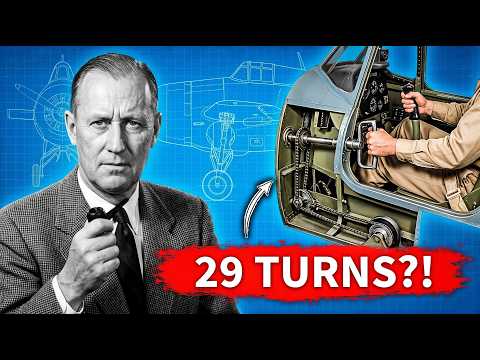
Here’s the strange part. That crank, and the reason it existed, is also the reason the Wildcat survived. To see how, we have to go back in time—not to a battle, but to a garage. The man the plane was named after almost didn’t become an aviation engineer at all. Leroy Grumman wanted to fly for the Navy in World War I. But he failed the medical exam because of flat feet. A simple administrative error sent him to a course on aircraft inspection instead. That accident put him around airplanes, and he turned out to be very good at the engineering side.
He joined a company run by Grover Loening, building amphibious aircraft, and worked his way up to running the factory. Then in 1929, Loening sold his company to a larger corporation, and Grumman was about to lose everything he’d built. So he made a reckless move. He left the company and took two colleagues with him—one a hard-driving production expert named Jake Swirbul, the other a quiet, precise engineer named Bill Schwendler. They pooled their money, found an abandoned car dealership in Baldwin, Long Island, that had once been used to build aircraft, and started work in January 1930 with eighteen employees.
They weren’t building fighters. They couldn’t yet. To keep the lights on, they welded aluminum truck frames and repaired crashed Loening amphibians that came in. Imagine the president and vice president kneeling on the workshop floor, sorting nuts and bolts by hand so they could reassemble other people’s aircraft floats. That was the beginning of Grumman—a repair shop with ambition.
But Grumman had one idea he believed in, and it happened that the Navy wanted it. The Navy wanted planes that folded their wheels in flight, because wheels hanging in the slipstream cut speed. Grumman was already thinking about that problem—a way to retract wheels into the float of an amphibian so they could be hidden when landing on water. He held a patent for retractable landing gear designed for a Loening flying boat. That became the startup’s first real product: floats with wheels that folded inward. And that one idea—the folding wheel—became the company’s signature. It also, eventually, became the source of the wobble.
Because when Grumman finally got to build a real fighter, the FF-1 biplane in 1931, he used the same trick. The wheels didn’t swing sideways into the wings. They were hand-cranked up into the belly of the fuselage, tires resting flush against the sides, half of each still showing. It worked. The FF-1 became the first American carrier fighter with retractable landing gear, and it was genuinely fast for its time. But folding the wheels into the fuselage instead of the wings had a hidden cost. It meant the two main wheels were close together at the centerline, a narrow track. It also meant the mechanism that raised them was a hand crank turned by the pilot. Not hydraulic—a crank. No one worried about that in 1931. Landings were slow, carriers were new, and airfields were grass. It was a clever, compact idea, and it brought them contracts.
So Grumman built biplane after biplane on the same basic skeleton—the F2F, then the F3F—each one more powerful and faster, and all of them kept that narrow belly gear and that turning hand. The company’s little barrel-chested fighters gained a reputation for bringing pilots home in one piece. Then the world around them changed, and the clever biplane trick had to go to war.
By 1935, the biplane era was over, and everyone knew it. The future was the monoplane—one wing, self-supported, no forest of struts and wires. Grumman started work on a monoplane fighter. And here’s a fact that doesn’t fit the Grumman legend, the lineage of great Navy fighters. They lost their first monoplane. The Navy held a competition. Grumman’s prototype faced a sleek monoplane from Brewster. Brewster’s entry was considered more maneuverable, and the Navy chose it—the Brewster Buffalo—for production. Grumman went home to think about what went wrong.
That should have been the end of the Wildcat before it even had the name. Instead, Grumman took the plane apart and rebuilt it almost completely, starting with the wing. A larger wing, a more powerful engine with a two-stage supercharger that let it fight at higher altitudes where thin air favored the machine that could still breathe. With a redesigned tail, the new version was faster and climbed better, and this time the Navy bought it. In October 1941, the model finally got its name: Wildcat. But look at what they kept. The new monoplane still carried the old landing gear, taken straight from the biplanes—a narrow track that folded into the belly and was raised by the same turning hand. Ten years after the FF-1, the crank was still there. And now, for the first time, it mattered.
Here’s what that crank was actually doing to the pilot. On takeoff, a Wildcat pilot’s left hand was on the throttle. To raise the gear, he had to leave the throttle, move his left hand to the stick, and reach down with his right hand to find the crank. Then he started turning. About twenty-nine or thirty full turns to fold the wheels into the belly. People differ on the exact number—some pilots and manuals say thirty, at least one says more. But the point is it was a lot, and it took real muscle. And while he cranked, his flying hand fought his gear hand. Every stiff turn of the handle shook the stick, and the plane wobbled—nose up, nose down, wings rocking, like a porpoise moving slowly through the sky right after leaving the deck. That wobble was the strain of labor, not tension—just a man doing two jobs with hands working against each other. And if his grip slipped, the crank could kick back hard enough to break his wrist.
The narrow belly gear carried another risk. Wheels close together make a plane unstable on the ground. Wildcats were prone to ground looping—a sudden, uncontrollable swerve on takeoff or landing. And on a rolling carrier deck, that narrow track gave pilots, in their own words, plenty of anxious moments. So by every obvious measure, this was a bad feature added to a mediocre plane—slower than the Zero, less agile, burdened with hand-cranked gear that had to be raised while the plane wobbled.
If you stopped the story here, the Wildcat would look like a mistake the Navy got stuck with. That is exactly the myth, and it is wrong. It’s easy to believe the myth—that the Wildcat was an obsolete stopgap, a plane America was cursed with until something better arrived. You can see why people believe it. The Zero really was superior in a turning fight. The hand crank really was primitive. And the first six months of the Pacific War went really badly. But the crank wasn’t there because Grumman was lazy or cheap. It was there because of a philosophy, and that philosophy is the heart of this whole story.
Hydraulic landing gear in that era was seen as something combat could destroy. A bullet through a hydraulic line might mean the wheels never came down at all. The hand crank had no lines to cut. It was simple, and simple things are hard to break. Grumman built its planes the way you build a tool you expect to be thrown down a flight of stairs. Heavy, strong, stubborn. The company earned a nickname for exactly that reason: the Grumman Iron Works.
That same instinct—accept the weight, accept the primitive, buy the toughness—ran through the whole airframe, not just the gear. While Horikoshi was stripping the Zero to save ounces, Grumman was adding armor behind the pilot’s seat, self-sealing fuel tanks lined with rubber that swelled to plug a bullet hole before fuel could pour out and ignite. Six heavy .50-caliber machine guns, and a structure you could bend and batter and still bring home.
Now the contrast stands clear, and it is the spine of everything. One side optimized the plane. The other optimized the pilot’s chance of coming home. That difference decided the air war, because the Zero paid for its lightness with its life. No armor, no self-sealing tanks, barely ten seconds of cannon ammunition. It was a scalpel with a glass handle. Put a burst into it in the right place and it burned, or simply came apart in the air. Put the same burst into a Wildcat and it often kept flying. Pilots came back with wings full of holes to tell the tale.
But knowing that wasn’t enough to win the fight, because you couldn’t out-turn her. A Zero on your tail could drop you into the sea before you found a chance to use your toughness. Toughness only helps if the pilot lives long enough to use it. Someone had to find a way to fight a plane that could not be out-flown. That someone was a Navy officer named John Thach.
Thach read the early, troubling reports of the Zero’s performance before he ever saw one. By his own account, he sat at his kitchen table at night moving matchsticks to study how slower fighters could protect each other. What he worked out was almost embarrassingly simple. Two Wildcats fly side by side with a gap between them. When a Zero chases one, both American planes turn hard toward each other. The maneuver baits the pursuing Zero in front of the wingman’s guns, which are now pointed straight at the enemy. He opens fire. Thach tested the idea in training with a friend flying the role of the Zero, a pilot named Butch O’Hare. Then at Midway in June 1942, despite being outnumbered, Thach used it in real combat. It worked.
The maneuver let a pair of tough, ordinary Wildcats take on the best fighter in the Pacific on nearly even terms. The Zero’s greatest strength—its superb tight turn—became a trap that led it straight into a wall of machine-gun fire. Then the Americans got a gift. In the summer of 1942, a nearly intact Zero crashed on a barren Aleutian island called Akutan. The Navy shipped it home, repaired it, and flew it. For the first time they could measure their opponent precisely and confirm in a test hangar, rather than a burning ocean, where the Zero’s strengths and fatal weaknesses lay. The recovered plane didn’t invent the tactics—pilots had paid for those lessons in blood—but it proved with hard numbers why they worked and helped refine them. Toughness gave the pilot a second chance. Teamwork and hard-won knowledge gave him a way to hit back.
Now Grumman had to solve a completely different problem: building enough of them. A good plane you can’t build in numbers will lose a long war. And this was going to be a long war. Grumman had grown from that eighteen-man garage into a real factory in Bethpage, Long Island. But the needs of a war fought in two oceans were bigger than any single plant. So the Navy did something that tells you how desperately it needed both the Wildcat and Grumman’s next design. To free Grumman to build its bigger, faster successor, the Hellcat, the Navy handed Wildcat production to the auto industry. General Motors, through a division called Eastern Aircraft, built Wildcats in factories that had been making car fenders and door panels a year earlier. The version they produced in the greatest numbers, the FM-2, was made lighter and given a bigger single-stage engine tuned for the small escort carriers—the slow, cheap ships that guarded convoys and covered invasions.
And so the plane that began as a frontline fighter America was forced to rely on ended the war as a specialist that ruled the little carriers, because it was light, tough, and simple enough to launch from a short, pitching deck. The same qualities the crank represented. In the end, nearly 8,000 Wildcats of all types were built. The plane nobody wanted to be stuck with never stopped being useful.
There was another piece of Grumman stubbornness built into her. From 1942, Wildcats got wings that folded back to lie along the fuselage, letting a carrier pack far more fighters into the same hangar. Leroy Grumman is said to have designed the mechanism himself with a bent paper clip and a rubber eraser on his desk, twisting the wire to see how a wing could pivot and fold on an angled hinge. Simple, physical, a little primitive—and it nearly doubled a carrier’s striking power.
Out there in the Pacific, ordinary men were doing extraordinary things in these planes. Butch O’Hare, the same pilot who played the mock enemy in Thach’s tests, found himself alone in February 1942 between a formation of Japanese bombers and his carrier, Lexington. He attacked anyway, and was credited with five kills in minutes, breaking up the raid. He became the Navy’s first ace of the war and its first naval aviator to receive the Medal of Honor. There is a major airport named for him now. Most people who rush through it have no idea who he was. Over Guadalcanal, a Marine named Joe Foss ran his score to twenty-six kills in Wildcats, tying the top American record of World War I, and earned the Medal of Honor for it. Dozens of Navy and Marine pilots made ace in a fighter that was supposed to be doomed.
On the Japanese side, the ace Saburo Sakai later wrote in his memoirs of watching Guadalcanal turn into a charnel house, going out again and again and coming back with fewer and fewer friends until the sky simply slipped from their grasp. That was the war Grumman’s little tough planes were quietly winning. By the end of 1942, the Navy was citing kill ratios for the Wildcat that sounded almost impossible—figures reaching nine to one in some accounts. Across the whole war, the type is usually credited with downing nearly seven Japanese planes for every Wildcat lost.
Now stop here, because this is the point where the numbers try to fool you. It’s tempting to hear seven to one and conclude the Wildcat was a super-weapon in secret. It wasn’t. It was tough and well-armed, and its tactics were smart, which is a big thing in itself. But those ratios were built by an entire system, not one machine.
Wildcat pilots were getting better and better training, and here is the quiet, decisive thing. They were coming home. The pilot in an armored fighter with self-sealing tanks who took a hit and survived came back to fly the next week, more experienced than before. The Zero pilot hit in the same fight often didn’t survive at all. Japan began the war with some of the best naval aviators in the world and had almost no way to replace them quickly. Every veteran the Zero lost was nearly irreplaceable. Every American who limped home in a damaged Wildcat became a veteran.
So the ratio wasn’t just Wildcat versus Zero. It was a durable plane feeding an aircrew that grew stronger over time, against a fragile plane draining an aircrew that grew weaker. Add radar. Add better fuel. Add the vast industrial mass of converted car factories, and that impossible ratio starts to make sense. The plane was one part of the equation. The system was the rest of the story.
That is the plain truth, and it is less magical but more interesting, because it means what won wasn’t a miracle. It was a choice made years earlier about what to value. And that choice outlived almost everyone who made it. Grumman kept building strong, practical, reliable machines. The Hellcat that replaced the Wildcat finally shed the belly gear and the hand crank, using wide-set wheels that folded neatly and hydraulically into the wings. No wobble, no hand-cranking. The company saw the jet age through to space. Grumman built the lunar module that put humans on the Moon—a spidery, ugly, deeply practical machine that followed the same old instinct: build it to survive, not to be beautiful. The name lasted until 1994, when Grumman merged into Northrop. Today the company lives on as part of a compound name on somebody else’s letterhead.
Now let’s go back to that wobble. A Wildcat lifts off a rolling deck in 1942, and the nose starts to shake and the wings rock because the pilot took his hand off the throttle to crank a stiff handle twenty-nine or thirty times while his other hand wrestled the stick. For years, people pointed to that awkward dance as proof the plane was primitive and outclassed—a lucky leftover that survived a war it was never meant to survive. But now you know what that crank really was. It was the visible tip of a decision. The same refusal to trust anything a bullet could pierce, the same willingness to accept weight and bulk in exchange for bringing the pilot home. The decision that put a hand crank in the cockpit also put armor behind his seat, rubber around his fuel, and a structure beneath him that simply would not give up. The Zero was built to be perfect in the air. The Wildcat was built to bring her pilot back to the deck alive. That is why she wobbled on every takeoff, and why, again and again, she landed safely.
So here’s the question for you: if you had to choose, would you fly the perfect machine that wins the fight—or the stubborn one that brings you home? Let me know in the comments.
Report this article
Select a reason for reporting:






