The darkness was absolute. Not the darkness of a moonless night, but the suffocating, living black of a triple-canopy jungle at 3 a.m. Three men—no, three patrols, separated by 140 miles of impossible terrain—moved through it with a silence that defied belief. They were British, Australian, and New Zealander. They were not supposed to be there. And their governments would deny their existence for the next thirty years.
In the western sector of Sarawak, a four-man patrol from Britain’s 22 SAS crept toward a border crossing that appeared on no map. Their faces were blackened. Every metallic surface on their gear had been taped down weeks earlier. They had not spoken in eleven hours. Each footstep was a deliberate act of faith—the difference between a successful mission and a fatal one often hinged on a single dry leaf.
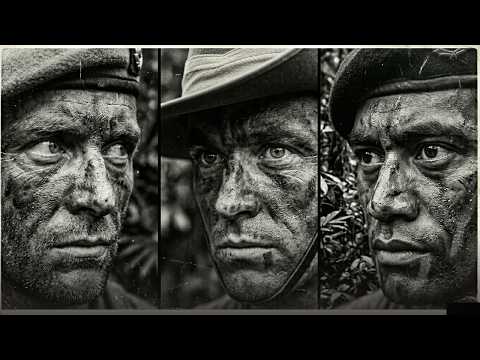
Far to the east, a New Zealand patrol lay motionless on a ridge overlooking the most exposed position in the entire theater. They had achieved full environmental integration in forty minutes—a feat that would have taken any other unit hours. The insects around them had resumed their natural chorus. In the jungle, that was the ultimate sign of acceptance. It meant the forest had absorbed them.
Between them, in the central sector, an Australian SAS patrol waited in absolute stillness. An Iban tracker pressed his fingertips flat against the jungle floor, reading compression patterns in fallen leaves that no Western training program had ever managed to replicate. He had found something. He was confirming it before he spoke.
Three patrols. Three sectors. Three nations. One rule that bound them all without exception: No prisoners. No casualties left behind. No physical evidence that Commonwealth forces had ever crossed into Indonesian territory.
The conflict that brought them there had a name most people in their home countries had never heard: Konfrontasi. Confrontation. Indonesian President Sukarno’s campaign to strangle the newly formed nation of Malaysia before it could establish itself—using military infiltration, political subversion, and the specific geography of Borneo to wage a war of attrition designed to cost the British more than they were willing to spend on a territory they were already preparing to leave.
Sukarno’s strategic logic was not irrational. The British Empire was visibly contracting. Malaya had gained independence in 1957. Singapore had achieved self-governance by 1959. Britain’s proposal for a Federation of Malaysia was an attempt to manage that contraction—to transfer power responsibly to a stable regional structure rather than leave a vacuum.
Sukarno saw it differently. He saw a British attempt to preserve colonial influence under a new flag. He declared his opposition with a phrase that became policy: Ganyang Malaysia. Crush Malaysia. And he began doing exactly that.
The border they would cross stretched nearly a thousand miles—the distance from London to Warsaw—through dense jungle, over seven-thousand-foot mountains, and across rivers that swelled to impassable torrents during monsoon season and shrank to ankle depth in dry months. There were no roads through most of it. Helicopters were the only lifeline, and Borneo’s weather grounded them with a consistency that turned that dependence into a critical vulnerability.
Britain could not allow Konfrontasi to succeed. An empire managing its own contraction could not afford a visible failure at this specific moment in this specific region. General Walter Walker arrived as Director of Operations, carrying the one qualification most British generals of his era lacked: a genuine understanding of the jungle, earned as a Chindit and Gurkha officer. His leadership philosophy would shape everything that followed. Control the border through presence and intelligence, not firepower. Know the crossing points before the enemy uses them.
Australia did not come out of imperial obligation but direct national interest. The archipelagos north of Australia were not an abstract idea in 1963. The Australian SAS arrived in early 1965 carrying fifteen years of Malayan jungle knowledge already crystallized into operational doctrine—a specific product of the Emergency that had embedded in the regiment’s institutional character a relationship with dense forest terrain that no realistic training program could simulate.
New Zealand came with the fewest numbers and would be most often overlooked in the historical record. Seven New Zealanders would die in Borneo. None of them would be publicly acknowledged for what they were doing when they died. They brought the same Malayan Emergency experience as the Australians, with the particular institutional character of a force that had built its entire identity around doing more than its size allowed.
The jungle itself was the first enemy all three forces shared. To describe the triple-canopy forest as dense is like describing the Atlantic Ocean as wet. The first canopy at 150 feet shattered aerial observation entirely. The second at 70 feet killed the light. The third at 30 feet created a permanent green darkness that hung at noon in the interior of Borneo. Not twilight, not shadow, but living dark that confused every visual reference.
Under that darkness, rivers rose six feet overnight and turned trails into streams before dawn. Equipment soaked on the first day of a three-week patrol never fully dried. Leeches—described by Major Vivian Robinson in his field reports as filling boots, penetrating uniform fabric, and attaching to skin in numbers that required deliberate discipline to ignore—were not a minor nuisance. They were a continuous test of a soldier’s ability to maintain focus amid sustained physical suffering, alongside the real threat of an enemy who knew this terrain better at the time.
Any map would show that Walker’s command decision that made the joint operation work was not the decision to bring three regiments to the same theater. It was the decision not to merge them. Three distinct forces assigned to three distinct sectors within a unified command framework. Each regiment deployed where its specific institutional nature would achieve the greatest operational return.
The British 22 SAS took the western Sarawak sectors—the longest-established areas of operation and the most politically sensitive border crossings. The routes Indonesian infiltrators favored because the terrain provided cover and the population centers on the Malaysian side provided targets. The Australian SAS took the central sectors—the most demanding terrain for extended patrols, the longest periods without resupply, the areas where Indonesian patrol activity was most consistent and aggressive. The New Zealand SAS took the eastern sectors and the most dangerous border positions. The places where the risk of detection was greatest, and where the margin between a patrol that returns and one that doesn’t is measured by the precise standard that only the smallest regiments possess.
The four-man patrol was the basic unit of war across all three sectors. But the way each regiment embodied that unit reflected something deeper than shared doctrine. It reflected three distinct institutional histories that arrived at the same operational result through different paths.
In the western sector, British 22 SAS four-man teams operated with the methodical authority of the regiment that had created SAS doctrine in the North African desert in 1941 and refined it through the Malayan Emergency before transferring to Borneo. Their patrol style reflected two years of operational experience in the western sector accumulated before the Australians and New Zealanders arrived. The specific knowledge of western crossing points, western Indonesian force patterns, and western population dynamics that no other regiment possessed.
In the central sector, Australian SASR four-man patrols operated with an environmental attunement forged by fifteen years in the Malayan jungle, embedded at a level below conscious thought. The “SASR step”—a movement technique refined from Malayan practice and adapted to Borneo terrain—was unlike any patrol movement specified by military doctrine in any other country. It was not slower than normal patrolling. It was an entirely different relationship with movement. Each foot was lifted, evaluated, and placed with a full attention that made speed an irrelevant military concept, because speed was dictated by the terrain, not by any predetermined operational tempo.
The Iban trackers who worked alongside SASR patrols in the central sector were not merely assistants. They were the operational difference. A SASR patrol operating in the central sector with an Iban tracker and a patrol operating without one were not the same entity performing a function at different capability levels. They were two different entities with different operational reach in the jungle’s intelligence environment. The tracker read things the four-man team could not read regardless of their training. Disturbed spiderwebs indicating a specific time of recent human passage. Leaf compression that communicated not just direction of travel but approximate number, weight, and pace of the people who caused it. The behavior of certain bird species in sections of jungle that should have been quiet. The specific alarm pattern that indicated human presence within the range the birds could detect.
These were not skills produced by Western training, or that Western training could produce in the time available. They were the product of generations of living in this specific terrain, embodied in a particular form of environmental knowledge that the Australian SASR—because of its institutional readiness to integrate Aboriginal tracking skills and value their expertise—could incorporate into its operational capability in a way that changed what four men could accomplish alone.
The New Zealand SAS operated in the eastern sectors with the disciplined silence developed by the smallest regiment through the institutional logic of a force that could never compensate for mistakes with numbers. When a British patrol was compromised, reinforcement was possible. When an Australian patrol was compromised, the larger SASR provided institutional flexibility. When a New Zealand patrol was compromised, the operational consequences were borne by a faction with no depth to absorb them. The precision that resulted was not merely a higher level of discipline maintained by the other two regiments. It was a distinct operational character, a relationship with silence and stillness and concealment built out of necessity into the institutional DNA of a force whose survival had always depended on getting everything right the first time.
The New Zealand patrol took forty minutes to achieve full environmental integration at their position. The distinctive sign of insects returning to activity around them was not a performance of a technique. It was an expression of training that had made that technique automatic.
Operation Claret—the code name for cross-border raids into Indonesian Kalimantan conducted by all three regiments in their sectors—was the most legally explosive and strategically significant military operation of the entire campaign. Small reconnaissance teams crossing into sovereign Indonesian territory, observing assembly areas and supply routes and troop concentrations for days without engaging. Passing intelligence to Walker’s headquarters that directed conventional border defense with a precision aerial surveillance could not match.
The golden rules the three regiments operated under were absolute and identical regardless of sector or regiment. No prisoners. No casualties left behind. No physical evidence of Commonwealth forces on Indonesian soil. The initial penetration limit of 3,000 yards was extended to 10,000 yards after the Battle of Plaman Mapu in April 1965, when 35 men of B Company, 2nd Battalion, Parachute Regiment held off 400 Indonesian soldiers for two hours, outnumbered more than ten to one, before helicopter reinforcements arrived. 35 against 400. That engagement changed the strategic calculus of the entire campaign. Walker doubled the penetration limit. The three SAS regiments pushed deeper into Kalimantan in their sectors, generating intelligence that conventional border defense could not obtain by any other means.
The British government classified the details of these operations until 1974. Australia denied any involvement until 1996. The New Zealanders participated in Claret operations in a silence their government maintained for the same three decades.
While the four-man patrols moved through their sectors and Claret missions executed in the darkness across the border, a different type of operation was running in every sector simultaneously. The hearts and minds campaign that General Walker established as the foundational logic of his command was not a supplementary program or a diplomatic courtesy. It was an intelligence strategy built on the operational realization that in border terrain where the enemy is invisible to every available technology, the only reliable source of information about where the enemy is and what he is doing is the people who live in the forest he moves through.
To win those people and win the intelligence war, each regiment approached the requirement through the specific lens of its institutional character and its sector’s population. In the western sector, British 22 SAS built community relationships through the sustained presence that two years of continuous operations allowed. Medics walked miles through jungle to provide care for children in communities that had never received any medical attention. The treatment was genuine, and it was also a medical strategy for children. The intelligence that came from parents and the BBC correspondent’s account that documented it were honest about both dimensions in a way that did not diminish the care and did not pretend the strategy wasn’t there.
Communities in the western sector that received sustained British medical care, and felt the presence of British soldiers as a reliable protective force, developed the confidence to report Indonesian infiltration activity that communities uncertain of their protection would not have risked providing.
In the central sector, the Australian SAS approach to hearts and minds carried the particular character of a regiment institutionally prepared to treat local knowledge as an operational asset rather than a cultural incidental. The Iban communities of the central border region experienced Australian soldiers not just as medical providers or a protective presence. They experienced them as a force genuinely interested in what Iban trackers and border scouts and border inhabitants knew about the terrain and the patterns of activity within it. The relationships built on that foundation were different in nature from those the British approach produced, less reciprocal in their external appearance and more genuinely aligned in their practical dimensions. The intelligence those relationships produced reflected that difference.
The Border Scouts program formalized what all three sectors were building informally. Local volunteers working alongside Commonwealth patrols in intelligence and tracking capacities, providing local knowledge that no external force could develop independently in any realistic timeframe. Iban scouts and DACs whose knowledge of trails included routes no map contained, whose community networks extended across the border and could report Indonesian movements before they became infiltrations, whose reading of the environment was the specific operational margin that distinguished four-man patrols with tracking support from those without it.
The program succeeded because the forces running it understood that the risks border communities faced by cooperating with them were real, and that rewarding those risks with consistent and reliable protection was not optional. Communities that trusted Commonwealth forces because Commonwealth forces earned that trust provided intelligence. Communities that did not trust them because the forces present had not invested in the relationship provided nothing. The Indonesians, whose relationship with border communities was based on coercion if it existed at all, did not compete in any of this.
The intelligence environment tilted gradually in the Commonwealth’s favor as Konfrontasi continued. Not because of superior technology, but because of superior human relationships built one medical visit and one border scout recruitment at a time.
By mid-1965, the Confrontation that had begun with Sukarno’s certainty that British imperial contraction made Malaysia indefensible was producing evidence that systematically contradicted that certainty. Claret operations in all three sectors were degrading Indonesian staging capabilities and inflicting losses the Indonesian government was absorbing without official acknowledgment. Hearts and minds investments in all three sectors were generating intelligence that conventional forces used to intercept infiltrations before they reached population centers. Behavioral evidence and observation posts across the western sector. Indonesian soldiers standing guard all day instead of wandering casually. The transformation of relaxed camps into frightened camps was the most direct measure of what the cumulative effect of three regiments operating in three sectors with three distinct but complementary approaches had produced.
The Indonesians in the border regions stopped feeling safe inside their own territory. They were hunting something they could not find. They were being watched by eyes they could not locate. The jungle ghosts of the SAS operating in their three separate sectors under separate commands within a unified framework made the border prohibitively expensive for Sukarno’s strategy.
On September 30, 1965, an attempted coup in Jakarta by seven senior Indonesian military figures resulted in the deaths of six army generals before Major General Suharto suppressed it. The political earthquake that followed demolished the political foundations on which Konfrontasi had been built. Suharto moved to consolidate power, using the coup as a vehicle for transformation. Sukarno’s credibility, built on a display of Indonesian strength that a three-year border campaign had systematically destroyed, could not survive the compounded failure of a military adventure that achieved no territorial gains and a domestic political crisis that cost over a million Indonesian lives in the purges that followed the coup’s suppression.
The Bangkok Agreement in May 1966 and the formal peace treaty on August 11 of that year ended a war that had never been officially declared, concluded with a document both sides signed with evident relief from governments that had been spending more than they wanted on a result neither could publicly clarify what they had sought. The final tally was recorded in specific numbers. 607 Commonwealth personnel killed, 590 Indonesians according to confirmed figures, with the actual number likely much higher given operations that saw no official Indonesian acknowledgment of human losses. Among the Commonwealth dead were 43 Gurkhas, 19 British, 16 Australians, and seven New Zealanders. A significant proportion of those losses across all nationalities occurred not in combat but in helicopter accidents that Borneo’s weather and terrain caused with relentless consistency.
On November 21, 1965, 16 Gurkhas faced an Indonesian machine gun position in the border region. Lance Corporal Rambahadur Limbu of the 2nd Battalion, 10th Princess Mary’s Own Gurkha Rifles, rushed the position alone under heavy fire and destroyed it with a grenade. Two men of his section were wounded and exposed under fire. Limbu returned to rescue them while still under fire. Then he succeeded again in extracting both men. He was awarded the Victoria Cross—the only one granted during the Borneo campaign. This act occurred in a war his government refused to publicly acknowledge as a war. The courage the act required was not diminished by the silence that surrounded it. It was, if anything, increased by that silence. The specific courage of a man who did an exceptional thing in a conflict that the official record spent thirty years not naming.
What the three SAS regiments built together in Borneo was never celebrated in ceremonies that acknowledged what they actually did or where they actually did it. The men returned from the western, central, and eastern sectors to find publics that did not know they had been at war, and governments with institutional reasons to preserve that ignorance. What they left behind was not a monument. It was a doctrine, a relationship, and a standard. The four-man patrol, developed across the three border sectors spanning a thousand miles, became the basic operational unit of special forces. Its influence extended beyond the three nations that developed it simultaneously to the American special operations community, which was receiving instruction in its principles from Australian SAS trainers in Vietnam at the same time it was proving its effectiveness in Borneo.
Delta Force, founded in 1977. Long-range surveillance units in the 1980s. The operational philosophy of modern special operations. Patience before firepower. Environmental adaptation before technological dependence. Small-unit autonomy before mass. All carried the DNA of what three battalions proved in three separate sectors of the same jungle over three years of a war that officially did not exist.
The Five Power Defence Arrangements of 1971 gave the institutional framework an official name. But the framework itself had been built before 1971, in jungle and in darkness, by forces that could not publicly acknowledge what they were building or where they were building it. The British SAS element that held the western sector, the Australian SAS tracker who held the central sector, and the New Zealand SAS signaller who held the eastern sector did not need a treaty to explain the nature of the relationship between them. The jungle had produced that relationship in the only way that particular type of relationship required for their operations could emerge: through shared secret purpose. Through parallel risk in separate darkness. Through mutual trust between forces that each operated to the same standard in adjacent sectors of the same impossible terrain against the same undeclared enemy, and each achieved results that no single battalion could have achieved for all three sectors alone.
Three flags folded inside rucksacks before three groups of soldiers entered a jungle their governments spent thirty years denying they had entered. The war they fought there shaped the political architecture of Southeast Asia. The doctrine they built there shaped the operational architecture of special forces for the next half-century. The silence they maintained about it lasted exactly as long as secrecy required, and not one day longer.
What that silence protected was not a secret. It was an alliance. The kind of alliance that treaties and ceremonies and diplomatic language do not produce, but only the specific experience of being in the same jungle separately, operating in the same darkness independently, and coming home knowing what the others had done even if the official record did not say so.
Three SAS battalions, one jungle, one secret that outlived the men who kept it, and one legacy that outlived the secret. The jungle does not remember them. The jungle keeps no records. It swallowed the trace of their passage and resumed its noise around them and left no sign at their departure that they had ever been there. That is exactly what they trained to achieve. The complete invisibility of forces that accomplished their work and left behind nothing but the results.
Three separate darknesses, one border. The first time Britain, Australia, and New Zealand fought together, and the last time they fought a war of this scale and these consequences. And this operational evolution occurred under a silence of such completeness.
They came from three countries, with three flags, three institutional histories, and three sets of operational habits built over fifteen years of shared and separate hard experience. They were assigned to three different sectors of the same thousand miles, and asked to hold those sectors by methods their governments would deny for thirty years. And they held them.
The western sector was held by British soldiers who spent two years learning the jungle’s harshness before the allies arrived. The central sector was held by Australians who spent fifteen years in Malaya building the environmental adaptation the central terrain required. The eastern sector was held by New Zealanders who built a standard of precision demanded by the margin of error of the smallest regiment, and demanded by the most exposed positions on the border.
Three separate forces, three separate contributions. One result that none of them could have achieved alone, and all of them achieved together without ever working in the same patrol, or sleeping in the same hide, or crossing the same stretch of border on the same secret night.
The first time Britain, Australia, and New Zealand fought together in Borneo was also the most effective counterinsurgency campaign produced by the modern era. The silence they maintained about it for thirty years was not reticence. It was the ultimate expression of the same operational discipline that made everything they did in that jungle possible. They trained to leave no trace. And they left no trace.
Then, when the secrecy finally ended, and the documents were released, and the testimonies of the men who were there could finally be assembled into something approaching the truth, the story that emerged was not the story of three nations doing the same thing in the same place. It was the story of three nations doing three distinct things in three separate places, and producing through the combination of those disparate contributions something that the history of modern warfare had not seen before.
A secret war executed with mastery by professionals who understood what they were doing and why it had to be done in silence. A war that cost men whose names most of their countrymen never knew, and ended with a peace treaty signed by governments that could not even then explain what had actually been done in the jungle to make that treaty possible.
But the story of how they got there—the decisions, the training, the first tentative crossings into a darkness that would consume some of them and define all of them—began long before that night in the western sector, when a British patrol moved toward a border crossing that appeared on no map. It began with a decision made in London, a calculation made in Canberra, and a commitment made in Wellington. And it began with the jungle itself, waiting to see what these men from three nations would become when the only thing standing between them and failure was each other.
Và khi câu chuyện cuối cùng đã được kể, khi những tài liệu đã được giải mật và những cái tên đã được xướng lên, một sự thật vẫn còn đó, lặng lẽ như chính khu rừng đã chứng kiến tất cả. Không có huy chương nào được trao cho sự im lặng. Không có đài tưởng niệm nào được dựng cho những bước chân không để lại dấu vết.
Ba quốc gia. Một khu rừng. Một bí mật sống lâu hơn những người đã giữ nó. Và một câu hỏi vẫn còn treo lơ lửng trong bóng tối ba tầng của ký ức: Nếu họ đã chiến đấu và ngã xuống trong một cuộc chiến mà chính phủ của họ thề rằng không hề tồn tại, thì điều gì mới thực sự là sự thật?
Bạn nghĩ sao—liệu một chiến công có còn là chiến công khi không ai được phép biết đến nó?
Report this article
Select a reason for reporting:






