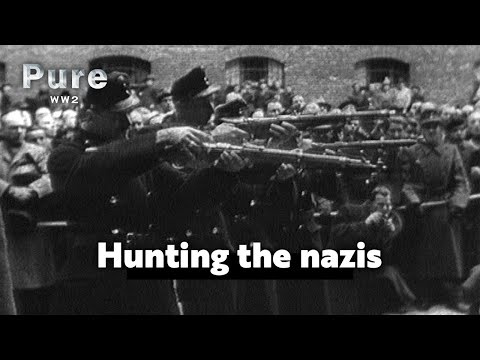
The war was over, but the hunt had only just begun. In the chaotic aftermath of World War II, as millions of refugees roamed across a shattered Europe, some of the most monstrous criminals in history slipped through the cracks. They were the architects of the Holocaust, the overseers of death camps, the doctors who performed unspeakable experiments—and now, they were vanishing.
Among them was Josef Mengele, the Angel of Death, whose name had been spoken at the Nuremberg doctors’ trial. He had been sentenced in absentia, but he was already gone, aided by a network of former SS comrades and a convenient lack of the telltale blood-type tattoo that marked so many of his peers. He had the means and the connections to borrow the celebrated Rat Road, a network organized long before by the Nazis. This was a way out through the Alps to Italy, to the Middle East, to Franco’s Spain, and ultimately to South America, where hunters would later flush them out.
Argentina, under the dictatorship of Juan Perón and his wife Evita, was notoriously favorable to the Nazis. The Argentine army had been equipped and trained by the Wehrmacht, and a powerful German colony had always hailed Hitler. German banking institutions were available to accommodate the SS’s hoard—gold melted down from the fillings and wedding rings of Holocaust victims, sent to Switzerland and then to Argentina, where it changed hands discreetly.
Three hundred Nazi runaways would enter Argentina with forged papers, but with authentic Red Cross travel documents and some help from certain offices in the Vatican. Not very mindful or even conniving ones, but run over by a real flood of refugees. Thus fled to Argentina the SS Adolf Eichmann, the organizing mind of the Final Solution, the planner of Nazi crimes, the master switchman of the death trains. His convoys of deportees from all over Europe ran to the death camps, right-of-way trains that kept running until the downfall of the Reich and Hitler’s last breath.
Eichmann was back every night in Simon Wiesenthal’s nightmares. “I keep thinking of him,” said Wiesenthal. “To me, he has now become the number one criminal.” But where was he hiding? Was he even alive? Wiesenthal had created a net of surviving victims who wrote to him from all over the world. But he also received denunciations of Nazis by other Nazis.
Thus, he got hold of an exceptional document: the official register ledger of the SS. “I paid for this book $500 from a former Gestapo chief,” Wiesenthal recalled. The man was only a simple party member, living in a small town after the war. He had seen that he was in a big murder party, and now he knew many big party members who had too much money, good cars, and factories. He was a little man. He came to Wiesenthal and said, “You know, I will for my conscience tell you what I know.”
Wiesenthal had thus rediscovered Adolf Eichmann’s trail. He now called himself Ricardo Clement. Wiesenthal knew he was alive—but where? Eichmann first hid in a farm in Argentina’s pampas. The great murderer bred rabbits, then held various small jobs. Nothing to be proud of, but at least he thought he was safe. As other former Nazis did, who thought safety was to be found at the world’s end—a world’s end for them, such as Bariloche, a small town in the Andes. There, those runaways had cottages built in the Bavarian style while still dreaming of a revival of Nazism.
Far from them now, Germany was slowly being rebuilt with all those Trümmerfrauen, women of the ruins, exhausting themselves to help do so. But the Germans also needed to recover their own memory. The very few who tried had a hard time of it. Wiesenthal felt isolated. He guessed that it would take another generation to face such a past. The children of Germany’s zero year were growing up with their parents’ silence.
Yet in Berlin, the Spandau prison still held the war criminals not hanged at Nuremberg. The people of Berlin came to watch the changing of the guards of the four occupying powers. British or American military police, French men at arms were everywhere. The Soviet soldiers were locked up in their lookouts by their officers to prevent them from fleeing to the West. Prison was a huge medieval-like jail building whose upkeep cost was outrageous for only seven prisoners. Among them was Rudolf Hess, Hitler’s heir apparent, who would cover his cell’s walls with photographs of the moon. Albert Speer, minister and close friend of Hitler’s, had been sentenced to 20 years in jail.
On the other side of these walls in the Soviet zone, a great amount of placards denounced the absence of von Papen at Spandau. How could this man who favored Hitler’s political takeover have been acquitted at Nuremberg? These demonstrations organized by the Soviets would lead to the opening of another trial in the rival zone of Germany. Von Papen was arrested again and tried by a West German court. Within a wide movement of denazification, he was sentenced to 8 years of hard labor. Millions of Nazis or Nazi sympathizers were then harassed. 100,000 were sentenced. But an awareness of the past was still hard to be awakened. Such trials would become fewer. People in Germany wanted to forget Nazism and turn the page—even those who were tattooed as they entered Auschwitz.
But for Wiesenthal and his network of hunters, forgetting was not an option. The trail of Adolf Eichmann had grown cold, but it was not dead. And somewhere in the world’s end, a man calling himself Ricardo Clement was still breathing, still hiding, still dreaming of the Reich that was no more.
Wiesenthal’s small office in Vienna became a clearinghouse for whispers. Letters arrived from Buenos Aires, from São Paulo, from remote villages in the Andes. Each one was a thread, and Wiesenthal pulled at them with the patience of a spider. He had no official authority, no police force, no budget—only the moral weight of his own survival and the stubborn refusal to let the dead be forgotten.
In 1954, a letter from Argentina gave him a name: Ricardo Klement. A German immigrant living in Buenos Aires, working at a Mercedes-Benz factory. The description was vague, but Wiesenthal felt the familiar chill. He wrote back, asking for more. The reply was cautious, almost fearful. The informant, a blind Jewish refugee who had lost his family at Auschwitz, wrote that Klement had a German accent, a scar on his face, and a way of speaking that made your skin crawl.
Wiesenthal cross-referenced the name with his ledger. No Ricardo Klement. But there was an Adolf Eichmann, and the physical description matched. He sent the file to the Israeli consulate, to the West German authorities, to anyone who would listen. For years, the response was the same: silence, or a polite brush-off. The world wanted to move on. The Cold War was heating up, and old Nazis were useful tools against the Soviets.
Then, in 1957, a prosecutor in Hesse named Fritz Bauer received an anonymous tip. A former SS man, now living in Argentina, had a daughter who was about to marry a man named Eichmann. The daughter’s name was in the German records. Bauer, a Jewish exile who had returned to rebuild German justice, passed the information to the Mossad. The Israeli intelligence agency had been waiting for this moment. They had never forgotten. They had never forgiven.
In a small apartment in Tel Aviv, a team of agents began to prepare. They studied photographs, rehearsed the capture, and waited for the right moment. The man who had sent millions to their deaths was living in a suburb of Buenos Aires, walking to the bus stop every morning, coming home to his wife and children. He thought he was safe. He thought the world had forgotten.
But Wiesenthal had not forgotten. And neither had the men who would soon arrive on his doorstep.
The Mossad team landed in Buenos Aires in the spring of 1960, traveling on forged passports and carrying the quiet intensity of people who had rehearsed a single moment for years. They rented safe houses, mapped the streets of the San Fernando suburb, and watched the man who called himself Ricardo Klement. Every morning at the same hour, he stepped off the bus and walked toward the Mercedes-Benz factory with a measured, unremarkable gait. To his neighbors, he was a quiet German immigrant, a devoted father, a man who kept to himself.
But the agents saw something else. They saw the face from the photographs, older now, the hairline receding, the mouth set in the same thin line. They saw the hands that had signed the orders. They saw the man who had once declared that he would leap laughing into his grave because the feeling that he had five million people on his conscience would be for him a source of extraordinary satisfaction.
The capture was set for a night in May. The team waited in a car near the bus stop, engines humming, hearts pounding. When Klement stepped off the bus, two agents seized him, bundled him into the vehicle, and drove into the darkness. For a long moment, there was only the sound of breathing and the hum of the tires on the wet asphalt. Then a voice spoke in German, and the man in the back seat went pale.
He denied everything at first. He gave a false name, a false story, a false life. But the agents had brought a list of names, and when they spoke the name Eichmann, he fell silent. He was not a man who broke easily, but the weight of his own identity pressed down on him. By the time they reached the safe house, he had signed a statement, in his own hand, admitting who he was.
Ten days later, the man who had organized the trains to Auschwitz was smuggled out of Argentina on a commercial flight, drugged and disguised as a crew member. The operation was so secret that even Wiesenthal, who had spent years chasing shadows, learned of it only after the plane had landed in Israel. He received the news in his Vienna office, and for a long moment, he simply sat in silence. The man who had haunted his nightmares was finally in a cell in Jerusalem.
But the capture was only the beginning. In Argentina, the news broke like a thunderclap. The Perón government, already weakened by economic crisis and political unrest, was humiliated. The German colony in Buenos Aires whispered in fear. If Eichmann could be taken from under their noses, who would be next?
In Jerusalem, preparations for the trial began. The world’s eyes turned toward the small courtroom where the testimony of survivors would be heard. For the first time, the Holocaust would be narrated not by historians or politicians, but by the people who had lived it. Wiesenthal understood the weight of the moment. He understood that the trial would not just judge one man—it would judge an entire era of silence.
Yet in Germany, the reaction was not what he had hoped. Many wanted to look away. Some dismissed the trial as a show, a spectacle staged by a foreign government. Others, still clinging to the myth of the clean Wehrmacht and the innocent civil servant, insisted that Eichmann was merely a cog in a machine. The old excuses were being polished and put back on display.
Wiesenthal watched the trial from Vienna, reading every transcript, every survivor’s testimony. “The world is finally listening,” he wrote to a friend. But he knew the verdict would not silence the doubts.
In 1962, Eichmann was hanged. His ashes were scattered at sea, beyond any grave that could become a shrine. The architect of the death trains was gone, but the questions he embodied remained.
Germany’s youth began to ask what their parents had done. The silence cracked, slowly, painfully. Wiesenthal kept his files open—there were still others to find.
He often returned to one thought: the world had needed a generation to face its past. Had it truly faced it—or merely learned to look away more quietly?
Report this article
Select a reason for reporting:






