For thirty years, Johnny Carson was America’s nightcap—the last voice millions heard before sleep. But behind that Midwestern smile and impeccable timing lay a comedic genius who understood something modern hosts have forgotten: true comedy can’t be manufactured. It erupts when everything goes perfectly wrong.
While today’s hosts chase viral clips with scripted bits, Carson created magic through genuine spontaneity. The raised eyebrow after an awkward silence. The perfect ad-lib when disaster struck. The willingness to let chaos unfold without intervention. Tonight, we revisit the unscripted moments that made The Tonight Show a master class in finding humor when the plan falls apart.
The date: April 27th, 1965. The guest: actor Ed Ames from the hit show Daniel Boone. Ames, who played the Native American character Mingo, arrived to demonstrate his tomahawk-throwing skills. The prop team wheeled out a large wooden silhouette of a cowboy. Carson stepped aside, giving Ames room to throw.
Ames took careful aim, drew back, and let the tomahawk fly. It sailed through the air and landed with a solid thunk—directly between the wooden figure’s legs. The placement couldn’t have been more perfect had they tried for a hundred takes.
The audience’s reaction was immediate: a gasp, then building laughter that grew into a sustained roar. The camera caught Carson’s face as he processed what had just happened. The laughter continued to build, and he simply waited, letting the moment breathe.
As the audience’s response began to peak, Carson stepped forward, surveyed the unfortunate placement of the tomahawk, then delivered with perfect deadpan timing, “I didn’t even know you were Jewish.”
The audience exploded. What had been loud laughter transformed into uncontrollable howling. Ed Ames doubled over. Even the normally composed Carson fought to maintain his straight face.
The moment wasn’t scripted. The throw wasn’t planned to land there. Carson’s line wasn’t written in advance. It was pure spontaneous brilliance—a split-second recognition of comedic opportunity by a master at the height of his powers.
The show tried to move on, but couldn’t. Every time Carson approached the target to remove the tomahawk, the audience would erupt again. Finally, he left it in place, occasionally glancing back at it through the interview, each look triggering renewed laughter.
NBC executives initially worried about the risqué nature of both the visual and Carson’s ad-lib. Instead, they received calls from viewers praising the moment as the hardest they’d laughed in years. The clip would be replayed on Carson anniversary shows for decades, becoming so iconic that even people born after Carson’s retirement recognized the moment.
It wasn’t just funny. It was a perfect demonstration of Carson’s unique gift: the ability to find exactly the right words at exactly the right moment when unplanned comedy struck.
But if the tomahawk represented Carson’s quickest wit, our next legendary moment revealed something even rarer—the night when television’s most controlled host completely lost control of himself.
Famous sage, seer, soothsayer, and former joke writer for Ronald Reagan: Karnak the Magnificent. Turban perched majestically on his head, cape draped over his shoulders, Johnny Carson transformed into the mystic from the East who could divine answers to questions sealed in hermetically sealed envelopes.
The routine followed a precise formula. Karnak would hold the envelope to his forehead, announce the answer, then open the envelope to reveal the question. The comedy came from the unexpected connection between the two.
On this particular night in 1974, Karnak held the envelope to his forehead with typical solemnity. “Sis boom bah,” he announced with mystic certainty. He tore open the envelope, removed the card, and read the question: “Describe the sound made when a sheep explodes.”
What happened next was something Tonight Show viewers almost never witnessed. Johnny Carson, television’s most composed performer, completely lost it.
He started with a small chuckle that quickly evolved into uncontrollable laughter. He tried to move on to the next envelope, but couldn’t compose himself. Ed McMahon’s booming laugh only made it worse.
Carson slumped forward onto his desk, shoulders shaking. When he finally looked up, tears were streaming down his face. The audience, witnessing this rare break in Carson’s famous composure, laughed even harder—not just at the joke, but at the spectacle of the unflappable host utterly defeated by his own comedy.
“I’m sorry,” he gasped, still fighting for control. “I don’t know why that struck me as so funny.” He picked up the next envelope, attempting to continue, but one glance at McMahon sent him spiraling into fresh peals of laughter.
It took nearly two full minutes—an eternity in television time—for Carson to regain enough composure to continue the sketch. Even then, occasional aftershock giggles interrupted his delivery of the next few jokes.
For viewers accustomed to Carson’s professional polish, this breakdown revealed something endearing. Beneath the suave exterior was a man who could be ambushed by genuine laughter, just like anyone else. The moment humanized television’s most iconic figure, showing the real person behind the polished persona.
While the Carnac moment showed Carson ambushed by successful comedy, some of his most memorable moments came from the exact opposite situation—when jokes didn’t work at all.
The monologue—eight to ten minutes of topical jokes delivered directly to the camera—opened every show for thirty years. Unlike today’s heavily tested, writer-room-approved monologues, Carson’s featured genuine risk. Jokes bombed regularly, and when they did, television magic happened.
Carson didn’t fear the silence after a failed joke. He weaponized it. When a punchline met with audience silence, Carson would pause, make direct eye contact with the camera, and say with perfect timing, “How many of you actually liked that joke? Let’s see a show of hands.”
The camera would cut to an audience member reluctantly raising their hand, triggering laughter far exceeding what the original joke would have generated. Carson had transformed failure into connection—inviting viewers to laugh not at the joke, but at the shared recognition of its failure.
On nights when multiple jokes faltered, Carson would launch into his soft-shoe routine—a vaudeville-inspired shuffle across the stage performed with exaggerated movements while humming tunelessly to himself. This wordless acknowledgement of comedy disaster became so beloved that audience members would sometimes cheer when a joke bombed, knowing it might trigger the soft shoe.
“These are the jokes, folks,” he would announce after a particularly egregious bomb. “They can’t all be winners.”
When a political joke failed to land, Carson would often turn to Ed McMahon with feigned irritation. “The country’s divided, Ed.” This simple line acknowledged both the bomb and the political climate that caused it, turning discomfort into shared understanding.
His most quoted recovery line appeared when jokes failed spectacularly: “I’m show business, folks. I’ll be here till Thursday. Try the veal.” This self-deprecating reference to the Borscht Belt comedy circuit simultaneously acknowledged the bomb while positioning Carson as a working comedian rather than a television star.
The failed monologue jokes revealed something essential about Carson’s appeal: his willingness to be vulnerable. By acknowledging his misfires instantly rather than pushing through with false confidence, he created authentic connection in an artificial medium.
During his final years on air, Carson’s joke-recovery techniques became so beloved that writers would occasionally plant deliberate bombs—jokes designed to fail—just to watch the master work his recovery magic. These planned failures were kept secret from Carson himself, ensuring his reaction remained genuine.
After one spectacular bomb in 1987, Carson put down his cards, walked to the edge of the stage, and told the audience confidentially, “You know, for what they’re paying me, you’d think they could hire someone to write decent jokes.” The line got a standing ovation.
Carson’s ability to mine comedy gold from comedy disaster showcased his fundamental philosophy: authenticity trumps perfection. He understood that audiences connected more deeply with genuine reaction than flawless performance—a lesson many of today’s more tightly controlled hosts have forgotten.
While Carson’s handling of his own failures demonstrated his solo brilliance, some of the show’s most memorable moments came when he surrendered control entirely—allowing himself to become the target of comedic attack. This willingness to be the butt of the joke revealed Carson’s remarkable security.
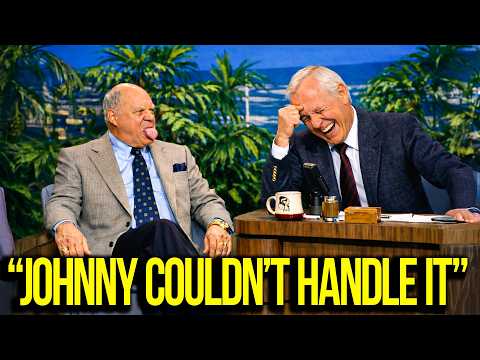
As television’s undisputed king, he could have maintained an untouchable persona. Instead, he allowed—even encouraged—select comedians to target him directly. Don Rickles made this his signature move. He would arrive for scheduled appearances, greet Carson warmly, then immediately pivot to savage mockery.
“You’ve had some bad breaks,” Rickles told Carson during one appearance, referencing his multiple divorces. “I’m married ten years, and I got a great wife. You’re a jinx. I’ll roll the dice again.”
Carson never seemed more delighted than when being methodically dismantled by Rickles. He would lean back in his chair, cigarette in hand, laughing harder than anyone as Rickles dissected his failed marriages, his wealth, and his alleged fair-weather friendships. “Nobody really likes you, Johnny,” Rickles would declare. “They just want to be on television.”
While Rickles specialized in direct attack, Rodney Dangerfield brought a different dynamic to his Carson appearances. His machine-gun delivery of self-deprecating one-liners created a different kind of comedic energy. During these appearances, Carson essentially transformed from host to audience member.
He would lean back in his chair, almost disappearing from the frame, giving Dangerfield complete control of the stage. Carson’s reaction shots—eyes watering with laughter, occasionally pounding the desk when a joke particularly landed—became the perfect comedic counterpoint to Dangerfield’s deadpan delivery.
After one particularly relentless set of one-liners, Carson could barely form his next question. “Do you write all these yourself?” he managed. “No, Johnny,” Dangerfield replied without missing a beat. “I pay a guy to follow me around and get no respect for me.”
These comedian appearances revealed Carson’s remarkable lack of ego regarding who generated the laughs. Unlike many hosts before and since, he showed no need to top his guest’s jokes or remain the focal point. He understood that his audience didn’t tune in to see him dominate conversations. They wanted to see him create an environment where comedy could flourish, regardless of its source.
This generosity extended beyond established stars to comics making their television debuts—moments when Carson’s reaction could literally change lives overnight. On October 23rd, 1981, an unknown comedian named Robin Williams made his first appearance on The Tonight Show, unleashing a hurricane of comedic energy that left Carson visibly stunned.
Williams didn’t simply walk onto the stage. He exploded onto it. Within seconds, he was everywhere—crouching, jumping, switching between voices, characters, and topics with such speed that both the audience and host struggled to keep up.
Spotting Japanese characters in a newspaper on Carson’s desk, Williams launched into an impromptu routine about strange words in the paper, transforming into a Japanese businessman before pivoting without warning to an extended bit about Chihuahuas in a cup that had the audience gasping for breath.
The camera caught Carson’s reaction: eyes wide, mouth slightly open, leaning forward in his chair. This wasn’t the polite attention he typically gave to new comedians. This was genuine astonishment.
When Williams finally concluded his set and joined Carson at the desk, Johnny’s first words captured what everyone was thinking. “God, you’re weird.” The line, delivered with affectionate bewilderment, was followed by an invitation to sit—the coveted signal that Carson approved.
Within seconds, Williams was reanimated, using Carson’s desk props to launch into fresh improvised routines. Rather than attempting to control this comedy cyclone, Carson simply leaned back, surrendering his show to the newcomer’s manic brilliance. His willingness to be upstaged—to become an audience member on his own program—revealed his fundamental security and love of authentic comedy, regardless of its source.
Just months after Williams’s explosive debut, a very different comedian made his first Carson appearance. Jerry Seinfeld, whose meticulously crafted observational humor about leftover items in a drugstore, represented the polar opposite of Williams’s improvisational frenzy.
“Have you ever noticed the things they sell in drugstores that just stay there forever?” Seinfeld began, launching into a precisely constructed routine about odd merchandise that seemed to exist in perpetual inventory. Where Williams had been physical, Seinfeld stood almost perfectly still. Where Williams created chaos, Seinfeld offered precision. Yet Carson’s reaction was equally enthusiastic—a demonstration of his appreciation for comedic excellence regardless of style.
As Seinfeld’s set concluded, Carson gave him the coveted okay sign and invited him to the couch—the signal that industry insiders recognized as career-changing approval. Years later, Seinfeld would describe this moment as more significant than winning any award. Getting Johnny’s approval was the comedy equivalent of being knighted. Suddenly, you weren’t just a comic. You were a comic Johnny Carson thought was funny. That distinction changed everything.
These debut appearances revealed Carson’s extraordinary eye for talent across vastly different comedic styles. His immediate recognition of both Williams’ manic energy and Seinfeld’s precise observations demonstrated not just appreciation for comedy, but an understanding of how diverse its expressions could be.
Yet some of the show’s most unpredictable comedy came when non-human guests took center stage. A young orangutan that had been sitting relatively calmly next to animal expert Joan Embery decided Carson’s famous silver hair looked like a perfect climbing opportunity—tiny fingers firmly grasping his carefully styled coiffure.
“We’re back in 30 seconds,” called the floor director. The crew froze. Instead of attempting to remove his new head ornament, Carson adjusted his position slightly to accommodate the added weight. “Just leave him,” he instructed as makeup people hovered nervously. “Let’s see what happens.”
This willingness to let chaos unfold without intervention defined Carson’s approach. While most hosts would have stopped the show, Carson recognized that the unplanned moment was far more entertaining than anything they had scripted.
That vulnerability was what people connected with—a man secure enough to let the audience see him completely at the mercy of a monkey or an elephant. It was the same gift that turned a wayward tomahawk into legend, that let him laugh at his own exploding sheep, that made failure feel like friendship.
Johnny Carson never needed to be the funniest person in the room. He only needed to be the most human. And in that, he was untouchable.
So here’s the question: in today’s world of perfectly scripted viral moments, have we lost something irreplaceable—or can authenticity still win the night? Tell us in the comments.
Report this article
Select a reason for reporting:






