In 1939, the world’s largest navy wasn’t American or Japanese—it was British. The Royal Navy boasted nearly 1,400 vessels, including 15 battleships and 7 aircraft carriers, and guarded sea lanes from Gibraltar to Singapore. Yet within months, German U-boats would send over 2,700 merchant ships to the bottom, and the fate of Britain would hang by a thread.
This is the story of how the Royal Navy, against overwhelming odds, kept the nation alive—and helped turn the tide of World War II.
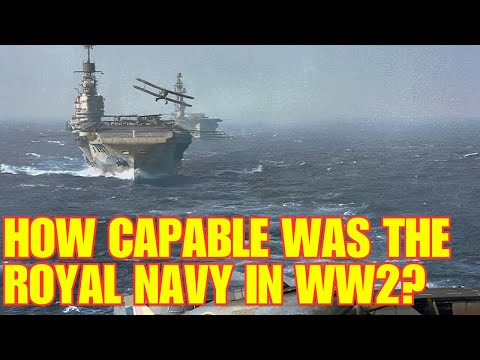
At the outbreak of war, the Royal Navy was a colossus astride the oceans. Its admirals—men like the cautious Sir Dudley Pound and the aggressive Andrew Cunningham—commanded a fleet that was the envy of the world. But beneath the surface lurked dangerous weaknesses. Many battleships were aging relics of World War I, vulnerable to modern firepower. Aircraft carriers were few and lightly armed. And British shipyards, unlike America’s industrial behemoths, could not quickly replace heavy losses.
These flaws would soon be tested in the icy waters of the Atlantic.
The survival of Britain depended on sea lanes. Food, oil, and weapons flowed across the Atlantic, and Germany’s U-boat wolfpacks, under Admiral Karl Dönitz, were determined to sever them. Between 1939 and 1945, over 2,700 merchant ships were sunk. At first, convoy escorts were too few. Destroyers like HMS Arcasta and HMS Ardent sacrificed themselves against German battlecruisers Scharnhorst and Gneisenau to protect merchantmen. The sinking of HMS Courageous and later HMS Ark Royal by U-boats proved even capital ships were not safe.
In October 1940, convoy SC7 lost 20 of its 35 ships. Britain was bleeding faster than it could replace. After the fall of France, U-boats operated from Atlantic ports like Lorient and Brest, extending their reach. In 1942, the ‘Second Happy Time’ began, with U-boats ravaging US coastal shipping, even sinking tankers visible from American beaches.
But by 1943, the tide turned. Escort carriers like HMS Audacity provided vital air cover, long-range Liberator patrol aircraft closed the mid-Atlantic gap, and new weapons like the Hedgehog mortar struck back. Alan Turing’s breaking of the Enigma code allowed commanders like Admiral Max Horton to coordinate escorts with deadly efficiency. Aggressive escort group commanders such as Captain Frederick John Walker destroyed six U-boats in a single patrol. In ‘Black May’ 1943, 41 U-boats were lost in one month. From then on, the U-boats were on the defensive. Britain’s survival was secured.
Beyond the Atlantic, the Royal Navy faced the Arctic convoys—supply runs to the Soviet Union through freezing northern seas. These carried tanks, trucks, and fuel vital for the Red Army. Ships were encased in ice, threatening to capsize. In summer, 24-hour daylight made them easy targets for Luftwaffe bombers. German heavy units like Tirpitz, Scharnhorst, and Lützow lurked in Norwegian fjords.
In July 1942, the ill-fated convoy PQ17 was scattered on Admiralty orders, fearing interception by Tirpitz. German U-boats and aircraft destroyed 24 of 35 ships—the costliest convoy of the war. Then in December 1942, convoy JW51B, better known as the Battle of the Barents Sea, saw a small escort of destroyers and two light cruisers under Rear Admiral Robert Burnett fight off the Hipper and Lützow, protecting nearly every merchant ship. Hitler, furious, lost faith in his surface fleet. In December 1943, convoy JW55B, escorted by Admiral Fraser, lured out Scharnhorst, which was sunk at the Battle of North Cape. Over 3,000 merchant ships reached Russia via Arctic convoys, a testament to the Navy’s endurance under the harshest conditions.
The Royal Navy’s record at sea was mixed—and nowhere was that clearer than in the Mediterranean. Here, Admiral Andrew Cunningham led with daring and flair. At the Battle of Taranto in November 1940, aging Swordfish torpedo bombers swooped low over the Italian fleet at anchor, crippling three battleships in a single night. The strike was so audacious that Japan studied it closely when planning Pearl Harbor a year later.
Yet the Mediterranean demanded a brutal price. Between 1940 and 1942, the Malta convoys kept the island alive against relentless air and sea attack. Operation Pedestal in August 1942 saved Malta—but cost a carrier, two cruisers, and a dozen destroyers. Against Italy and later Germany, the Royal Navy proved both resilient and aggressive, keeping the supply lines open for the Desert War.
Far to the east, Britain struggled most. The fall of Singapore in 1942 shattered the myth of imperial invincibility. Worse, the sinking of HMS Prince of Wales and HMS Repulse by Japanese aircraft off Malaya marked the end of battleship dominance. Two great capital ships, sent to the bottom in minutes by land-based bombers—the lesson was brutal, and the Royal Navy had no carriers nearby to answer.
But Britain learned. By 1944, a rebuilt British Pacific Fleet, built around modern carriers like HMS Indomitable, fought alongside the US Navy at Okinawa and struck directly at the Japanese home islands. The Royal Navy that limped out of the Far East in 1942 returned as a carrier force to be reckoned with.
Throughout the war, innovation was a quiet British strength. Convoy escort groups were perfected to counter the U-boat wolfpacks. Radar-directed gunnery and night carrier operations gave British ships a decisive edge in darkness. Anti-submarine weapons like the Hedgehog mortar and improved depth charges helped win the Battle of the Atlantic—the one naval battle Britain could not afford to lose.
Yet the weaknesses were real. Limited shipbuilding meant Britain relied on American landing craft and Liberty ships. Old battleships and thin carrier decks had to soldier on until late in the war. And there was constant overstretch—never enough ships to provide depth across every ocean at once.
By war’s end, the Royal Navy had paid dearly. Over 50,000 sailors were lost. 278 major warships and more than 500 escorts were sunk or destroyed. Merchant losses exceeded 11 million tons of shipping. And yet the fleet had fulfilled its mission. It kept Britain alive through the Atlantic battle, sustained the Soviet war effort through the Arctic convoys, contained the Axis fleets in the Mediterranean, and contributed to every major Allied landing from North Africa to Normandy.
So how capable was the Royal Navy in World War II? The answer is complicated—and it depends entirely on where you look.
In the Atlantic, it was indispensable. Without the convoy system, the escort carriers, the codebreakers at Bletchley Park, and the relentless destroyer captains like Walker, Britain would have been starved into submission by the spring of 1943. The Battle of the Atlantic was the one campaign the Royal Navy could not lose—and it did not lose it.
In the Mediterranean, it was aggressive and inventive. Taranto proved that a handful of obsolete biplanes could cripple a modern fleet at anchor. Cunningham’s relentless pursuit of the Italian navy kept the supply lines to North Africa open, and the Malta convoys—though costly—denied the Axis a decisive victory in the Middle Sea.
In the Arctic, it was stubborn beyond reason. Sailors fought ice, darkness, and the constant threat of Tirpitz lurking in the fjords. The convoys kept coming, and the Red Army kept fighting.
But in the Far East, the Royal Navy was humbled. Singapore’s fall and the loss of Prince of Wales and Repulse exposed decades of complacency. Britain had built its empire on the battleship, and Japan had just proved the battleship could be killed from the air. It was a lesson the Royal Navy absorbed painfully—and only rebuilt its Pacific presence late in the war, largely with American help.
There was also the quiet problem of industrial capacity. Britain could not build ships fast enough to replace its losses. American yards produced Liberty ships by the dozen, but British shipyards could not match that pace. By 1944, the Royal Navy was increasingly dependent on American equipment, American landing craft, and American fuel. The fleet that entered the war as the world’s largest emerged from it as a respected but clearly secondary partner to the United States Navy.
And yet—and this is the crucial point—the Royal Navy did exactly what Britain needed it to do. It held the line when Britain stood alone. It kept the sea lanes open when the alternative was surrender. It fought in every theater, from the freezing Arctic to the sun-baked Mediterranean, from the Atlantic depths to the Pacific skies.
It was not flawless. It was overstretched, underbuilt, and sometimes outmatched. But it was indispensable. Without the Royal Navy, there would have been no Allied victory to celebrate—because there would have been no Britain left to celebrate it.
As the fleet returned to its anchorages in 1945, its admirals knew the world had changed. The age of the British battleship was over. The age of the American carrier had begun. But the Royal Navy’s legacy was secure—written in the survival of a nation and the freedom of the seas.
The war had tested the Royal Navy as never before, and it had emerged transformed. The lessons of the Atlantic, the Mediterranean, and the Pacific were written in steel and blood. But the most important lesson was that sea power alone could not win a war—it had to be backed by industry, alliance, and innovation.
As the fleet returned home, the sailors who had survived the icy Arctic, the burning tankers, and the relentless U-boat packs knew they had been part of something historic. They had held the line when hope was thin. And in doing so, they had ensured that the sun would never fully set on the freedom they defended.
So what do you think? Was the Royal Navy’s contribution to Allied victory truly indispensable, or was it merely a supporting player to the industrial might of the United States? Let us know in the comments below.
Report this article
Select a reason for reporting:






