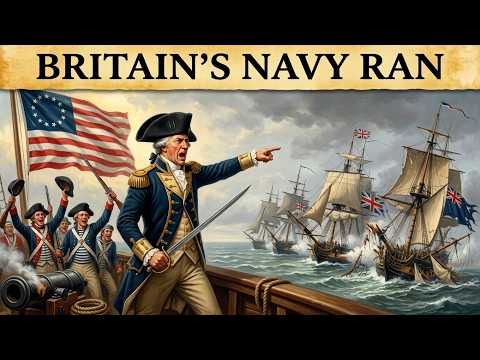
On September 5, 1781, a British admiral named Thomas Graves stood on the deck of his flagship and stared at something he was never supposed to see. Anchored at the mouth of the Chesapeake Bay, stretching across the water like a floating city, lay the largest French naval fleet ever to cross the Atlantic. Twenty-four ships of the line, hundreds of cannons aimed at the open sea, while Graves—who had sailed south from New York with only nineteen ships—had led his entire fleet straight into a trap.
What happened over the next few hours would cost Britain its American colonies, humiliate the most powerful navy on earth, and give a group of broke, exhausted rebel farmers the one thing they needed to win a six-year war.
But to understand how this disaster took shape, we must go back a few months, because the Battle of the Chesapeake was never really about ships and cannons. It was about timing, deception, borrowed money, and a French admiral who bet everything on a single move that no one in London saw coming.
By the spring of 1781, the American Revolution was in serious trouble—and not from the side you might expect. George Washington’s Continental Army was starving, unpaid, and on the verge of collapse. Entire regiments had mutinied over the winter because Congress couldn’t afford to feed them, let alone pay them. In January, soldiers of the Pennsylvania Line had marched on the Continental Congress to demand back pay and better conditions. Washington had to send other troops to put down the mutiny.
This was the state of things: the commander-in-chief of the Revolution was using part of his army to stop the other part from quitting. He wrote in his diary in April: “Instead of having a chance for a glorious offensive campaign, I was facing a perplexing and gloomy defensive one.”
The war had entered its sixth year. France had been an ally since 1778, but French money and troops had not delivered the decisive victory everyone was waiting for. The Continental dollar was worthless. Desertions were climbing every month, and London was in no hurry to finish the job.
The British strategy was simple: hold the major cities, tighten the grip on the coast, and wait for the rebellion to burn itself out. By the spring of 1781, that strategy was working.
Meanwhile, the British were tightening their hold on the southern colonies. General Charles Cornwallis had fought his way through the Carolinas, winning battles and burning towns. By the summer of 1781, he had marched his army north into Virginia. His superior, General Henry Clinton in New York, sent him a series of confusing, contradictory orders that essentially told Cornwallis to find a deep-water port and build a fortified position.
Cornwallis chose a small tobacco port on the York River called Yorktown and began fortifying it. It was a strong position against any land attack, but it contained a problem Cornwallis either ignored or didn’t fully appreciate. Yorktown sits on the tip of a peninsula, with the York River on one side and the James on the other, both emptying into the Chesapeake Bay. If an enemy fleet closed that bay, Cornwallis would be trapped on that peninsula with no sea exit and no way to receive supplies or reinforcements.
His army would become like a cork in a bottle—and that was exactly what a fifty-nine-year-old French admiral was about to arrange.
François Joseph Paul, the Comte de Grasse, was not a man inclined to play it safe. He was fifty-nine, tall—reportedly over six feet, unusual for the era—and had spent most of his adult life fighting the British at sea. He had good connections at the court of Versailles and was highly regarded for his seamanship and courage, but he also had a talent for irritating his fellow officers and had few real friends in the French Admiralty.
His flagship, the Ville de Paris, was said to be the largest warship of its time, carrying 110 guns across three decks. In March 1781, de Grasse sailed from the French port of Brest with the largest fleet France had ever assembled—twenty-eight ships of the line and roughly two hundred merchant vessels, all bound for the Caribbean.
His orders from the Navy Minister, Charles de Castries, were to protect France’s sugar colonies in the West Indies, cooperate with Spain against the British, and then send part of his fleet north toward the winter to assist the Americans on the mainland. That last part matters: his orders specified part of his fleet. De Grasse ignored that. He brought the entire fleet.
That decision changed the course of the entire war, and it came down to a disagreement between two generals.
Washington and his French ally on land, General Rochambeau, disagreed about where to strike. Washington wanted to attack New York City, the center of British power. Rochambeau thought that was a terrible idea. New York was heavily fortified, and its harbor was nearly impossible for a large fleet to navigate. Rochambeau wanted instead to chase Cornwallis in Virginia. They sent letters to de Grasse via a fast frigate laying out both options and asking him to choose.
De Grasse chose Virginia. The entrance to the Chesapeake was easier, Cornwallis was exposed, and the timing was right.
But there was another problem—and it was a big one. Washington’s army and Rochambeau’s French troops were camped outside New York, more than 400 miles from Yorktown. They would have to march south without the British in New York realizing what was happening. Because if Clinton understood that the target had shifted to Virginia, he would reinforce Cornwallis by sea long before any army could arrive on foot.
So the entire plan depended on secrecy, speed, and French naval control of the Chesapeake before the British navy could respond. Three things had to succeed at the same time, and if any one of them failed, the whole campaign would collapse.
De Grasse left the Caribbean on August 5 with twenty-eight ships of the line and roughly 3,300 troops under the Marquis de Saint-Simon. These were troops borrowed from the garrison earmarked for a possible invasion of British Jamaica, and de Grasse had been warned they could not stay in America past mid-October. So the clock was already running.
But de Grasse had another problem before he even left port. Rochambeau had asked him to bring money—no less than a million livres—to pay Washington’s soldiers, who hadn’t been paid in months. De Grasse tried to borrow the money from French merchants in Haiti. He even offered his own plantations as collateral. They refused him. No one trusted the French treasury to repay the debt.
So de Grasse turned to Spain. Working with a Spanish diplomat named Francisco de Saavedra, he arranged a loan of 500,000 pesos from merchants and organizations in Havana, Cuba. The money was raised in just forty-eight hours and loaded onto a frigate called the Aigrette, which rushed to meet de Grasse’s fleet at sea.
Without that cash from Havana, Washington’s army might never have held together long enough to fight at Yorktown. Some of those soldiers received their first pay in years from Spanish coins that had been sitting in Cuban counting houses just weeks earlier.
And now, here is where the plan becomes brilliant. De Grasse did not take the direct route north from Haiti. He sailed through the Old Bahama Channel—a narrow, dangerous passage between Cuba and the Bahamas—guided by Spanish sailors who knew those waters. The British were watching the usual shipping lanes, but they were not watching this one. The entire French fleet slipped through undetected.
Meanwhile, the British had their own counter-move in motion, and here the timing becomes almost unbelievable. Admiral Samuel Hood, who had been shadowing de Grasse in the Caribbean, realized the French fleet was heading for the American coast. Hood left the West Indies on August 10 and sailed straight for the Chesapeake. His ships had copper-sheathed hulls—a recent British innovation that reduced drag and made them far faster than the French ships foul with barnacles.
Hood actually reached the Virginia Capes on August 25, a full five days before de Grasse. He looked into the Chesapeake, scanned the horizon, and saw nothing at all. No French ships, no American transports, no sign of any naval activity whatsoever. The bay was completely empty.
So Hood concluded that de Grasse must be headed to New York, turned north, and sailed up the coast to join Admiral Thomas Graves. It was a reasonable decision based on what he saw, but it was completely wrong. De Grasse was not headed to New York. He was still at sea, threading through the Bahamas in that hidden passage. He reached the Chesapeake on August 30, just five days after Hood left.
Had Hood anchored inside the bay and waited a week, he would have been sitting there with fourteen ships of the line when de Grasse appeared. The French would have had to fight their way in, and the entire campaign might have unraveled. But Hood did not wait.
Now the Chesapeake was de Grasse’s alone. The French fleet anchored inside Cape Henry and went to work immediately. De Grasse landed 3,300 troops under Saint-Simon to link up with the small American force already in Virginia under the Marquis de Lafayette. Supplies, ammunition, and that Spanish money were rowed ashore.
And while this was happening, a second, smaller French squadron was sailing south from Newport, Rhode Island. Admiral de Barras had eight ships and a convoy of transports carrying the heavy siege guns and engineering equipment needed to break Cornwallis’s fortifications at Yorktown. Everyone was converging on the same point, and the timing had to be almost perfect.
Washington and Rochambeau were marching south from New York with about 6,000 troops, a 400-mile march with a British garrison directly behind them. If Clinton in New York discovered what was happening, he could reinforce Cornwallis by sea or attack the allied army from behind while it was strung out on the road.
So Washington pulled off one of the finest deceptions of the entire war. He set up fake camps near the New Jersey coast, lit cooking fires that could be seen from British positions, and even started building what looked like bake ovens near the obvious crossing points for an attack on Manhattan. French engineers began assembling what appeared to be floating boats for crossing the river. The whole show was designed to make Clinton think a massive attack on New York was coming.
Clinton believed it completely. He kept his forces in the city waiting for an attack that would never come. By the time the British in New York realized the allied army had slipped away and was marching hard for Virginia, it was too late to stop them.
In the north, Admiral Graves had combined his fleet with Hood’s ships, giving him a total of nineteen ships of the line. He sailed south toward the Chesapeake, knowing the French might be headed there too, but expecting to find only part of de Grasse’s fleet. British intelligence believed de Grasse had divided his forces, leaving some ships in the Caribbean. They were wrong.
On the morning of September 5, 1781, Graves arrived at the mouth of the Chesapeake and saw what Britannica describes as a forest of masts anchored inside Cape Henry. It was de Grasse’s entire fleet—twenty-four ships of the line, all in one place.
Graves was outnumbered, and he knew it. But de Grasse was also caught off guard. He had not expected the British to arrive with Hood’s squadron added, and his fleet was in a vulnerable position. Many of his ships were still unloading supplies. Hundreds of his sailors and officers were ashore. Some of his ships were short-handed. His fleet was at anchor, meaning ships had to cut their cables and rush out of the bay in a long, disorganized line to form for battle.
For a brief window, the French fleet was exposed and unformed, strung out in a line as it exited the harbor. If Graves had attacked immediately, he could have destroyed the French ships one by one as they came out. This is the moment military historians still argue about today, because Graves did not attack.
Instead, he spent hours maneuvering his fleet into a formal line of battle, following the British fighting instructions to the letter. He formed his ships in a neat parallel line and tried to close with the French at an angle, leading ship to leading ship. And in those hours of cautious repositioning, de Grasse got his fleet out of the bay and into open water.
The actual fighting did not begin until about 4 p.m. The two fleets approached at an angle, meaning the leading ships on both sides were in range long before the center and rear divisions could engage. The British van took a heavy pounding. Ships like Shrewsbury and Intrepid were badly hit at close range. Their masts were shattered and their rigging torn apart. But behind them, the rest of the British fleet could not get into the fight.
Here the disaster compounded, because Graves sent a series of signals his captains could not understand or reconcile. He raised the signal for “line ahead,” which meant keeping your position in the line and following the ship ahead. At the same time, he raised the signal for “close action,” which meant attacking the enemy. The two signals contradicted each other. If you kept your position in the line while the line was angled toward the enemy, only the leading ships could fight. If you broke formation to close with the French, you were violating the line-ahead signal.
Hood, commanding the rear division, read the signals and concluded that he was supposed to keep his position in line behind the ship ahead, even though that put him at an angle to the French and far out of range. His ships fired almost no shots during the entire battle.
The day after the engagement, Graves issued a written memo trying to explain his signal system, arguing that the line-ahead signal was not meant to cancel the close-action signal. Hood wrote notes on the back of his copy, dismantling the logic entirely. He argued that Graves had eliminated any possibility of attacking a disordered enemy because the British would have had to become equally disordered to close the distance. The quarrel between the two admirals became one of the bitterest disputes in British naval history. A formal inquiry followed, and the arguments went on for years.
Some historians blame Graves for hiding behind the rules while the French escaped. Others point out that Hood, as a subordinate admiral, had every reason to use his own initiative and choose to fight, but held back because he did not want to take the blame if things went wrong. Either way, the result was the same. Half the British fleet stayed out of the battle while the other half was pounded.
The fighting lasted nearly two hours. By sunset around 6:30 p.m., the firing began to die down. Both sides had taken damage, but the British had taken more. Six British ships in the van were badly damaged, with shattered masts, torn sails, and leaks from shot holes below the waterline. The Terrible, a seventy-four-gun ship, was in the worst shape of all, taking on water faster than her crew could pump it out.
French casualties were about 220 killed and wounded across the fleet. The British lost 90 killed and 246 wounded—an unequal toll that reflected how concentrated the fire had been on the van while the rear never fought.
But the battle was not really over. What happened next was even more important than the cannon fire itself. Over the next four days, the two fleets drifted east toward the open Atlantic, watching each other, neither willing to renew the engagement. Graves knew his damaged ships could not take another round. De Grasse was content to wait because he was playing a longer game. Every mile Graves drifted east was a mile farther from the Chesapeake.
And while de Grasse was quietly luring the British fleet away from Virginia, Admiral de Barras was sailing south from Newport with those eight ships and the siege guns that would decide Yorktown’s fate.
De Grasse was not just fighting the British fleet. He was running a deception operation.
On September 9, de Grasse broke off contact and sailed back toward the Chesapeake. When he arrived on September 12, he found de Barras had beaten him there. The two French squadrons merged into one massive fleet of thirty-six ships of the line, anchored across the entrance to the bay. There was no force on earth left that could break that blockade to save Cornwallis.
Graves, still limping east with his battered ships, ordered the Terrible scuttled on September 11 because she was sinking. When he finally learned that the French had returned to the Chesapeake and that de Barras had arrived, he called a council of his admirals. Their verdict, recorded in the official minutes, was grim. Because of what they described as the truly deplorable state to which they had been reduced, they voted against any further attempt to engage the French.
Graves took his fleet north to New York, arriving at Sandy Hook on September 20. The news of the defeat caused panic among the Loyalists in New York, and its impact was even sharper in London. King George III, in writings that predated his knowledge of Cornwallis’s surrender, said that after learning of the defeat of our fleet, he almost believed the empire had been destroyed.
Back in Virginia, the noose was tightening. Washington and Rochambeau completed their long march and arrived outside Yorktown in mid-September with a combined army of about 16,000 troops. Cornwallis had about 7,000 men inside his fortifications, and he was now surrounded on all sides. The French fleet prevented any escape or resupply by sea. The American and French forces cut off the land route.
The heavy guns de Barras had sent from Newport, which had sat in Rhode Island for months waiting for this moment, were dragged into position by teams of soldiers and oxen. On October 9, the bombardment began. Washington himself is said to have fired the first cannon.
The guns pounded Yorktown day and night, smashing the earthworks and buildings and sinking British ships anchored in the harbor. Cornwallis moved his headquarters underground to escape the shelling. His soldiers’ supplies of food, ammunition, and medical stores ran low. Disease spread through the garrison.
He made one last desperate attempt to ferry his troops across the York River at night to escape through Gloucester on the opposite bank. But a sudden storm scattered the boats and ended the plan.
Cornwallis realized his command was finished. He had sent messages to Clinton in New York begging for help, and Clinton had promised a relief fleet would sail. But the relief fleet did not leave New York until October 19. It was the same day Cornwallis surrendered.
Too late, 7,000 British soldiers marched out of their shattered fortifications and laid down their arms, while a band is said to have played a tune called “The World Turned Upside Down.”
The surrender at Yorktown did not technically end the War of Independence. The Treaty of Paris would not be signed for another two years, but Yorktown broke Britain’s will to keep fighting. When the news reached London, Prime Minister Lord North is said to have reeled and said: “Oh God, it is all over.”
Parliament voted against continuing the war the following year, and peace negotiations began.
And all of it came down to one afternoon off the coast of Virginia. The Battle of the Chesapeake lasted about two hours. The casualties were modest by the standards of eighteenth-century naval warfare. It was not a dramatic, decisive annihilation like Trafalgar twenty-four years later. Tactically, the result was almost inconclusive, but strategically, it was everything.
De Grasse did not need to destroy the British fleet. He only needed to keep it away from the Chesapeake long enough for the trap around Cornwallis to close, and that is exactly what he did. He lured Graves away from the bay, bought time for de Barras to arrive with the heavy guns, and then sealed the entrance with a fleet too large for the British to challenge.
Graves, for his part, had a narrow window to attack the French while they were weak and disorganized, but he threw that chance away arranging his ships in a theoretical formation his captains could not execute. His contradictory signals turned a numerical disadvantage into a real catastrophe, because half his fleet never fought at all.
There is a side worth reflecting on in the way this battle unfolded. The British Empire possessed the most powerful navy in the world. They had been winning naval battles for decades. They had better-trained crews, faster ships, and a tradition of aggressive seamanship that had sustained them in their wars against Spain, France, and the Netherlands. But none of that mattered on September 5, 1781, because the battle was decided before the first cannon fired.
It was decided in a counting house in Havana, where Spanish merchants fronted the money to pay Washington’s army. It was decided in a narrow strait between Cuba and the Bahamas, where de Grasse slipped his fleet past British patrols. It was decided in a fake camp outside New York, where Washington’s men lit fires and baked bread to make Clinton look the wrong way. And it was decided when Hood sailed past an empty Chesapeake five days early, assuming no one was coming.
By the time Graves arrived with his nineteen ships and found twenty-four French ships of the line waiting for him, the outcome had already been written. He just had not read it yet.
De Grasse himself did not get a happy ending. He returned to the Caribbean after Yorktown and was captured by the British at the Battle of the Saints in April 1782, a defeat that partly restored the Royal Navy’s pride. He spent time as a prisoner in London, was eventually released, and then faced an inquiry in France about that loss. He was exonerated, but he spent his remaining years in relative obscurity, dying in January 1788, just one year before the French Revolution tore apart the aristocratic world he had served all his life.
In America, his contribution faded from popular memory. Washington and Lafayette became legends. De Grasse became a footnote, but a monument stands today at Cape Henry in Virginia Beach, at the spot where his ships once anchored, commemorating the French sailors who made American independence possible. It is a quiet place. Most people pass it without noticing.
The Battle of the Chesapeake is one of those rare moments when everything converged: politics, money, geography, weather, and mistakes, at a single point and on a single afternoon. And a nation that did not yet exist survived because a French admiral brought every ship he had, borrowed money from people who had no reason to give it, sailed a route no one expected, and fought just long enough to shut the door.
If you found this story worth your time, hit the like button, subscribe, and leave a comment telling me which moment you think mattered most. Was it the borrowed Spanish money, Graves’s lost golden opportunity, or Hood sailing past an empty bay five days too early?
Report this article
Select a reason for reporting:






