They had wealth, beauty, and access to the most exclusive circles in the world. On the surface, their lives seemed charmed—endless parties, powerful connections, and adoration from high society. But behind the glittering facade, many of these socialites faced unimaginable tragedies, descending into madness, isolation, and despair. The spotlight that once warmed them eventually burned them alive, leaving behind stories that are as haunting as they are fascinating.
In this video, we delve into the lives of four such women, each blessed with extraordinary beauty and status, yet cursed with fates that would break even the strongest souls. From a self-invented socialite who hid in a hotel room for decades, to a duke’s wife who kept a revolver by her bed, to a literary muse who spent her life in asylums, and a president’s sister whose story was erased from history—these are the beautiful socialites you wouldn’t want to be.
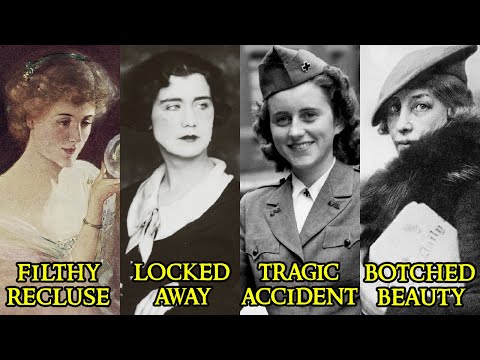
Our first story takes us to the 19th century, where a poor girl would rise to the top of New York society despite all odds. The woman known today as Ida Mayfield Wood was actually born Ellen Walsh in England on January 14, 1838. Her father was Thomas Walsh, an Irish peddler, and her mother was Anne Crawford. Ellen’s father was one of millions of Irishmen who left Ireland between the 1830s and 1870s, fleeing poverty and the Great Potato Famine.
The family relocated to the United States in the early 1850s, first settling in Boston. But this was a time of pronounced anti-Irish sentiment in America, with signs reading “No blacks, no Jews, no Irish” hanging in many establishments. Faced with such xenophobia, Ellen made a bold decision: she changed her name to Ida Mayfield and invented an elaborate backstory, claiming she was from Louisiana and the daughter of a sugar plantation owner.
Not long after arriving in New York, Ida became interested in Benjamin Wood, the editor of the New York Daily News. Despite Wood being married, Ida began writing him unsolicited letters. Her interest was sufficiently piqued that he responded, and they soon met and began a relationship. When his wife died in 1867, they married, catapulting Ida to the forefront of New York society.
Benjamin Wood was not just a newspaper editor but also a three-time member of Congress, holding a seat in the US Senate for New York for two terms. Thus, despite his questionable politics—his paper had argued in favor of retaining slavery—the Woods were among New York’s leading political dynasties during the Gilded Age. Ida rubbed shoulders with figures such as President Abraham Lincoln, the Prince of Wales, and the extended family of President Ulysses S. Grant.
Ida and Benjamin’s marriage was also peculiar for their invention of a daughter. For decades, the pair claimed to have a daughter named Emma, born before they married. However, Emma was actually a younger sister of Ida. The exact motivations for this deception are unclear, though it was surely to do with Ida’s ongoing efforts to cover up her Irish background. Benjamin was aware of where his third wife was actually from and agreed to hide the deception.
As he grew older, Benjamin Wood became a hardcore gambler, often wagering large sums of money on cards and dice. He is once even believed to have bet the New York Daily News on a hand of cards. Fortunately, he won and retained control of the newspaper. But faced with his reckless behavior, Ida began taking control of much of his finances in the 1880s and 1890s to ensure he did not gamble everything away.
When Benjamin died in 1900, Ida inherited a fortune of approximately $2 million—equivalent to over $75 million today. She never remarried. Instead, she initially put her energies into the New York Daily News, even becoming editor for a time. However, in a world where it was still enormously difficult for women to gain respect in business, she soon tired of the challenge and sold the paper for over a quarter of a million dollars.
Not much is known about Ida’s life between 1901 and 1907. She lived quietly. That is, until one very strange month in 1907 that led to her hiding for years. One day, Ida started withdrawing large sums of money from her bank accounts and other assets in New York. In total, she withdrew about $1 million—40% of her wealth. Then she and her sister Mary and her alleged daughter Emma rented a two-room suite at the Herald Square Hotel.
You would probably think nothing of this, but for whatever reason, the women decided to remain in rooms 551 and 552 for a quarter of a century. They did not allow cleaning staff to enter. Instead, they only interacted with the maids at the door to receive deliveries, have trash taken away, or sheets replaced. Other than this, staff and hotel managers were happy to leave the neurotic wealthy customers to their own devices, and they remained there, hidden from society for decades.
As the years went by, the women were completely forgotten. But as their lives passed and came to an end, their odd tale would resurface. Emma died in 1928 at 71. Prior to her passing, the sisters were still somewhat lucid and realized she needed medical attention. During this time, it was revealed that Emma had been born in 1857—about the same time that the 19-year-old Ida was beginning to take an interest in Benjamin Wood.
Three years later, in May 1931, Ida’s other sister Mary became ill. When the 93-year-old Ida eventually called for medical help, it was too late. By the time doctors arrived, they found Mary dead on a couch in the suite. When they entered, they found dreadful scenes: Ida, despite her riches, had been living in a mess of hoarding and squalor for years.
In the weeks that followed, authorities attempted to uncover what had happened to one of New York’s richest heiresses of the 20th century, who had seemingly disappeared in 1907 and then been found 24 years later living as a recluse. By this time, Ida was not lucid enough to explain why they had made the decision they did. She was declared psychologically incompetent a few months later.
As best as anyone could determine, Ida’s decision had been made in the midst of the banking crisis of 1907, known as the Panic of 1907. During that crisis, Ida decided her money was no longer safe in the banks and withdrew as much as she could. Why she, Emma, and Mary then elected to lock themselves up in a hotel room, hardly ever leaving again, remains a mystery. But one must consider that Ida had been running away from society and its judgment all her life, changing her identity and name along the way. In 1907, she simply decided to run away in person as well.
In the months following Mary’s death, Ida was moved downstairs to another suite despite her objections. By now, her old room was rotting and decaying, and it was gutted and renovated. Staff soon discovered long-forgotten trunks of her possessions and money that had been locked away in 1907. She passed away not long after her sister on March 12, 1932, aged 94, from bronchial pneumonia.
When Ida died, there was a growing issue concerning her inheritance, as she had not left a will. A large fortune remained to be claimed. Dozens, then scores, and then hundreds of individuals attempted to claim all or part of it. When a legal trial opened in 1937, 1,013 people claimed to be Ida’s rightful heir, while 616 appeared with legal counsel when the court sat.
At the heart of this circus was Ida’s shadowy past. Because she had invented the vast majority of her life story, hundreds of people were able to claim to be related to her, with many arriving in New York claiming to be her relatives from Louisiana—a story we know to be fabricated today, but which many still believed in the mid-1930s. Others showed up from Ireland, England, and Massachusetts, where the family had settled after first arriving in the US. There were even petitioners from California who claimed to be family relatives.
Eventually, the judge and his staff managed to whittle the number down to 22 applicants who seemed to have clear evidence of being related to Ida. In March 1939, two years after the case began and seven years after Ida’s death, a ruling was finalized which divided her fortune between 10 individuals, all of whom were first cousins of Ida and grandchildren of her aunts and uncles. Thus, despite her best efforts to muddy the waters through her invented personal history, Ida’s fortune descended to rightful heirs in the end, owing to the intricate investigative work of the New York judiciary.
Next, we look into one of the great beauties at the turn of the 20th century whose messy love affairs and declining mental health led to a sad life. Gladys Marie Deacon was born on February 7, 1881, in the Brighton Hotel in Paris. She was the eldest of five children of Edward Parker Deacon and Florence Mary Deacon. Edward hailed from a wealthy and once highly distinguished family from Boston, while Florence was a daughter of Rear Admiral Charles Henry Baldwin, a naval commander who had served in the Mexican-American War and the American Civil War.
Gladys’s early life was extremely turbulent, largely owing to her parents’ conduct. Despite their increasing brood of children, theirs was not a happy union and resulted in infidelities. One of these eventually proved fatal. In the spring of 1892, just after Gladys’s 11th birthday, her father shot and killed Emile Abe, his wife’s lover, in an apartment at the Hotel Splendid in the city of Cannes on the French Riviera. Edward had arrived unannounced, and after hearing his wife and her lover talking inside the room, he convinced hotel staff to unlock the door before gunning down Abe.
This was a time when money and influence could easily brush aside a charge as serious as murder, and Edward was able to have the case reduced to manslaughter, for which he was sentenced to just one year in prison. He was then pardoned by the French government. At this juncture, Gladys was briefly sent to a convent, from which her mother effectively kidnapped her just weeks later to ensure she did not return to her father’s custody. Shortly afterwards, Gladys’s parents divorced, and she was forced to return to America to live with her father in New England.
During this period, she was educated at the Howard Seminary in Massachusetts. Her father’s mental health deteriorated in the years that followed, and in 1899, he was committed to the McLean Hospital for the Insane in New England. He died two years later in 1901, at which time Gladys and her three surviving siblings inherited a quarter each of his sizable estate. By that time, Gladys and her siblings had returned to Europe to live with their mother in France, though they regularly visited Italy and England as well.
By the time her father was committed, Gladys was blossoming into a beautiful young woman, one who was drawn and painted by many acclaimed figures of the Belle Époque in Paris. The famed French writer Marcel Proust stated of her that “I never saw a girl with such beauty, such magnificent intelligence, such goodness and charm.” Accordingly, she was linked romantically with many individuals among Western Europe’s nobility from the late 1890s, including the Crown Prince of Prussia.
One of these was particularly significant. In 1897, when she was still just 16, Gladys was invited to visit Blenheim Palace in England, the family seat of the Spencer-Churchill family, headed by Charles Spencer-Churchill, 9th Duke of Marlborough. In 1895, Marlborough had married Consuelo Vanderbilt, an enormously wealthy American heiress, rescuing the Spencer-Churchills from a chronic financial situation. However, while the union was beneficial financially and socially, it was not a happy one. And as Gladys became more acquainted with Marlborough, she was soon involved in an extramarital affair with the Duke, one which would continue for over two decades before the Duke and his first wife divorced.
The early 1900s were also notable for Gladys being involved in one of the world’s earliest famed cases of botched plastic surgery. In 1903, when she was just 22 and despite her attested beauty, Gladys underwent an early form of cosmetic surgery whereby paraffin was injected into her nose and jawline to give them greater definition. This early precursor to Botox injections was unsuccessful. The paraffin in her jawline collected around her chin where it formed into large lumps that remained with her for the rest of her life.
Despite this setback, she remained a figure of considerable interest to high society. She was immensely well-read but also elusive. For instance, she could be equally sociable and reclusive. While she would often pursue writers and painters as acquaintances before promptly abandoning her interest in these friendships for seemingly no reason, several of these friendships resulted in her portrait being painted over the years, notably by Giovanni Boldini and John Singer Sargent.
Despite her botched cosmetic surgery, her relationship with the Duke of Marlborough continued throughout the 1900s and 1910s. Throughout this period, the Duke’s marriage was effectively an open relationship, and Consuelo was involved in her own affair with Jacques Balsan, an early pioneer of European aviation. Eventually, in 1921, Consuelo and the Duke agreed to divorce to pursue their other relationships. Consuelo soon married Balsan, while Gladys and the Duke of Marlborough wed in Paris later that year on June 25.
Curiously enough, the marriage of Gladys and the Duke after a 20-year semiclandestine courtship did not prove happy. By the 1920s, Gladys, now in her 40s and nearing the age when her father’s psychological state began to fragment, began to develop serious mental health issues herself. Her father’s mother had also suffered from mental instability in her later years. This genetic component was compounded by the lifelong disfiguration from her botched cosmetic surgery and by the inability of her and Marlborough to have children.
As a result, the Duke and Gladys’s relationship became increasingly tense at Blenheim Palace. Gladys was largely responsible for these tensions. First, she insisted on having large paintings of her eyes painted over the main porticoes and doorways of the palace. Then she developed an obsession with breeding and raising Blenheim spaniels. Her overzealous passion for dog rearing evidently displeased the Duke. The situation deteriorated further from 1927 onwards following the Duke’s conversion to Roman Catholicism.
By the late 1920s, she was known to keep a revolver by her bedside at night in case the Duke, who by then slept in a different suite of rooms, attempted to call on her. Once, during a dinner party at Blenheim, Gladys arrived downstairs with a gun and set it on the table next to her when she sat down in front of the gathered guests. When one intrepid visitor asked her what she was doing with the revolver, she responded by saying, “Oh, I don’t know. I might just shoot Marlborough.” She was also known to speak in emasculating terms concerning her husband, claiming that she had married a house rather than a man.
By the early 1930s, Marlborough had evidently had enough of his wife’s increasingly erratic behavior. He briefly moved out of Blenheim in 1931, but only long enough to plot Gladys’s ousting from the palace. In 1933, he fired all of her staff and told her to leave. Their marriage was effectively at an end, though they never divorced, as Marlborough died prematurely in the summer of 1934 while divorce papers were still being filed.
Gladys was not without the ability to maintain herself financially. In the aftermath of her separation from Marlborough, she moved with her many dogs to a residence in North Oxfordshire and then lived between there and a second home at Grange Farm in Chacombe, Northamptonshire. Though her behavior continued to get worse. At one point during her split from Marlborough, when approached and questioned by a journalist, she tipped a bucket of water over his head. More broadly, Gladys became more and more of a recluse from the mid-1930s onwards. She was wealthy enough to shut out the rest of the world and effectively surround herself with little more than her many pets.
Biographers have claimed, based on statements of those who knew her from the mid-1930s onwards, that she became an increasing fantasist who amused herself with memories of her early life among the artistic community and high society of Paris, London, and Rome. During this time she had known figures like Marcel Proust, Claude Monet, and Auguste Rodin. By the 1950s, though, her behavior had become erratic enough that it could not be ignored by the authorities any longer. For instance, she was prone to ringing people she had not seen in decades or even complete strangers in the middle of the night. She was also known for threatening to shoot local children who tried to take apples from her orchard. And past a certain point, the local community became concerned that she would actually act on these statements.
Thus, in 1962, she was committed to St. Andrew’s Psychiatric Hospital. There she remained a curious patient, still maintaining an interest in the wider world of politics and society as well as keeping a diary—all things which made it appear as though she was perfectly lucid. But her behavior could turn difficult just as swiftly. Gladys Deacon finally died in St. Andrew’s Psychiatric Hospital on October 13, 1977, at the age of 96. She was buried in the churchyard at Chacombe in Northamptonshire.
Gladys’s story has been recounted many times over the years, notably in a biography by Hugo Vickers and fictional versions of her life in novels such as I’ll See You in Paris by Michelle Gable and Death at Blenheim by Robin Page. Today, the visitor to Blenheim Palace will still witness her painted eyes peering at guests from above doorways, while a pair of stone sphinxes are located in the courtyard, commissioned to mark her move into Blenheim as the Duke’s second wife in the early 1920s. In a marriage which promised much but delivered so little, her story remains a haunting reminder of beauty and madness intertwined.
Our next story follows a young woman who was locked away in asylums by her family for over 50 years. Lucia Anna Joyce was born on July 26, 1907, in the port town of Trieste in the northeast of the Kingdom of Italy. This small city is located on the Adriatic Sea near the modern-day border between Slovenia and Italy. But back then it bordered the Austro-Hungarian Empire. It is impossible to understand Lucia’s life story without exploring who her parents were.
Her father was James Joyce, an Irishman who became one of the most influential literary figures of Europe in the 20th century. He authored works such as Dubliners and A Portrait of the Artist as a Young Man. However, his most famous work was Ulysses. Joyce is widely regarded as having established many of the elements of avant-garde literature and modernism. Lucia’s mother was Nora Barnacle, a woman from a poor family in Galway in the west of Ireland, who had moved to Dublin when still a child. She met Joyce there in 1904 and they began a relationship.
Despite the fact that Joyce’s works were nearly always set in Dublin, the pair left the island within a few months of meeting each other and would never return for any sustained period, establishing their home in Trieste. Lucia’s older brother, Giorgio, was born there in 1905, and she followed two years later. After Nora suffered a miscarriage in 1908, she would not have any further children.
The small family lived during Lucia’s early years in Trieste. At this time, Joyce was not an established writer, and it was a precarious existence for them, with the family often surviving on small bequests from patrons. When Lucia was born, Joyce was recovering from rheumatic fever, which had incapacitated him for weeks. This caused him to briefly give up alcohol, which he was a heavy partaker of for most of his life.
Although Lucia’s first years were spent in Trieste, she was too young to remember the period. Consequently, her most formative years in the 1910s were experienced as an itinerant literary family. The Joyces briefly returned to Ireland in the early 1910s as Lucia’s father attempted to acquire a position at University College Dublin teaching Italian. When this failed, they returned to Trieste. Shortly after this, James did acquire some success with the publication of Dubliners, but the outbreak of the First World War in the late summer of 1914 made living in Trieste increasingly hazardous.
These dangers only got worse for the Austro-Italian border town. After Italy entered the war against Austria-Hungary in May 1915, the Joyces left Trieste and moved to Zurich in neutral Switzerland. They would live there for the remainder of the war before briefly returning to Trieste again in the late 1910s. It was a disruptive amount of moving around for a child, and by the end of it, as Lucia was entering her teenage years, she was already developing a strange relationship with her parents, particularly her mother Nora.
Her early years had also made Lucia something of an international citizen. She grew up multicultural and, despite her Irish parentage, considered Italian to be her first language. Another peculiar feature of her upbringing was that her parents were not actually married—an unusual arrangement in the early 20th century. They would only finally marry in a London registry office in 1931.
In 1920, Lucia’s life and that of her brother and parents finally began to take on a note of greater stability when they moved to and settled in Paris. The Joyces would live here for the most part over the next 20 years, only eventually relocating when the Second World War led them to depart again for Zurich. However, while Paris brought initial stability, it was also here that Lucia would experience the first emergence of her mental health problems.
These were exciting years in Paris. After the trauma of the First World War and the Spanish flu epidemic which followed it, the 1920s were a time of great economic growth and cultural revival in Europe and the Americas. The French capital was the epicenter of this. The 1920s consequently became known as the années folles in France—the crazy years—as writers like F. Scott Fitzgerald, Ernest Hemingway, and Gertrude Stein made the city their home for periods of time.
Lucia’s father was emerging as one of the most successful and prominent writers of the era following the publication of Ulysses in serialized form in the late 1910s. Owing to this, the Joyce home became a retreat for the gathering of many famous literary and cultural figures in 1920s Paris, and Lucia grew up around people such as Pablo Picasso, Gertrude Stein, Hemingway, and the Russian composer Igor Stravinsky. We might speculate that growing up in such an environment brought certain pressures to bear on her—the need to achieve something from a cultural perspective while surrounded by so many overachievers.
Much of this was channeled in her early adult years into her career as a dancer. Lucia first began dancing in 1922 when she was 15 at the Dalcroze Institute. Yet it wasn’t until 1925, when she was nearing her 18th birthday, that Lucia began training in a more serious manner. Her family’s position within the cultural world of Paris in the 1920s afforded her connections with some of the leading ballet and contemporary dance instructors of the day. These included Raymond Duncan, a dance instructor and artist who was also the brother of the more famous Isadora Duncan, and Margaret Morris, an English dance pioneer.
Today, charges of being a “nepo baby” would be leveled at Lucia for benefiting from her father’s cultural connections, but there is no doubt that she was good. By 1928, she was accepted into a dance troupe called Les Six de Rythme et Couleur—The Six of Rhythm and Color. The sextet performed in the year that followed in Paris, Vienna, and Berlin. While in 1929, Lucia was runner-up at the first International Festival of Dance held in Paris that year. After witnessing one of her performances during this period, a critic for the Paris Times remarked that “Lucia Joyce is her father’s daughter. She has James Joyce’s enthusiasm, energy, and a not yet determined amount of his genius. When she reaches her full capacity for rhythmic dancing, James Joyce may yet be known as his daughter’s father.”
But just as her career as a dancer was taking off, it came to a shuddering halt. In late 1929, Lucia suddenly abandoned her career as a dancer, telling her friends that she was not physically strong enough to continue. The exact reasons for her decision have been a matter of considerable debate, with some historians suggesting that it was her father who put a stop to her career. Apparently, Joyce believed that his daughter’s dancing career was too physically demanding and was causing Lucia lots of stress, worsening the already very difficult relationship between Lucia and her mother.
It was around this time that she began a relationship with Samuel Beckett, an Irish writer living in Paris who was briefly her father’s secretary. He would go on to win the Nobel Prize in Literature many years later in 1969. Their relationship was short-lived, as Beckett was involved with another woman and told Lucia that he was more interested in her father and his writing than he was in her.
Lucia’s decision to quit dancing, combined with the collapse of her relationship with Beckett, led to a dramatic decline in her mental health in 1930. Joyce would write to Harriet Shaw Weaver, one of his patrons, regarding this, stating that this led to “a month of tears as she thinks she has thrown away three or four years of hard work and is sacrificing a talent.” Things deteriorated further in the early 1930s. The exact nature of Lucia’s malady is a point of contention, though there appears to have been elements of schizophrenia involved.
At one point, she was sent to Switzerland, where she spent time at the Burghölzli psychiatric clinic in Zurich, where the family had lived in the mid-1910s and where James Joyce still returned on occasion for treatment for his prematurely failing eyesight. There, Lucia was treated for a time by Carl Jung, the great psychoanalyst who had trained under Sigmund Freud and later emerged as a rival to his mentor. These were strained years, with Lucia often suffering from violent outbursts which manifested towards her family and her mother in particular.
Lucia’s deteriorating psychological state came to a head in 1935 during a visit to some relatives in the town of Bray, south of Dublin in Ireland. During the holiday, she lit a fire in the middle of the living room of her cousin’s home and tried to unbutton the trousers of several male visitors to the house. She was also known to open the gas tap at night, flooding the house with fumes until someone awakened turned it off again. To cap things off, she then disappeared from Bray altogether and eloped to Dublin, where she spent nearly an entire week sleeping in doorways.
Perhaps unsurprisingly, when she returned to Paris and her parents learned the full extent of what had occurred, they decided to have her committed to an asylum in Ivry on the outskirts of the French capital. Lucia would spend most of the next 15 years at Ivry, though she was sent for a time to St. Andrew’s Hospital in Britain for assessment. Her father and brother Giorgio would visit her at Ivry on Sundays over the next several years, but there is no record that her mother ever saw her again after she was committed.
James was evidently very troubled by her condition, and the character of Anna Livia Plurabelle in his 1939 novel Finnegans Wake is likely based to some extent on Lucia. The visits stopped in the summer of 1940 when the Joyces fled Paris in the wake of the Nazi invasion of France and settled in Zurich. James died there just six months later, while Lucia’s mother lived for another decade in the Swiss city before her own death.
In 1951, Lucia was transferred from Ivry in France to St. Andrew’s Hospital in Northampton, England, where she had been examined back in the mid-1930s. She would spend the rest of her life here. This was at the request of Harriet Shaw Weaver, an English political activist and literary figure who had patronized her father James in years gone by and who agreed to become Lucia’s guardian in 1951 following the death of Lucia’s mother. She often had visits from friends and acquaintances who had known the Joyce family in the 1920s and 1930s, including Harriet, who was aging by then.
Chief among them was Samuel Beckett, her former suitor from the early 1930s and her father’s close literary acquaintance. By then, Beckett was a successful author himself. And when Weaver died in 1961, he financed her continuing care at Northampton. Meanwhile, her brother Giorgio only visited her once in 1967. Lucia died from complications arising from a stroke on December 12, 1982, aged 75. She was the last surviving member of her family, Giorgio having died six years earlier.
Following Lucia’s death, her nephew Stephen took most of her writing and destroyed it. This included her correspondence with her father and apparently some poetry and a novel she had written. It seems as if her family tried to destroy any trace of Lucia. Her medical records were burnt, and Carl Jung had also destroyed all his notes in relation to his time with Lucia. Friends and acquaintances of the Joyce family were also encouraged to destroy any correspondence to do with Lucia, acting like she had never existed and erasing her from history.
She was buried in Kingsthorpe Cemetery near St. Andrew’s, where a ceremony near her grave is held each year on Bloomsday, a festival celebrating her father’s greatest work, Ulysses. Plans have been brought up in recent years to have the remains of the Joyces repatriated to Ireland. While several books have appeared in the early 21st century reclaiming Lucia’s story from obscurity.
Let’s now head back to 20th-century USA, where one father forced his daughter to undergo a lobotomy which left her incapacitated for life. Rosemary was born as Rosemary Kennedy on September 13, 1918, in Brookline, Massachusetts. She would soon become known more simply as Rosemary to differentiate her from her mother Rose. She was the third child born to Joseph P. Kennedy Sr. and his wife Rose Kennedy née Fitzgerald. At the time of her birth, she had two older brothers, Joseph Jr., born in 1915, and John, better known to posterity as Jack or JFK, who was born just over a year before Rosemary in the summer of 1917.
Eventually, Joseph and Rose Kennedy would have six more children: four daughters—Kathleen, Eunice, Patricia, and Jean—and two sons, Robert and Edward. The youngest of the Kennedys, Edward, who finally became known as Ted or Teddy, was not born until 1932. And so, the age difference between the elder Kennedys, such as Rosemary, and the younger ones was quite considerable.
The family Rosemary was born into was one with a lengthy political and business history. The Kennedys had first settled in the United States after leaving Ireland in the late 1840s in the wake of the Great Famine, which killed over a million people on the island in the space of a few years and caused the exodus of millions more. P.J. Kennedy, who was Rosemary’s grandfather, was elected to the Massachusetts State Legislature in the mid-1880s, beginning a long, almost uninterrupted period of over a century in which a Kennedy would occupy political office in America. In tandem, the family’s business interests expanded in Massachusetts. And by the time Rosemary was born in 1918, the Kennedys were already well established as one of the most significant political and business families in all of New England.
Rosemary’s early life is shrouded in mystery. There are claims that she suffered from an intellectual disability from a young age on account of having been partially deprived of oxygen during her birth. However, it is unclear if these claims were later exaggerated by the Kennedy family to justify what happened to her in the 1940s. Whatever the exact truth of it, by the late 1920s, as she neared her teenage years, Rosemary was placed in a school for the intellectually disabled in the state of Pennsylvania. Later in the mid-1930s, she began attending a convent school on Rhode Island but was educated separately from most of the other girls there.
During these years, she demonstrated a desire to be an actress or a social worker and seemed to be developing somewhat more fully, but her parents were still concerned by reports from the convent of some unusual behavior on her part. Throughout her younger years, her father’s business and political interests continued to expand. For instance, in the 1920s, Kennedy was involved in refinancing several of the major Hollywood film studios at the time when they were about to begin making the transition from silent movies to the talkies. He also made an enormous amount of money bootlegging Scotch whiskey during the Prohibition of alcohol, which prevailed across America in the 1920s. The wealth produced allowed him to further his political career, and he became a rising figure within the Democratic Party.
Finally, in 1938, when Rosemary was nearing her 20th birthday, her father, Joseph Kennedy, was appointed as the American ambassador to Britain. Thus, the Kennedys moved across the Atlantic. There, Rosemary seemed to begin to flourish, being presented as a debutante at the court of King George VI in 1938 and attending many social events in London and beyond as part of the ambassador’s family, even at a time when war was brewing and eventually broke out with Nazi Germany on the continent.
However, when the Kennedys returned to America in 1940, Rosemary would take a turn for the worse. The full details of exactly what happened to Rosemary in the early 1940s are not precisely clear, but she seems to have responded very poorly to the family’s departure from Britain and return to the United States. According to her younger sister Eunice, speaking decades later, Rosemary became irritable and difficult in 1940. These episodes intensified to the point where she would lash out at others around her and even experienced convulsions. To add to this, there were reports that Rosemary had been engaging in sexual activities with many partners for several years. Whether any of these were true or not is unclear.
But what is certainly clear is that by the early 1940s, her father, Joseph Kennedy, who had developed the ambition that one of his sons would one day become President of the United States, was increasingly wary of Rosemary. She was, he believed, a liability who could bring shame or embarrassment on the family if her behavior was not tempered. The reality, though, as many now believe, is that Rosemary was simply suffering from mental illness and was perhaps depressed and anxious rather than being mentally incapacitated in any serious manner.
It sounds shocking to the modern mind, but Joseph Kennedy soon turned to a lobotomy as the best means of ridding Rosemary of her ailments. A lobotomy is a form of neurosurgical treatment which was pioneered and popularized in the early 1940s. It was developed at a time when treatments for psychological disorders which we would view as brutal today were being experimented with, notably electroconvulsive therapy and various forms of shock therapy. A lobotomy effectively involved surgery on the brain to sever some of the connections in the prefrontal cortex. This was developed as a way of treating psychological ailments as it was believed that it reduced the suffering of somebody who suffered from seizures, mental incapacitation, and hysterical behavior. It was developed by a Portuguese neurologist by the name of António Egas Moniz, and indeed he went on to win the Nobel Prize for Physiology and Medicine in 1949 for his work.
Many people believed that lobotomies were a miracle cure for severe psychological disturbances. As we now know today, lobotomies were in fact only appearing to cure the patient because they were effectively rendering them brain damaged. A famous example of this in popular culture was in the film One Flew Over the Cuckoo’s Nest, based on Ken Kesey’s novel, where Jack Nicholson’s character is lobotomized at the end of the movie. Though it seems almost inconceivable that it could have been so readily accepted as a form of effective therapy at the time, lobotomies were used widely in countries like the United States throughout the 1940s and 1950s and into the 1960s in some places.
In the autumn of 1941, it was suggested to Joseph Kennedy by a neurologist that a lobotomy might be the best measure available to cure Rosemary of her allegedly disturbed behavior. Thus, it was in November of that year, without ever consulting with her mother, that Joseph sent Rosemary to have what was still a novel surgery for the time to be carried out. Rosemary’s lobotomy was performed by Dr. Walter Freeman and Dr. James Watts of George Washington University School of Medicine. Effectively, the surgery involved drilling into the skull and severing brain tissue while asking Rosemary, who was mildly sedated but conscious throughout the whole operation, questions. Once her answers began to become incoherent, they decided that enough brain tissue had been cut.
This horrendous form of alleged therapy was a catastrophic failure. Rosemary was left brain damaged afterwards with the mental capacity of an infant. She could not walk unaided, could not engage in intelligible conversation, and was henceforth reliant on minders to carry out even the most basic of activities. While Joseph Kennedy had aimed to cure his daughter of her perceived illness through the lobotomy, it immediately became apparent that the surgery had damaged her irreparably.
However, rather than accept responsibility for his actions and setting up Rosemary in facilities around the Kennedy’s home at Cape Cod and elsewhere in New England, where his wealth could have afforded her the best care possible, he had Rosemary institutionalized at Craig House, a psychiatric hospital in upstate New York. She remained there for many years before being relocated to another hospital in Jefferson, Wisconsin, in 1949. Admittedly, Joseph did see to it that a private cottage was built for her here at the St. Coletta School for Exceptional Children. Funding was also provided to have her cared for by several members of staff in a compassionate fashion. Yet, while Joseph Kennedy might have spent an extensive amount of money on looking after Rosemary from afar, she effectively became the dark secret of the Kennedy family.
None of her siblings or even her own mother visited her throughout the 1940s and 1950s. When her older brother John’s political career began to take off in the 1950s and he eventually ran for president in the 1960 US presidential election, Rosemary’s absence from the campaign trail was explained away as that she was a recluse who was not interested in John’s political career in the same way as her other siblings. There was never any public revelation of what had happened to her in reality. This information would not become publicly available until the 1980s, nearly half a century after Rosemary was lobotomized.
The figure of Joseph Kennedy has to be held accountable for all of this. He decided to have the lobotomy carried out on Rosemary, and it was he who then disguised where she was located from her siblings for the next 20 years. As late as the early 1960s, many of Rosemary’s brothers and sisters were still not sure where she was or what had happened to her. It was only when their father suffered a stroke in 1961 that he began to fully share details with them, and they became aware that she was in Wisconsin and had been operated on back in 1941.
Rosemary’s life in Wisconsin might be best described as acceptable over the long decades that she lived there. She was well cared for by the sisters and staff of the school, though she never regained the majority of her cognitive functions which had been lost in the operation in 1941. For instance, while she learned to partially walk again herself, this was not without significant impairment, and her speech never recovered beyond a point of bare articulation. Eventually, as her father entered his terminal illness and eventually died in 1969, Rosemary’s siblings began to visit her in Wisconsin. Though by then, both John and Robert had been assassinated in America’s turbulent political atmosphere of the 1960s.
By the 1980s and 1990s, she was a regular visitor to the Kennedy compound at Cape Cod in Massachusetts for family events as the surviving siblings tried to make right the sins of the past. She was said to become noticeably excited when she had visitors in Wisconsin or headed to Massachusetts, a sign that despite the damage which had been inflicted in 1941, Rosemary continued to have some awareness of the fact that her family had reestablished contact. Rosemary’s plight was also a motivating factor in Eunice Kennedy’s drive to establish the Special Olympics, a development which she was instrumental in.
Eventually, Rosemary Kennedy died on January 7, 2005, at the age of 86 at Fort Atkinson Memorial Hospital in Wisconsin. The death was recorded as having occurred owing to natural causes. When she passed, her four surviving siblings—Eunice, Jean, Patricia, and Ted—were present. She was later buried at the Kennedy family memorial site at Brookline in Massachusetts.
Although our final story features someone of sound mind, her life would also end up being tragic owing to her family curse. Kathleen Kennedy was born at 83 Beals Street in Brookline, Massachusetts, on February 20, 1920. Her father was Joseph Kennedy Sr., while her mother was Rose Fitzgerald. She had three older siblings: Joseph Jr., Rosemary, and John, better known to his family as Jack. In due course, five more Kennedy children were born in the 1920s and early 1930s: Eunice, Patricia, Robert (better known as Bobby), Jean, and Edward, the youngest, known to history as Ted Kennedy.
Kathleen was a flamboyant child who was given the nickname Kick by her family during her early years, a name which would endure for the rest of her life. She was educated at Riverdale Country School in the Bronx in New York City before attending different high schools in Connecticut and for a time a convent school in France. Growing up, she was a keen athlete and quite extroverted. She liked to play football with her older brothers, and her high spirits led to her gaining the attention of lots of Jack’s friends.
Kathleen had been born into a family which was already well established as a leading American business and political family. The Kennedys were Irish Americans who trace their roots back to the settling of the Kennedys in the US in the aftermath of the Irish potato famine of the late 1840s. Kathleen’s grandfather P.J. Kennedy served in the Massachusetts State Legislature in the mid-1880s. He was also a successful businessman, and his son Joseph Kennedy Sr., Kathleen’s father, inherited a large fortune even before P.J. died in 1929. In the 1920s, while Kathleen was still a child, Joseph Kennedy expanded the Kennedy business interests, becoming a financier to the emerging Hollywood film studios as they transitioned from silent movies to the talkies. Kennedy also made a small fortune as a bootlegger of Scotch whiskey during the era of Prohibition between 1920 and 1933.
As Kathleen grew up and the Kennedy fortune expanded hugely, her father began to acquire political ambitions, and these would see Kathleen develop an association with Britain which would characterize her adult life. In the first weeks of 1938, when Kathleen was still shy of her 18th birthday, her father was appointed as the US ambassador to the United Kingdom by President Franklin D. Roosevelt. Shortly afterwards, Kathleen and the rest of her family set off across the Atlantic for Joseph to take up his position in London.
It would be a controversial appointment, as Joseph was an American isolationist who believed the US should remain aloof from the growing conflict between Britain and France and Nazi Germany. Shortly after the Kennedys’ arrival in London, Kathleen turned 18 and was introduced to high society at the debutante ball known as Queen Charlotte’s Ball, a high society event held since the late 18th century. Such debutante balls were a common practice during the interwar period. Owing to the media attention focused on Joseph Kennedy and his family shortly after their arrival in England, a lot of press focus was pointed towards Kathleen’s appearance at the ball, and she was touted in the British newspapers as the debutante of 1938.
When the Second World War broke out in the first days of September 1939, Kathleen was in France. She was quickly summoned back to Britain as there were fears that the Germans would attempt an invasion of France in the late autumn of 1939, though this would not eventually occur until the early summer of 1940. Back in England, Joseph Kennedy’s isolationist stance and his sympathies towards fascism became indefensible, especially as President Roosevelt was in favor of providing covert aid to Britain against the Nazis. Consequently, he was withdrawn as ambassador, and in 1940 the Kennedys returned to America.
There Kathleen dated several young men for a time, though her relationships did not last long, in large part because she was moving around the country, attending the Finch School and Undergraduate College in New York for a while before heading south to Florida to take classes at the commercial college in the Sunshine State. At the time, she began volunteering with the American Red Cross and eventually obtained a junior position with the Washington Times-Herald, a newspaper based out of the capital, for which she wrote cultural reviews.
Kathleen’s decision to sign up for the Red Cross in the early 1940s was her way to contribute something towards the war effort in Europe. The Kennedy children, generally speaking, did not share their father’s political views to any extent, and decades later, they became the antithesis in many respects of what Joseph Sr. believed. In the early 1940s, Kathleen and several of her siblings were in favor of US entry into the war on the side of Britain and were happy when in December 1941, President Roosevelt ended US neutrality and entered the conflict against Germany and Japan following the attack on the US Pacific Fleet in Pearl Harbor.
As part of her work with the Red Cross, Kathleen returned to Britain early in 1943, serving in various hospitals and convalescent centers in England. It was during this time that she began a relationship with William Cavendish, the Marquess of Hartington and the heir designate to Edward Cavendish, 10th Duke of Devonshire and one of the most senior aristocrats in Britain. William was close in age to Kathleen, and they had known each other since the late 1930s during the Kennedys’ time in Britain as the ambassador’s family. Now they resumed their friendship and eventually began dating each other.
At a time when courtship was often a short affair, they quickly made plans to marry and were wed on May 6, 1944. The relationship between the wider Cavendish and Kennedy families was tense, in large part because Kathleen’s drift away from the Roman Catholic Church, which her family were avowed members of, was seen as partly owing to her ties to the Cavendishes. As a result, Kathleen and William were married in a register office on the King’s Road in Chelsea, London. The only Kennedy family member to attend the ceremony was Kathleen’s eldest brother, Joseph, whom she had grown close to during these years.
Sadly, their union would not last long. At the time of their marriage, William was serving in the 5th Battalion of the Coldstream Guards. Just weeks later, his unit was prominent in the D-Day landings in northern France, and William was sent to Europe to fight the Nazi threat. On September 9, 1944, as part of the drive to liberate the port city of Antwerp in Belgium, which the Allies needed to seize in order to bring in further reinforcements and material to Western Europe, William was shot by a Waffen-SS sniper in the town of Heppen in Belgium. He died almost instantly. He was just 26 years old, and he and Kathleen had only been married for four months.
Kathleen was one of many young women who were widowed in the course of the Second World War, but her loss was especially cruel. William and she had only been married for five weeks when he left for France, and she never saw him alive again. In the interim, her brother Joseph was also killed while on a flying mission over England in August 1944. Neither body was brought back to England for burial. Joseph’s plane had exploded in such a fashion that it caused damage even on the ground below, and so his body was never found. William was buried in Belgium near where he was killed, at a time in the war when few bodies could be repatriated.
Following her husband’s death, Kathleen moved out of the order of succession to the duchy of Devonshire. Had William lived, she would have become the Duchess someday. But with his death and Kathleen and he not having had any children, the succession now passed to William’s brother Andrew and his wife Deborah Cavendish, née Mitford. Kathleen retained the title of Lady Hartington following her husband’s death.
Kathleen soon recovered from her grief, and in the aftermath of the end of the war in May 1945, she began seeing Peter Wentworth-Fitzwilliam, 8th Earl Fitzwilliam. This was a problematic relationship, as Fitzwilliam had been married to Olive Dorothea Plunkett since 1933, and so Kathleen was entering an extramarital relationship when she began seeing Fitzwilliam. This perturbed her family, and her parents had indicated that she would be cut off financially from the Kennedy fortune if she continued on her present path. Kathleen persisted, though, and by 1948 Fitzwilliam had agreed that he would leave his wife if Kathleen could get her family’s approval of the union. Yet the effort to do so would prove fatal for both of them.
In the late spring of 1948, Kathleen and Lord Fitzwilliam decided to head to France for a trip which had two purposes. Firstly, they were taking a holiday. Secondly, Kathleen’s father was due to be in Paris for a time early that summer, and they wanted to meet with him and gain his blessing for them to marry as head of the Kennedy household. They were in the French capital by early May, and they decided to fly to the French Riviera. The private chartered plane that Kathleen and Peter were flying on left Paris at half past three on the afternoon of May 13. It proceeded south on a normal flight trajectory, but around 4:30 p.m. the plane entered stormy conditions in the skies above the town of Vienne in southeastern France. Radio contact with the ground was lost shortly afterwards. Severe turbulence followed over the next 20 or so minutes, eventually ripping one of the plane’s wings off. As the plane plummeted downwards, the engine and fuselage were compromised, and the plane eventually crashed into a ravine near Saint-Bauzile about midway between Lyon and the southern French coast.
Kathleen, Peter, and the pilot and navigator were all killed in the crash. Their remains were recovered, and Kathleen was subsequently buried at her late husband’s family burial plot at Chatsworth House in Northern England. The rift between Kathleen and her family was severe owing to her rebellious nature and her complicated love life, and only her father showed up to represent the Kennedys at the funeral.
Kathleen’s premature death in 1948 was just one of the first incidents in what has become known as the Kennedy curse. As we saw earlier, less than four years before her own passing, her older brother, Joseph Jr., had also been killed in an air accident when the bomb plane he was flying during the Second World War malfunctioned over Suffolk in August 1944 and exploded. Just a few years before this, another of their siblings, Rosemary, had been lobotomized at a time when lobotomies were still experimental and believed to be effective against mental health issues. And the Kennedy curse did not end with Kathleen. Fifteen years later, her brother John, better known to the world as JFK, was assassinated in Dallas, Texas, followed by her other brother Bobby in 1968. Since then, the Kennedy curse has claimed many other relatives to accidental deaths, plane crashes, and drug overdoses, making one of America’s most notable families also one of its most tragic.
Thank you so much everyone for watching this video on these tragic socialites. I hope you found it interesting. Let me know what you thought of their lives down below in the comments. And if you have any suggestions, also be sure to leave them down below in the comments. I hope you guys are subscribed and have notifications turned on to get all my videos as soon as I upload them. Anyway, that’s all from me. So, I’ll see all of you in the next Forgotten Life. Thanks.
Four women, four gilded cages. Each had wealth, beauty, and access to the world’s most exclusive circles—and each was ultimately destroyed by the very society that once adored them.
Ida Wood ran from her past and vanished into a hotel room for 24 years. Gladys Deacon, once called the most beautiful girl in Paris, died in a psychiatric hospital with her painted eyes still staring down from Blenheim’s doorways. Lucia Joyce, a gifted dancer, was erased from history by her own family. Rosemary Kennedy was robbed of her mind by a father obsessed with image.
Their stories remind us that behind the glitter of high society, there are often shadows no spotlight can reach. Wealth could buy them everything except peace, sanity, and the freedom to be themselves.
Which of these four tragic socialites moved you the most—and do you think any of them could have been saved? Let me know in the comments below.
Report this article
Select a reason for reporting:






