Captain James Mitchell stood in the briefing room at Fort Bragg, surrounded by twenty-three of America’s most elite Green Berets. They were the best of the best—until four Australians walked in. No chest full of medals, no intimidating presence—just quiet men in simple uniforms carrying gear that looked decades old. One American captain, a veteran of three Vietnam tours, couldn’t hide his smirk. “With respect, what exactly do you think you can teach us that we don’t already know?”
Warrant Officer Robert Sullivan’s response was quiet, almost polite. “How to move through jungle without being detected. How to observe enemy without being observed. How to survive for weeks behind enemy lines with what you can carry.” He paused. “Small things like that.”
The American captain smiled. “We do that every day in Vietnam.” Sullivan didn’t smile back. “Do you? Then why are your reconnaissance teams sustaining 40% casualties? Why are you being detected and ambushed at rates five times higher than our patrols? Why do your teams average four days in the field while ours average eighteen?”
The room went silent. Sullivan had just challenged everything these elite soldiers believed about their training. For the next two weeks, he continued, they would train the way Australian SAS trained. “The first lesson is forgetting everything you think you know about jungle warfare. Because what you know is getting people killed.”
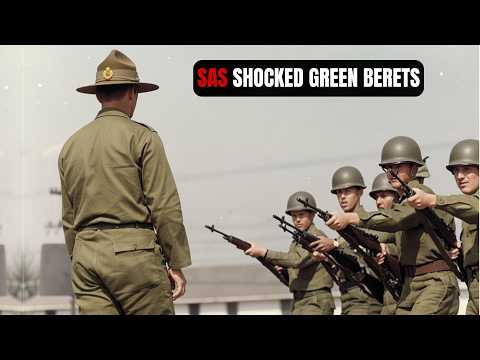
Mitchell felt the weight of those words. He’d been confident, proud even. But a friend—a fellow Green Beret—had recently died in Binh Duong province, his six-man team wiped out within hours of insertion. The funeral was still fresh in Mitchell’s mind. Maybe American training wasn’t as adequate as they thought.
Warrant Officer Sullivan was not what Americans expected from elite forces. At thirty-four, he was average height, wiry, with a face weathered by years in jungle sun. No swagger, no bravado—just quiet competence and eyes that constantly scanned his surroundings. He’d served in Korea, then spent nine years in Malaya and Borneo hunting communist insurgents who knew the terrain, had local support, and were experts at ambush.
That first day, the Americans moved through the woods using standard patrol techniques—point man, slack man, proper spacing, weapons ready. They reached their objective in two hours, professional by the book. Sullivan gathered them in a clearing. “My team and I were following your patrol. You were audible from fifty meters. You silhouetted yourselves on ridge lines three times. Your point man followed the easiest route instead of the safest. And you walked within five meters of my observation post without detecting it.”
The Americans were skeptical—until Corporal Henderson, one of the Australian instructors, stood up from a position ten meters away, perfectly camouflaged, completely motionless. He’d been there the entire critique, invisible. “That’s what we mean by stealth,” Sullivan said quietly. “By our standards, your entire patrol just died.”
Over the next two weeks, the Americans learned to move invisibly, to remain motionless for hours, to establish observation posts that went undetected even when enemy patrols passed within meters. They learned that speed in reconnaissance gets you killed, that patience keeps you alive. They learned to respect the enemy and to adapt.
On graduation day, Sullivan delivered a final assessment. “Two weeks ago, you were confident, experienced soldiers who thought you understood jungle warfare. You were wrong. Your confidence was based on American training against American standards. That training is good for what it’s designed for. It’s inadequate for deep reconnaissance against guerrilla enemies.”
Mitchell stood up. “Warrant Officer Sullivan, on behalf of all of us, thank you. You came here to teach us. You succeeded, but you also humbled us. That was harder to accept, but more valuable to learn. We’re better soldiers because of this training. More importantly, we’re smarter soldiers. Some of us will survive Vietnam because of what you taught us. We owe you our lives in advance.”
Sullivan’s response was characteristically understated. “Survive Vietnam. Help your mates survive. Share what you learned. That’s how you repay us.”
The impact of that two-week course rippled through US special forces for decades. Within six months, American LRRP teams trained using Australian-influenced techniques showed measurable improvement: mission duration increased from 3.8 to 7.2 days, casualty rates dropped from 38 per 100 missions to 19, and unintended contact rates decreased from 67% to 31%. The Pentagon ordered additional Australian training exchanges. By 1967, Australian SAS instructors were permanently stationed at Fort Bragg.
Mitchell went to Vietnam in late 1966. He led reconnaissance patrols using Australian techniques, survived his tour, and returned to Fort Bragg as an instructor. For the next fifteen years, he taught Australian methods to new generations of special forces soldiers. “Sullivan and his team saved my life,” Mitchell said in interviews years later. “Not by teaching me to shoot better or be tougher, by teaching me to think differently, to respect the enemy, to prioritize intelligence over action, to understand that survival comes from being smarter, not just braver.”
But the story didn’t end at Fort Bragg. In the summer of 1967, Mitchell found himself in the Central Highlands near Đắk Tô, leading a six-man reconnaissance patrol deep inside territory the Americans had long since written off as enemy-controlled. His team moved in silence, single file, spaced ten meters apart, their boots finding the soft earth beside trails rather than on them. They carried four days of rations and enough water for six, because Mitchell had learned that the difference between a four-day patrol and a two-week patrol was the discipline to carry less and move slower.
On the third night, they established an observation post above a suspected supply route. They dug no foxholes, built no defenses, left no trace. They simply melted into the vegetation and became still. For thirty-one hours, they watched. They counted porters, noted the timing of enemy patrols, mapped the rhythm of a supply line that had been invisible to American intelligence for months. Not one Viet Cong soldier looked in their direction. Not one dog barked. Not one bird flushed from the canopy.
When Mitchell radioed the extraction coordinates, the battalion commander on the other end hesitated. “You’ve been in there four days, Captain. That’s twice our standard. Are you sure you’re not compromised?” Mitchell smiled in the darkness. “We’re not compromised, sir. We’re just doing it the Australian way.”
What Mitchell didn’t know—what no one at Fort Bragg knew—was that Warrant Officer Robert Sullivan had been watching the results of his training from half a world away. In late 1967, Sullivan was in Borneo, leading a four-man SAS patrol along the Indonesian border when a message arrived from Australian headquarters. It contained a single paragraph: American LRRP casualty rates in Vietnam had dropped by half. Mission durations had doubled. The techniques Sullivan had taught at Fort Bragg were being used in the field, and they were working.
Sullivan read the message twice, folded it, and tucked it into his map case. He said nothing to his patrol. There was no celebration, no prideful speech. That evening, as they prepared to move out, one of his soldiers asked if the message contained good news. Sullivan considered the question for a long moment. “It means some Americans are going to live who might have died,” he said. “That’s good news enough.”
He never mentioned the Fort Bragg course again. Not to his superiors, not to his men, not to the historians who would later try to piece together the story. He simply went back to work, because in Sullivan’s mind, there was nothing remarkable about what had happened. Professionals shared knowledge. Allies helped allies. The Americans had listened, adapted, and survived. That was the entire point.
But the ripples kept spreading. In 1968, a young American lieutenant named Daniel Carver arrived at Fort Bragg for the modified reconnaissance course. He’d heard rumors about the Australian instructors—that they were ghosts, that they could hide in plain sight, that they’d humbled the best Green Berets in the Army. Carver was skeptical. He’d graduated top of his class at Ranger School. He’d served a tour with the 101st Airborne. He didn’t believe in ghosts.
On the first day, an Australian instructor named Corporal Thomas Whitfield demonstrated observation post techniques. He selected a patch of ground that looked utterly ordinary—a cluster of ferns, a fallen log, dappled shade—and vanished into it. For forty-five minutes, Carver and his classmates searched. They walked within three meters of Whitfield. One soldier nearly stepped on him. None of them saw him.
When Whitfield finally revealed himself, Carver felt something shift in his chest. It wasn’t humiliation. It was something closer to awe. “How long can you stay like that?” Carver asked. Whitfield shrugged. “Twelve hours, if I have to. Longer if the mission requires it.” Carver shook his head. “That’s not human.” Whitfield smiled for the first time. “It’s not superhuman, mate. It’s just training. And you’re about to learn it.”
Carver went to Vietnam in 1969. He led eleven long-range patrols. He was never detected. He never lost a man. When he returned home, he requested a posting to Fort Bragg specifically so he could teach the course himself. “I owe the Australians my life,” he told his commanding officer. “The least I can do is pass it on.”
By 1970, the Australian-influenced reconnaissance course had become mandatory for every LRRP team deploying to Southeast Asia. The techniques had been refined, adapted, and integrated into American doctrine. But the core philosophy remained unchanged—the philosophy Sullivan had articulated on that first day in 1966. Observe without being observed. Move without being detected. Survive without support. Respect the enemy. Adapt or die.
And somewhere in the jungles of Borneo, a quiet Australian warrant officer kept doing what he’d always done—leading small patrols, gathering intelligence, surviving. He never knew how many American lives his two weeks at Fort Bragg had saved. He never wanted to know. In his mind, the credit belonged to the Americans who had listened, who had been humble enough to learn, who had carried his techniques into a war he would never fight.
But the men who survived Vietnam because of those techniques knew the truth. They knew that four Australian instructors had walked into a briefing room at Fort Bragg in 1966 and changed everything. They knew that elite wasn’t about confidence or reputation. It was about competence, humility, and the willingness to learn from anyone who knew something you didn’t.
And they knew that sometimes the most important lesson a soldier can learn is that he still has something to learn.
Years later, in a quiet Sydney suburb, an aging Robert Sullivan received a letter. It was from James Mitchell, now a retired colonel, who wrote that he had just watched his own grandson graduate from the Special Forces Q course. “He learned the Australian way,” Mitchell wrote. “He learned to walk slowly and survive. I thought you should know.”
Sullivan read the letter twice, folded it, and placed it in a drawer beside his old map case. He said nothing to his wife, who had long since stopped asking about the war. That evening, he sat on his porch and watched the sun sink below the eucalyptus trees. “They listened,” he murmured to himself. “That’s all we ever asked.”
The lessons of 1966 never faded. They simply changed form—from jungle patrols to desert reconnaissance, from Vietnam to Afghanistan, from one generation of quiet professionals to the next. The names changed, the wars changed, but the philosophy endured. Observe without being observed. Move without being detected. Respect the enemy. Adapt or die.
And somewhere, even now, a young soldier is learning to be still. To wait. To become invisible. To understand that elite isn’t a badge you earn once—it’s a discipline you practice every single day.
So here’s the question for you: If four quiet Australians could humble the best of the best in just two weeks, what might you still have to learn from someone you’ve already dismissed?
Report this article
Select a reason for reporting:






