The gates swung open, and the Austrian prisoners braced for the worst—shackles, shouts, the cold bite of humiliation. Instead, the night air split with the bright, brassy wail of a saxophone, a sound they had been told was filthy, dangerous, forbidden. Jazz. In an American POW camp. The men stood frozen, their breath caught between disbelief and a strange, terrifying hope.
They had arrived expecting starvation and cruelty. What they found was warm soup, clean sheets, and guards who didn’t sneer. And now this—music that danced over the barbed wire like it belonged to no one. “It sounds like freedom,” one man whispered, his voice cracking. No one dared answer, but the first crack in the wall of their beliefs had already begun to spread.
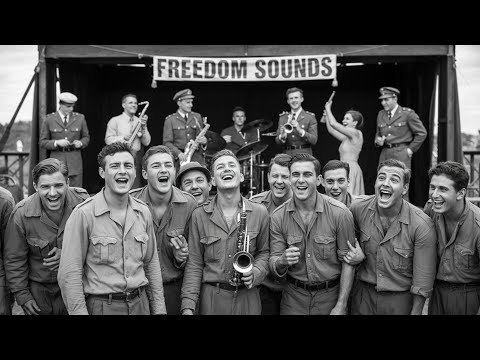
Spring 1944 had been a season of ash. In Austria, cities crumbled under bombs, bread lines stretched for blocks, and families huddled in cellars counting explosions. Jazz and swing had been banned for years, branded degenerate and dangerous. The only sounds most of these young men knew were marching boots and the harsh bark of radio propaganda. They were farmers, students—one dreamed of becoming a teacher. None had chosen this war. They were told America was weak, chaotic, a land of greed and noise. They believed it.
Then they were captured, shipped across a dark ocean, and herded through the gates of a camp in the American heartland. Their boots sank into soft soil, and their eyes searched for the hell they’d been promised. Instead, they saw neat wooden barracks, the smell of fresh grass, and guards who watched from towers but didn’t shout or strike. They were led to rooms with beds and blankets, given metal trays of hot stew, bread, and even fruit. Many hadn’t seen that much food in months. They ate in silence, hands trembling not just from hunger, but from confusion.
Days passed, and the strangeness deepened. Work details were light—kitchen help, sweeping paths, mending fences. The guards gave clear orders and left them to their meals. Whispers began to spread: perhaps the enemy was not as they’d been told. But no one dared say it aloud. Doubt was dangerous, even behind wire.
Then came the night the music floated through the camp. Soft at first, like a breeze through reeds, then rising bright and alive—trumpets, drums, a rhythm that swung and laughed. Jazz. The very sound they’d been taught to despise. Some men covered their ears as if it were blasphemy. Others stared wide-eyed, hearts racing with something they couldn’t name. One whispered that it sounded like freedom itself. Another shook his head, wordless. The melody rose and fell, sweet and wild, and the prisoners lay awake long after it faded, staring at the ceiling. They had come expecting chains and hunger. Instead, they were spellbound by music. And deep inside, the first crack in the wall of their beliefs widened.
The next morning, the camp glowed with the smell of bacon and coffee. The Austrians lined up with their trays, unsure what to expect. The cooks filled every plate with hot eggs, fresh bread, and a spoonful of jam glistening in the sun. Some stared before eating, then licked their fingers slowly, trying to stretch the sweetness. One man whispered that his family back home had nothing but boiled potatoes this week. The contrast rang in their heads like a bell.
As days turned to weeks, the oddity grew. Trucks rolled in and out, engines humming with efficiency. One day, a bright red Coca-Cola truck pulled up, its bed loaded with bottles glittering in the sunlight. The prisoners leaned toward the fence, throats dry. At home, people scavenged rubble for crumbs of bread; here, bottles of sweet drink were stacked like they were endless. In the kitchens, steel counters gleamed, huge pots boiled, and bread rose in golden rows. The American cooks joked and moved with ease, as if food would never run out. The Austrians couldn’t stop comparing it to the empty shelves and dark queues back home.
Evenings brought something stranger still. The music that had once drifted faintly now played loud and clear. Guards organized small gatherings where a band performed—brass, drums, guitars filling the air. At first, the prisoners stood at a distance, unsure if they were allowed to listen. Slowly, some crept closer and sat on benches, faces lit by lantern glow. The music swung and twisted, free of the rigid rules they’d been taught. Some began tapping their feet without thinking. One man even clapped softly before catching himself, as if afraid to show enjoyment. But the notes seeped into them, stirring something they’d forgotten they carried.
One evening, an American soldier walked past carrying a tray of ice cream, pale scoops glistening under the lights, already melting at the edges. The Austrians watched in stunned silence. Cold sweets in the middle of a war, while their families back home boiled watery soup just to survive. The contrast was so sharp it almost hurt to look at.
They lay awake in their bunks that night, the jazz notes and the image of melting ice cream spinning in their minds. What kind of country gives so much, even to its prisoners? The whispers grew, though they stayed careful. Something in their old beliefs was beginning to dissolve, and every man felt the ground shifting beneath him.
Summer pressed down on the camp, but the nights pulsed with life and sound. Then one evening, the guards announced a special festival. The prisoners gathered with watchful eyes, unsure what to expect. Lanterns glowed along the yard, their soft light scattering over the dirt paths. A stage had been set up with chairs and gleaming brass instruments.
When the first note rang out—sharp and bright—the Austrians froze in place. Then the music poured out, fast and free, drums popping like firecrackers, horns bursting into the belly of the night. It was a jazz festival, something none of them could have imagined, let alone inside a camp built to hold enemies.
At first, the men stood stiff, arms folded tight across their chests as if shielding themselves from the sound. They remembered the warnings from home, the voices that called this music shameful and dangerous. But the music didn’t stop. It leaped and twisted, laughing one moment and weeping the next.
A saxophone cried out in a long, winding note that shook the air. One prisoner—a man who had played piano before the war—closed his eyes. A tightness rose in his chest, a lump in his throat. He thought of the years he’d spent silent, afraid to touch the keys for fear of punishment. And here was music, unleashed and offered freely, even to captives.
As the band played on, the prisoners began to change. Some tapped their boots against the ground. Others swayed without thinking. The rhythms pulled at them, daring them to feel something other than fear. “It sounds like hope,” one man whispered. Another laughed—a real laugh, his first in months.
As the drummer spun his sticks through the air and caught them again, the barbed wire and guard towers seemed to blur for a moment, replaced by sound and light. Later, in the quiet of the barracks, the men couldn’t stop their thoughts from flowing. Notes passed from hand to hand. One wrote: “The saxophone bends like truth itself.” Another wrote: “Why share this with us if they hate us as we were told? Why give us joy when we are their prisoners?”
The words were simple, but they carried great weight. And as the days passed, those feelings deepened. The men noticed how the guards sometimes smiled at the music, even clapped without fear. They thought of the rigid military displays back home, the cold marches, the silence in the streets. Here, music flowed without restraint, and it seemed to speak of power in a way rifles never could.
“Maybe real strength isn’t in armies,” one man said quietly before sleep, “but in how free a song can be.” His words echoed in the dark, and no one argued. Deep in their hearts, they all understood that something had changed. What they had seen and heard could no longer be erased. The wall of their beliefs had cracked, and through it poured the sound of jazz, carrying a new vision of the world.
When the war finally ended, the gates swung open and the prisoners were told they would go home. The Austrians packed what little they owned—a few clothes, a book, sometimes a scrap of paper with notes they had written. Some even carried small harmonicas or sheet music given to them by the Americans. The journey back was long, but their hearts were full of questions. They had arrived expecting chains and hunger, and left with memories of songs and kindness.
As the train passed through a sea of ruined towns and burned fields, they wondered what awaited them in the land they had once called home. When their feet touched Austrian soil, the shock was deep. Cities were hollow shells, roofs collapsed and windows shattered. Families dug through rubble for wood and food. Lines still formed for meager loaves of bread, and the smell of smoke and ash clung to every street.
The men walked past people with pale faces and tired eyes. Mothers clutched their children, whispering about the little they could cook that night. Compared to the camp, this felt colder, crueler, more hopeless. It was strange to think that prison had fed them better than freedom did now.
In the evenings, the men gathered in small groups, trading stories from the camp. They spoke of the music that had drifted through the barbed wire, the jazz festival that had seemed impossible, the food and the strange taste of Coca-Cola. They spoke of guards who had treated them like humans, not animals. Some friends at home shook their heads in disbelief. “You were prisoners,” they said. “How can you talk about joy?” But the men only smiled faintly, for they knew what they had seen could not be erased.
Over time, some began to bring music back into their lives. One man repaired an old piano sitting in the corner of a ruined hall. Another found a radio and searched late at night for the faint hum of foreign stations. They traded small instruments, and some began to hum tunes they had once been afraid to enjoy. Slowly, clubs and cafés reopened, and the first notes of jazz returned to the streets of Vienna.
For the former prisoners, every note carried more than rhythm. It carried memory, a reminder that the world was bigger than fear and rules. Years later, one of the men—now a very old grandfather—sat with his family in a small living room. His grandson asked him what life had been like in the camps. The old man smiled, his eyes far away. “I went to war believing music was dangerous,” he said softly. “But in prison I learned it was the sound of freedom.”
His voice lingered, gentle but firm. The room fell quiet as the family listened. The war had taken much, but the music had given him something no bullet or bomb could tear away. It had shown him a truth deeper than orders, deeper than hatred. And that truth stayed alive, carried in every note of the songs he still hummed long after the guns had fallen silent.
But the old man’s story did not end there. In the years that followed, he found himself drawn to the small jazz clubs that had begun to bloom in the backstreets of Vienna. He would sit in the corner, a glass of something warm in his hand, and listen. The young musicians played with a fire he recognized—a hunger to be heard, to break rules, to feel alive. They did not know the war as he did, but they knew the music, and that was enough.
One night, a young saxophonist approached him after a set. The boy had noticed the old man’s quiet attention, the way his fingers tapped the table in time. “You play?” the boy asked. The old man hesitated, then nodded. The next week, he brought a battered trumpet he had carried home from the camp, its brass dulled but still true.
He raised it to his lips, and the first note trembled—rusty, uncertain. But then the boy joined in on saxophone, and the other musicians picked up the thread, and the old man felt something unlock inside him. The sound filled the small room, and for a moment, he was back behind the wire, hearing jazz for the first time.
Word spread through the neighborhood. People came to hear the old prisoner who played the trumpet. They brought their own stories—of loss, of survival, of small joys found in dark times. The club became a place where the past and present met, where the music did not erase the pain but transformed it into something shared.
And the old man, who had once believed music was dangerous, now understood its true power. It was not a weapon, not a lie. It was a bridge. It connected him to the young, to the strangers, to the world beyond his own memories. He played until his lips grew tired, and when he finally set the trumpet down, he knew he had found what he had been searching for all along.
The years turned, and the old man’s trumpet grew silent, but the music never left him. His grandson, now a young man, picked up the battered horn and learned to play. “You gave this to me,” he said one evening, holding the trumpet like a relic. The old man smiled. “No,” he replied. “The enemy gave it to me. And I gave it to you.”
In the corner of the room, a small radio hummed with a jazz station, the same forbidden sound that had once cracked a wall of hatred. The grandson played a few notes, clumsy but true, and the old man closed his eyes. He heard the barbed wire, the lanterns, the melting ice cream. He heard freedom, still bending like truth itself.
What would you have believed if you had been behind that wire?
Report this article
Select a reason for reporting:






