The engines roared to life, a defiant chorus against the grey September sky. Fifteen Bristol Blenheim bombers, their sleek frames burdened with two 500-pound bombs each, lifted off from RAF Wattisham and RAF Wytten. It was September 4th, 1939—just one day after Britain declared war on Germany. The target: Wilhelmshaven, the vaunted German naval port. The mission: destroy the heavy cruiser Admiral Scheer and the light cruiser Emden. For the young crews, this was more than a bombing run; it was a chance to strike the first blow against the Nazi war machine.
The day before, a lone Blenheim had slipped through German defenses at 24,000 feet, capturing vital reconnaissance photos. The element of surprise was on their side. But as the bombers droned westward, the weather turned. Heavy rain and low clouds forced them to fly mere feet above the churning waves, visibility near zero. Navigators strained to find landmarks, while pilots fought to keep their aircraft steady. The mission was fraught with peril, but the crews pressed on.
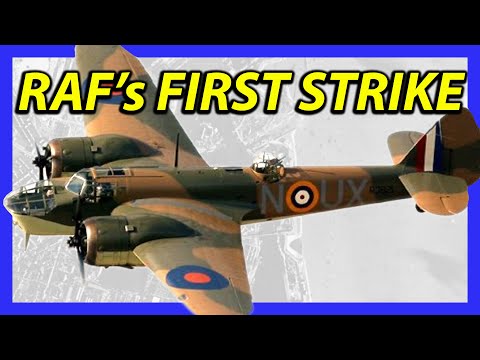
At RAF Wytten, 139 Squadron took off first, followed by 110 Squadron from Wattisham and 107 Squadron minutes later. Each Blenheim carried a crew of four: pilot, navigator, air gunner, and observer. Their orders were strict: bomb only battleships or destroyers, avoid civilian casualties. The bombs were fitted with 11-second fuses to give the aircraft time to clear the blast radius. At 100 feet, that was a deadly gamble.
As they approached Wilhelmshaven, the weather briefly cleared. The lead aircraft of 110 Squadron, piloted by Flight Lieutenant Duran, spotted the Admiral Scheer dead ahead. “Target in sight! Going in!” he radioed. Dropping to masthead height, Duran released his bombs. One bounced off the cruiser’s armored deck, the other embedded itself but failed to explode. Undeterred, Pilot Officer Lings attacked from the side, his bombs narrowly missing. Sergeant Han’s bombs were off target. The surprise was gone; anti-aircraft fire erupted from every ship.
Meanwhile, Flying Officer Henry Lovell lined up the Emden. His Blenheim was hit almost immediately, riddled with flak. “I’m hit! I’m hit!” he cried, but the aircraft plunged into the cruiser’s bow. The explosion killed Lovell, his crew, and nine German sailors—the first German naval casualties of the war. The remaining Blenheims of 110 Squadron scattered, one failing to find a target and turning for home.
By now, 107 Squadron arrived—straight into a wall of flak. The first three Blenheims were shot down in quick succession. Canadian Sergeant Prince managed a controlled ditching, but he succumbed to his injuries; his crew became the first Allied prisoners of war. Another Blenheim was destroyed by its own bomb blast when the delay fuse malfunctioned. The final aircraft, piloted by Officer Stevens, couldn’t locate a target and returned with bombs still onboard.
Back at base, the survivors counted the cost. The Admiral Scheer had escaped with minimal damage; the Emden was repaired within three months. Yet the Ministry of Information declared a propaganda victory. Flight Officers McPherson and Duran received the Distinguished Flying Cross—the first gallantry awards of the war. The fallen were buried with full military honors by the Germans, a gesture of respect between enemies.
But as the last Blenheim touched down, the true impact of the raid was yet to be felt. The RAF had drawn blood, but the Luftwaffe would soon retaliate in kind. The war was only just beginning.
The men who returned to Wattisham and Wytten that evening were not greeted with fanfare. Ground crews counted the aircraft as they came in—one, two, three—then waited in the drizzle for the others that never arrived. Mechanics climbed onto the wings of the surviving Blenheims and found them riddled with shell splinters, the fabric of the fuselage torn open like paper. One fitter, wiping oil from his hands, muttered that he’d never seen a machine come back so chewed up and still fly.
In the operations hut, the intelligence officers spread the reconnaissance photographs across a table and tried to piece together what had gone wrong. The plan had assumed surprise, and surprise had lasted only minutes. The low-level approach that was meant to protect the bombers from fighters had instead delivered them into the teeth of every anti-aircraft gun in the harbor. The eleven-second fuses, designed to save the crews, had in one case killed them.
Yet the most bitter discovery came later, when the first reports filtered in from neutral observers and from the German radio broadcasts themselves. The Admiral Scheer had not been seriously hurt. The bomb that embedded itself in her deck had been defused by a damage-control party within the hour, and the cruiser was already preparing to sail. The Emden, her bow crumpled and her forecastle a tangle of twisted steel, would be in dry dock for three months—but she would return.
What the crews could not know, as they sat in the mess that night nursing cups of tea and staring at nothing in particular, was how the raid would be remembered. Within days, newspaper headlines across Britain proclaimed a great blow struck against the German fleet. Photographs of Blenheims in formation ran above stories of daring low-level attacks and heroic sacrifice. The Ministry of Information, hungry for good news in the first uncertain weeks of the war, made certain the public heard of the Distinguished Flying Crosses awarded to McPherson and Duran.
But in the hangars and barracks, the talk was quieter and more honest. The crews had gone in at a hundred feet against the most heavily defended port in northern Germany and had come back with a handful of near-misses and one bomb that refused to explode. They had lost aircraft and men, and they had not sunk a single ship. “We gave them a bloody nose,” one navigator said to his pilot as they walked back to their quarters. “Trouble is, it was our own.”
The lessons were written up in reports that climbed the chain of command. Low-level attacks against defended harbors needed fighter cover, or better weather, or both. The fuses needed testing. The crews needed training in ship recognition, for the Germans had mistaken the Blenheims for their own Junkers and the British had nearly done the reverse. Every one of these conclusions would be paid for again, in other skies, before the RAF learned them properly.
And across the North Sea, in the cramped wardroom of the Admiral Scheer, a German gunnery officer wrote in his diary that the British had come with courage but without sense. He did not know that within a month his own bombers would fly up the Firth of Forth on a near-identical mission, and that the same grim arithmetic of surprise, flak, and luck would be worked out again over the anchored ships of the Royal Navy.
The men of 107 Squadron had borne the worst of it. Of the five Blenheims that left Wattisham, only two came back. The pilots who survived sat apart in the mess, not speaking, staring into the middle distance. One of them, a young flying officer named Stevens, kept turning his cap over in his hands as though he could not quite believe it was still his to hold. He had flown all the way to Wilhelmshaven and back with two bombs still slung under his wings, unable to find a target in the smoke and the rain.
It was Sergeant Abbott, of 110 Squadron, who broke the silence. He had also turned for home without releasing his bombs, and he said what several of the others were thinking. “We flew a thousand miles to drop nothing at all. The brass will call it a success, but we know better.” No one answered him. There was nothing to say.
The next morning brought the newspapers, and with them the version of events that Britain would read. The headlines spoke of Blenheims sweeping in at masthead height, of German cruisers straddled by bombs, of the first blow struck for freedom. The names of McPherson and Duran appeared in print, their Distinguished Flying Crosses announced with photographs and careful praise. In the officers’ mess at Wytten, someone read the account aloud and then folded the paper very carefully and set it down without a word.
What the public did not read was the signal that arrived at Group Headquarters two days later. It came from the Air Ministry, and it was marked most secret. The raid had been reviewed by the staff, and the conclusions were blunt. The attack had achieved no significant damage to either cruiser. The Admiral Scheer was already at sea. The Emden would be repaired. Fifteen aircraft had been dispatched, and six had failed to return or been destroyed. The cost in trained crews could not be easily replaced.
But the signal did not end there. It went on to note that the raid had proved the Blenheim could reach a heavily defended target in daylight and press home an attack. It had proved that German anti-aircraft defenses, while ferocious, could be survived. And it had proved, beyond any doubt, that the crews of Bomber Command would go where they were sent, whatever the odds. The staff officer who drafted the signal added a single line at the end: “The spirit of these crews is beyond praise.”
That line, more than any newspaper headline, was what the survivors carried with them. They had gone in expecting to strike a great blow and had come away with little but scars. Yet they had done what was asked of them, and they had done it without flinching. In the long, grim years that followed, through the darkness of the Blitz and the long road back to Germany, that would have to be enough.
At Geestemünde cemetery, the German naval honor guard folded the Union Jacks with careful precision. The coffins were lowered into the earth, and a bugler sounded a lament that carried across the flat coastal plain. A young German officer, watching the ceremony, wrote later that he had never expected to bury his enemies with such ceremony. “They came to kill us,” he wrote, “and we buried them as though they were our own. Perhaps that is what war does to men who understand it.”
Within weeks, the reciprocal raid on the Firth of Forth would prove him right. German bombers would fly up the estuary to attack the anchored ships of the Royal Navy, and British gunners would mistake them for their own returning aircraft. The same arithmetic of surprise and flak and luck would be worked out again, and men on both sides would die in the same bewildered way. The war had begun in earnest now, and there was no calling it back.
For the men of 107 and 110 Squadrons, the raid became a quiet legend. New crews arriving at Wattisham were shown the patched fuselage of a Blenheim that had flown home on one engine, its bombs still hanging beneath the wings. “That,” the ground crew would say, “is what a hundred feet over Wilhelmshaven does to a machine.”
McPherson and Duran wore their Distinguished Flying Crosses to the mess, but neither man ever spoke of the raid with pride. Duran, who had watched his bombs bounce off the Admiral Scheer’s deck, told a reporter only that they had done their duty and that the dead deserved the credit. “We came back,” he said. “They did not. That is the whole story.”
The Ministry of Information kept its version, and the public kept its faith in the Blenheim crews. The war rolled on, and the lessons of September 4th were paid for again and again in other skies. But somewhere in the archives, a staff officer’s line survived: the spirit of these crews was beyond praise.
And so the first blow was struck—clumsy, costly, and brave. Six aircraft gone, a dozen men dead, and not a single ship sunk. Was it a success, a failure, or simply the first honest measure of what this war would demand of those who fought it?
Report this article
Select a reason for reporting:






