February 1st, 1942, 04:43 hours. The flight deck of the aircraft carrier Enterprise, somewhere north of the Marshall Islands. The Pacific is black—not the dark of a highway or a field, but the absolute black of open ocean at 4 a.m., where even a low moon cannot reach the water below, and the nearest land is a coral atoll 155 miles to the south that no American pilot has ever attacked, defended by an enemy who, eight weeks ago, sank most of your fleet while your country was still sleeping.
Commander Howard Young stands near the island superstructure, watching his aircraft handlers wrestle Dauntless dive bombers into launch position by the glow of hooded flashlights. He commands Enterprise’s air group—37 dive bombers about to be hurled into the dark toward islands that appear on his charts as rough outlines drawn from old League of Nations survey maps from the 1920s. Some of those outlines are wrong. He knows this. His pilots know it. They are going anyway.
Somewhere behind him on the bridge, Vice Admiral William Halsey grips the rail with both hands, chewing a fingernail, watching the same darkness. Halsey has not slept. He has barely eaten. He has chain-smoked through the night, and the sailors on the bridge can smell the tobacco on him when he passes. He is 59 years old, and every calculation he has made in the last three weeks has led to this moment—a moment the rest of the United States Navy’s senior leadership thinks is somewhere between reckless and insane.
He is about to send those aircraft south into the darkness toward the most fortified island chain in the Japanese outer perimeter. He is doing it with one aircraft carrier. He has no battleships. He has no reserve. If Enterprise is sunk this morning, the Pacific Fleet will have two operational carriers left in the entire ocean. The Japanese have ten.
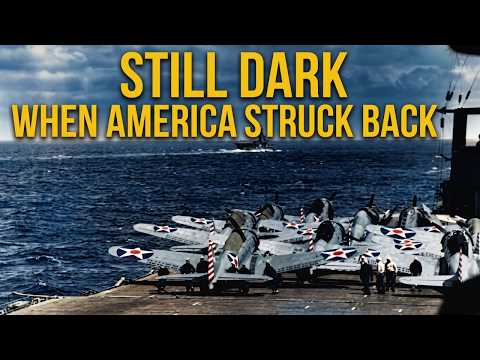
The launch officer drops his flag. The first Dauntless roars down the deck, dips slightly toward the water, and claws upward into nothing. One after another, 37 dive bombers follow, each one disappearing into the black sky within seconds of clearing the bow. The pilots cannot see each other. They cannot see the ocean. They are flying on instruments toward a target they have never visited in a war their country has been losing every single day since it started.
This is the first offensive strike the United States will launch in the Pacific War. Not the Doolittle Raid that is still ten weeks away. Not Coral Sea, not Midway. This, right here, 37 dive bombers in the dark, launched from the deck of a carrier whose crew fully expected a Japanese counterattack before the morning was over.
And the question that this story turns on is not whether the raid succeeded. The damage it inflicted was, by the cold accounting of postwar records, modest. The question is why it happened at all. Why did the United States Navy, outgunned, outmaneuvered, and still pulling bodies from the mud at Pearl Harbor, risk its most valuable ship and its most aggressive admiral on a strike that every senior planner in Washington believed could not change the outcome of the war?
The answer to that question is the reason you are watching this. Because what happened over the Marshall Islands that morning did not change the war the way a battle changes a war. It changed the war the way a decision changes a man. It was the moment the United States Navy stopped being the force that had been hit and became the force that hit back. And the men who made that decision—from the admiral on the bridge to the machinist’s mate on the flight deck who would do something in nine hours that no one had asked him to do and that no manual had ever described—were not following a plan for victory. They were following something older than a plan. They were refusing to accept that the war was already lost.
To understand why those aircraft launched into the dark that morning, we have to go back eight weeks and 2,000 miles to the northwest, to a Sunday morning in Hawaii when the world the United States Navy had built for itself was burning.
December 7th, 1941, 7:48 in the morning. The first wave of 183 Japanese aircraft crossed the northern coast of Oahu and dove on a fleet that was not expecting them. Within 90 minutes, the Pacific Fleet’s battleship force—the backbone of American naval power in the Pacific—ceased to exist. Eight battleships were sunk or crippled. 188 aircraft were destroyed, most of them on the ground. 2,403 Americans were dead. The attack was executed with a precision and a violence that stunned not just the American military, but the Japanese themselves. Commander Mitsuo Fuchida, leading the first wave, sent the famous signal confirming total surprise: Tora, Tora, Tora.
In the weeks that followed, the destruction only spread. Guam fell on December 10th, overwhelmed in hours by a force ten times the size of its garrison. Wake Island held for two weeks in a defense that captured the imagination of the entire country. The tiny Marine garrison sank two Japanese destroyers with shore batteries and repulsed the first invasion attempt entirely—a humiliation that forced the Imperial Japanese Navy to divert carriers from its advance to support a second assault. But the relief force never came. The decision to abandon Wake was made at Pearl Harbor on December 22nd, and the island surrendered the next day. The men who had held Wake became prisoners of war. The military garrison was shipped to camps in China and Japan, but 98 American civilian construction workers were kept on the island as forced laborers. In October of 1943, all 98 of them were executed by order of the Japanese garrison commander.
Manila fell on January 2nd, 1942. General Douglas MacArthur withdrew his forces to the Bataan Peninsula, where 76,000 American and Filipino troops would hold out for three months on starvation rations before surrendering in the largest capitulation in American military history. Rabaul, the great anchorage in the Bismarck Archipelago that would become the anchor of Japan’s southern perimeter, fell on January 23rd. The British battleship Prince of Wales and the battlecruiser Repulse were sunk off Malaya on December 10th by Japanese land-based bombers—the first capital ships ever sunk by air attack while underway in the open sea—eliminating the Royal Navy as a force in the Pacific. Singapore, the so-called Gibraltar of the East, was under siege and would fall on February 15th with the surrender of over 80,000 British and Commonwealth troops, the worst defeat in British military history.
The Japanese Empire was expanding at a rate that not even its own planners had anticipated. In eight weeks, Japan had seized a perimeter stretching from the borders of India to the central Pacific, and there was nothing on the horizon to suggest that it could be stopped.
And back in Hawaii, in the oil-slicked anchorage at Pearl Harbor, where the capsized hull of the battleship Oklahoma still jutted from the water and the Arizona still leaked fuel oil that stained the harbor surface black, the United States Navy was asking itself whether it could fight back at all. Time magazine ran a piece in early January that asked the question the entire country was asking: “Where is the fleet?” Japanese propaganda radio was more direct: “Where, oh where is the United States Navy?” It was a taunt. It was also, in that moment, a fair question.
This was the Navy that Admiral Chester Nimitz inherited when he arrived at Pearl Harbor on Christmas Day 1941 and formally took command of the Pacific Fleet six days later on December 31st. The ceremony was held on the deck of the submarine Grayling because there was no undamaged capital ship in the harbor on whose quarterdeck a change of command could properly take place. The symbolism was not lost on the officers present. The most powerful fleet in the Pacific was changing command on a submarine because its battleships were lying on the bottom.
Nimitz had flown in from the mainland and was driven to the harbor through streets that still bore the scars of the attack. Buildings at Hickam Field were pocked with bullet holes. The hangars were skeletal. At the harbor itself, the smell of fuel oil still hung in the air three weeks after the attack because the Arizona and other sunken ships were still leaking. The water was streaked with iridescent slicks. Salvage crews were working around the clock cutting into the capsized hull of the Oklahoma with acetylene torches trying to reach the men who were still trapped inside. Aboard the sunken West Virginia, sailors had been tapping on the hull for days after the attack—signaling that they were alive. The tapping had stopped by December 23rd. When salvage crews eventually reached them months later, they found the bodies of three men and a calendar with the days crossed off.
Nimitz, a quiet Texan with blue eyes and white hair, who spoke in measured sentences and listened more than he talked, stepped into a command that was, by his own private assessment, thoroughly demoralized. The officers were shaken, the enlisted men were angry and frightened, the civilian population of Honolulu was half convinced that a Japanese invasion was imminent. There were anti-aircraft batteries on the rooftops of Waikiki hotels and barbed wire on the beaches. A blackout was enforced every night. Sentries shot at shadows.
From Washington, Admiral Ernest King, the newly appointed commander-in-chief of the United States Fleet, was sending Nimitz messages that were not suggestions. King wanted offensive action—not defensive patrols, not convoy escorts, but offensive strikes against the Japanese perimeter. King was a hard, brilliant, often cruel man who believed that the fastest way to restore morale was to hit the enemy, even if the hit was small, even if the cost was high, even if the strategic value was questionable. He wanted the fleet to fight, and he wanted it to fight now.
Nimitz agreed in principle. The problem was resources. He had three operational carriers in the Pacific: Enterprise, Lexington, and Yorktown. Saratoga, the fourth, was torpedoed by a Japanese submarine on January 11th and would be in repair for months. Each of those carriers was irreplaceable. The first new fleet carrier, Essex, would not be commissioned until the last day of 1942 and would not see combat until the following summer. If Nimitz lost even one of his existing carriers in a raid that accomplished nothing, the consequences would be catastrophic.
But the pressure to act was becoming unbearable—not just from King, but from Congress, from the newspapers, from the families of the men who had died at Pearl Harbor, and who wanted to know what their Navy was doing about it. Nimitz needed to strike. The question was where.
The answer came from his war plans officer, Captain Charles McMorris, a man the staff called Sock, short for Socrates, because of his photographic memory and reputation as the sharpest strategic thinker on the staff. McMorris had been studying the Japanese outer perimeter—the chain of island bases that stretched from the Marshalls through the Gilberts and down to the Solomons. The Marshall Islands, mandated to Japan by the League of Nations after World War I and closed to outside observers for 20 years, were the closest major Japanese base complex to Hawaii. They were also, by the fragmentary intelligence available, not as heavily defended as the Navy had feared.
On January 27th, the submarine Dolphin returned from a reconnaissance patrol with critical information. The anchorage at Kwajalein, the largest atoll in the Marshalls, was busy with shipping. There were transports, auxiliaries, and at least one warship. The airfields at Roi, at the northern end of Kwajalein atoll, and at Wotje and Taroa on neighboring atolls, were operational but did not appear to host large numbers of fighters. This was the opening. McMorris drafted a plan. Nimitz approved it. And on that same day, Vice Admiral William Halsey—who had been pushing for an offensive strike since the moment Enterprise returned to Pearl on January 7th—got the order he had been demanding: Take Task Force 8. Take Enterprise. Go to the Marshall Islands. Hit them.
Halsey had Task Force 8 organized within days. Enterprise would carry the strike. The heavy cruisers Northampton, Salt Lake City, and Chester would provide the escort and surface bombardment capability. The destroyers Balch, Blue, Craven, McCall, Ralph Talbot, Dunlap, and Maury would screen against submarines. The fleet oiler Platte would keep them fueled. Rear Admiral Raymond Spruance—a methodical, cerebral officer who was in almost every way Halsey’s temperamental opposite—would command the cruiser screen from Northampton. Spruance was quiet where Halsey was loud, cautious where Halsey was aggressive, and analytical where Halsey was instinctive. The two men trusted each other completely, which is one of those facts that only makes sense if you understand that war requires both kinds of minds, and that the best commanders know which one they need standing next to them.
Enterprise‘s air group, commanded by the tall, lean Commander Howard Young, consisted of four squadrons. Scouting Six and Bombing Six flew the Douglas Dauntless dive bomber—a rugged, reliable aircraft that could carry a 1,000-pound bomb in a near-vertical dive and absorb punishment that would destroy a lesser airframe. Torpedo Six flew the Douglas Devastator, an older torpedo bomber that was already obsolete and that every pilot in the squadron knew was a death trap at low altitude against fighters. Fighting Six flew the Grumman Wildcat—a stubby, barrel-chested fighter that was slower and less maneuverable than its Japanese counterpart, the Mitsubishi Zero, but could absorb more damage and dive faster.
None of these aircraft were the best in the Pacific. The Japanese had better fighters, better torpedoes, and more experienced pilots. What the Americans had was willingness. The day before the attack, the pilots and gunners of Fighting Six did something that no supply depot or engineering manual had authorized. They took boiler plate steel from the ship’s stores and bolted it behind the seats of their Wildcats as improvised armor plating. The factory had not armored those seats. The Navy had not issued an order to armor them. The men who were going to sit in those seats decided they would rather have steel between their backs and a Japanese bullet, and they installed it themselves. It was in miniature the same impulse that would define the entire operation. The system had not provided what the men needed, so the men provided it for themselves.
I need to tell you who Halsey was, because without understanding the man, you cannot understand why the raid happened the way it did, and why its consequences reached so far beyond the damage it inflicted. William Frederick Halsey, Jr., was 59 years old in January of 1942. He was a surface officer who had earned his naval aviator wings at the age of 52—not because he loved flying, but because the Navy required carrier division commanders to be aviators, and Halsey wanted to command carriers. He had the build of a retired middleweight boxer, a square jaw, thick eyebrows, and a voice that could carry across a flight deck in a crosswind. He was profane, aggressive, impatient with caution, and beloved by enlisted men in a way that most admirals were not, because he talked to them and remembered their names, and ate the same food they ate when he was aboard ship.
When Enterprise had returned to Pearl Harbor on the evening of December 8th, 1941—the day after the attack—and Halsey saw the burning wreckage and the capsized battleships and the oil fires still flickering on the water, he said something that would follow him for the rest of his life: “Before we are through with them, the Japanese language will be spoken only in hell.” It was the kind of thing Halsey said. It was raw. It was angry. And it was exactly what the men around him needed to hear at that moment. Whether it was wise is a different question. Whether it was necessary is not.
From that evening forward, Halsey was a man with a single purpose. He wanted to take the war to the enemy. Every day Enterprise spent in port was a day he considered wasted. When the raid plan came together, Halsey did not merely accept it. He shaped it. His chief of staff, Commander Miles Browning—a brilliant and abrasive officer whom almost no one on the staff liked personally, but whose tactical instincts Halsey trusted completely—argued for adding Wotje itself to the target list. This was the most heavily defended atoll in the chain. It meant flying Enterprise‘s air group within range of three separate Japanese airfields simultaneously. It meant accepting the possibility of a sustained counterattack with no friendly base within a thousand miles. Halsey approved. He later wrote that the plan was one of those which are called brilliant if they succeed and foolhardy if they fail.
The run into the Marshalls took four days. On the night of January 28th, Enterprise refueled at sea in total darkness, running alongside the fleet oiler Platte for five and a half hours, connected by fuel hoses that could snap if either ship drifted more than a few yards off station. Night refueling was a dangerous maneuver that few warships had ever attempted. It worked. The crew was exhausted, but the bunkers were full. On the final night, January 31st, a bridge watchman reported with alarm that sand was blowing in his face. For a brief, terrifying moment, the navigation team believed they were closer to land than their charts showed. The grains turned out to be sugar from a sailor’s coffee mug that the wind had picked up. The tension broke. The ship sailed on.
At 0300 on February 1st, the crew was roused. At 0430, Enterprise turned into the wind. At 0443, the first aircraft launched. The United States Navy’s first offensive carrier strike of the Pacific War had begun.
And here is what I want you to hold in your mind as those aircraft disappear into the dark: Nobody on that ship knew whether they were coming back. Nobody on that ship knew whether the Japanese already knew they were there. A patrol plane had passed within 30 miles of the task force the day before without spotting them. The naval historian Samuel Eliot Morison would later suggest that some kind of guardian angel must have been watching over them. The angel had held so far. Whether it would hold for the next 12 hours was a question no one on the bridge could answer.
Commander Young led the main strike of 37 Dauntlesses southeast toward Kwajalein, 155 miles away. Behind him, nine Devastators carried 500-pound bombs instead of torpedoes, and twelve Wildcats under Lieutenant Commander Wade McClusky headed for Wotje and Taroa. Then the first man died. Ensign David Criswell’s Wildcat stalled on launch and dropped into the sea. He was never found—the first American lost in the first American offensive of the Pacific War, killed by the dark before he ever saw the enemy.
The main strike reached Kwajalein just before sunrise, over fog and charts that did not match the terrain below. Islands appeared where the maps said open water. But the anchorage was exactly where the chart said it was, and it was full of ships. Lieutenant Commander Halstead Hopping led the first gliding attack through anti-aircraft fire heavier than anyone had expected. A Mitsubishi Claude caught his Dauntless, and Hopping and his rear gunner, Radioman First Class Harold Thomas, were killed—the first American air crew to die in combat on the first offensive strike of the war.
The rest of the squadron did not turn back. They dove on the anchorage, on the airfield at Roi, on hangars and ammunition dumps. One bomb struck the headquarters of Rear Admiral Sukeyoshi Yatsushiro, killing him—the first Japanese flag officer to die in the war. In the anchorage, Lindsey’s Devastators hit the light cruiser Katori, wounding Vice Admiral Mitsumi Shimizu. The cruisers Northampton and Salt Lake City opened a naval bombardment, and between air attacks and surface gunfire, the submarine chaser Shonan Maru and the patrol boat Toyotsu Maru were sunk.
But it was Taroa that produced the shock of the morning. McClusky’s pilots had expected a lightly defended seaplane base. What they found was a fully operational airfield with two mile-long runways and an estimated 30 to 40 twin-engine bombers parked on the aprons. The intelligence had been wrong. Taroa was a major base. Lieutenant James Gray led five Wildcats into the attack; Lieutenant Junior Grade Wilmer E. scored Fighting Six’s first confirmed aerial victory, and Gray limped home with more than 30 bullet holes in his aircraft. The cruiser Chester took a direct bomb hit on her well deck. Eight of her crew were killed. Thirty-eight were wounded.
Back on Enterprise, Halsey made a decision his staff considered either courageous or reckless, and possibly both. Instead of withdrawing, he held the carrier within range of three Japanese airfields for nearly nine hours, launching follow-up strikes on Taroa and Wotje through the late morning. Smoke columns from Wotje were visible from the ship. His pilots flew strike after strike, returning, rearming, refueling, and launching again. Lieutenant Richard Best—who would become one of the most consequential dive bomber pilots in naval history four months later at Midway—led a third strike at 10:30. On that strike, Ensign John Doherty and his gunner, Aviation Ordnanceman Third Class Will Hunt, were shot down and killed.
It was Hollingsworth who finally climbed to the bridge, looked at Halsey, and said what the rest of the staff had been thinking for hours: “Admiral, do you not think it is about time we got the hell out of here?” Halsey grinned. He agreed. The crew would later call the withdrawal hauling ass with Halsey, but the Japanese were not finished.
At approximately 13:35, twin-engine Mitsubishi G3M Nell bombers from Taroa found the task force. They came in at medium altitude, aiming for Enterprise. Captain George Murray began combing the bomb tracks with hard rudder changes, throwing the 20,000-ton carrier into turns that heeled the flight deck. Most of the bombs fell to port, exploding in the water and sending geysers of spray across the deck. But one near miss was close enough to sever a gasoline line and start a fire. Boatswain’s Mate Second Class George Smith was mortally wounded by shrapnel. He would be the only man killed aboard Enterprise that day.
Then one of the bombers, flown by Lieutenant Kazuo Nakai and riddled by anti-aircraft fire, banked hard and aimed itself directly at the carrier. It was a deliberate crash dive. The anti-aircraft guns were firing, but the bomber was closing fast and nothing seemed to be stopping it. What happened next was not in any manual. It was not in any training program. It was not ordered by any officer aboard the ship.
Aviation Machinist’s Mate Third Class Bruno Peter Gaido was on the flight deck catwalk when he saw the bomber coming in. He was not at a battle station. He was not assigned to any gun. He was an aviation mechanic, a man whose job was to maintain engines and check spark plugs and tighten bolts on dive bombers. But he saw the bomber, and he saw a parked Dauntless with a .30 caliber rear machine gun, and he made a decision in a fraction of a second that no committee had approved and no chain of command had authorized. Gaido climbed into the rear cockpit of the parked dive bomber, grabbed the machine gun, and opened fire on the incoming aircraft.
He was shooting from a stationary plane on a pitching deck at a moving target that was trying to kill him and everyone around him. Lieutenant Nakai’s bomber missed the flight deck. Its wing clipped the tail of the very Dauntless Gaido was sitting in, shearing it off, and the bomber cartwheeled into the sea. Gaido was unhurt. He climbed out of the wrecked aircraft, grabbed a fire extinguisher, put out the gasoline fire from the severed fuel line, and then quietly disappeared into the ship. He assumed he was going to be punished for abandoning his assigned station.
Halsey heard the story within the hour. He had Gaido found and brought before him. Instead of disciplining the machinist’s mate, Halsey gave him a double promotion on the spot, advancing him from aviation machinist’s mate third class to aviation machinist’s mate first class in a single moment. It was the kind of thing Halsey did. It was also the kind of thing that made enlisted men willing to follow him into places that admirals were not supposed to take ships.
I want to pause here and ask you to remember Bruno Gaido. Not because of what he did that morning, although what he did that morning was extraordinary. Remember him because of what happened to him afterward. Four months later, Gaido was a rear gunner in a Dauntless at the Battle of Midway. His aircraft was shot down. He and his pilot, Ensign Frank O’Flaherty, were captured by the Japanese. Both men were interrogated, bound to weighted objects, and thrown into the sea. They were murdered. Bruno Gaido was 26 years old. He did not do what he did on the flight deck of Enterprise because someone told him to. He did it because the situation required it, and he was there. That is the thread that runs through this entire story, from the admiral on the bridge to the mechanic on the catwalk. The men who struck back at the Marshall Islands were not following a grand strategy. They were following a reflex that is older than strategy and harder to kill. The reflex that says, When someone hits you, you do not lie on the ground and count your injuries, you get up and you hit back.
Every like on this video does a small thing, but it keeps the names of men like Bruno Gaido visible a little longer. And those names deserve to be visible.
A second wave of Japanese bombers found Enterprise near 1600 hours that afternoon. Lieutenant Junior Grade James Daniels of Fighting Six intercepted one of the attackers. According to the ship’s unofficial history, his radio call back to the carrier was simply: “Bingo bingo, I got one.” By sunset at 18:35, all 14 of Fighting Six’s Wildcats were airborne on combat air patrol. The last one landed at 19:02 under a full moon. Halsey feinted northwest to throw off pursuit, then ducked into a cold front—what the crew would come to call Enterprise weather—and ran for Pearl Harbor at 30 knots.
They did not know it yet, but the Japanese had already launched a response. Within two hours of the raid, the Japanese Sixth Fleet Headquarters ordered nine submarines to sea to intercept Halsey’s force: I-9, I-15, I-17, I-19, I-23, I-25, I-26, RO-61, and RO-62. All nine failed to make contact. Elements of the Japanese striking force, including the carriers Zuikaku, Akagi, and Kaga, sortied from Truk to pursue. They too failed to find Enterprise. The guardian angel that Morison described held for one more day.
Meanwhile, 300 miles to the south, a second American task force had been fighting its own battle. Rear Admiral Frank Jack Fletcher, commanding Task Force 17, built around the carrier Yorktown, had launched strikes against the Southern Marshalls and the Gilberts. His targets were the atolls of Jaluit, Mili, and Makin. The results were far less dramatic. A tropical thunderstorm over Jaluit scattered his formations, fogged his pilots’ bomb sights, and turned the coordinated strike into a ragged series of individual attacks. One hit was scored on the transport Kanto Maru. At Makin, the patrol boat Nagata Maru was damaged, and two large flying boats were destroyed on the water. Mili had almost nothing worth hitting. Fletcher lost more aircraft to weather and fuel exhaustion than to the enemy. Several torpedo bomber crews went down near Jaluit, and six men were taken prisoner by the Japanese. Other air crew, including pilots whose names survive in the records only because they never came back, vanished into the storms and were never found. Among them were Annapolis graduates George Bellinger, Francis Maher Jr., and Jack Moore, and a floatplane pilot from the cruiser Louisville named Lieutenant Worthington, who reported by radio that he had located downed airmen, circled their position, and was never heard from again.
Fletcher’s contribution is the part of the Marshalls raid that rarely makes the highlight accounts. It was messy. It was frustrated by weather. Its results were marginal. But the men who flew those strikes into that thunderstorm did not know their strikes would be marginal. They knew only that they had been told to go, and that they went.
Enterprise and Task Force Eight arrived at Pearl Harbor on February 5th. Yorktown arrived the following day. What greeted them was something none of the crew had expected. Sirens blew across the harbor. Sailors on every ship in port lined the rails and cheered. Troops at Hickam Field—the same airfield that had been strafed and bombed eight weeks earlier—crowded the shoreline and shouted themselves hoarse. Small boats and tugs sounded their horns. It was a tradition from the Royal Navy, cheering a ship home from battle, and Halsey wrote later that he had never heard it before in the American service. The crew of Enterprise—the men who had not slept for three days, who had launched and recovered aircraft in the dark, who had watched bombs fall around their ship and a burning Japanese bomber cartwheel off their flight deck—stood on the rails in their dress whites and listened to the sound of their own navy welcoming them back from the first fight. Halsey wrote that he cried and was not ashamed.
Nimitz was waiting on the dock. He took Halsey’s hand and told the press that the raids had been, in his words, well-conceived and well-planned, and that the task forces had been obliged to make their attacks somewhat blindly due to lack of hard intelligence data and in the face of appalling weather conditions. The newspapers seized on the raid and inflated it beyond recognition. Initial reports claimed 15 ships sunk at Kwajalein alone—a Japanese Pearl Harbor in reverse. The real number was three small auxiliary vessels: the submarine chaser Shonan Maru, the patrol boat Toyotsu Maru, and the transport Bordeaux Maru. The light cruiser Katori was damaged but not sunk. About 15 to 18 Japanese aircraft were destroyed between both task forces. Approximately 90 Japanese personnel were killed at Kwajalein. Rear Admiral Yatsushiro was among them.
The American losses were real, and they were not small. Six officers and five enlisted men from Enterprise‘s air group were killed or missing, including Hopping and Thomas, Doherty and Hunt, and young Criswell who had gone into the water in the dark before ever seeing the islands. Eight men from Chester‘s crew were dead. George Smith aboard Enterprise was dead. Task Force 17 lost roughly eight aircraft and the men who flew them, and the six captured near Jaluit would spend the rest of the war in Japanese prison camps if they survived at all. A combined total of roughly 40 Americans died in the first offensive strike of the Pacific War.
So, here is the question that the damage reports force you to ask: was it worth it? Three small ships sunk, a handful of aircraft destroyed, a rear admiral killed and another wounded, against the loss of approximately 14 American aircraft and 40 American lives, and the risk of losing the most important carrier in the Pacific Fleet. If you judge the raid by the numbers alone, the answer is not obviously yes, and there were officers in the Navy—careful men, cautious men, men who understood mathematics—who said exactly that in the weeks that followed. They said the risk to Enterprise was disproportionate to the damage inflicted. They said Halsey had lingered too long within range of the airfields. They said the intelligence had been inadequate and the target selection had been flawed. All of those criticisms were, in their way, correct.
But the men who made those criticisms were measuring the wrong thing. They were measuring damage. The raid was never about damage. The raid was about something that damage reports cannot capture and that no after-action summary ever quite put into words. It was about the fact that the United States Navy, 56 days after the worst defeat in its history, had gotten off the floor and thrown a punch. It did not have to be a knockout punch. It had to be a punch. It had to be visible. It had to say to the Japanese High Command, to the American public, to the demoralized crews on every ship in every Pacific port that the fleet was not hiding, that the carriers were not afraid, that the men in the aircraft were willing to fly into the dark toward an enemy they could not see on charts they did not trust, and fight with whatever they had. That message landed harder than any bomb dropped on Kwajalein.
Within the Japanese High Command, the raid did something the Japanese had not considered possible in February of 1942. It introduced doubt. The assumption since Pearl Harbor had been that the American Pacific Fleet was broken, demoralized, and incapable of offensive action for at least 12 months. The war plans drafted by the Imperial General Headquarters in Tokyo had allocated that 12 months to consolidating the defensive perimeter, fortifying the island chains, and building the network of airfields and naval bases that would make the perimeter impregnable before the Americans could recover. The entire timetable depended on a passive enemy. The Marshall Islands raid shattered the assumption of a passive enemy. Not through superior firepower, not through decisive damage, through the simple, shocking act of showing up. If the Americans were willing to raid the Marshalls with one carrier in February, what would they be willing to do with three carriers in April? Or five in June? The perimeter that was supposed to have 12 months of quiet consolidation was under attack before the concrete on the runways had cured.
And it was not just the Marshalls. Halsey hit again. On February 24th, Task Force 16, again built around Enterprise, raided Wake Island. On March 4th, they struck Marcus Island, barely a thousand miles from Tokyo itself. Each raid was small. Each raid inflicted limited damage. And each raid drove the same message deeper into the calculations of the Japanese Naval General Staff: The Americans are not waiting. They are coming.
That message began to work on the mind of one man in particular: Admiral Isoroku Yamamoto, Commander-in-Chief of the Japanese Combined Fleet, the man who had planned Pearl Harbor, and who understood the industrial capacity of the United States better than any officer in the Imperial Japanese Navy. Yamamoto had spent time in America. He had studied at Harvard. He had served as a naval attaché in Washington. He had traveled the American heartland, visited the automobile factories in Detroit, seen the oil fields of Texas, and understood what those factories and those oil fields would mean once they were converted to war production. His entire strategy from the first day of the war had been built on one premise: Strike so hard at the beginning that the Americans will negotiate a peace before their industrial power becomes decisive. He had told his superiors before the war that he could run wild for six months to a year, but after that he had no confidence. The Marshall Islands raid told Yamamoto that the Americans were not going to negotiate. They were not even going to wait for their industrial power to become decisive. They were going to fight with what they had right now, today, before the factories had finished building the fleet that would make them unstoppable.
The Doolittle raid on Tokyo in April of 1942 confirmed it in the most dramatic way possible. That raid, which used the same hit-and-run carrier doctrine that Halsey had tested in the Marshalls, and which Halsey and Enterprise escorted to within roughly 670 nautical miles of the Japanese home islands, put 16 Army bombers over the capital of the Japanese Empire. The physical damage was negligible. The psychological damage was catastrophic. The Japanese public had been told the home islands were inviolable. American bombs on Tokyo proved they were not. This realization drove Yamamoto to the decision that would cost him his fleet. He concluded that he had to force the American carriers into a decisive battle before the American shipyards produced carriers he could not match. He chose Midway as the bait. He set the operation for June. He wagered four fleet carriers and most of Japan’s naval aviation on a single engagement designed to draw out and destroy the American carrier force once and for all.
He lost the wager. At Midway, in the first week of June 1942, four Japanese fleet carriers—Akagi, Kaga, Soryu, and Hiryu, the same striking force that had attacked Pearl Harbor—were sunk in a single day by American dive bombers, several of whom had flown their first combat missions over the Marshall Islands four months earlier. Lieutenant Richard Best, who had led a strike on Taroa on February 1st, put a bomb into the flight deck of Akagi at Midway. Lieutenant Commander Wade McClusky, who had led the Wildcat fighter strikes on Wotje and Taroa, and had since been promoted to air group commander, led the dive bomber attack that found the Japanese carriers at the critical moment on June 4th. The men who had practiced in the Marshalls delivered the killing blow at Midway. The raid that was not supposed to change anything had, through a chain of consequences that no planner could have predicted, changed everything.
If your father or grandfather served in the Pacific in World War II, in any branch, on any ship, at any island, I would consider it an honor to read their story in the comments. The specific details—the ship names, the island names, the things they remembered, and the things they would not talk about—those details are the real history. They matter more than anything in any official archive, and they deserve to be preserved by the families who carry them.
Now, here is the part of the story that requires me to be honest with you about what the raid was and what it was not, because this channel does not tell you the version that flatters anyone. It tells you the version that is true. The Marshall Islands raid of February 1st, 1942, was not a great victory. It was a raid. The damage it inflicted was modest by any honest accounting. Three small auxiliary ships sunk, roughly 15 to 18 aircraft destroyed, one Japanese rear admiral killed. The airfields were cratered, but operational again within days. The anchorage at Kwajalein was never seriously threatened. The garrison was not overwhelmed. It was stung. The American execution was uneven. The intelligence was incomplete, and the pre-war charts were badly outdated. The strikes on Jaluit were scattered by weather and accomplished almost nothing. The Wildcat fighters suffered chronic gun jams that nearly cost pilots their lives. The coordination between the two task forces was loose at best. Halsey held Enterprise within range of enemy airfields for far longer than prudence dictated. And if the Japanese bomber that Bruno Gaido shot at had struck ten feet to the right, the story of the Pacific War might read very differently.
But the raid taught the Navy things it could not have learned any other way. Halsey’s after-action report was brutally honest about what had gone wrong. He highlighted serious concerns about the 5-inch anti-aircraft batteries’ failure to stop the Nell bombers during the afternoon counterattack. The guns had fired. The bombers had kept coming. Only Gaido’s improvised intervention and the ship’s violent maneuvering had saved the carrier. That report drove immediate changes in anti-aircraft gunnery training and fire control doctrine across the fleet. Changes that would save carriers at Coral Sea and Midway. The fighter shortage exposed by the raid was equally consequential. Enterprise had launched only 12 Wildcats for the strikes, and several of those had been diverted to targets of opportunity, leaving the ship dangerously short of combat air patrol when the Japanese bombers arrived. Halsey recommended increasing the fighter complement on every carrier from 18 aircraft toward 27. That recommendation was adopted. By Midway, the fighter squadrons were larger, better trained, and better integrated into the ship’s defensive plan. The lessons were paid for in blood at the Marshalls. They saved lives four months later.
The initial press reports claiming 15 ships sunk were fantasy. The Navy knew they were fantasy and allowed them to circulate because the country needed good news and the truth—three auxiliary vessels sunk—was not going to make anyone feel like the war had turned. There is an uncomfortable honesty in admitting that the morale value of the raid depended in part on exaggeration, but the morale value was real even if the numbers were not. What the public felt when they read those headlines—the sense that America was fighting back—was not a lie. It was true. The scale of the fighting back was simply smaller than the headline said.
The press latched onto Halsey in particular. Newspapers needed a hero and Halsey looked like one. Somewhere in those early months, his nickname shifted from Bill to Bull. Halsey himself blamed a newspaper typo. Others traced it to his Annapolis days or to fellow officers who knew his temperament. The true origin is disputed, but the name stuck. Halsey reportedly disliked it. His friends never used it. But the country needed Bull Halsey—the aggressive, profane, fearless admiral who took the fight to the Japanese when everyone else was still counting the wreckage. And so Bull Halsey was what they got. The image was partly manufactured. The courage behind it was not. And the cost was real.
Forty men who left Pearl Harbor in late January did not come home. Lieutenant Commander Halstead Hopping and Radioman First Class Harold Thomas, the first Americans to fall in combat on the first American offensive of the war. Hopping was a career officer, a man who had devoted his adult life to naval aviation and who died leading the attack he had trained his squadron to execute. Thomas was his radio man and rear gunner, the man who sat behind him and trusted him to fly the aircraft while Thomas operated the radio and manned the gun. They died together. Ensign David Criswell, who never saw the dawn, who died in the water before the islands were even visible, killed by the dark and a stalling engine. Ensign John Doherty and Aviation Ordnanceman Third Class Will Hunt over Taroa, shot down on the third strike of the day—one of the strikes that the cautious men in the planning offices would later say should never have been flown. George Smith on the flight deck, killed by shrapnel from a bomb that missed. The eight men from Chester‘s crew, killed when a single bomb found a gap in the ship’s defenses. The aviators from Yorktown who disappeared into tropical storms or were captured near Jaluit and spent years in captivity. And Bruno Gaido, who survived the raid and the war’s most famous battle and was then murdered by his captors in the open ocean. These men did not die for a decisive victory. They died for a gesture. But the gesture mattered because it was made at the moment when the only alternative was silence.
And silence in February of 1942 meant acceptance. Acceptance that Pearl Harbor had decided the war. Acceptance that the Japanese perimeter could not be touched. Acceptance that the Pacific Fleet would wait and wait and wait while the shipyards built the fleet that might someday, in 1944 or 1945, be strong enough to fight. The men on Enterprise did not accept that. Halsey did not accept that. Nimitz did not accept that. And so they went—not because they were sure they would win, but because they were sure they could not sit still.
There is a detail about the return to Pearl Harbor that I have not seen discussed in most accounts of the raid. And it is the detail that stays with me most. When Enterprise entered the harbor on February 5th, the crew was called to quarters in dress whites. The ship moved slowly past the wreckage of Battleship Row. The sailors on deck could see the overturned hull of the Oklahoma, the shattered superstructure of the Arizona, the salvage cranes working on the West Virginia. They had left that wreckage behind them three weeks earlier. They were returning to it now having done the thing that the wreckage said could not be done. They had taken the war to the enemy with one carrier, with incomplete intelligence, with outdated charts and jamming guns, and aircraft that could barely see each other in the dark. They had lost friends. They had nearly lost their ship. And they had proved to themselves and to the enemy and to the country watching from the mainland that being hit is not the same as being beaten.
Halsey received the Distinguished Service Medal. So did Browning, who was promoted to captain. Halsey would go on to command the Third Fleet in the great carrier battles of 1944 and 1945, and his legacy would become complicated by decisions at Leyte Gulf and by typhoons that cost ships and lives. The stress of those months of continuous combat took a physical toll that few accounts mention. By late May of 1942, after leading raid after raid from the Marshalls to Wake, to Marcus Island, to the Doolittle Mission, Halsey had developed a severe psoriasis flare that spread across his body. He had lost 20 pounds. The condition was so debilitating that he was hospitalized at Pearl Harbor and forced to miss the Battle of Midway. The man who had done more than anyone to prepare the fleet for that battle was in a hospital bed when his pilots fought it. He recommended Spruance—the quiet cruiser admiral who had screened Enterprise in the Marshalls—as his replacement. Spruance went on to command the American carriers at Midway and to win the most decisive naval battle in the Pacific War. That recommendation, made from a hospital bed by a man covered in a skin condition brought on by months of unrelenting combat stress, may have been Halsey’s single most consequential decision of the entire war.
Enterprise herself would go on to become the most decorated warship in the history of the United States Navy. She fought in more major engagements than any other American vessel, from the Marshalls through Midway, the Eastern Solomons, Santa Cruz, the Naval Battle of Guadalcanal, the Philippine Sea, Leyte Gulf, and the final strikes on the Japanese Home Islands. She was hit, burned, patched, and sent back into the fight so many times that her crew called her the Big E, and the sailors on other ships called her the Gray Ghost because she kept appearing in battles where the Japanese believed they had already sunk her. After the war, despite a public campaign to save her as a memorial, she was scrapped in 1958. There is no museum ship named Enterprise from World War II. The name lives on in aircraft carriers that came after her, but the ship that launched the first American offensive of the Pacific War—the ship that Bruno Gaido climbed into a parked dive bomber to defend—is gone. Only her story remains. But on that morning in the Marshalls, at 0443, when the first Dauntless went down the deck into the black, Halsey was the right man in the right place doing the right thing, and the men who followed him into the dark knew it.
The Marshall Islands were still dark when those aircraft launched. They were dark because it was 4:00 in the morning over open ocean, because the atolls had no lights, because the war was barely eight weeks old, and the enemy owned everything between Hawaii and the coast of Asia. They were dark because no American had attacked them before, and no one knew what was waiting on those coral strips below the clouds. But the darkness was also the point. The men who flew that morning did not wait for daylight. They did not wait for more carriers. They did not wait for better intelligence or better charts or better odds. They went into the dark because the dark was where the enemy was. And waiting for perfect conditions was another way of saying that you were not going to go at all.
The Marshall Islands raid was not Midway. It was not Leyte Gulf. It was not Iwo Jima or Okinawa. It was smaller than all of those, and its place in the history books is smaller, too. But every one of those battles was downstream of the decision made on the bridge of Enterprise before dawn on February 1st, 1942. The decision that said: “We are not waiting. We are going now with what we have into whatever is out there.” That decision, made by an admiral who could not sleep and carried out by pilots who could not see, was the first act of the war that the United States chose to fight rather than the war that had been forced upon it.
And the 40 men who did not come home from that decision deserve to be remembered not for the damage they inflicted, which was modest, but for the thing they proved, which was not modest at all. They proved that a fleet that has been knocked to the ground can choose to stand up before it is ready. They proved that the willingness to fight when the odds say you should not is itself a weapon, and sometimes the most important one. They proved that the men who flew those aircraft into the dark over the Marshall Islands were not waiting for someone to tell them the war could be won. They had already decided it could, and they were willing to bet their lives on that decision before the sun came up.
If this story gave you something to think about, that like button matters more than you might expect. It helps this kind of history reach the people who want the real version—not the version that has been cleaned up for a textbook, not the version that leaves out the cost, but the version that tells you what actually happened with the names, the details, and the parts that are hard to hear. Subscribe if you want more. There are many of these stories. Most of them are about ordinary men who did extraordinary things—not because they were ordered to, but because the moment demanded it, and they were the ones who were there.
And if you know the name of someone who served, put it in the comments. That is where the real history lives—not in the archives, in the families.
So now I’ll ask you: whose story will you keep alive?
Report this article
Select a reason for reporting:






