Spring 1939, a wet road in occupied Moravia. A German officer slides behind the wheel of a car that looks like it fell from the sky. Silver, smooth as a raindrop, a fin running down its spine like a shark’s. Behind his head, an air-cooled V8. He takes the bend too fast. He lifts off the gas. The tail swings around. The trees rush in. That is the legend. Legend says so many Nazi officers died in this car that their own army forbade them to drive it. Legend says the Czechs gave it a name, their secret weapon. No one has ever produced the body count, but one number in this story is real. In 1965, Volkswagen paid 1 million Deutsche marks to quietly end a lawsuit over where its most famous car came from.
The car in the legend was the Tatra T87. By 1950, it was out of production. By 1999, Tatra had built its last passenger car, and the idea inside it had already rolled into millions of American driveways under another name. Tatra built the future so well that somebody else got to sell it.
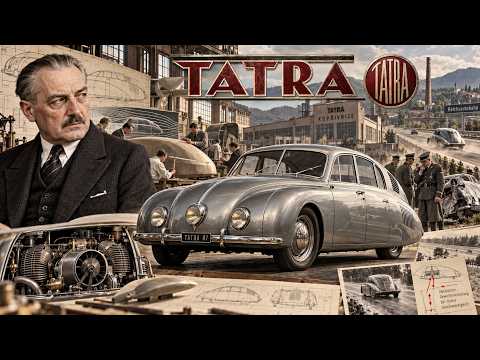
This is the story of the Czech car that was too far ahead of the men who drove it, and so good that a dictator’s engineer took its ideas home. The most famous thing about this car may never have happened, and the most important thing about it ended up in millions of driveways wearing someone else’s badge.
Before there was a streamliner, there was a carriage. In 1850, in a small Moravian town the Czechs called Kopřivnice, and the Austrians called Nesselsdorf, a man named Ignác Šustala opened a workshop with two apprentices. They built horse-drawn carriages, wooden wheels, leather seats, iron fittings shaped by hand. It was not glamorous work, but it was honest and it grew. By the 1880s, the little shop was building railway cars, freight wagons and passenger coaches for the sprawling rail network of the Austro-Hungarian Empire. The company took a long German name to match its ambitions: the Nesselsdorfer Wagenbau Fabriks-Gesellschaft.
Then in the 1890s, the world began to change. In Germany, Karl Benz was selling motor cars. In France, Peugeot was building them. And in Nesselsdorf, the company’s technical director, Hugo Fischer von Roslerstamm, made a decision that sounds simple today and looked close to reckless then. He bought a Benz. He brought it back to a factory that built railway coaches, and he asked his people a dangerous question: “Could we do this?”
In 1897, the wagon builders of Nesselsdorf answered. They rolled out their own automobile and called it the President. It was the first motor car built in Central Europe, and it was shown that same year in Vienna. Orders followed. Before the turn of the century, the works had built nine more improved cars based on it. Among the men who built that first car was a 19-year-old who had only just walked through the factory gates. Remember his name: Hans Ledwinka.
He was born on February 14th, 1878 in Klosterneuburg, a town on the Danube just outside Vienna. His father, Anton, ran an inn. There was no family fortune, no engineering dynasty. There was a public house, a working town, and a boy who wanted to know how things moved. At 14, Hans was apprenticed to his uncle, Johann Sferer, a mechanic and toolmaker with a reputation across the region. This was where his real education began, not in a lecture hall, at a workbench. Files, lathes, measurements down to a hair. A machine either worked or it did not, and the shop taught him to hear the difference before any drawing could show it.
Two years later, he passed the entrance exams for a state craft school in Vienna. Then in 1897, he took a job at Nesselsdorf, not in the automobile department. There barely was one. He started in the railway wagon division. Within months, he was working on the President. Within 3 years, he had designed a car of his own. The type A of 1900 was the first Nesselsdorf automobile drawn entirely by Ledwinka’s hand.
And here is the first thing you need to understand about him. He was brilliant. He was stubborn, and he was restless. Not long after the type A, he walked away to chase a completely different idea: steam power for automobiles. He tested it. He studied it. And he concluded that steam was a dead end for the car. So, he came back. For the next decade, he built the conventional machines of the age, fours and then sixes, each one bigger and more refined than the last.
By 1914, Nesselsdorf was offering the type U, a 5.3 L six-cylinder. By 1915, the company was building cars with brakes on all four wheels at a time when most cars on the road still braked only at the rear. The machines were getting better, but the world around them was coming apart.
The First World War destroyed the Austro-Hungarian Empire. In 1918, Moravia became part of a brand new country called Czechoslovakia, and the old wagon works needed a new identity. In 1919, it found one. Its cars would carry the name of the mountains that rise along the border between Czechoslovakia and Poland: Tatra.
But Ledwinka was not there to see it. In 1916, he had left again, this time for a rival in Austria, Steyr. When the empire broke apart, he chose to remain an Austrian citizen. A man between countries, between companies, between ideas. It did not last. In 1921, Tatra called him home, and he said yes.
And this is where the story takes its first strange turn. Steyr would go on to hand its top engineering job to another brilliant, ambitious engineer, a man born in Bohemia whose name would one day be printed on some of the most famous cars ever built: Ferdinand Porsche. Two men. The same drawing office at Steyr, one after the other. For the next 20 years, their ideas would orbit each other so closely that only a courtroom could try to pull them apart. And Ledwinka was about to hand the world the idea that would start the fight.
By the time Hans Ledwinka came home to Kopřivnice in 1921, he was carrying an idea that broke almost every rule of the automobile. In those days, a car was built like a ladder. Two heavy steel rails ran from front to back, and everything else was bolted on top. The engine, the body, the seats, the axles. It was strong, it was simple, it was also heavy, and it twisted on bad roads like a plank across a creek.
Ledwinka threw the ladder away. In its place, he put a single steel tube, one rigid spine running down the center of the car with the engine bolted to the front and the transmission running inside. At the back, he gave each rear wheel its own swinging half-axle, so that one wheel could drop into a pothole without dragging the other one down with it. Independent rear suspension. In the early 1920s, that was something you expected on a racing car, not a family sedan.
He called the result the Tatra 11. It went on sale in 1923, powered by a small, air-cooled two-cylinder engine up front. It was cheap, it was light, and it simply would not die. On the rutted roads of Central Europe, the backbone chassis shrugged off punishment that broke conventional cars in half. The Tatra 11 and its successor stayed in production for 10 years and built the company a reputation for toughness that still defines it a century later.
The tube, the swinging axles, the air cooling. Engineers would call it the Tatra concept, but Ledwinka was not finished. He was already looking past the chassis. He was looking at the air, and the man who understood the air better than anyone alive had learned it building airships. His name was Paul Jaray.
He was born in Vienna on March 11th, 1889 into a family of Hungarian Jewish descent. He studied engineering in Vienna, then worked in Prague as an assistant to one of the earliest scientists to treat aerodynamics as a serious field. In 1914, he joined Luftschiffbau Zeppelin in Germany, the company building the giant rigid airships that floated over Europe like silver whales.
At Zeppelin, Jaray had something almost no car designer on Earth had: a wind tunnel. He used it to study one question: what shape slips through the air with the least resistance? His answer became the airship LZ 120 Bodensee, launched in 1919. Its teardrop form became the template for the great zeppelins that followed, including the Graf Zeppelin and the Hindenburg.
Then Jaray turned his tunnel on the automobile. In the early 1920s, he filed a patent for a streamline car body, not a boxy coach with a pointed nose, but a true three-dimensional teardrop, rounded at the front and tapering to a long tail at the rear. His prototypes proved the theory on the road. They needed far less power to reach the same speed. He had cracked the code, and almost nobody wanted it.
Buyers in the 1920s wanted cars that looked like money. Tall grills, upright windshields, long square hoods. A Jaray car looked like a beetle that had swallowed a balloon. In 1923, he left Zeppelin, moved to Switzerland, and went into business licensing his patents to any car maker brave enough to try.
One car maker was. In 1931, Tatra built a prototype called the V570. It was a small car for ordinary people and Ledwinka turned the layout inside out. He moved the engine to the back. With nothing driving the front wheels, he reasoned, you could delete the long drive shaft that ran under the cabin. With air cooling, you could delete the heavy radiator. You gained space. You lost weight.
A second V570 followed and this time it wore a streamline body. It was a people’s car, rear-engined, air-cooled, shaped by the wind, and Tatra’s board said no. The company’s conventional small car, the T57, was selling well. Why gamble on a strange little machine with its engine in the wrong place? The V570 was shelved.
Remember that moment. The cheap, rear-engined, air-cooled car for the masses was sitting in a Tatra workshop. Finished years before the world would hear of the Volkswagen and Tatra put it away. But Ledwinka did not give up the idea. He just aimed it higher. If the board would not build a streamline car for the people, he would build one for the rich, big, fast, luxurious.
With his son Eric and a German engineer named Erich Übelacker, he went to work in secret under a license from Paul Jaray. Two years later, they invited the press to Prague. And not one of those reporters believed what they were about to see.
March 5th, 1934, Prague. The reporters filed into Tatra’s offices expecting a new car. What they found looked like it had been delivered from another decade. It was long, low, smooth from end to end. The nose sloped down to the pavement like the front of an airship. The windshield was split into angled panes of flat glass. The headlights sat flush with the bodywork instead of bolted on like a pair of buckets. And the rear of the car did not end so much as taper away, stretching back into a long sloping tail with a fin rising along its spine. There was no grill. There was no radiator. There was nothing under the front hood but space. The engine was in the back.
Tatra had built the car in near total secrecy, and the secret had held right up to the day of the unveiling. Its name was the Tatra 77, and Tatra presented it as something no car maker had managed before. A streamlined automobile built not as a one-off show car, but in series production for customers who could walk in and buy one.
The engineering was as radical as the shape. Under that long tail sat a 2.7 L V8, air-cooled with a single overhead camshaft. Instead of Ledwinka’s trademark tube, the backbone was now a pressed steel box section platform that carried the body. Six people rode inside in the hushed comfort of a luxury sedan. And then Tatra gave the number that started the arguments. 60 horsepower.
The journalists in that room knew cars. They knew that to push a big six-passenger sedan to around 87 mph in 1934, you normally needed something close to twice that much power. A car with 60 horsepower was a car for puttering to the market. Not for flying down an open road. Either Tatra was exaggerating or the laws of physics had changed.
So Tatra did the only thing that could settle it. It handed over the keys. The company organized demonstration drives on the road west from Prague to the spa town of Karlovy Vary. The reporters climbed in. The V8 behind them began to sing. And the long silver body began to do something they had never felt before. It kept accelerating.
At speeds where an ordinary sedan of the era would be straining, shaking, and roaring against the wind, the Tatra simply slipped through. Out on the open road, it reached about 90 miles an hour. 90. On 60 horsepower. What stunned the press was not just the speed, it was the calm. At around 60 miles an hour, the car rode smoothly, handled with confidence, and stayed quiet enough to hold a conversation. The wind that hammered every other car of the period seemed to just slide off this one.
That was Paul Jaray’s theory, proven on a public road. It was Erich Übelacker’s work in the wind tunnel, refining every curve until the air had nothing to grab. And it was Hans Ledwinka’s conviction that the engine belonged behind the passengers, pushing the car forward with no radiator and no drive shaft to get in the way.
The Tatra 77 did not stay a Czech secret for long. Shortly after its debut in Prague, it went on display at the motor shows in Berlin and Paris, in front of the most demanding car audiences in Europe. Designers stared at it. Engineers crawled under it. Journalists across the continent wrote about the strange Czech car with its engine in the tail. And in that same year, 1934, more than 4,000 miles away, Detroit was attempting the very same thing. Chrysler had just launched its own streamline car, built on many of the same aerodynamic principles. You will hear about how that turned out. Hold on to it.
Because in coup shapeliness, the triumph came with a bill. The Tatra 77 was a coach-built luxury car assembled largely by hand and it was priced for a tiny slice of the market. Only the wealthiest buyers in Czechoslovakia could even consider one and the market of the early 1930s was not in a mood to experiment. Europe, like America, was in the grip of the Great Depression. The orders came slowly.
Worse, Ledwinka himself was not satisfied. He was a perfectionist and he could see what the first car got wrong. After the first run of roughly 100 cars, he went back to work. The answer arrived in 1935, the Tatra 77A. The wheelbase was stretched by about 4 in. The aerodynamics were refined further. The V8 grew to 3.4 L and power climbed into the 70s. The car gained roughly 200 lb and yet its top speed still rose to around 93 mph. The air was doing the work the horsepower could not.
It was better. It was faster. It was still a car almost no one could buy. When production of the 77 and 77A ended in 1938, Tatra had built about 249 of them plus a handful of pre-series cars. 249 for the world’s first series-produced streamliner, a machine that had beaten the laws of physics in front of the press on the road to Karlovy Vary. Not a failure of engineering, a failure of arithmetic.
One of the few men who did own a 77 was Erich Übelacker, the engineer who had shaped it. He drove his own from 1934 onward. The man who knew the car best chose to live with it every day. But even he could see the problem. The 77 was long, heavy, and expensive. Its first-generation chassis had been a bold experiment and some of what it taught the team was hard-earned.
The question inside Tatra was no longer whether streamlining worked. They had proved that. The question was whether they could build a Streamliner that was lighter, tighter, more nimble, and more practical without losing a single mile an hour. Ledwinka and Ubelacker had their answer. They had learned their lessons from the 77, and they poured every one of them into a new design. It would be shorter than the 77, lighter, built around a new V8 cast in magnesium alloy, it would carry the same long tail, the same fin, a third headlight staring out from the middle of the nose. And in time, it would carry something else: a reputation. It was called the T87.
So the T87 rolled into history not as a killer, but as a blueprint. Its shape slipped into wind tunnels from Stuttgart to Detroit, its engine layout into the Beetle that put the world on wheels, its backbone into trucks that still grind through deserts a century later.
Hans Ledwinka died in Munich in 1967, his name cleared only in 1992 — on his birthday, 44 years after the conviction. He never saw the rehabilitation, but the idea he chased never needed one. It just needed someone brave enough to build it.
Tatra built the future so well that somebody else got to sell it. Yet the future kept the fingerprints. Every teardrop nose and rear-mounted engine is a quiet nod to Kopřivnice.
If you’ve ever driven a Tatra — or an air-cooled Volkswagen that owes it a debt — tell us: did that heavy tail ever try to pass you on a wet road?
Report this article
Select a reason for reporting:






