He was the son of privilege, a Yale man with a silver spoon in his mouth and a flask of Vat 69 never far from his lips. But behind the polished veneer of Captain Lewis Nixon, Easy Company’s brilliant intelligence officer, a far darker truth lurked—one that Band of Brothers only hinted at. While the series portrayed his drinking as a quirky flaw, a coping mechanism for the horrors of war, the reality was far more devastating. Veterans who served alongside him painted a picture of a man whose alcoholism was not just a personal battle, but a force that impacted his duties, his relationships, and the men who depended on him.
In the acclaimed miniseries, Nixon’s reliance on alcohol is woven into the fabric of his character—a charming rogue whose fondness for whiskey never seemed to interfere with his tactical genius. But was this depiction merely a sanitized version, shaped by the biased lens of his best friend, Richard Winters? The truth, as revealed by those who witnessed it firsthand, is far more complex and troubling.
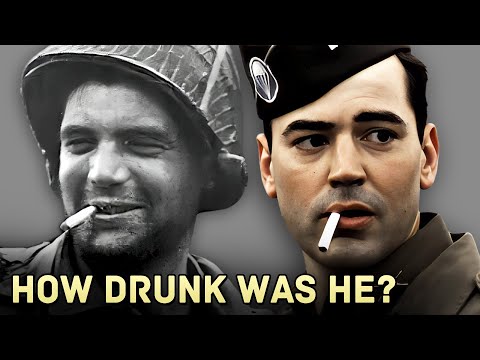
Ed Shames, a fellow Easy Company veteran, didn’t mince words. “Nixon was the worst drunk there’s ever been in the history of the United States military,” he declared. Shames, who briefly served as Nixon’s assistant, described a scene that could have come straight from a frat house rather than a war zone: Nixon had rented a private home in Aldbourne, England, littered with empty bottles. “He expected me to keep the house in order and also look after the daily running of the S2,” Shames recalled. But the most shocking admission? “I had to scrape him off the floor three or four times.” This was a level of intoxication that Band of Brothers never showed—a stark contrast to the functional alcoholic portrayed on screen.
And Shames wasn’t alone. Colonel Robert Sink, Nixon’s commanding officer, grew so frustrated with his drinking that he demoted him from regimental to battalion staff. In a conversation with Winters, Sink vented, “God damn it, the man’s drunk all the time. I mean, I certainly tip a few myself at night and went off duty, but with him, it’s all the time. I can’t get any damn work out of him.” Yet in the series, this demotion is glossed over—almost presented as a favor to Winters rather than a consequence of Nixon’s addiction.
Other veterans offered mixed views. Sergeant Don Malarkey called Nixon a “full-blown alcoholic” and “the resident lush,” but also acknowledged his courage—like when Nixon won a lottery for a 30-day furlough in Bastogne and gave it up to stay with his men. Clancy Lyall, however, insisted, “He wasn’t a drunk as they wanted to depict him. He was a real fine intelligence officer.” The discrepancy in these accounts raises a crucial question: was Nixon’s drinking as debilitating as some claimed, or was it exaggerated by those who disliked him?
Perhaps the most revealing perspective comes from Richard Winters himself. In letters and memoirs, Winters admitted that Nixon was “the biggest drunk I’ve ever seen, known, or hoped to see,” yet in the same breath called him “absolutely the most reliable man I’ve ever known.” This contradiction—buffering criticism with praise—suggests a deep loyalty that may have softened the portrayal in Band of Brothers. But Winters also confessed, “My only problem with Nixon was keeping him sober.” And after the war, their friendship frayed as Winters watched his best friend drink himself into oblivion: “To visit with Nixon was to sit there and watch him get drunk. That’s no fun when you’re sober.”
So how drunk was Lewis Nixon during World War II? The answer is complicated. He was a highly functional alcoholic who could summon brilliance under pressure, but his addiction was far more severe than the series let on. The omission is understandable—Band of Brothers aimed to honor the men of Easy Company, not expose their demons. Yet by softening Nixon’s struggle, the show may have done a disservice to the truth of his experience and the sacrifices he made despite it.
As we delve deeper into the accounts of those who knew him, a portrait emerges of a man who was both a hero and a victim—a decorated soldier who earned a Bronze Star and three combat jump stars, yet couldn’t escape the grip of the bottle. His story is a reminder that war leaves scars that aren’t always visible, and that even the bravest among us have battles that rage long after the guns fall silent.
But the story of Lewis Nixon’s drinking doesn’t end with the war—it followed him home, into the boardrooms of Nixon Nitration Works and the quiet dinners of suburban New Jersey. Winters, who accepted a job at the family business after the war, found himself in the uncomfortable position of watching his former commander and closest friend unravel in peacetime. The same man who had once coordinated intelligence for an entire regiment now struggled to coordinate his own days without a drink in hand.
According to Winters’s recollections, Nixon’s marriage to his second wife, Grace, was strained by his continued drinking. The couple had two children, but Nixon’s absences—whether physical or merely emotional—were a constant presence in the household. “Nixon and I always remained good friends, but our relationship after the war was tough,” Winters admitted. “The thing that kept us together was the bonding we had from the war.” That bond, forged in foxholes and frozen forests, was strong enough to survive the peace—but only just.
What makes Nixon’s postwar trajectory so poignant is the contrast with his wartime performance. During the war, he had been the man who could produce a map of enemy positions from memory, who could brief a colonel on troop movements with the precision of a scholar. His mind was a steel trap, even when his body was pickled. But alcohol is a patient adversary. It waits. And in the decades after 1945, it began to collect its debt.
In the 1950s, Nixon’s drinking led to a series of business failures and personal embarrassments. He was fired from his own family’s company—a humiliation that would have broken a lesser man. “He was absolutely the most undependable man you’d ever want to find,” Winters wrote in one candid letter, a stark reversal from his earlier praise. The inconsistency wasn’t hypocrisy; it was the impossible task of describing a man who was both brilliant and broken, reliable and ruined, all at once.
Yet even in his decline, Nixon retained a flicker of the man his friends had admired. He remained generous to a fault, often picking up tabs he couldn’t afford and buying rounds for strangers. He was, by many accounts, a warm and witty companion—until the whiskey turned on him and the warmth curdled into something darker. Veterans who visited him in his later years described a man who could still quote Shakespeare and dissect a military campaign, but who also nodded off mid-sentence and repeated himself endlessly.
Perhaps the most heartbreaking detail comes from Winters’s biography, Biggest Brother. In the 1980s, long after the war and long after their friendship had settled into something more distant, Winters visited Nixon at his home in California. Nixon was in poor health, his body finally rebelling against decades of abuse. The two men sat together, the way they had in Holland and Bastogne, and for a while they simply talked—not about the war, but about their families, their regrets, the roads not taken.
As Winters prepared to leave, Nixon reached for his hand. “Dick,” he said, his voice thin and tired, “I would have followed you anywhere.” Winters, ever the stoic, nodded and squeezed his friend’s hand. He didn’t say what he was thinking: that he would have followed Nixon too, if only Nixon had known where he was going.
Lewis Nixon died in January 1995, just a few months before the fiftieth anniversary of V-E Day. He was seventy-six years old. The official cause was complications from diabetes, but those who knew him understood that the real culprit was something that had been killing him for half a century. In his final years, he had stopped drinking—or so the story goes—but the damage had been done. His body, like his spirit, had been worn down by the slow erosion of the bottle.
When Band of Brothers premiered in 2001, a new generation discovered Lewis Nixon. They saw the witty, charming officer with the flask in his hand and the smirk on his face. They saw a man who could drink anyone under the table and still lead a mission. What they didn’t see was the man who had to be scraped off the floor in Aldbourne, the man whose wife left him, the man who was fired from his own family’s company. The series gave us the legend; the veterans gave us the truth.
And yet, the truth is not a simple indictment. Nixon volunteered for the paratroopers when he could have sat out the war in comfort. He jumped into Normandy, Holland, and Belgium, earning three combat jump stars—a distinction shared by only a handful of men. He gave up a thirty-day furlough in Bastogne to stay with his men. He was, in Winters’s words, “the finest combat officer” he ever knew. The same addiction that nearly destroyed him also, in some strange way, fueled him—a fire that burned hot enough to illuminate the darkest corners of the war.
In the end, perhaps that is the only verdict we can honestly render: Lewis Nixon was a hero and an alcoholic, and neither truth cancels the other. The men who loved him learned to hold both in their hands at once, the way Winters did—praising and criticizing in the same breath, because the man himself refused to be reduced to a single word.
What Band of Brothers gave us was a story we could bear to watch. What the veterans gave us was a story we needed to hear. “Here’s to that day,” Nixon had toasted, flask raised, when Winters warned the whiskey would kill him. It did, in its slow and patient way—but not before the man had jumped into Normandy, survived Bastogne, and stood among the few who earned three combat jump stars.
So the next time you watch Nixon smirk over his Vat 69, remember the empty bottles in Aldbourne and the friend who had to scrape him off the floor. Remember that legends are polished by love, and that the truth is always messier—and more human—than the screen allows.
Was Band of Brothers right to soften Lewis Nixon’s demons, or did the omission rob us of a truer, harder kind of respect? Let us know your thoughts in the comments below.
Report this article
Select a reason for reporting:






