In 1944, readers of the New York Times turned a page to find a small, strange gallery. The same man, over and over, the most recognizable face on the planet. And in almost every image, something had been altered. In one, his hair was styled differently. In another, he hid behind thick horn-rimmed glasses. In a third, he was completely bald. In a fourth, a dense beard covered the lower half of his face. These variations came from a New York makeup artist named Eddie Senz, a man who spent his career making film stars and opera singers look like other people. The question behind it was simple: if Adolf Hitler tried to slip out of collapsing Germany in disguise, what would he look like?
Now look at the one feature the artist manipulated again and again. That small, dark square of hair between the nose and upper lip. Shave it, thicken it, or blend it into a beard, and something strange happens. The most hunted man in the world starts to look like a bank clerk, a ticket collector, a man queuing for bread, or anyone else. Which leads us to a question that seems absurd until you take it seriously. Why did he wear that moustache in the first place?
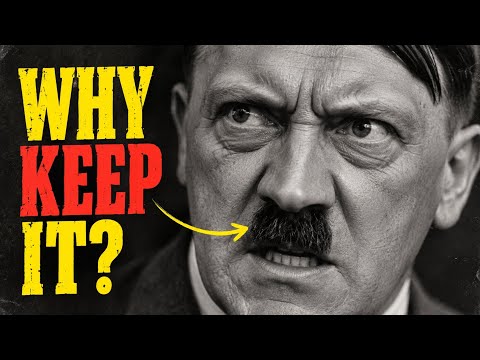
Because this was a man obsessed with his own image. A man who had himself filmed practicing speech gestures so he could study them later. A man who understood, better than any politician of his age, what a face could do on a poster or a cinema screen. And the thing he placed dead center on his face was a style of moustache that, in the world he grew up in, was considered slightly odd, slightly cheap, and in some circles, faintly ridiculous.
There are three main stories about how that moustache came to be. One involves an Irish woman in a cramped Liverpool flat. Another involves a pacifist medic, a cellar under bombardment, and a rubber gas mask. And the third involves a nose. One of these stories is almost certainly invented. Another may be entirely true. And the third might be the truest thing Hitler ever said about himself. To find out which is which, we have to go back to a world where the moustache was not a joke and not a warning. It was an announcement of exactly who you were.
Imagine Europe in the years before 1914. For a grown man of standing, a bare upper lip looked almost boyish. Facial hair meant maturity, authority, seriousness. And no one proved this point more loudly than the German Emperor. Kaiser Wilhelm II wore a moustache that extended sideways and then curled up at the tips, like two daggers held out for inspection. It was maintained by his personal barber, François Haby, who sold moustache products to the public under the smug and glorious name “Es ist erreicht” – “It is achieved.” Men across Germany bought it. Some slept at night with a special cloth strap wrapped around their faces so the shape wouldn’t collapse against the pillow. To that extent, the moustache was taken with the utmost seriousness.
It wasn’t just vanity. In Imperial Germany, the army was the model for what a man should be, and officers set the fashion. A large, disciplined, upward-curled moustache meant you belonged to that order of things. Loyal, military, German. The British went further. Since the 1860s, army regulations required a soldier to shave his chin and lower lip, but not his moustache. Shaving the moustache was, technically, a breach of discipline. So when a new style began to spread in the late nineteenth century – a small, clipped rectangle that stopped at the edges of the nostrils – it was a complete break with everything that had come before.
This style came from the United States, where a growing class of office workers, engineers, and salesmen wanted something neat that required no effort. No wax, no nighttime straps, a few minutes with scissors, and it was done. By the early 1890s, American newspapers were already calling it by the name it still carries, because the resemblance was unmistakable: the toothbrush moustache. In a sense, it was the moustache of the machine age; uniform, efficient, and modern.
When it reached Germany in the early twentieth century, traditionalists were not drawn to it, and they had nicknames to prove it. The most memorable was “Rotzbrams,” which literally meant “snot brake.” To a traditional German, the toothbrush moustache was a clerk’s moustache, a salesman’s moustache, an American moustache. It had no grandeur and no history. It had nothing of the Kaiser’s prestige. Keep that in mind, because it will become important later.
When Hitler finally settled on the toothbrush moustache, he wasn’t reaching for something great or inherited. He was wearing something small, modern, and somewhat vulgar. For a man who spoke endlessly of German tradition, it was a thoroughly untraditional face. So what was on his upper lip before that?
Adolf Hitler was born on April 20, 1889, in Braunau am Inn, on the Austrian border with Bavaria. In his youth, he moved to Vienna determined to become a painter, but the Academy of Fine Arts rejected him twice. By 1910, he was living in a men’s hostel north of the city, painting small views of Vienna landmarks and selling them through intermediaries for pocket money. Photographs of him before the war are very rare. But the most famous images taken of him in his early military years agree on one thing. This young man was not wearing the brush moustache. He wore a full, dark moustache that stretched across his lip and past the corners of his mouth. It wasn’t quite the Kaiser’s pointed style, but it clearly belonged to the old world.
And that brings us to our first suspect. In 1909, Alois Junior, Hitler’s half-brother, was working as a waiter in Dublin when he met a teenage Irish girl named Bridget Dowling at a horse show. He told her family he was a successful hotel owner. He wasn’t. The two eloped to London, married, and eventually settled in a three-room flat at 102 Upper Stanhope Street in Liverpool. Their son, William Patrick, was born there in 1911. In that year’s census, the young family was listed under the name Hitler.
Years later, long after leaving Liverpool and after her marriage collapsed, Bridget wrote a memoir. In it, she made a startling claim. She said that in November 1912, her brother-in-law Adolf arrived unannounced at Lime Street station and stayed with the family for about five months. A sullen, idle young man dodging military service in his own country and absorbed in studying maps. And she insisted that she was the one who told him his moustache was too big and that he should trim the sides. It’s a wonderful story. Young Hitler wandering Merseyside and an Irish woman giving him the look that would haunt the twentieth century.
It almost certainly never happened. Vienna police registration records place Hitler in the men’s hostel during the very months he was said to be in Liverpool. No one ever corroborated the visit. Bridget was writing at a time when anything with the Hitler name might sell. And most historians have long treated the chapter as an invention added to attract publishers. The memoir remained forgotten in the New York Public Library until a researcher found it in the 1970s. It was published only after Bridget herself had died.
Yet the story leaves some strange margins behind. The first is that when Alois Junior abandoned his wife and son in 1914 and returned to Germany, he was said to have intended to go into the razor blade business. Second, the house at Upper Stanhope Street no longer exists. It was destroyed in January 1942 during the last German air raid on Liverpool. Whatever happened or didn’t happen in that flat, German aircraft erased it from the map. As for the child born there, William Patrick, he grew up to serve in the U.S. Navy in the war against his uncle. So suspect number one is ruled out. The toothbrush did not come from Liverpool.
But to reach the real turning point, we have to go to a darker place. In May 1913, Hitler left Vienna for Munich, fleeing service in the Austro-Hungarian army he despised. Fifteen months later, at the outbreak of war, he volunteered for the Bavarian army with something like joy. He was assigned to the 16th Bavarian Reserve Infantry Regiment, known as the List Regiment after its first commander, and spent most of the war as a dispatch runner between regimental headquarters and the nearby battalions at the front. Keep that image in your mind, because the war was about to change what a man could safely wear on his face.
By then, the air itself had become a weapon. On April 22, 1915, near Ypres in Belgium, German forces opened thousands of pressurized cylinders to release a yellow-green cloud of chlorine gas toward the French and colonial trenches opposite. Men choked, tore at their throats, and fled. Within months, both sides were using gas. The first defenses were desperate and improvised. Cloth pads soaked in water or chemicals, pressed to the mouth. Then came proper respirators, with rubberized fabric, glass eyepieces, a filter box, and straps to pull the mask tight against the skin. That last detail is everything. A gas mask’s efficiency depends entirely on its seal. Any gap between the mask’s edge and the face, however small, was an open door to poison.
Now imagine what a large moustache does to that seal. Coarse, thick hair sticking out toward the corners of the mouth, exactly where the mask’s edge must sit flat. The British army found itself in an absurd position. Rules requiring men to grow their facial hair in a war where too much hair could cost you your life. The rule was widely ignored in the trenches, and in October 1916, it was abolished. The order was signed by General Sir Nevil Macready, a man who had always hated his own moustache, and who was said to have gone straight to the barber that evening to get rid of it.
On the German side of the lines, in Hitler’s own regiment, there was someone paying attention. His name was Alexander Moritz Frey. He was a writer of satirical literature and strange fiction, a pacifist working as a medic, and he could not stand Adolf Hitler at all. Frey first met him in 1915. He later described an evening when shells began falling, and a pale, thin soldier came rushing into a cellar for cover, looking frightened and furious at the same time, before unleashing a stream of curses against the English. Then Frey added a small detail about that young man’s face. Frey wrote that he had a full moustache, which he later had to trim because of the new gas masks. In Frey’s account, it was not a choice at all. Hitler was ordered to cut his moustache so the mask would fit his face. The toothbrush moustache was not invented in a barber’s shop. It was born from a military order.
Frey’s article about Hitler was not published during his lifetime. It remained unnoticed for half a century until a German journalist named Stefan Ernsting began digging into the life of this nearly forgotten writer and found it. The article finally appeared in 2007 in Ernsting’s biography of Frey, and newspapers around the world picked up the gas mask story. So is it true? Honestly, we can’t be sure. Frey is a single witness writing years after the event. Surviving photographs cannot pinpoint the exact moment the change occurred because of what he became later. For almost everyone in those cellars, the record is just a line in a ledger, a name on a memorial, or nothing at all. And the war he started 21 years later took that silence and doubled it. Every concentration camp, every beach, every river crossing, every catastrophic night in a small town. The same kind of stories repeat in places where no one was filming. Eleven such stories have been told here on this channel, complete accounts from World War II that no newsreel ever covered. I’ve deleted those videos myself, so you can’t watch them anywhere now. The only place those eleven stories still exist is in an audio collection called “Behind the Wire.” Nearly 6 hours of narration with an accompanying booklet. If you’d like to listen, you’ll find it in the description.
Meanwhile, Hitler was taken north to a military hospital in Pasewalk, Pomerania. He slowly regained his sight. Then in November came the news that Germany had lost the war, that there was revolution in the streets, and that the Kaiser had abdicated. According to his own account, the world went dark in his eyes a second time. And here is something often overlooked. The Kaiser didn’t just lose his throne. He fled into exile in Holland, and somehow, he took his moustache with him. Those thick, upward-twisted moustaches belonged to an empire that had just collapsed in defeat. In Germany in the early twenties, hungry, chaotic, and humiliated, that look suddenly became a leftover from yesterday. The small, neat, practical moustache, the moustache of the office and the factory, and perhaps the trench, was better suited to the new world. For a few years, this moustache was genuinely fashionable. Ordinary German men grew it without a second thought.
Hitler himself remained in military uniform. In 1919, the army sent him to monitor small political groups springing up in Munich. One was a tiny organization called the German Workers’ Party. He attended a meeting, got into an argument, and was invited to join. Within two years, he was running it. As images of Hitler the politician appeared, the toothbrush moustache was there, and it never left him after that. And he wasn’t the only rising star adopting it. In 1914, a young English comedian working in California assembled a costume from odd pieces. Baggy trousers, a tight jacket, a bowler hat, a cane, oversized shoes, and to complete the look, a small pasted-on moustache. Charlie Chaplin later explained that he added it to look older without hiding his facial expressions. The “Little Tramp” became one of the most famous characters on earth. And that little square of hair became a comic trademark. Oliver Hardy wore his own version too, which is part of why the style was seen in the English-speaking world as cute, silly, and harmless.
And here’s the detail that sounds like fiction. Charlie Chaplin was born on April 16, 1889. Adolf Hitler was born on the 20th. Just four days apart. Two men of exactly the same generation wearing remarkably similar moustaches. One would use his to make the whole world laugh. It’s often said that Hitler copied Chaplin. There’s no real evidence for that. Both men were drawing on the same fashion of the time. And if Frey is right, Hitler’s version came from a military order, not a cinema seat. But that resemblance would come back to haunt him.
Before we get to that, here’s what makes this moustache so revealing. Whatever its origin, whether fashion or regiment or a mix of both, there came a moment when Hitler could have changed it, and people advised him to. Enter Ernst Hanfstaengl, known to everyone as “Putzi.” He was a tall Bavarian who played the piano, half-American by birth, a Harvard graduate who had spent years running his family’s art publishing firm in New York. In 1922, as a favor to an American military attaché, he went to a beer hall in Munich to hear an unknown speaker, and came out dazzled. He became one of Hitler’s closest companions in the early years, lending him money, introducing him to high society, and calming his nerves with Wagner on the piano. Putzi had refined tastes and was never shy about sharing his opinion. He told Hitler to his face that his moustache was ugly and that he should let it grow wider.
Hitler’s reply, as Hanfstaengl remembered it, tells you almost everything about the man. He didn’t defend his moustache as beautiful. He didn’t say it was comfortable or practical or a memory from the trenches. He said that if it wasn’t fashionable now, it would be later, because he wore it. Think about how much arrogance is in that. The moustache doesn’t follow fashion. Fashion follows the moustache. For the record, Putzi later lost favor, fled Germany in 1937, and spent part of World War II advising the Americans about his old friend. But in the early twenties, the advice about that moustache was ignored. And it turned out Hitler’s instinct was craftier than his friend’s taste. Because Hitler understood something about the coming age of media that many of his rivals did not. In his early years in Munich, he was known for being wary of cameras, which only increased curiosity about him. Then he attached himself to a single trusted photographer, Heinrich Hoffmann, who shot him relentlessly over the next two decades and controlled which images the public saw. Every angle, every pose, every expression was managed. And in that world of posters, cheap newspapers, flickering newsreels, and rally slogans seen from 200 meters away, the moustache was a gift. It’s a face you can draw with a few strokes. A side part across the forehead and a dark square under the nose. That’s it. A child could draw it. A cartoonist could draw it. A propagandist could paint it on a wall and everyone who walked past would know exactly who owned that face. In modern terms, it functioned as a brand. And like any good brand, it never changed. His titles changed, his uniforms changed, the borders of Europe changed. For over 20 years, the moustache stayed exactly the same.
There is another explanation. One that came from Hitler himself. Christa Schroeder, one of his personal secretaries from 1933 until the final weeks of the war, wrote in her memoirs that his nose was large and somewhat pointed, and that he was aware of it. According to Schroeder, Hitler told her the moustache was there to soften the look of his nose. She added, frankly perhaps easier after his death, that in her opinion he should have grown a beard to hide his mouth as well. So now we have an arrogant man hiding a nose he didn’t like behind a moustache the army may have forced on him, who then refused to change it because he expected the world to follow him. All of these things could be true at the same time.
But the story of that moustache doesn’t end there, because the very thing that made it a powerful symbol also made it a target. A face that simple is a face anyone can mock. All you need is a finger or a pocket comb held under your nose and a stiff-armed salute, and everyone in the room knows exactly who you’re imitating. By the late thirties, this little pantomime was being performed in bars, schoolyards, and vaudeville theaters across the democratic world. Inside Germany, the same joke could cost you dearly. Under a 1934 law against so-called malicious attacks on the state and the party, Germans were prosecuted for repeating jokes about the regime and its leaders. The moustache that made Londoners roar with laughter was, in Munich or Hamburg, something you mocked only in whispers and only among those you trusted.
Hollywood, at first, was nervous about upsetting Germany. But in January 1940, the Three Stooges released a short film called “You Nazty Spy!”, with Moe Howard as a blustering dictator sporting a toothbrush moustache. In October of that year came the bigger work, Charlie Chaplin’s “The Great Dictator,” in which he played Adenoid Hynkel, ruler of Tomainia, a swaggering, screaming tyrant who dances a dream ballet with an inflatable globe. It was the collision that pushed a makeup artist to predict the Führer’s disguises and send the results to Allied leaders so they could hunt him down. It’s a great story. It’s also, as far as anyone knows, not quite what happened. The images were published in the New York Times in 1944, alongside an article by German journalist Victor Schiff, who invited readers to imagine the dictator stripped of his moustache and famous forelock. With dyed hair, perhaps wearing a bowler hat, Eddie Senz provided those looks. The Office of Strategic Services, the wartime predecessor of the CIA, regularly collected photographs of prominent figures, often from commercial sources, and someone there clipped the article and saved it in the archive. The intelligence community, and the legend took off from there.
But the most revealing part of the real story is one note from Senz himself. According to him, the hardest feature to disguise was not the moustache at all. It was the eyes. The moustache, as everyone realized, could disappear in a minute with a razor blade. And that is exactly what worried people. The most recognizable thing about the most dangerous man alive was also the easiest thing in the world to get rid of.
In the end, of course, Hitler never tried to shave his moustache to escape Berlin. On April 30, 1945, with Soviet troops fighting their way through the streets above his bunker, he shot himself. The moustache that had stared from countless walls and posters went with him, and on that same day, about 500 kilometers to the south, one of the strangest photographs of the entire war was being taken. In Munich, the American photographer Lee Miller, a former Vogue model turned war correspondent, had made her way into Hitler’s private apartment at Prinzregentenplatz with her colleague David Scherman of Life magazine. She had just come from the newly liberated Dachau camp, where she had photographed things that would stay with her for the rest of her life. And in Hitler’s bathroom, she stepped into his bathtub, and Scherman took the picture. Her dirty military boots rest on his white bath mat, still caked with Dachau mud. And propped on the edge of the tub is a framed photograph of the man himself, with his side-parted hair and stern gaze. That little dark square under the nose, watching an American woman wash the camp off her skin. Neither of them knew yet that he was dead.
In the days that followed, American and French forces reached Berchtesgaden, where RAF bombers had already destroyed Hitler’s mountain retreat. And within a little over a week, the war in Europe was over. Across Germany, Allied soldiers entered the homes and offices of the Nazi leadership and came out carrying souvenirs. Silverware engraved with Hitler’s initials, books from his shelves, flags, daggers, weapons. Let’s put the pieces together. The style itself came from America. A neat, modern, low-maintenance look that crossed the Atlantic and offended traditionalists. Bridget Dowling’s story of his stay in Liverpool is almost certainly invented. The most credible account of the moment he first trimmed it comes from Alexander Moritz Frey, a young soldier ordered to trim his moustache to fit a gas mask in a war he would end up being gassed in anyway. The reason he gave in secret to his secretary was the most ordinary of all. He didn’t like his nose.
But none of this fully explains the moustache we remember. Many men were ordered to trim their facial hair in that war. Many men disliked the shape of their noses. What made Hitler’s moustache different was that he refused to give it up. His friend told him it was ugly, and he kept it. The world mocked it, and he kept it. He realized that in an age of posters, newsreels, and mass rallies, a face that never changes becomes a flag. And a flag is something people follow. So the honest answer is this. We can’t be entirely sure why he first cut it, but we know exactly why he kept it. Think of those images in the New York Times. If you remove the moustache, Hitler looks like anyone else. That was always the point. He was just a man. A failed art student. A lodger in a men’s hostel. A corporal ordered to trim his lip. The moustache was the thing that turned a nobody into a symbol, and he kept it for a quarter of a century because he knew it. But a symbol ends up meaning whatever its owner does. In the end, the face he built to be known by became the face the whole world knew for the worst reasons imaginable. A style that was once American, modern, and slightly edgy now carries forever the weight of a world war, the camps, and millions of dead. He once told Putzi Hanfstaengl that it would become fashionable because he wore it. It was the other way around. Because he wore it, it became the one moustache almost no one dares to wear.
That is the strange afterlife of a small square of hair. A fashion from America, a soldier’s trim, a tyrant’s brand. And now, a warning. The moustache that once meant modernity became the most recognizable symbol of evil. No one dares to wear it today.
Eddie Senz’s disguises remind us how easily a face can vanish. But the moustache could not vanish from memory. It became a permanent scar on the human story.
So ask yourself: if a single moustache can carry so much history, what else are we wearing without knowing it?
Report this article
Select a reason for reporting:






