January 1966, the Iron Triangle, Vietnam. The world’s greatest superpower had spent a year pouring millions of dollars and thousands of tons of explosives into these jungles, trying to silence the ghosts attacking from beneath the earth. Yet, after a year of scorched earth and chemical warfare, the American giant was still punching shadows. The tunnels remained an impenetrable mystery.
But then the Australians arrived. In just 24 hours, a group of mud-caked diggers did what an entire armored division couldn’t achieve in a year. They didn’t use B-52s, and they didn’t use gas. They used something far more terrifying: patience and a 9-mm pistol. While the Americans were trying to blow up the labyrinth, the Australians were learning how to inhabit it.
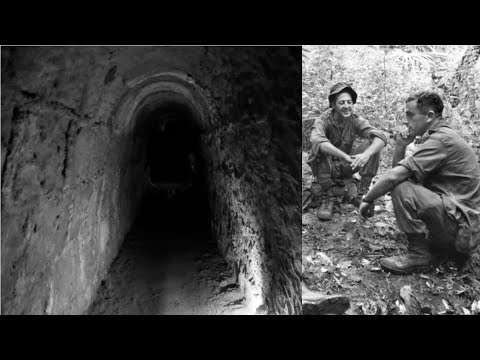
In the mid-1960s, the dense jungles of the Cu Chi and Long Khanh districts in South Vietnam became a frustrating graveyard for conventional military logic. The United States military, equipped with the most advanced technology and overwhelming firepower the world had ever seen, found itself shadowboxing with an invisible enemy. To the American high command, the solution was simple: if the enemy is hiding in the brush, remove the brush. If the enemy is in the earth, shatter the earth.
This led to the deployment of million-dollar firepower. B-52 Stratofortresses rained thousands of tons of high explosives, turning the lush canopy into a moonscape of craters. On the ground, M48 Patton tanks crushed everything in their path, while soldiers armed with flamethrowers incinerated every bush and thicket. The landscape was scorched, flattened, and chemically defoliated. Yet, as soon as the smoke cleared and the American patrols moved in, they were met by the same lethal ghosts. Snipers would fire from the middle of a cleared field, and entire squads would vanish before the Americans could even return fire.
The technical attempts to solve the tunnel problem were equally sophisticated and equally unsuccessful. The US military deployed sensitive seismic sensors designed to detect the subtle vibrations of human movement deep underground. However, the cacophony of constant artillery barrages and the rumbling of armored columns rendered these high-tech ears virtually deaf. When a tunnel entrance was actually discovered, the standard operating procedure was search and destroy—but mostly destroy. Americans would pump colored smoke or riot control gas, CS gas, into the holes, hoping to flush the defenders out or suffocate them.
To their bewilderment, the smoke would often vanish without a trace or, worse, pop up hundreds of meters away in a completely different sector. They didn’t know that the defenders had engineered a brilliant system of internal airtight trapdoors and water-filled U-bend pipes that acted as natural airlocks. These smart air pockets neutralized the gas, leaving the occupants safe and laughing in the dark. The American approach was one of destruction through technology, an attempt to use brute force to solve a problem that required a surgeon’s scalpel. They were trying to blow up a labyrinth they didn’t understand, using tools that were too loud, too heavy, and too clumsy for the world beneath the roots. It was a stalemate of the highest order. The most powerful army on earth was being humbled by a subterranean world they couldn’t see, couldn’t hear, and certainly couldn’t conquer.
It would take a different kind of soldier with a different kind of philosophy to finally go down into that darkness.
In January 1966, the strategic stalemate in the Iron Triangle reached a breaking point, leading to the launch of Operation Crimp. This massive search and destroy mission aimed to uncover the suspected Viet Cong headquarters hidden beneath the Cu Chi district. As American armored divisions rolled in with their characteristic roar, the First Battalion, Royal Australian Regiment, 1 RAR, was assigned to a sector that had previously been written off as impossible to pacify. It was here that a fundamental clash of military philosophies occurred. While the American strategy focused on search and destroy, the Australians introduced a more patient, lethal alternative: search and occupy.
The contrast was immediate and striking. The American units arrived as a mechanical storm, preceded by thunderous artillery and moving in loud, clanking columns of M113 armored personnel carriers. To the defenders underground, this was a clear signal to hide, wait, and prepare ambushes. In stark contrast, the Australians moved like ghosts. They abandoned the noisy machinery, opting instead to move on foot, gliding through the undergrowth with a silence that earned them the nickname the cats of the jungle. They didn’t want to announce their presence. They wanted to blend into the environment until the jungle itself seemed to belong to them.
This wasn’t just about stealth; it was about an entirely different level of environmental literacy. Australian soldiers were trained to read the rainforest like a book. While an American patrol might walk past a cluster of disturbed leaves, an Australian scout would stop dead. They looked for the unnatural: a snapped twig that didn’t follow the wind’s direction, a patch of discolored dirt that suggested recent digging, or an unusual pattern in a colony of ants. They understood that the defenders needed to breathe, and therefore every tunnel system had a lung. The Australians began to identify tiny, well-hidden ventilation holes, some disguised as termite mounds, others hidden inside hollowed-out tree stumps. By observing the subtle rise of heat haze or the faint smell of cooking fire at dawn, they could map the living pulse of the ground beneath them.
When they found a potential entrance, they didn’t immediately call in an airstrike or toss a grenade. Instead, they marked the spot and waited. During Operation Crimp, the Australians proved that the only way to beat a subterranean enemy was to stop trying to destroy the earth from above and start learning how to inhabit it. They realized that the tunnels were not just holes, but a sophisticated nervous system. If you blew up the entrance, the system would simply grow a new one. But if you could penetrate the system, you could strike at the brain. This realization by 1 RAR shocked the American observers, who watched in disbelief as the Australians systematically uncovered the entrances to what would turn out to be one of the most complex military structures in history. The Australians weren’t just fighting a war—they were solving a puzzle, and for the first time, the shadows had nowhere left to run.
To the Australian tunnel rats, the greatest threat in the subterranean world was not just the darkness or the booby traps—it was the human nose. Under the earth, where the air is stagnant and every draft carries a message, smell is a lethal indicator. The defenders had spent their lives in these tunnels. They knew the scent of the damp earth, the lingering smoke of cooking fires, and the smell of their own people. A single whiff of something foreign was enough to trigger a lethal ambush or the detonation of a gallery.
Recognizing this, the Australians developed a ritual of sensory reconnaissance that was as extreme as it was effective. Twenty-four hours before a team was slated to descend into a tunnel system, their preparation began with a radical process of biological concealment. The first thing to go was the scent of the Western world. The soldiers were forbidden from using scented soaps, deodorants, or shaving creams. To the sensitive noses of the defenders below, the smell of Old Spice or floral soap was as loud as a gunshot.
But the Australians went even deeper, realizing that what they put into their bodies was just as important as what they put on their skin. For the final day of preparation, these soldiers stopped eating American C-rations. They understood that the high-protein preserved meats and heavy seasonings of Western rations altered a man’s body odor and his breath. If a soldier had spent the last day eating canned ham and processed cheese, his very sweat would betray his presence the moment he entered a narrow tunnel. Instead, the Australians would often eat as the locals did—simple, bland food—or fast entirely to neutralize their metabolic scent.
Smoking was strictly prohibited. The smell of tobacco clings to hair, skin, and clothing for hours, and in the recycled air of a tunnel, a single stale puff of cigarette smoke could travel dozens of meters, alerting a sentry long before the Australian could see him. This was not just about discipline; it was about transforming oneself into a scentless predator. By the time they reached the tunnel entrance, the Australians were stripped of the aroma of the foreigner. They smelled only of the jungle’s humidity and the local soil.
This sensory preparation extended to their silence and their focus. They entered a state of heightened awareness, where every sense was tuned to the environment. They didn’t just walk to the tunnel—they observed the air currents, noted the direction of the wind, and listened for the subtle changes in the forest’s acoustic profile. By shedding the sensory noise of the modern world, the Australians achieved a form of biological camouflage. They were no longer invaders from across the sea; they were invisible entities, blending into the darkness by becoming part of the atmosphere itself. This 24-hour ritual ensured that when they finally slipped into the narrow, dark holes, they didn’t just bring their weapons—they brought the silence of the grave.
Long before the United States military formally established specialized units to handle subterranean warfare, the men of the 1st Battalion, Royal Australian Regiment, had already earned the title of the original tunnel rats. During Operation Crimp in 1966, while others viewed the discovery of a tunnel as a cue for demolition, the Australians viewed it as an invitation. However, entering these black holes required a total rejection of standard military equipment. The Australians realized that high-tech gear was a liability in the claustrophobic, booby-trapped tunnels of Cu Chi. To survive, they embraced a minimalist toolkit that favored reliability and sensory awareness over sheer firepower.
The first rule of the Australian tunnel rats was the abandonment of the standard M-16 rifle. While the M-16 was a revolutionary weapon on the surface, it was a death trap underground. In the narrow, echoing confines of a tunnel, the ear-splitting report of a 5.56 mm round would instantly shatter the eardrums of the shooter and his comrades, leaving them disoriented and vulnerable. Furthermore, the thick clouds of cordite smoke produced by a rifle would have nowhere to dissipate in the stagnant air, causing the soldiers to choke and lose visibility within seconds.
Instead, the Australians reached for the Browning Hi-Power 9 mm pistol or the classic .45 caliber handgun. These weapons provided enough stopping power to neutralize a threat at point-blank range while remaining compact enough to maneuver in a space no wider than a man’s shoulders. The second essential tool was the flashlight—but not in the way one might expect. A standard military flashlight was often modified or replaced with a simple, rugged torch. Crucially, both the pistol and the flashlight were tethered to the soldiers’ wrists with paracord. This was a lesson learned through bitter experience. In the pitch-black silence, a sudden jump scare or an explosion could cause a man to instinctively drop his equipment. Without light or a weapon, a soldier in a tunnel was as good as dead. The tether ensured that even if a rat was startled or wounded, his life-saving tools remained within reach.
Beyond the weapon and the light, the toolkit was remarkably primitive. A simple bayonet or a sharpened screwdriver was often used to prod the earth for hidden wires or pressure plates. They carried a compass to maintain a sense of direction in the disorienting labyrinth and a piece of chalk to mark walls, preventing them from walking in circles. Every item was chosen for its silence. There were no rattling canteens, no clinking buckles, and no heavy helmets. This minimalist approach was a masterclass in adaptation. By stripping away the clunky, noisy technology of the 1960s, the Australians gained something far more valuable: a direct connection to their environment. They relied on their skin to feel drafts, their ears to catch the scrape of a sandal, and their intuition to sense a trap. These original tunnel rats proved that in the most extreme combat environments, the most effective technology is a sharp mind, a steady hand, and the courage to face the unknown with nothing but a pistol and a prayer.
Entering a tunnel was a psychological transition. The moment an Australian slipped below the surface, the sun-drenched jungle vanished, replaced by a humid silence so absolute it felt physical. There was no front line—only the immediate three feet ahead and the crushing weight of the earth above. The first man to make a sound was usually the first to die.
They moved by tactical intermittent lighting: a split-second flash to burn the tunnel’s geometry into memory, then total darkness. Hands became eyes, sweeping ahead for the spiderweb touch of a tripwire or the slight give of a trapdoor. A single fifty-meter stretch could take an entire afternoon to clear.
Then came the breakthrough. Following unusually well-built galleries deeper into the earth, the rats emerged into cavernous chambers—the Viet Cong’s regional command. Walls were covered in charts, wires ran along the ceiling, desks groaned with documents. They had found the brain of the insurgency.
Where an American sweep might have cleared the room with grenades, the Australians moved with surgical precision, subduing officers in silence. They hauled out thousands of pages—including a list of covert agents embedded in the South Vietnamese government that the Americans had hunted for years.
At dawn, mud-caked diggers emerged from the red earth, their uniforms shredded, their arms full of treasure. American generals watched in stunned silence. One officer remarked that while the US had been trying to kill the anthill, the Australians had simply walked inside and taken the queen.
They didn’t wait for medals. They cleaned their pistols, washed the mud away, and prepared for the next mission. The lesson endured: technology is a tool, never a substitute for the human spirit. The shadows were once the enemy’s sanctuary—until a few patient men proved that even the deepest darkness can be conquered.
So tell us—could modern soldiers, raised on drones and thermal optics, ever match that kind of primitive, nerve-shredding patience? Share your thoughts below.
Report this article
Select a reason for reporting:






