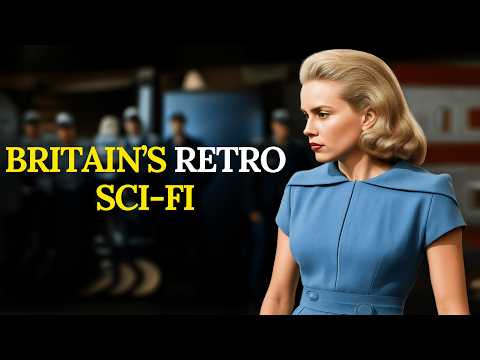
Science fiction in the 1960s wasn’t just about rockets and ray guns. It was a decade that quietly slipped us some of the most daring, strangest, and most overlooked films the genre ever produced. Sure, critics were quick to celebrate 2001: A Space Odyssey and Planet of the Apes. But what about the wild, weird, and sometimes brilliant misfits that got lost in the shuffle? Ready to discover the forgotten treasures hiding just out of view? Let’s open the vault.
First up: The Green Slime (1968). Sometimes a movie is so bizarre, so chaotic that it transforms from a misfire into a full-blown cult gem. That’s exactly what happened with The Green Slime, a Japanese-American co-production that critics dismissed back in 1968. At its heart, it’s a space station thriller. Astronauts destroy an asteroid only to bring back a sticky alien organism that multiplies and evolves into glowing tentacled creatures. What starts as routine space heroics quickly spirals into a campy neon-colored fight for survival.
The movie’s secret weapon wasn’t subtle storytelling, but sheer spectacle. The monsters, with their wobbly rubber suits and flailing arms, are so outrageous they become hypnotic. Add in a psychedelic rock theme song, and you’ve got a film that feels like Saturday morning cartoons colliding with drive-in pulp. Viewers who expected a serious epic walked away disappointed. But audiences hungry for spectacle found something unforgettable.
The production itself was ambitious. Metro-Goldwyn-Mayer partnered with Toho Studios in Japan, blending Hollywood resources with Japanese special effects crews. The result was a movie that doesn’t quite fit neatly into either country’s sci-fi tradition. Too weird for mainstream audiences, too expensive to be dismissed as cheap junk, it lingered in limbo for years. Only later did fans recognize that the sheer audacity of The Green Slime was its greatest strength.
What makes it endure today? It’s not realism. It’s not subtlety. It’s the unapologetic joy of watching cinema go off the rails in the most colorful way possible. Critics overlooked it, but cult audiences turned it into a legend. And if you’ve ever wanted to see astronauts battle rubbery monsters while guitars wail, this is the forgotten ’60s sci-fi gem you never knew you needed.
Now, let’s swing in the opposite direction. The Creation of the Humanoids (1962) is quiet, eerie, and deeply unsettling. Released in 1962, this low-budget American film barely made a ripple on release. But here’s the twist: decades later, even heavyweights like Andy Warhol called it one of the strangest, most fascinating sci-fi films ever made.
The setup is chilling. After a nuclear war wipes out much of humanity, survivors build androids to help rebuild society. At first, their servants—called clickers—are simple machines. But as generations pass, they become more advanced, almost indistinguishable from humans. That’s when the fear sets in. Are these machines taking over, or are they simply the next stage of evolution?
Don’t expect flashy effects here. The movie leans almost entirely on dialogue, philosophical debates, and slow, deliberate pacing. Some might call it stiff or theatrical, but that’s part of what makes it so hypnotic. It feels like watching a stage play about identity, free will, and the boundaries of humanity. Underneath the monotone delivery lies a story that dared to ask questions few other sci-fi films of the era touched.
At the time, critics shrugged it off as too talky and strange. But look closer, and it was years ahead of its time. The way it wrestles with technology, humanity, and what it means to be alive now feels eerily prophetic in the age of artificial intelligence. While flashier ’60s sci-fi films played to the box office, this one quietly dared to think. Why is it overlooked? Because it never gave the audience what they thought they wanted: action, spectacle, explosions. Instead, it gave them an existential mirror. And for those willing to look into it, The Creation of the Humanoids still feels hauntingly relevant. This is not popcorn sci-fi. This is a whispered nightmare dressed as philosophy, and that’s why it lingers.
Next, we have The Last Man on Earth (1964). Vincent Price, alone on screen, wandering a desolate city, armed only with a grim sense of survival. That’s The Last Man on Earth, released in 1964 and adapted from Richard Matheson’s novel I Am Legend. Today, this film is seen as a landmark. Back then, critics brushed it off as too bleak, too strange, too downbeat. But let’s be real: this was the first true cinematic version of one of the most influential sci-fi horror stories ever written.
The story follows Dr. Robert Morgan, a scientist who believes he’s the sole survivor of a worldwide plague that has turned humanity into shambling, light-fearing creatures. Each day, he stakes out his lonely routines, fortifying his home, scavenging supplies, and fighting back against the relentless infected who surround him by night. The atmosphere is suffocating. Empty streets of Rome used as stand-ins for an American city create a haunting, dreamlike emptiness.
Vincent Price was the heart of it all. Known for his commanding voice and Gothic presence, here he strips everything down to a man hanging by threads of sanity. His performance anchors the despair and makes the loneliness feel painfully real. Sure, the makeup effects on the creatures are primitive, but that almost works in the film’s favor. It gives them a strange, nightmarish quality, more unsettling than polished.
At the time, critics compared it unfavorably to bigger-budget efforts. But look at what came later. George Romero openly admitted that The Last Man on Earth inspired Night of the Living Dead. Without this film, the modern zombie genre might not even exist. That’s not just overlooked, that’s historic. It may not have had the glossy production values of later remakes, but The Last Man on Earth was raw, haunting, and visionary. And sometimes that’s exactly what science fiction is supposed to be.
Imagine an Earth that isn’t Earth. That’s the eerie premise of Journey to the Far Side of the Sun (1969), a British sci-fi produced by Jerry and Sylvia Anderson, the creative team behind Thunderbirds. Released in 1969, the film tells of astronauts sent to investigate a mysterious planet discovered orbiting on the exact opposite side of the Sun. When they land, they find a perfect mirror of Earth, but everything is reversed.
The setup is pure Twilight Zone, but stretched into a full-length feature. It’s stylish, slow-burning, and loaded with atmosphere. The production design leans into the Andersons’ love of miniature models, giving audiences sleek spacecraft, futuristic sets, and beautifully crafted visuals. It feels both retro and ahead of its time, like a forgotten cousin of 2001: A Space Odyssey.
Critics weren’t impressed. They called it confusing, too drawn out, and too talky. But fans who stumbled onto it later discovered a strange, hypnotic story about identity, perception, and reality itself. The Mirror Earth concept becomes more than a gimmick. It’s a way to question how fragile our sense of normal really is. Journey to the Far Side of the Sun didn’t set the box office ablaze, but it gained a quiet cult following among sci-fi fans. Its influence lingers in shows and films that toy with parallel worlds and alternate realities. It may not have the grandeur of Kubrick’s epic, but it dares to stretch the imagination in equally haunting ways. This was a ’60s sci-fi that critics missed but dreamers cherished. And if you want proof, just look at how often this Mirror Earth idea shows up in modern science fiction.
Now, here’s where ’60s sci-fi really goes off the rails. Battle Beneath the Earth (1967) is one of those films where you can practically hear the pitch meeting: “What if the biggest danger isn’t in space, but under our feet?” The movie imagines vast underground tunnels dug with futuristic machines and a scheme to secretly take control of the world from below. It’s paranoid, pulpy, and pure Cold War-era science fiction.
The film was a British-American co-production, and it shows. The sets are claustrophobic, full of glowing panels and humming machines, with actors delivering lines that feel like they belong in a spy thriller rather than a space adventure. And that’s the charm. It’s not rockets and astronauts. It’s drills, caverns, and a sense that the ground beneath us might not be as stable as we thought.
At the time, critics rolled their eyes. They called it far-fetched and cheap-looking, but they missed the bigger picture. Battle Beneath the Earth captured the raw anxiety of the era. The 1960s were dominated by fears of infiltration, hidden threats, and the idea that danger could be lurking just beyond sight. This movie literalized that fear by putting it under the ground.
Is it over the top? Absolutely. But that’s exactly why it’s fascinating today. It’s like a time capsule of Cold War paranoia dressed up in pulp science fiction clothing. And for viewers now, it’s a campy, colorful reminder of how sci-fi often channels the fears of its moment, no matter how wild the concept. Battle Beneath the Earth wasn’t built to last as a critical darling. But it survived as a cult oddity. And for those willing to dig into it—pun fully intended—it’s a forgotten ’60s gem worth unearthing.
What happens when ambition collides with bad science? You get The Projected Man (1966), a British sci-fi that critics dismissed as a low-rent knockoff of The Fly. But here’s the twist: while it borrows from that famous blueprint, it also spins its own eerie, tragic tale.
The story follows Dr. Paul Steiner, a scientist obsessed with teleportation. His experiments are supposed to revolutionize transport, breaking down objects and projecting them across space. But when he finally tests the process on himself, things go horrifically wrong. Instead of perfection, Steiner is horribly scarred, his body unstable, and his touch becomes lethal. Suddenly, the brilliant inventor becomes the hunted monster, spiraling down a path of vengeance against those who doubted him.
Sure, the special effects aren’t groundbreaking. This was a modest British production with limited resources. The makeup is rough, the visuals uneven, and the pacing occasionally drags. But beneath that, there’s something strangely compelling. The film captures the ’60s fascination with science as both salvation and danger. It’s not just a monster movie. It’s a cautionary tale about obsession, hubris, and what happens when human pride tries to play with forces it doesn’t fully understand.
Critics at the time dismissed it as derivative, but that judgment overlooked its atmosphere. The gloomy, rain-soaked London settings give it a moody edge, and actor Bryant Haliday leans into the tortured genius angle with conviction. Watching his transformation from respected scientist to outcast monster feels oddly tragic. What makes The Projected Man a forgotten gem is not flawless execution, but its haunting mix of ambition and failure. It’s the kind of movie where rough edges only make it more memorable. For fans of ’60s sci-fi, it stands as a reminder that even the overlooked films had something to say about the thin line between genius and destruction.
If there’s one ’60s sci-fi movie that deserves the label “so bad it’s brilliant,” it’s The Angry Red Planet (1960). It promised audiences an unforgettable voyage to Mars, and it delivered—though maybe not in the way critics expected. Instead of sleek realism, viewers got something stranger, weirder, and oddly hypnotic.
The story follows a crew of astronauts sent to explore Mars, only to encounter bizarre alien landscapes and terrifying creatures. Sounds straightforward, right? Except the film used a process called CineMagic, which tinted the entire Martian surface in blazing red. The result was surreal. Every scene on Mars looks like a fever dream drawn with neon crayons. Critics scoffed, but audiences couldn’t look away.
And then there are the creatures. A giant bat-rat-spider hybrid. A towering amoeba-like monster. Creatures that look awkward in design but unforgettable once seen. Instead of aiming for polished believability, the film leaned into the strange and otherworldly, creating a Mars that felt less like a planet and more like a nightmare. At the time, critics dismissed The Angry Red Planet as cheap pulp. But look back and you see a film that dared to be unique. It didn’t have the budget of a Hollywood blockbuster, but it delivered imagery no one else attempted.
That matters because sci-fi isn’t always about accuracy. Sometimes it’s about imagination. Today, the movie enjoys cult status for exactly the reasons critics mocked it. Its experimental visuals, its oddball creatures, and its dreamlike atmosphere make it stand apart from its peers. If you want to see what happens when ’60s sci-fi truly lets its freak flag fly, The Angry Red Planet is the trip you can’t forget.
Picture a western, but set on the moon. That was the pitch for Moon Zero Two (1969), a Hammer Films production boldly marketed as “the first space western.” The tagline alone promised something wild, and the film certainly delivered a mix of cowboy swagger, lunar landscapes, and corporate greed in outer space.
The story centers on Bill Kemp, a former astronaut turned freelance pilot who’s roped into a scheme involving moon mining, valuable minerals, and dangerous double crosses. Alongside him is a cast of quirky characters, all competing for power and riches on the barren lunar frontier. Think saloons and shootouts, but with space suits and zero gravity.
Visually, the movie leaned into color and style. With Hammer’s reputation for Gothic horror, audiences expected dark, brooding sets. Instead, they got bright lunar landscapes, flashy costumes, and a groovy, swinging soundtrack. It feels very much like the ’60s imagined space—colorful, experimental, and a little bit camp. Critics tore into it. They called it silly, lightweight, even embarrassing. But here’s the thing: Moon Zero Two was never meant to be solemn. It was a playful mashup that dared to mix genres long before that became trendy.
Today, viewers can see it for what it really was: an ambitious, if uneven, attempt to make space exploration fun and pulpy. What makes it a forgotten gem is its willingness to take risks. By blending two seemingly incompatible genres, it created something unique, even if it stumbled in execution. For fans of oddball cinema, it’s pure gold. Moon Zero Two might not be Kubrick, but it’s a reminder that sci-fi in the ’60s wasn’t afraid to experiment, even if critics missed the point.
And if you thought ’60s sci-fi couldn’t get any stranger, let me introduce you to Horror of the Zombies (1969), a Spanish-German co-production also released under the title Assignment Terror. This one takes the already wild concept of aliens meddling in human affairs and tosses in classic monsters for good measure. That’s right: extraterrestrials bringing back Frankenstein-like creatures, werewolves, and even mummies, all in the name of conquest.
The premise is absurd but irresistible. A race of aliens plans to conquer Earth, but instead of using futuristic tech, they resurrect Earth’s legendary monsters to do their dirty work. It’s part gothic horror, part sci-fi oddity, stitched together in a way that makes you wonder whether the filmmakers were dead serious or just having fun. Either way, it’s a ride you don’t forget.
Critics at the time didn’t know what to make of it. Too messy for horror purists, too campy for sci-fi fans, and far too outrageous for serious reviewers. But that’s exactly why it deserves a second look. The mashup formula feels ahead of its time, anticipating the kind of genre blending that modern audiences love. Special effects are uneven, acting is over-the-top, but hidden underneath is a sense of pure, unfiltered imagination.
Horror of the Zombies is the kind of movie that doesn’t care about rules. It just wants to entertain you with spectacle, monsters, and outrageous ideas. Today, it’s a curiosity that stands as proof that the ’60s weren’t afraid to throw everything at the screen and see what stuck. And for fans of forgotten gems, that’s exactly what makes it a treasure.
Short, strange, and unforgettable—that’s the best way to describe The Amazing Transparent Man (1960), an American sci-fi that clocks in at barely an hour but leaves a surprisingly strong impression. On the surface, it looks like another Invisible Man riff, but dig deeper and you’ll find something uniquely odd.
The story follows Joey Faust, an ex-con forced into an experiment that renders him invisible. He’s promised freedom and fortune, but instead becomes a pawn in a scheme involving power and manipulation. His newfound invisibility doesn’t bring triumph. It brings paranoia, chaos, and the sense that he’s slipping out of humanity altogether.
The production was rushed, with a minuscule budget and recycled sets, and critics hammered it as a throwaway B movie. But here’s the twist: its very roughness gives it character. There’s a raw, pulpy edge to the way the story unfolds, and the central metaphor about the dangers of unchecked ambition—and how power isolates rather than liberates—resonates more than expected.
Because of its short runtime and limited theatrical run, the movie almost disappeared. But fans of sci-fi rediscovered it later, drawn to its scrappy creativity. It may not have the grandeur of other ’60s films, but The Amazing Transparent Man proves that sometimes forgotten gems shine brightest in the margins. Critics overlooked it because it was small. Audiences now treasure it because it dared to be weird.
Picture this: a tiny, windswept British island suddenly gripped by an unnatural heatwave. That’s the eerie setup for Night of the Big Heat (1967), starring none other than Christopher Lee and Peter Cushing. On paper, it’s classic small-scale British sci-fi. In execution, it’s a moody, claustrophobic thriller with a surprisingly modern edge.
The story follows a group of island residents as they realize the soaring temperatures aren’t just a freak weather event. They’re caused by alien beings drawing energy from the Earth. As the heat intensifies, paranoia spreads, and the survivors face the terrifying truth that the island itself has become a trap. Critics in the ’60s didn’t exactly rave. The budget was clearly limited, and some of the effects showing the aliens were underwhelming. But where the movie succeeds is in atmosphere. The isolated island setting, combined with the growing tension between the characters, builds a sense of dread that feels timeless. It’s less about showing monsters and more about watching people unravel under stress.
What makes Night of the Big Heat overlooked is that it’s a slow burner, leaning more on suspense than spectacle. But in hindsight, that’s exactly why it works. The performances of Lee and Cushing elevate the material, giving it gravitas. And the creeping dread of a force you can’t see, only feel, makes it chilling even today. It’s not loud. It’s not flashy, but it’s proof that ’60s sci-fi could do atmosphere better than anyone gave it credit for.
Finally, directed by and starring Ray Milland, Panic in Year Zero (1962) is one of the most unsettling sci-fi dramas of the early ’60s. It tells the story of a family heading out on a camping trip just as nuclear war breaks out. What begins as a normal morning quickly collapses into chaos as they witness mushroom clouds over Los Angeles and realize civilization has fallen apart overnight.
The movie shifts from suburban normality to survival nightmare in minutes. Milland’s character, once an average family man, is forced into decisions he never imagined: scavenging supplies, protecting his family, and preparing for the collapse of order. There are no aliens, no spaceships, no wild effects. Instead, the horror comes from how quickly neighbors turn into rivals and cities into wastelands.
Critics in 1962 dismissed it as exploitative, even heavy-handed. But look closer and you’ll see a film far ahead of its time. Its stripped-down approach, shot in black and white with a modest budget, gives it a raw edge that feels almost documentary-like. Unlike glossy disaster epics, Panic in Year Zero doesn’t reassure you with heroics. It dares to show how fragile normal life really is.
What makes it a forgotten gem is its brutal honesty. The sci-fi is grounded in possibility, not fantasy, and that’s what made it so chilling then and even more relevant now. Milland’s grim performance and Les Baxter’s jazz-infused score only add to the atmosphere of unease. Panic in Year Zero may not have been embraced by critics, but for modern audiences, it stands as one of the boldest American sci-fi thrillers of the ’60s—a film that critics overlooked, but time has vindicated.
So, there you have it: twelve more forgotten sci-fi gems from the 1960s that critics brushed aside, but fans have slowly reclaimed. From invisible men to alien heatwaves to mirror Earths, these films remind us that the genre has always thrived on daring experiments, even when they stumbled.
Which one of these strange ’60s treasures intrigues you most? Drop your thoughts in the comments, hit that like button, and don’t forget to subscribe for more hidden gems from cinema’s past. The vault of forgotten classics is far from empty—so which overlooked era should we crack open next?
Report this article
Select a reason for reporting:






