In 1913, the city of Los Angeles did the impossible: it moved a river 233 miles across the Mojave Desert without a single pump. Picture a bare brown hillside at the top of the San Fernando Valley, a long concrete staircase running down the slope, and people lined up along both sides as far up as you can see. Then the water comes over the top step, white and loud, and tumbles down toward them. That water had been falling since it left the Owens River—every mile of the way under mountains, across the desert, down into canyons, and back out. But one stretch built a few feet too high anywhere on that line, and the whole river would have stopped where it stood. This is how they found that fall and held on to it through five miles of granite and down into an 850-foot canyon with hand drills, mule teams, and money that nearly ran out.
I’ve built it from the city’s own construction report printed in 1916, with its tunnel logs, its pay schedules, and its accident table. And the numbers in it are better than any legend. Two stories run through it. One belongs to two tunnel crews under the coast range, digging toward each other from opposite sides of a mountain for more than three years, trusting a line on paper to bring them face to face in the dark. The other belongs to a 74-year-old mule driver they called Whistling Dick, who hauled the heaviest pipe on the whole aqueduct to the rim of a desert canyon behind 52 mules. And by the end, you’ll see why that concrete staircase in the hills matters so much. It’s the one moment on the whole trip where you can actually watch the fall that was happening the entire way.
Los Angeles, July 1904. For ten straight days that month, the city used nearly four million gallons of water a day—more than was running into its reservoirs. The level was going down, and the summer was only half over. The board of water commissioners handed the problem to the city’s water superintendent, William Mulholland, and two other engineers, and told them to find more water. Meters went on to houses to slow the drinking down, and new wells went into the ground. And none of it lasted, because the city kept growing faster than the fixes. In 1900, Los Angeles had about 102,000 people. By the time the aqueduct was voted, the city’s own count put it near 284,000.
The engineers’ answer came back in 1905, and it was about as bleak as an engineering report gets. There was no river, no lake, and no watershed anywhere south of the Tehachapi Mountains that could carry a city growing like that. There was water under the ground, sure, but the pumps on thousands of farms and orchards were already pulling the water table down, and taking more for the city would only move the thirst from the orchards into town. The water that could do it was on the far side of those mountains, in the Owens Valley, where the snowmelt off the eastern Sierra Nevada gathers into a river running south. And that river sat high—where the engineers wanted to take it out of its bed near a place called Black Rock Springs, the water stood about 3,800 feet above the sea. The city itself sat on average somewhere between 250 and 300 feet.
What surprised me in the report is a price the engineers worked out for a much closer source. The gravel beds of the San Gabriel River lay only about 15 miles from town, but that water sat low, and every gallon of it would have had to be pumped up into the city. They ran the numbers. Pumping that water into the city per thousand gallons came out costing more than bringing the Owens River all the way down from the Sierra. The far river was cheaper than the near one because it was higher. Every foot that river stood above Los Angeles was a foot the city would never have to buy coal or electricity for.
So in June 1907, the city put a $23 million bond in front of its voters, and it passed 10 to 1. The engineers made a promise in return, and it’s printed right there in the report: five years and water delivered into the San Fernando Reservoir for that same money. But a promise like that is easy to print. The hard part was a number nobody had yet: how much could the water fall, and where, across 233 miles of desert and mountain, and still arrive?
The surveyors went out into that country and ran about 1,500 miles of survey lines to find the one route that worked. That’s more than six miles of walking with a level and a rod for every mile of aqueduct that got built. And the route they settled on was pinned to a handful of heights that could not move. The intake had to sit exactly where the water of Black Rock Springs could run into it. Sixty miles south, the first big storage reservoir at a place called Haiwee had to hold its water at 3,760 feet. That left 54 feet of change for the water to fall across the first 60 miles—less than a foot of drop for every mile. Stand on the bank of that canal and it looks dead level. Over a whole mile, the water comes down a little less than the length of a school ruler, and it keeps moving the entire time because nothing is standing in its way but its own friction.
The engineers spent that fall like it was the last money in the house. Every foot they used up in the valley was a foot they wouldn’t have later—and later was where the mountains were below highway. The report fixes a gate at 3,545 feet. Between that gate and the reservoir at the foot of the coast range, the aqueduct had exactly 510 feet to spend across the Mojave and all the broken country in between. And it wasn’t spent evenly. An open canal cut in earth, a concrete tube buried in the desert, a tunnel through rock, and a steel pipe across a canyon—each carried water at a different slope. And the engineers priced every kind of conduit at every slope before they decided how many feet each one would get. A steeper slope pushes the same water through a smaller tube, and a smaller tube is cheaper to dig, but whatever fall one stretch used up was gone for every stretch after it.
They also decided to put a roof over most of it. South of Haiwee, 98 miles of the aqueduct run as a covered concrete conduit to keep the desert sun and the dirt out of the water. The first estimate never paid for that cover, and the engineers promised they’d save enough on the tunnels to buy it. The report says they did. I’ll be honest, that section of the report is pages of cost curves, and I found it strangely moving. Underneath the arithmetic is a small group of men deciding foot by foot where a river would be allowed to lose its height. They even threw out their first route into the city. The early line ran by way of Palmdale and Acton over to Big Tujunga Canyon, and the surveyors swapped it for a line down through San Francisquito Canyon that saved 20 miles of very rough country.
But no amount of clever surveying could get the water around the last wall. Between the Antelope Valley and Los Angeles stood the coast range with no pass low enough for water that had to keep falling. The only way was straight through the mountain, and the engineers were sure that one tunnel would decide the day the city got its water. So the Elizabeth Tunnel was the first thing they started. In October 1907, before a single mile of canal was dug, crews opened both ends of it at once. Fairmont Reservoir, where the water would enter the mountain, sits at 3,335 feet. By the time the river gets there, it has already given up almost 800 feet of its height, and the hardest five miles are still in front of it. The tunnel would run 26,870 feet through the crest of the range. The nearest railroad was 20 miles away. Every drill, every stick of powder, and every sack of cement for the lining had to come the rest of the way by road.
The outside experts who checked the whole plan in 1906—the board of consulting engineers—figured a fair pace in rock like that was about a mile a year, working from both ends together. That meant five years for this one tunnel, which was the entire schedule for the entire aqueduct. For the first stretch, they didn’t even have the machines. The report says the early footage went in by hand. Men swinging hammers on steel drills while the air drills and the equipment to run them were still being bought and hauled over the hills. So the city tried something to speed it up. Every man in a tunnel crew got his regular day’s wage—$3 for a miner and $2.50 for a mucker, the man with the shovel. On top of that, the board set a pace of 8 feet a day for each end, and for every foot a shift drove past that pace, every man on it earned 40 cents more. The crews were capped—16 men in solid rock, and 23 where the tunnel had to be timbered—so nobody could win the bonus by throwing bodies at the face. And the foremen didn’t share in it at all. Their job was to make sure the extra footage was good footage.
It worked. The bonus raised a tunnel man’s daily pay by about 30%, and the city’s cost per foot of tunnel still went down by 10 to 15%. The men found their own ways to go faster. The muckers worked in relays. Four of them would shove an empty car up to the pile of broken rock from the last blast, fill it, and push it back to the switch, and four fresh men would already be coming up behind them with the next empty car. At the south end, the rock was granite that broke clean. The superintendent there was W.C. Aston, with a foreman named Barney Powers and a driller named Rodney Carwathan. And in April 1910, that south heading drove 604 feet in a single month. That’s about 20 feet a day, every day, into solid granite with drills and black powder. It was the American record for hard rock. And the city put it up over the south portal for anyone to see. They knew exactly who they were racing. The only longer tunnel in the country was the Gunnison Tunnel in Colorado, a federal government job. And the report says flatly that the Elizabeth’s hard-rock men raced that crew and beat them. When the aqueduct was done, a company struggling with a tunnel in Spain hired one of the Elizabeth record-breakers at a big salary and sent him to Barcelona to sort it out.
The north end was a different story. The superintendent there was John Gray, with a foreman named Colbert Fountain. And the report calls their rock uneven, full of water, difficult, and dangerous. That end had to be timbered as it went, which is slower, and it was wet. Now think about what those two crews were trusting. Each one was driving toward a spot it couldn’t see, more than two miles inside the mountain, following a line and a grade the surveyors had carried up over the top of the range and down the far side. If that line was off by a few feet, the two tunnels would slide right past each other in the dark. And if the grade was off, the two halves would meet at two different heights, with the whole city’s water supply depending on the difference.
In the last week of February 1911, about 25 feet of granite was all that stood between them. They broke through that week. When the surveyors checked the meeting point, the two tunnels were off-center by 1 and 1/8 inches, and the grade matched within 5/8 of an inch. More than five miles of granite, dug blind from both sides, and they missed each other by about the width of a thumb. The board had allowed five years. The crews finished in 40 months—450 days ahead of schedule, and for less money than the estimate.
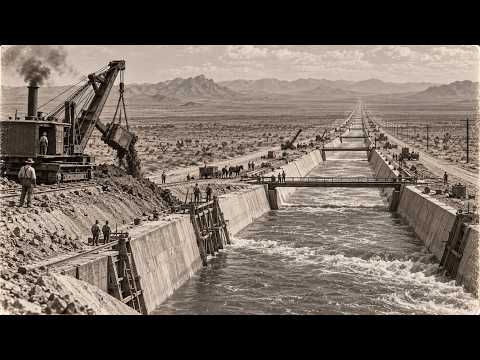
The tunnel was the hardest problem, but it wasn’t the first place the water had to go. Start at the very top of the line, where the river leaves its bed. For the first 23 miles below the intake, the aqueduct is an open earth canal through the wet bottomland of the Owens Valley. The ground there is so soaked that the water sits two to four feet under the surface. With a slope that gentle, the canal had to be wide to carry a river. It’s 38 feet across the bottom and runs about 10 feet deep. Pouring concrete into ground that wet would have been slow and expensive, so they didn’t line it at all. They dug it with boats. The city floated electric dredges in the very canal they were digging, ran them on power from two small hydroelectric plants it built on Division Creek and Cottonwood Creek, and let them eat their way south from Black Rock Springs. The division engineer in charge of that whole stretch was a man named H.A. Van Norman.
Opposite Sawmill Creek, the first suction dredge ran into a bed of hard lime deposit about a mile long that it simply couldn’t cut, and the crews had to blast it. So they brought in a different kind of dredge, one with a big dipper bucket, and it worked so well they finished the whole canal with it. One of the old suction dredges was taken apart and shipped south to the city’s cement plant. Then the floor of the valley starts dropping faster than the aqueduct is allowed to. So from the Alabama Hills south, the canal stays up on the face of the hills while the valley falls away below it. And because the ground up there is porous enough to drink a river, that section is lined with concrete. Another division engineer, O.W. Peterson, ran it with as many as five steam shovels at a time.
Along that stretch, the line follows the old beach of Owens Lake—a shoreline left from a time when the lake stood 220 feet higher than it did in 1913. Flash floods out of the canyons had been dumping boulders on that beach for ages, and lime in the ground had cemented them together into something close to natural concrete. Some of the boulders the crews had to move were 10 to 30 feet across. All of that came before the water ever reached Haiwee.
While the two Elizabeth crews were still underground, the rest of the line had a problem that sounds almost silly until you picture the country. You can’t build an aqueduct across a desert with no water to mix concrete, no roads, no power, and no telephone. And the line crossed some 150 miles of country with no water at all. So before the city could build the aqueduct, it had to build everything the aqueduct needed. Fifty-seven work camps went up along the line, most of them in the mountains. The crews laid 230 miles of pipe just to bring water to those camps. They graded 215 miles of road to reach them. They strung 377 miles of telegraph and telephone line so a camp in the badlands could talk to the city. And the Southern Pacific built a new branch line from the town of Mojave north toward the Owens Valley, finished late in 1910, just to haul freight for the job.
And the camps filled with men from everywhere. Accounts of the work list laborers drawn from all over the West and from immigrant crews—Greeks, Bulgarians, Serbs, Montenegrins, Swiss, and Mexicans among them. Every man signed a paper before he started, a memorandum of employment that fixed his wage and let the city take out money for his board and his hospital fee. A meal in the camps cost 25 cents. The hospital fee came out of every paycheck, too—a dollar a month, and half that for the lowest-paid men. The medical side was run by a doctor named Raymond G. Taylor, whose department built field hospitals at nine points along the line and sent the serious cases down to the California Hospital in Los Angeles. The report says no epidemic of any kind broke out on the work. For camps strung across a desert in summer heat, that line stopped me.
Then there was the cement. Near Tehachapi, the city bought 4,300 acres covering limestone quarries, clay beds, and deposits of a volcanic rock called tufa, and had built its own cement mill there, a place they named Monolith. The engineers found that grinding tufa together with Portland cement doubled the amount of cement they had. And in tunnel linings and buried conduit, it kept getting harder long after ordinary cement stopped. The aqueduct used more than a million barrels of cement. The report puts that in a way I can actually picture: enough concrete for a road 12 feet wide running from Portland, Oregon, all the way down to Yuma, Arizona. By 1909, the city was making its own cement, its own electricity, and its own roads. In the middle of the desert, what it couldn’t make was a way to move all of it.
Everybody expected a machine to solve that. A new kind of traction engine had just been developed in California with a wide continuous track running over sprocket wheels instead of plain wheels, and people called it the Caterpillar. The city bought one steam model and two gasoline models and tried them out on the roads of the Jawbone Division with the manufacturer’s own mechanic in charge. The trial went beautifully. The engines beat the 40 cents a ton-mile that the freight contractors had bid, so the city kept buying them until it owned 28. Then the desert went to work on them. As the engines got older, the breakdowns turned into a daily event. The tracks and gears filled with grit and rock, and the repair bills climbed until they matched what it cost to run the things. The city made its own replacement castings in its shops at Mojave to save money, and even that wasn’t enough. In the end, the report says the traction engines were condemned and abandoned.
What replaced them was the oldest engine in the West. The city bought its own mules—hundreds of them from the Midwest at around $200 for a good one. A single driver handled a team of 10 to 14 animals, pulling two or three heavy wagons coupled together. On the desert roads, each animal could pull about a ton, and a team could make 20 miles a day. Hauling with the city’s own mules cost about half of what the contractors had bid. I love that part of the record because it runs backward from how these stories usually go. The newest machine in California got the first chance, and the mule took the job away from it.
But hauling powder to a tunnel was as far as a mule could help. And up in the badlands north of Mojave, a crew with hand drills was about to go after a world record held by the Swiss. That stretch of the line was some of the roughest country on the whole route—a maze of deeply eroded sandstone the engineers simply called the Badlands. From Red Rock Canyon down through Jawbone Canyon to the edge of the Mojave, the water would travel nearly 19 miles through tunnels, steel pipes, and conduit, and very little of it in daylight. The sand in Red Rock Canyon was so deep that wagons could barely move freight through it. So the city had nine miles of railroad laid up the canyon from a siding at a place called Cantil just to keep the tunnel crews supplied.
At the head of that canyon was the Red Rock Tunnel, more than two miles through soft sandstone—so soft the crews could bore the holes with augers. Work started at the end of May 1909. And at the same time, on the other side of the world, crews in the Swiss Alps were driving the Lötschberg Tunnel with compressed air drills, going for the fastest month of tunneling anyone had ever recorded. In August 1909, the Swiss broke their own record. They drove 1,313 feet in a month with four air drills working in a single heading. That same August in the Red Rock Tunnel, a crew led by Tom Flanigan, working with hand drills in one heading, drove 1,161 feet. The city’s report calls it the world’s record for fast tunnel driving for one month’s run. I have to stop on that for a second. A crew in a sandstone hillside in the Mojave with hand tools outdug the Swiss crews and their air drills. The man who made that record drive later went east to work on the Catskill Aqueduct for New York.
By the end of that first year, the aqueduct was running well ahead of its own schedule. In its first 11 months, the city’s crews had driven 22 miles of tunnel. The report says that pace would have had water in the San Fernando Reservoir by the fall of 1912. It says something else right after that, too: had there been no delay in providing funds. A bond vote only gives a city permission to borrow. Somebody still has to buy the bonds. And in 1907, that turned out to be the hardest sale in the whole project.
The city printed its aqueduct bonds in thousand-dollar pieces and handed the job of selling them to W.B. Mathews, a lawyer who had served three terms as city attorney. He started close to home. The state of California took $510,000 worth as an investment for its school funds, and banks in Los Angeles took about the same. Then Mathews tried something that tells you how much the city believed in this. He offered smaller bonds, $200 apiece, to ordinary people in Los Angeles, so anybody could own a piece of the aqueduct. It barely moved. The whole popular offering sold only a few thousand. The country was still limping out of the Panic of 1907. Money was scarce, and Californians were used to earning a lot more interest than a city bond paid. By the spring of 1908, the report says the money from those first sales would soon be gone, and unless more bonds were sold, the construction forces would have to be disbanded and the work stopped.
So in May, Mathews went to New York. In July 1908, he came back with a contract. Two New York houses, Conant Brothers and A.B. Leach & Company, agreed to buy a first block of a little over $4 million worth outright. They also took an option on the rest, to be delivered in installments every February through 1912. That deal saved the job, and then the job outran it. You’ve heard how fast those tunnel crews were going. The city was spending money faster than the installment schedule allowed. And while the bond market stayed healthy, the New York houses were happy to take their bonds early. Early in 1910, the market for city bonds went quiet. The New York houses stopped taking anything ahead of the schedule, and they argued that every bond they’d already taken early should count against the installments still to come. The city still had its $23 million authorization, but the money it could actually spend that summer was running out.
In the summer of 1910, the aqueduct shut down. At the moment the money stopped, there were about 4,000 men in the field. Within a few weeks, the force was down to around a thousand. Think about what that looked like out there. Camps that had been running three shifts a day went quiet. Men who had spent two years learning this work were paid off and sent down the road, and nobody knew whether they’d come back. Even the kitchens nearly went under. The contractor who fed the camps at 25 cents a meal had watched the price of meat climb until he was thousands of dollars in debt. In October 1910, the board let him raise a meal to 30 cents rather than watch the camp kitchens collapse in the middle of everything else.
The city found its way out in pieces. And one of those pieces I had to read twice. Los Angeles took $1,326,000 of its own aqueduct bonds and sold them into its own sinking fund—the account it kept for paying those same bonds off. In other words, the city bought its own debt. Then two life insurance companies in New York, Metropolitan Life and New York Life, took a million dollars of bonds between them. The bond houses themselves took $530,000 more. The last of those sales closed on the 12th of August, 1910, and the work started back up. It came back weaker. The report counts the cost of that shutdown at a quarter of a million dollars at the very least, and it names where that money went: in lost organization, lower efficiency, idle equipment, and delay.
And the money wasn’t done with them. On the 10th of January, 1912, Conant Brothers and Leach & Company sent the city a notice. They would not take the rest of the bonds. Nearly $2,900,000 of the aqueduct’s money was suddenly without a buyer. That same month, down in Jawbone Canyon, the city was starting the most imposing piece of steelwork on the entire aqueduct. Mathews headed back to New York. Within a month of that notice, he had a new buyer, Speyer and Company, which took the unsold aqueduct bonds along with two other city issues for power plants in the harbor—more than $9.5 million in all, at full price. By then, the city had grown to about 425,000 people. And the report says that growth is exactly what made the bonds easier to sell the second time around.
So the money held, and the steel went down into Jawbone Canyon. That siphon sits about 120 miles from Los Angeles, in the middle of the division that ran through the Badlands. By the time the water gets there, it has already left the Owens Valley, run along the old lake beach, passed through Haiwee, and threaded the tunnels at Red Rock—and then the ground just drops out from under it. Jawbone Canyon is deep and wide, with walls that slope as steep as 35 degrees, and the aqueduct reaches the rim at a height it cannot afford to give up. What the engineers did there sounds impossible without a pump. They sent the water down into the canyon and back up the other side inside a steel pipe, and there isn’t a pump anywhere in it. It’s called an inverted siphon.
Picture a garden hose lying in a deep U with both ends held up in the air. Pour water into one end, and it runs down around the bottom and up the other side. And as long as the far end is a little lower than the near one, it keeps coming out. The water going in is pushing everything ahead of it. People hear the word siphon and assume there’s a pump hiding somewhere, or that somebody has to start the flow by sucking on one end. An inverted siphon needs neither. The water arrives at the rim already moving, and the weight of the water coming in behind it is the only push it ever gets. Jawbone is that garden hose, more than a mile long, with the bottom of the U sitting 850 feet below the line the water is flowing on. At the bottom of that pipe, the water presses outward at 365 pounds per square inch. That’s more than 11 times the air pressure in a car tire, pushing on every square inch of steel day and night.
The trip does cost something. The engineers budgeted 26 feet of the aqueduct fall for friction on this one siphon, and nothing more. The water goes all the way down into that canyon, climbs the far wall, and leaves the pipe only that much lower than it came in. Even while the water is climbing the far side of Jawbone Canyon, it’s still losing height on the one measure that mattered to the men who designed it: the line they drew on paper. That line never goes up. Not here, and not anywhere else on the aqueduct.
The pressure at the bottom is so much greater than at the top that a pipe built the same all the way through would have wasted a mountain of steel. So E.A. Bayley, the aqueduct locating engineer—the man whose job had been deciding exactly where the line would run—worked out the lightest safe shape on paper with a graphical method of his own. The pipe starts 10 feet across at each rim and narrows as it goes down to 7½ feet at the bottom of the canyon, where the steel is more than an inch thick. Bayley’s design saved 298 tons of steel over a pipe of one size. Nobody driving past that canyon would ever notice it, but it’s the kind of detail that tells you how carefully this line was thought through. Even so, the finished siphon weighs more than 3,200 tons.
The man who built it, along with the rest of that division from the Badlands down to the desert, was the division engineer A.C. Hansen. Every ton of that steel came from the east, with the heaviest pieces riveted into finished sections before they shipped. It came by rail to a desert siding called Cinco, four miles from the siphon, and from there it had to go up a sandy road to the canyon rim. The sections for the bottom of the canyon were 36 feet long, each one several rings of steel already riveted together, and every one of them weighed 26 tons. That’s about the weight of four bull elephants in one piece of pipe, going uphill through sand. They didn’t go up by engine. They rode on special wagons with steel wheels and tires two feet wide. And the report lists the hitch that pulled them: 52 animals, six abreast at the wheel and the rest strung out ahead on three jerk lines, with three freighters and two swampers working the load.
The man on those lines was Dick Wright. Everybody called him Whistling Dick, and in 1912 he was 74 years old. There’s a photograph of that team in the Department of Water and Power Collection at the Los Angeles Public Library. Wright is sitting on the left wheel mule holding the jerk line, and his two swampers are riding up on top of the pipe. Try to picture it. A man that age, on a mule, steering that whole team and that much steel up a sand road toward a canyon rim. The newest machines in California had already failed out here, and the job came down to him.
At the rim, the mules’ part was over. The steel went down the canyon walls on a rope hoist track built right alongside the pipeline, lowered by a 15-ton hoist driven by electric motors. Erection started at the very bottom of the canyon with the thickest plate, and the pipe was built up both walls at the same time. Every joint was riveted right there in the canyon. Each rivet weighed about five pounds, and they were driven with air hammers, with a second hammer bucking up against them from inside the pipe. In May 1912 alone, the crews drove 1,160 of those rivets across the floor of the canyon. The pipe sits on concrete piers set every 36 feet, dug down into gravel at the bottom and built on bedrock up the walls. They started in January 1912. By March 1913, the Jawbone siphon was finished, cocked, and painted.
From Jawbone, the water runs another 68 miles across the Mojave Desert to the far end of the Antelope Valley, most of it in buried concrete conduit. Jawbone carried the most pressure on the line, but it wasn’t the only siphon. The aqueduct crossed canyon after canyon this way, with about 12 miles of steel siphon pipe in all. The longest one ran straight across the floor of the Antelope Valley at the western edge of the Mojave for 21,767 feet. Its pressure was lower, with a head of 200 feet at the deepest point. So the city built the shallow ends out of concrete and saved the steel for the middle, where a pipe 10 feet across runs over the desert floor for almost three miles.
With Jawbone done, the whole line from the Owens River to the San Fernando Valley was finally in place, and the city expected water that June. Everywhere except one canyon the engineers had never fully trusted. That was Sand Canyon, about 150 miles north of Los Angeles. The first plan there had called for a steel pipe, the same as Jawbone. But the rock on the surface was hard gray granite, as hard as anything the tunnel crews met on the whole line—so hard it took 40 to 50 pounds of dynamite for every foot of tunnel. And the engineers worked out that a cheaper design would do. Instead of steel all the way across, they cut two steep tunnels down into the granite, one on each side of the canyon, each more than 630 feet long, lined them with concrete, and joined them with a short steel pipe along the bottom. The rock itself would hold the pressure, and at the bottom of that siphon, the head was 455 feet.
The first filling didn’t go well. As water went in, the pressure climbed to 60 or 70 pounds, and then started to sag, and a spring appeared on the north side of the canyon, right about level with the bottom of the pipe. By the 25th of March, 1913, more springs were showing up on that hillside, 200 and 300 feet from the pipe. On the 26th, the engineers decided to find out for certain. The aqueduct above them was finished by then. So they turned about 100 cubic feet of water a second into the siphon on purpose, so that if there was a weakness, it would show itself right away instead of sometime after the city was depending on it. At 1:28 that afternoon, the gauge on the pipe read 60 pounds. At 1:30, it read 100. A minute or two later, it hit about 150, close to the top of that gauge. The crew was pouring sawdust and fine sand into the incoming water, hoping it would plug whatever the spring was finding. At 1:33, the spring on the north side blew out. At about 1:34, the hillside itself broke open, 80 feet above the top of the pipe. When they drained it and went inside, they found a crack about three inches wide, running diagonally up both sides of the tunnel lining. They tried again in May with a big head of water sent down from Haiwee for a final test, and this time the tunnel on the south side of the canyon blew out. The report doesn’t soften it. It says the side of the mountain was lifted bodily and shattered into a mass of debris. And then it adds, almost dryly, that the engineers were not wholly surprised.
When they studied the ground afterward, they found a likely reason. The bottom of the canyon had probably once run a little farther north, and that old channel had filled up with loose rock, so the solid granite over the tunnel was thinner than it looked from the surface. Even the hard gray ledge at the north portal—the rock that had convinced them in the first place—had been misleading. I respect that. The same pages that print every world record also admit that at Sand Canyon, the rock beat them. There was only one fix left, and it was the one they’d started with. The replacement steel pipe was rush-ordered from a mill in Pennsylvania, and the delay cost about three months. The water the city expected in June would come in November.
On the 5th of November, 1913, the Southern Pacific ran special trains out of Los Angeles for a dollar round trip. People came out by automobile, by wagon, in buggies, and on horseback to the hills at the northern end of the San Fernando Valley. When noon came, about 30,000 of them had settled into a natural bowl in those hills around the head of the concrete cascade. At 10 minutes after 12, the program was called to order. The chief engineer’s speech lasted about as long as it takes to read one sentence. “This rude platform is an altar,” he said. “And on it, we are here consecrating this water supply and dedicating this aqueduct to you and your children and your children’s children for all time.” Then he unfurled the American flag on the speaker stand. That was the signal. Down at the gates at the mouth of the last tunnel, General Adna R. Chaffee gave the word, and the gates swung open.
And look at who was standing at those gates. Four of the five gatemen were engineers who had built the thing. Van Norman, who ran the dredges in the Owens Valley, was there. So was Hansen, who built Jawbone, and D.L. Riaburn, who built the Sus Division, and Rodrick Mai, the aqueduct’s chief construction engineer. The fifth was a young army officer. Sometime after 1:00, the water came through. As it came foaming down, the chief engineer turned to the mayor, H.H. Rose, pointed at it, and said “There it is, Mr. Mayor—take it.” It might be the shortest dedication speech ever given for a job that size, and I think it was exactly right.
Then the whole bowl came apart. Hundreds of cups were dipped into that water. Car horns went off, handkerchiefs and pennants waved, aerial bombs and rockets went up, and a flag came floating down on a parachute. Somebody was selling souvenir bottles for 10 cents. The celebrating ran into the next day, with a second dedication in the city on the day Exposition Park opened.
I think about the other numbers in that same report while I read about the rockets. By the summer of 1912, the city’s accident table listed 43 men killed on the work. Only five of them died in explosions, out of millions of pounds of blasting powder. And the report is proud of that, and it has a right to be. A man hurt on the job was kept in the hospital with free board and half his pay. And the report’s own ledger puts $12.5 million of the aqueduct cost into payrolls—more than half of everything the city spent. But those men did not see that water come down the hill. In the report, they are a number in an accident table. And far to the north, the river that filled that cascade no longer ran down into its lake. In the years after the diversion, Owens Lake dried into a flat of salt and alkali. The people of that valley paid a price for this day that the crowd holding the cups mostly never had to think about, and this story isn’t honest without saying so.
The aqueduct came in within its original estimate, without a single extra bond. When it opened, no aqueduct in the world was longer. You can still follow that water almost the whole way today. It starts in the Owens Valley at a concrete diversion weir that turns nearly the whole river out of its natural course—a spot that isn’t open to the public, about a four-hour drive from downtown Los Angeles. From there, the open canal that Van Norman’s dredges cut still runs down the valley floor, gathering seepage as it goes. At the Alabama Gates, a set of gates on the east bank of the canal can turn water back into the old riverbed when the channel runs too full. Below them, the concrete-lined canal runs about 35 miles along the Alabama Hills outside Lone Pine and on down the valley past the wide white bed where Owens Lake used to be. Haiwee Reservoir still sits in its narrow saddle between two hills past Olancha, seven miles south of that dry lake bed. It was built as a buffer so the aqueduct could keep running if something went wrong upstream. And the long, slow trip through it gives the desert sun time to work on the water.
Below Haiwee, the water goes underground into the covered conduit. And for most of the next stretch, you won’t see it at all. Down past Little Lake and into Red Rock Canyon, the water runs through the sandstone where Flanigan’s crew outdug the Swiss. Then comes Jawbone Canyon, right beside Highway 14. You can still see the siphon, a steel pipe running straight down one canyon wall and straight up the other, doing exactly what it did in 1913. Across the Mojave, past the town of Mojave, where the city kept its machine shops and freight yards, the conduit runs mostly underground. And then comes the long siphon across the Antelope Valley, which has a story of its own from three months after the opening.
In February 1914, a cloudburst dropped nearly half again the desert’s normal yearly rainfall in just three days. A wash under the pipe that had never run more than 15 feet wide tore itself out to 50, carried off the concrete piers, and the pipe sagged and broke open at a seam. The water ran out under 200 feet of head. As it emptied, the air outside crushed the pipe inward, and nearly two miles of that 10-foot steel siphon collapsed like an emptied fire hose. In some places, the top of the pipe was pushed down to within a few inches of the bottom. Many engineers said it was a total loss and that the whole thing should be taken apart. The city patched the break instead, and turned the water back in slowly and let the pressure do the work. A month after the collapse, the pipe was round again, without a sheared rivet or a broken joint. The repair cost about $3,000. Rebuilding it would have cost about a quarter of a million.
At the south edge of the Antelope Valley, about 200 miles from the intake, Fairmont Reservoir still sits at the head of the Elizabeth Tunnel, and the water still goes straight through the mountain on the line that Aston’s and Gray’s crews met on. Out the south end, it drops down San Francisquito Canyon, and this is where the aqueduct finally spends its height. All at once, the report counted 1,470 feet of fall in that canyon, and the city turned it into electricity. The biggest of the power plants along the aqueduct, San Francisquito Power Plant Number One, still stands in that canyon. In 1928, a dam in that same canyon failed, and more than 400 people died in the flood below it. That sorrow deserves its own full telling, and it isn’t one I’ll rush through here.
And at the bottom of it all, at Sylmar, is the cascade. Today, there are two lines coming down that hill. One is the big pipe and open spillway of a second aqueduct finished in 1970. The other is the pipe of the original 1913 aqueduct, coming out halfway down the hillside and still in use. Most days the water stays in the pipes and runs the power plants at the foot of the hill. When there’s more than they can take, it comes thundering down the cascade. It looks so much like a giant water slide that locals still joke online about riding it. In November 2013, for the 100th anniversary, a string of about a hundred mules walked the length of the aqueduct and gathered on the hill above that cascade. And this year, the city’s water forecast still counts on the snow of the Eastern Sierra, carried down this same line for a big share of what comes out of Los Angeles faucets.
So go back to that hillside one more time. The city’s report, printed three years after the opening, says there was not an error in instrumental work, either in line or grade, in any of the tunnels or anywhere else on the job. That means the water fell every single mile of the way from the Owens River to this hill, a little at a time, and nobody could see it happen. The cascade is the one place the aqueduct lets it show. The last 190 feet of that fall, out in the open, in front of the people it was built for.
New York tried the same idea 70 years earlier, for a city dying of cholera—and that story is how America tunneled 41 miles to save a city from a plague.
The Owens River still leaves its bed at Black Rock Springs. The canal still runs. The mules are gone, the traction engines were condemned, and the men who drove the headings are names in a ledger. But the fall is still there, foot by foot, all 233 miles of it, and at Sylmar it finally shows itself.
That is the whole trick of the thing. A city did not pump a river over a mountain. It found a height and never let go of it. Every mile was a promise that the next mile would be a little lower.
So here is my question for you: if Los Angeles could move a river 233 miles with mules, hand drills, and a line on paper—what is stopping us from building the next impossible thing? Tell me in the comments.
Report this article
Select a reason for reporting:






