Most people, when they think of Iraq, picture Saddam Hussein, the Gulf War, the 2003 invasion, and the chaos that followed. But few remember that before all that, Iraq was a kingdom—with a royal family, a king in tailored suits, palaces along the Tigris, and servants pouring tea in marble halls. Then, one July morning in 1958, it was all ripped away in a hail of bullets and blood. What happened to the people connected to that throne is one of the most haunting and underexplored stories in modern Middle Eastern history.
Because the fall of Iraq’s monarchy didn’t just end a dynasty—it set in motion a chain of violence, coups, and dictatorships that shaped the country for the next half century and beyond. The echoes of that single morning are still reverberating today.
To understand what was lost, you first need to understand what was built. The Hashemite family traces its lineage directly back to the Prophet Muhammad. For centuries, they held the title of Sharif of Mecca, custodians of Islam’s holiest city. Their prestige was immense, rooted not in military conquest but in something far older and more spiritual. But prestige alone doesn’t build kingdoms—what built kingdoms in the early 20th century was the backing of the British Empire.
In 1916, during the chaos of World War I, Sharif Hussein bin Ali, the patriarch of the Hashemite family, launched the Arab Revolt against the Ottoman Empire. The British promised him independence for the Arab lands if he rose up. His sons, Faisal and Abdullah, led the military campaigns alongside the legendary T.E. Lawrence—riding through deserts, capturing Aqaba, and marching triumphantly into Damascus in 1918.
The Ottomans were defeated. The Arab Revolt had succeeded. But the promises the British made were hollow. Even as they whispered assurances of independence, they were secretly cutting a deal with France—the Sykes-Picot Agreement—carving up the Middle East into spheres of influence. The Arabs had been betrayed, and they didn’t even know it yet.
Faisal had been declared king of Syria, but in 1920, French forces invaded and drove him from his throne. His kingdom lasted less than a year. Now the British had a problem: they had made promises to this family, and they needed cooperative rulers in the territories they controlled. Iraq, a restless territory, had erupted in a massive revolt against British rule in 1920. They needed a local ruler with credibility but also dependent on British support.
Enter Faisal. At the Cairo Conference in 1921, chaired by Winston Churchill, the decision was made: Faisal would become King of Iraq. His brother Abdullah would be given Transjordan. It was called the Sharifian Solution—a tidy arrangement where the British could appear to grant self-rule while maintaining control behind the scenes.
Faisal arrived in Basra in June 1921 aboard a Royal Navy vessel. He traveled through the Shia holy cities, meeting tribal leaders and building support. A referendum was held, carefully managed by the British, and he won 96% of the vote. On August 23, 1921, Faisal was crowned King of Iraq.
Faisal was no puppet, even if his crown had been placed by British hands. He was a skilled diplomat who understood Iraq’s fractures—Sunni, Shia, Kurd, Turkmen, Christian, and Jewish communities with different loyalties. He negotiated treaties that gradually expanded Iraqi sovereignty, built institutions, established a parliament, and invested in education. In 1932, Iraq was admitted to the League of Nations as a fully independent state—the first Arab country to gain admission.
But Faisal didn’t get to enjoy that triumph for long. On September 8, 1933, while receiving medical treatment in Bern, Switzerland, he died at the age of 48. The official cause was a heart attack, but rumors of poisoning immediately swirled. His political instincts, his diplomatic finesse, his ability to balance competing factions—all of that died with him.
He was succeeded by his only son, Ghazi. And if Faisal was a statesman, Ghazi was anything but. He was 21, impulsive, and far more interested in fast cars and radio broadcasting than governance. Ghazi was openly hostile to the British, which made him popular among nationalists but uncomfortable for the power brokers. He even set up a private radio station in his palace that broadcast anti-British propaganda into Kuwait.
His reign was chaotic and brief. On April 4, 1939, King Ghazi died in a mysterious car accident—his car reportedly crashed into a utility pole at high speed. Many Iraqis believed it was no accident. The prime minister at the time, Nuri al-Said, was widely suspected. Crowds at Ghazi’s funeral chanted for Nuri’s death. The conspiracy theories never went away.
But the immediate consequence was that the crown passed to Ghazi’s only son, Faisal II. The boy was just 3 years old. He couldn’t tie his own shoes, let alone rule a country. So a regent was appointed: his uncle, Prince Abd al-Ilah, who would effectively rule Iraq for the next 14 years until young Faisal came of age.
Abd al-Ilah is a critical character because many historians argue that his policies sealed the monarchy’s fate. He was firmly pro-British at a time when anti-Western sentiment was surging across the Arab world. He was seen as aloof, aristocratic, and disconnected from ordinary Iraqis. While the regent lived in marble palaces, the gap between the elite and the poor grew wider.
Oil revenues were flowing, and by the 1950s, a significant development budget had been established. New infrastructure was planned—dams, irrigation projects, roads—but the benefits trickled down slowly. Ordinary Iraqis saw the ruling class getting richer while they struggled.
And then there was the geopolitical context. This was the Cold War, and the Middle East was a volatile theater. In 1952, a group of military officers in Egypt led by Gamal Abdel Nasser overthrew the Egyptian monarchy. Nasser became the darling of Arab nationalism, speaking of Arab unity, anti-imperialism, and resistance to Western dominance. His message resonated like a thunderclap across the region.
While Nasser was nationalizing the Suez Canal and defying Britain and France, Iraq’s leadership was joining the Baghdad Pact—a military alliance with Britain, Turkey, Iran, and Pakistan that was seen by many Arabs as continued subservience to Western imperialism. When Britain, France, and Israel invaded Egypt during the Suez Crisis of 1956, King Faisal II sided with the British. For many Iraqis, this was an unforgivable betrayal. Massive protests erupted. The streets of Baghdad filled with demonstrators chanting for Nasser and against the monarchy.
Meanwhile, inside the Iraqi military, a secret organization was taking shape. They called themselves the Free Officers, directly inspired by Nasser’s movement. They were led by Brigadier Abd al-Karim Qasim and Colonel Abdul Salam Arif—military men from modest backgrounds who saw the monarchy as a puppet of foreign powers and the ruling elite as a corrupt clique.
For years, they planned in secret, waiting for the right moment. That moment came in the summer of 1958. In February, Syria had merged with Egypt to form the United Arab Republic, sending shockwaves through the region. Iraq’s monarchy responded by forming its own federation with Jordan, called the Arab Federation. But this union was fragile from the start—a desperate attempt to counter Nasser’s influence.
Then, in July, a crisis erupted in Lebanon, where pro-Western and Arab nationalist factions were locked in conflict. Jordan’s King Hussein requested military assistance from Iraq. The Iraqi government agreed and ordered army units to march toward Jordan. On the night of July 13, 1958, the 20th Brigade, under Colonel Arif, was ordered to move through Baghdad on its way to the Jordanian border.
This was a fatal miscalculation. For the first time in nearly four decades, a fully armed military unit was allowed to pass through the capital. It was the opening Qasim and the Free Officers had been waiting for. Instead of continuing toward Jordan, Arif’s troops turned their guns on Baghdad.
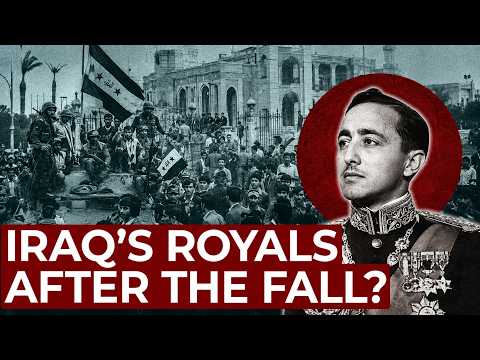
In the early hours of July 14, 1958, the revolution began. Soldiers seized the radio station, the telephone exchange, the Ministry of Defense. Colonel Arif went on the radio and announced that the monarchy had been overthrown. He declared Iraq a republic. The streets of Baghdad erupted. For many Iraqis, this felt like liberation.
But inside the walls of Al-Rehab Palace, a nightmare was unfolding. King Faisal II was just 23 years old—quiet, bookish, plagued by asthma. He had only been ruling in his own right for five years. He was not a tyrant. He was, by most accounts, a gentle and somewhat naive young man dealt a terrible hand by history. He was engaged to be married in just two weeks to Princess Sabihah Fazile, a descendant of Egypt’s royal family. It never happened.
When the revolutionary troops surrounded the palace, Faisal ordered the royal guard not to resist. He surrendered. He walked out with his family, apparently believing that if they cooperated, they would be spared. Around 8:00 in the morning, Captain Abdul Sattar al-Aboussi, leading the assault group, ordered the royal family to gather in the courtyard. The king was there. Prince Abd al-Ilah, the former regent, was there. Princess Nafisa, Abd al-Ilah’s mother, was there. Princess Abadiya, Faisal’s aunt, was there. Princess Hiyam, Abd al-Ilah’s wife, was there. Several servants stood with them.
They were told to face the wall. And then, without warning, the machine guns opened fire.
King Faisal II did not die immediately in the first burst. He was placed in a vehicle, reportedly to be taken to a hospital, but he died en route. He was 23 years old—a young man who never asked to be king, who had inherited a throne as a 3-year-old orphan, and who spent his entire short life caught between forces far larger than himself.
Prince Abd al-Ilah’s fate was even more gruesome. After his body fell, it was dragged through the streets of Baghdad. According to witnesses, his limbs were severed, his body was disemboweled, and his remains were hung from a building before being thrown into the Tigris River. The violence inflicted on his corpse was an expression of decades of suppressed rage.
Princess Abadiya and Princess Nafisa were killed in the courtyard. Several servants and guards died alongside them. But not everyone perished. Princess Hiyam, Abd al-Ilah’s wife, was hit during the fusillade but survived. She escaped to Amman, Jordan, where she lived until her death in 1999.
Princess Badiya bint Ali was not at the palace that morning. She escaped with her husband and three young sons, fleeing to London. She lived to be 100 years old, dying in 2020—the last surviving princess of the Iraqi royal house. She never returned to the country her family once ruled.
The bloodshed was not limited to the palace. The next day, the revolutionaries found their other target: Nuri al-Said, the prime minister who had served in that role 14 times across three decades. He had slipped out of his house disguised in a woman’s abaya, attempting to blend into the crowds. But he was recognized—or perhaps betrayed. He was shot dead on the street. Like Abd al-Ilah, his body was dragged through the streets, run over by vehicles, and mutilated by the mob.
What followed the fall of Iraq’s monarchy was not liberation. It was a descent into one of the most unstable and violent political eras in the modern Middle East. General Abd al-Karim Qasim declared himself prime minister and sole leader of the new republic. At first, there was euphoria—land reforms were announced, political prisoners were released, and Iraq withdrew from the Baghdad Pact. But power has a way of corrupting even the most well-intentioned revolutionary.
Qasim grew paranoid. He surrounded himself with loyalists and crushed dissent. He played communist factions against Arab nationalists, Kurds against Arabs, alienating nearly every political group. In October 1959, a group of militants from the Ba’ath Party attempted to assassinate him. One of the gunmen was a 22-year-old from the dusty town of Tikrit named Saddam Hussein. The attempt failed, reportedly because Saddam opened fire prematurely, botching the ambush. He was wounded and fled to Syria, then Egypt. But the failed assassination elevated his profile within the party. He had shown his willingness to kill for the cause.
In February 1963, the Ba’ath Party, with suspected CIA support, overthrew Qasim in a violent coup. He was captured, given a brief show trial, and executed by firing squad. His body was displayed on Iraqi television. The pattern was now established: in Iraq, power did not transfer peacefully—it transferred through blood.
The Ba’athist government lasted only nine months before being overthrown in yet another coup. The new government was led by Abdul Salam Arif—the same colonel who had led troops into Baghdad on the morning of the monarchy’s fall. Arif ruled until 1966, when he died in a helicopter crash many believed was not accidental. He was succeeded by his brother, who held on until 1968, when the Ba’ath Party returned to power in yet another coup.
This time, they came to stay. The new government was led by Ahmed Hassan al-Bakr as president, but the real power was his deputy, his kinsman from Tikrit—Saddam Hussein. Saddam had spent the intervening years building a fearsome security apparatus, eliminating rivals, and consolidating power with a ruthlessness that made him the most feared man in Iraq long before he officially became president.
In 1979, Saddam pushed al-Bakr aside and assumed the presidency. One of his first acts was to convene a gathering of senior Ba’ath Party members, during which he read out a list of names—people he accused of plotting against him. As each name was called, the accused was dragged from the room and executed. It was a chilling display of power that set the tone for the next 24 years.
In just two decades, Iraq went from a constitutional monarchy with a young king planning his wedding to a series of military coups, assassinations, and purges—to the absolute dictatorship of Saddam Hussein. The revolution of 1958 did not bring democracy. It did not bring justice. It brought chaos, then authoritarianism, then totalitarianism of the most brutal kind.
Wars with Iran and Kuwait followed. Sanctions devastated the economy. Hundreds of thousands died. And the country that Faisal the First had built from the ruins of the Ottoman Empire—the first Arab state admitted to the League of Nations—was reduced to a pariah state.
But what about the Hashemites themselves? After the massacre of the immediate royal line, the headship of the Iraqi royal house passed to Prince Zeid bin Hussein, the youngest son of the original Sharif Hussein of Mecca. Zeid had been living abroad at the time of the revolution. He assumed the role of head of the royal house in exile from 1958 until his death in Paris in 1970. His wife, Fahrelnissa Zeid, was one of the most celebrated modern artists of the 20th century—a Turkish-born painter whose large-scale abstract works are still exhibited in major museums around the world.
After Zeid’s death, the claim passed to his son, Prince Ra’ad bin Zeid, who was born in Baghdad in 1936 and spent much of his life in Jordan, serving as a constitutional adviser to King Hussein. Because that is the great irony of this story: the same family that was slaughtered in Baghdad still rules in Amman. Jordan’s King Abdullah II is a direct descendant of the same Sharif Hussein who launched the Arab Revolt alongside his brother, Faisal the First. Two branches of the same family—one wiped out in a palace courtyard, the other still reigning over a stable and relatively prosperous kingdom.
The difference between survival and annihilation came down to luck, geography, and the particular temperament of each country’s political dynamics. The Hashemite survival in Jordan is not a story of inevitable success. It’s a story of extraordinary resilience, shrewd diplomacy, and more than a little good fortune. King Abdullah the First was assassinated in Jerusalem in 1951, shot by a Palestinian gunman as he entered the Al-Aqsa Mosque. His grandson, King Hussein, survived dozens of assassination attempts and coup plots during his 47-year reign.
But the most fascinating figure among the Iraqi royal descendants was Sharif Ali bin al-Hussein, the son of Princess Badiya—the survivor who had fled to London. Sharif Ali was born in Baghdad in 1956, just two years before the revolution that would destroy his family’s world. He grew up in exile in London, educated in British schools, raised on stories of the kingdom his relatives had lost. And for most of his adult life, he dedicated himself to a single cause: restoring the Hashemite monarchy in Iraq.
In the 1990s, while Saddam Hussein still ruled, Sharif Ali established the Constitutional Monarchy Movement, an Iraqi opposition party based in exile. His argument was elegant in its simplicity. Iraq, he said, was a country torn apart by sectarian and ethnic divisions. It needed a unifying symbol, an institution that stood above the fray of partisan politics. A constitutional monarchy, he argued, could provide that stability. He pointed to the relatively peaceful period of Hashemite rule as evidence that the monarchy had offered something the republics never could: a sense of continuity, legitimacy, and order.
When Saddam’s regime fell in 2003, following the American-led invasion, Sharif Ali returned to Baghdad for the first time since he was an infant. He walked through the streets of the city his family had once ruled. He visited the site of the old royal palace. He spoke to Iraqi media and made his case for a restored monarchy. The Constitutional Monarchy Movement, later renamed the Constitutional Movement, participated in the new political process. But the idea of restoring the monarchy never gained serious traction.
By 2003, Iraq was a different country. The population had lived through decades of Ba’athist dictatorship, two devastating wars, crippling sanctions, and a foreign military occupation. The political landscape was dominated by sectarian parties—Shia, Sunni, and Kurdish blocs jockeying for power in the new democratic framework. A Sunni Arab monarch from a dynasty that many Iraqis associated with British colonialism was not a popular sell, no matter how eloquently Sharif Ali made his case.
Some Iraqis were nostalgic for the monarchical era, particularly older generations who remembered it as a time of relative stability and rising prosperity. But nostalgia is not a political movement, and the Constitutional Monarchy option was never put to a vote. Sharif Ali continued his political work in Iraq throughout the 2000s and 2010s, advocating for national unity and constitutional reform. He was respected by many, including Iraqi political leaders, who admired his dedication even if they didn’t share his vision.
When he died in March 2022 in Amman, Jordan at the age of 66 from health complications, both the Iraqi president and prime minister issued official statements of condolence. The president called him a patriotic figure who had struggled against tyranny. The prime minister remembered his commitment to a democratic Iraqi state. But the monarchy he had dreamed of restoring remained firmly in the past.
With Sharif Ali’s death, the question of succession for the Iraqi royal house became even more theoretical. He left behind three children, but the idea of an Iraqi restoration—already remote during his lifetime—has become even more so since his passing. There is no organized movement, no political party, no serious institutional effort to bring back the monarchy. The Hashemite kingdom of Iraq is now a chapter in a history book, a brief 37-year experiment that began with a British coronation and ended with a machine gun.
And yet, there is something haunting about the way Iraqis continue to talk about the monarchical period. Sixty years after the revolution, a survey conducted by Arab News found that many Iraqis still viewed the monarchy as the most stable period in their country’s modern history. And there is a bitter logic to that view. Under the three Hashemite kings, for all their flaws and for all the injustices of the colonial system that propped them up, Iraq experienced nothing like the horrors that followed.
The monarchy had its problems, certainly. It was too close to the British. It was too disconnected from the poor. It failed to address the aspirations of its diverse population. But it never engaged in the systematic terror, the wars, the aggression, the chemical weapons attacks, the mass graves, and the genocidal campaigns that characterized the Ba’athist era under Saddam Hussein. The revolution promised liberation, but what it delivered was a catastrophe that took decades to unfold.
The fall of Iraq’s monarchy is a case study in what happens when a ruling class loses touch with the people it governs. The Hashemites in Iraq were not uniquely evil or incompetent. In many ways, they were genuinely trying to build a modern state. They invested in infrastructure, in education, and economic development. They created institutions that, given time, might have evolved into something genuinely democratic. But they made a critical error: they tied their legitimacy too closely to a foreign power, Britain, at a time when the entire Arab world was in revolt against foreign domination. They failed to read the room. They failed to understand that the tides of history were moving against them. And by the time they realized it, it was too late.
The revolutionaries who killed them did not create a better Iraq. Qasim was murdered within five years. Arif died in a suspicious crash. The Ba’athists who replaced them created one of the most repressive police states in the modern world. And Saddam Hussein, the ultimate product of this violent political culture, led the country into three devastating wars and left behind a shattered nation. The monarchy’s failures were real, but the republics that replaced it failed far more catastrophically. That paradox—the revolution that was supposed to bring freedom but instead brought tyranny—is one of the central tragedies of modern Iraqi history.
As for the royal palace where it all ended, Al-Rehab Palace in Baghdad still stands. For years after the revolution, it was used as a government building. After the fall of Saddam’s regime in 2003, it became the headquarters of the Iraqi National Intelligence Service. The courtyard where King Faisal II and his family were lined up and shot is still there—a quiet patch of ground where one of the 20th century’s most dramatic political murders took place. There is no memorial. There is no plaque. The blood was washed away decades ago, but the stain on Iraq’s history never fully faded.
The Hashemite legacy in Iraq is one of those stories that forces you to sit with uncomfortable questions. Was the monarchy doomed from the start—a colonial imposition that could never have survived the rising tide of nationalism? Or was it destroyed prematurely, robbing Iraq of a stabilizing institution that might have guided the country through the turbulent decades that followed? The answer is probably both. The monarchy was flawed, but what replaced it was so much worse that even its flaws look tolerable in retrospect.
Princess Badiya, the last survivor of Iraq’s royal family, spent 62 years in exile in London before she died in 2020 at the age of 100. She never spoke publicly about the massacre. She never gave interviews or wrote memoirs. She simply lived her life quietly, carrying the weight of a history that most of the world had forgotten. Her son, Sharif Ali, spent his entire adult life trying to restore what was lost, and he died without achieving that dream.
And back in Iraq, a country that has known nothing but revolution, war, and occupation since that July morning in 1958, the memory of the monarchy grows fainter with each passing generation. The young people of Baghdad today have no living memory of kings and palaces and crowns. They know only the Iraq that came after. And maybe that’s the most tragic part of all—not just that a family was destroyed, but that the world they represented, flawed and imperfect as it was, was wiped away so completely that most people don’t even know it existed.
So the next time you hear about Iraq—about its conflicts and its struggles and its seemingly endless instability—remember that it wasn’t always this way. There was a time when Iraq had a king, a young man with asthma who liked to read, who was planning his wedding, who surrendered peacefully because he believed that cooperating with the revolutionaries would save his family’s lives. He was wrong. And Iraq has been living with the consequences of that morning ever since.
But here’s the question that lingers: if you could turn back the clock to that July morning in 1958, would you have warned the young king to resist—or would you have let history unfold as it did, knowing that the alternative might have been just as bloody? What do you think Iraq would look like today if the monarchy had survived? Let me know in the comments below.
Report this article
Select a reason for reporting:






