The desert sun beat down on the American tankers as they rolled into their first battle, hearts pounding with confidence and inexperience. “We thought we had the best equipment and everything,” one recalled. “We thought we were well-prepared.” They were about to learn a brutal lesson.
In the vast, unforgiving landscape of North Africa, 1943, two of the greatest tank commanders of World War II were about to clash: Germany’s Erwin Rommel, the legendary Desert Fox, and America’s George S. Patton. The fate of North Africa hung in the balance.
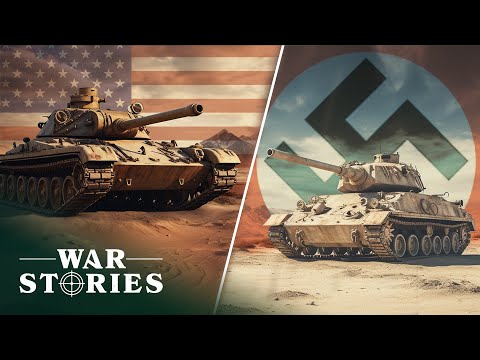
Rommel’s Afrika Korps, battered and reduced to just 64 tanks after El Alamein, retreated 2,500 kilometers to Tunisia, only to face a new threat from the west: the fledgling US First Armored Division, eager and green. “I had no fear,” a young American tanker admitted. They were armed with the latest Sherman tanks, fast and powerful, but untested in the cauldron of war.
For Rommel, the situation was desperate, but reinforcements arrived: the 5th Panzer Army with powerful anti-tank guns and long-barreled Panzer IVs. “In my opinion, it was possibly the best tank in the world at that time, even better than the Sherman,” a German commander noted. The stage was set for a deadly confrontation.
The Americans attacked first at Faid Pass, charging blindly into an ambush. German 88mm guns, camouflaged in cactus groves, opened fire with devastating effect. “The Americans didn’t stand a chance against the 88 anyway,” a German soldier recalled. Sherman tanks were ripped apart, one after another. “It was like a feast for us,” another German remarked.
The Americans reeled, but worse was to come. At Sidi Bou Zid, they launched another reckless charge, only to be torn apart by Panzer IVs. “We took out at least 45 to 60 Shermans,” a German commander boasted. “Our casualties were zero.” The desert was littered with burning American tanks.
Rommel saw his chance to finish the Americans for good. He launched Operation Storm Tide, a three-pronged assault through the mountain passes, aiming to drive straight through the heart of the Allied position. The epicenter was Kasserine Pass.
There, C Company of the 805th Tank Destroyer Battalion held the high ground, but they were outgunned and outnumbered. “When we saw them, I’ll tell you it put the fear in you right off the bat,” an American soldier admitted. The German Panzers advanced relentlessly, and the Americans were trapped.
Just when all seemed lost, American planes swooped in, strafing the Germans and showing the trapped soldiers a escape route over the mountain. “Some of us made it, some didn’t,” one recalled. The Americans retreated, suffering over 6,000 casualties and losing more than 200 armored vehicles.
But Rommel’s victory was short-lived. His enemies closed in from all sides. At Medenine, his attack was shattered by British guns, and he was recalled to Germany, leaving his Afrika Korps without their inspirational leader. The Americans, humiliated but not broken, regrouped under a new commander: General George Patton.
“He told us we were men from Mars, have no fear of anything,” a soldier remembered. Patton’s task: transform a retreating army into one that would stand and fight. And at El Guettar, he would draw a line in the sand.
Patton’s tank destroyers dug in along the ridges, their guns trained on the pass below. “We had 36 of them guarding the pass,” one crewman recalled. “Our recon went out and bumped into the Germans. I counted 75 German tanks coming at us across the desert.” The Panzers advanced slowly, deliberately, like an iron fortress rolling forward at five kilometers per hour.
The German plan was simple: use their heavy armor as a blunt instrument to bludgeon straight past the American lines. But Patton had learned from the disasters at Faid and Sidi Bou Zid. This time, the Americans would not charge. They would wait, hidden in the rocks, and make every shot count.
“As long as we were along the top of the ridge, we couldn’t shoot,” an American gunner explained. “So you’d pull up, shoot, and back down. Pull up, shoot, and back down.” It was a deadly game of peek-a-boo, and the Germans had no answer for it.
The 88s and Panzer guns fired back, but the Americans held the high ground. “When you’re on higher ground shooting down, it’s a big advantage over somebody shooting up at you,” a tank destroyer commander noted. Shell after shell slammed into the German formation, disabling tracks, punching through armor, turning the pass into a graveyard of burning steel.
Still, the Panzers came. “I’m not being arrogant, but let’s face it, we were valued,” a German tanker said. “We were an elite troop, weren’t we?” But elite or not, they were dying in the dust of El Guettar.
For twelve torrid hours, the battle raged. “It’s either gonna be them or us, one or the other,” an American soldier said. “You just gotta hope you’re doing the right thing and doing it as fast as you can.” The heat, the noise, the fear—it was almost too much to bear.
“We were terribly frightened,” a German veteran admitted. “Every soldier would have this nervous feeling in his guts and would shit his pants.” Even the hardened Afrika Korps was shaken by the ferocity of the American defense.
One by one, the Panzers were picked off. “We knock out a tank, and the crew men, if they weren’t hurt, they would take their machine gun off the tank and ground mount it and lay there and keep shooting,” an American recalled with grudging admiration. The Germans fought with a tenacity that matched their reputation.
But by day’s end, the plain was littered with wreckage: 21 American tank destroyers and 31 German Panzers, all burning. The battlefield belonged to Patton. The exhausted Panzer force had nowhere left to turn.
“And that was the end,” a German soldier said quietly. “After we had run out of ammunition and gas, there was nothing else to do but give up.” On May 13th, 1943, more than a quarter of a million German troops in Tunisia surrendered to the Allies.
For the Americans, El Guettar was their first armored victory of the war. No longer would their battle-scarred tankers be seen as the Allies’ weakest link. But the cost had been high, and the lessons had been written in blood.
“No, I didn’t think it would be a breeze,” one veteran said with a dry chuckle. “You know, actual combat is never a breeze.” Another nodded. “It’s part of warfare that you’ve got to accept—the fact that you’re going to have casualties, that some of your best friends might not survive.”
The Battle of Tunisia was the closing chapter for Rommel’s Afrika Korps. But for Patton and his battle-hardened tankers, it was only the beginning.
The surrender at Tunisia was not the end of the story for the men who had survived the desert. It was a beginning forged in fire, and the lessons they had paid for so dearly would echo across the battlefields of Europe.
In the weeks that followed, the American tankers who had once charged blindly at Faid and Sidi Bou Zid were a different breed of soldier. The swagger had been replaced by something harder—a quiet, grim competence. “We thought we had the best equipment and everything, but we finally found out that we didn’t,” one of them reflected. That admission, born of disaster, had become the foundation of their new strength.
Patton, never one to rest on a single victory, drove his men relentlessly. The rocky passes of Tunisia became a training ground for a new kind of warfare. Tank crews that had once fired blindly now learned to coordinate with infantry, to use terrain, to wait for the perfect shot. The tank destroyer crews of the 805th, who had been cornered at Kasserine and rescued by a stroke of luck, now drilled their tactics until they were second nature.
“We just do our duty and follow orders,” a gunner said, but there was a new edge to his voice. The blind obedience of the rookie had been tempered by experience. They followed orders, yes—but they also questioned, adapted, survived.
For the Germans, the defeat in Tunisia was a catastrophe from which the Afrika Korps would never recover. More than a quarter of a million men were marched into captivity. “The feeling was horror about being captured, of course,” a German veteran admitted. “There’s nothing worse that can happen to a soldier.” Yet even in defeat, there was a flicker of pride. “Until today, we are still proud to have been part of the Africa Corps.”
Rommel, the Desert Fox, was gone—recalled by Hitler before the final collapse, spared the humiliation of surrender but never again to command in Africa. His legend would endure, but his army was finished. The men who had once swept across the desert with him now sat behind barbed wire, their tanks reduced to smoking wreckage scattered across the plains of El Guettar.
The road to Berlin lay open, but it would be a long and bloody one. The Americans had learned the cost of arrogance, and they had paid it in full. Now, they would carry those lessons forward—into the mountains of Italy, onto the beaches of Normandy, and across the rivers of Germany.
As the sun set over the Tunisian hills, a young tank driver climbed out of his Sherman and looked at the horizon. He had survived his baptism of fire. He had seen friends die and enemies burn. He was no longer a rookie.
He was a soldier.
The young driver stood there a long moment, the smell of cordite and burning oil still thick in the cooling air. Somewhere behind him, a crew was already stripping a wrecked Panzer for parts, and a sergeant was shouting about fuel and ammunition. The war, relentless, was moving on.
“You get scared,” an older tanker had told him once, back before any of it started. “You can’t help it if you got anything about you. It’s human.” The driver understood that now, in a way he never could have from a training manual. Fear wasn’t the enemy. Complacency was.
He thought of the men who hadn’t climbed out of their Shermans—at Faid, at Sidi Bou Zid, at Kasserine. He thought of the German crews who had burned just as brightly on this plain. “It’s either gonna be them or us, one or the other,” he murmured to himself. The words felt less like a slogan now and more like a prayer.
Behind him, a mechanic slapped the hull of his tank and grinned. “She’ll roll again tomorrow, Lieutenant.” The driver nodded, climbed back up, and dropped into the hatch. The engine coughed, caught, and roared. Ahead lay Italy, then France, then the heart of the Reich itself—and none of it would be won by the cocky boys who had shipped out from Fort Knox believing their Shermans were invincible.
It would be won by men who knew exactly how much they could lose.
And as the column formed up and rumbled west toward the sea, the desert behind them fell silent at last—save for the wind moving through the burned-out hulks, keeping its own long account of what had been paid here.
What do you think was the single most important lesson the Americans carried from Tunisia into the rest of the war?
Report this article
Select a reason for reporting:






