You’ve seen them on the silver screen, larger than life, their faces etched into our collective memory. But have you ever wondered what happened when the cameras stopped rolling? When the glittering gowns were traded for comfortable robes, and the spotlight faded into the warm glow of a living room lamp?
These are the moments we were never meant to see—the private, unguarded snippets of Hollywood royalty that reveal the human behind the icon. From Cary Grant’s quiet dinners to Sophia Loren’s family devotion, these rare glimpses offer a portal into a bygone era, where legends let their hair down and allowed themselves to simply be.
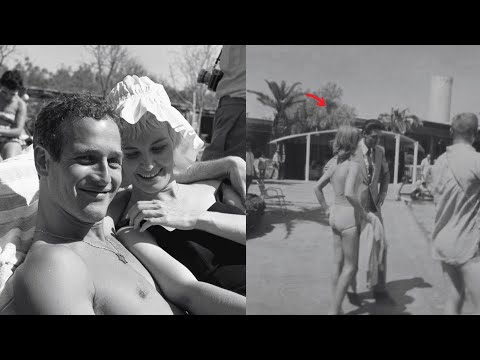
Cary Grant, the epitome of suave sophistication, was known for his charm and wit on screen. But off screen, he cherished quiet evenings with loved ones, far from the paparazzi’s flash. “He enjoyed quiet dinners and private moments with those he loved most,” whispers a close friend. Imagine the clinking of glasses, the soft laughter, the absence of pretense—a side of Grant that few ever witnessed.
Then there’s Sophia Loren, the Italian bombshell whose beauty and talent captivated the world. Yet, beyond the Hollywood spotlight, she was a devoted mother and wife, finding solace in the warmth of family. “Sophia shared warmth and devotion with family,” a confidante reveals. These rare photos capture her in candid moments—perhaps cooking pasta in her kitchen or playing with her children—reminding us that even icons crave the simple joys of home.
Do these old Hollywood vibes make you feel like you’re time traveling? You’re not alone. For many, these images evoke a sense of nostalgia, a longing for a time when glamour was effortless and stars seemed both untouchable and intimately familiar.
As you scroll through these forgotten treasures, you might find yourself drawn to a particular era—the ’40s with its wartime resilience, the ’50s with its postwar optimism, or the ’80s with its bold excess. Each decade offers its own flavor of stardom, yet the allure of private moments remains timeless.
Which of these rare photos will steal your heart? Will it be a laughing Clark Gable caught off guard, or an introspective Audrey Hepburn in her garden? The stories behind these images are as compelling as the stars themselves, and we’re about to delve deeper into the hidden lives of the legends you thought you knew.
But first, we want to hear from you. Which vintage era is your favorite? Let us know in the comments below. And if you’re enjoying this journey through time, hit that like button—it helps us keep bringing you these rare gems.
Stay tuned, because the next photo might just change the way you see your favorite star forever.
Take, for instance, the image of Clark Gable, the undisputed King of Hollywood. We know him as Rhett Butler, the roguish charmer with a devil-may-care grin. But in one candid shot, he is not the swaggering hero. He is sitting on the tailgate of a dusty pickup truck, a fishing rod resting loosely in his hand, his famous ears catching the afternoon sun. He is laughing—a genuine, unforced laugh, the kind that crinkles the corners of his eyes and reveals a boyishness the cameras rarely captured.
“He was never happier than when he was outdoors,” a longtime friend once recalled. “The studio was his job, but the wilderness was his sanctuary.” It’s a reminder that for all the glamour, these icons were often most at home away from the lights, in the quiet spaces where they could simply be themselves.
And then there’s Audrey Hepburn. The gamine elegance, the doe eyes, the effortless grace—she was the epitome of refined beauty. But one rare photograph shows her in a completely different light. She is kneeling in the soil of her garden, wearing a simple cotton shirt and a pair of worn gloves, her hair tied back in a loose scarf. There is no makeup, no designer gown. Just a woman, deeply connected to the earth, tending to her roses with the same care she brought to her most iconic roles.
It’s a side of Hepburn that few ever saw—the private gardener, the devoted mother, the woman who found peace in the simple act of nurturing life. “She would spend hours out there,” a neighbor remembered. “It was her escape, her way of staying grounded in a world that constantly demanded so much of her.”
These images, these stories, they do more than just satisfy our curiosity. They remind us that behind every legend is a person—with their own joys, their own sorrows, their own quiet moments of reflection. They remind us that the Golden Age of Hollywood was not just about the films, but about the flawed, beautiful, and deeply human individuals who brought those stories to life.
As we continue to unearth these hidden treasures, we invite you to reflect on what they mean to you. Do they make you feel closer to the stars you’ve admired from afar? Do they inspire you to seek out your own quiet moments of joy?
Because the truth is, the magic of Hollywood isn’t just in the movies. It’s in the moments between the scenes—the laughter shared over a simple dinner, the quiet contentment of a garden well-tended, the love that endured long after the credits rolled. And that, perhaps, is the most precious treasure of all.
But the archives hold far more than just these gentle, sun-dappled scenes. Some photographs carry a weight that lingers long after you look away—a flicker of melancholy, a hint of a road not taken. Take, for instance, the haunting image of Marilyn Monroe, alone on a soundstage after everyone else had gone home. The lights are still hot, the cameras silent, and she sits cross-legged on the floor, a script open in her lap, her expression unreadable.
“She was never truly alone when the cameras were rolling,” one crew member later said. “But when they stopped, that’s when the loneliness crept in.” It is a portrait of vulnerability, a reminder that the brightest star in the room can also be the one carrying the heaviest burden.
And then there is the unexpected tenderness between Elizabeth Taylor and her beloved Richard Burton, captured in a rare off-set moment. They are not fighting, not performing—they are simply sitting on the steps of a trailer, her head resting on his shoulder, a half-eaten sandwich in his hand. No jewels, no drama. Just two people who, for all their fiery history, found a strange and enduring peace in each other’s company.
These are the photographs that don’t make the magazines—the ones tucked away in shoeboxes and forgotten drawers, discovered decades later by archivists and collectors who understand their true worth. They are not polished. They are not posed. And that is precisely why they matter.
Consider the story of a young James Dean, long before the leather jacket and the brooding stare made him a myth. In one grainy snapshot, he is just a lanky teenager at a county fair, holding a stuffed bear he won for a girl whose name history has forgotten. He is grinning—actually grinning—with none of the tortured intensity that would come to define him. “He was just a kid who wanted to be loved,” his cousin once remarked. “The world turned him into something else.”
It’s a sobering thought, isn’t it? We build these legends up, layer by layer, until the person underneath becomes almost invisible. But every now and then, a photograph like this one slips through the cracks and reminds us that they were never gods. They were people—complicated, contradictory, and achingly real.
And perhaps that’s why we’re so drawn to these forgotten moments. Not because they shatter the illusion, but because they make the illusion feel more human. They let us imagine that maybe, just maybe, the icons we admire were not so different from us after all.
So as we continue to dig through the vaults, unearthing these hidden gems one by one, a pattern begins to emerge. The most powerful images are rarely the ones taken on set. They are the ones taken in the margins—the backyards, the kitchens, the quiet corners where no one was watching. And it’s there, in those unguarded spaces, that the real story of Hollywood is told.
But there is one photograph in particular that has confounded historians for decades—a picture so strange, so out of place, that no one has ever been able to fully explain it. It shows a legendary star, one of the most famous faces in the world, standing in a dimly lit room, holding a letter. And the expression on their face is one of pure, unadulterated fear.
The letter, yellowed with age, trembled in the star’s hand. Historians have debated its contents for years—some say it was a threat, others a confession. But the fear in those eyes was unmistakable, a crack in the flawless facade that had never been seen before.
“No one was supposed to find that photo,” a studio archivist once whispered. “It was hidden for a reason.” The star’s identity remains a mystery, but the image itself is a haunting reminder that even the brightest stars have secrets they’d rather keep in the dark.
Perhaps that’s the true allure of these forgotten treasures—not just the nostalgia, but the unanswered questions. They invite us to look closer, to wonder, to imagine the stories behind the stories. And in doing so, we become part of the ongoing narrative of Hollywood’s golden past.
So the next time you watch a classic film, remember: the person on screen is only half the story. The other half is waiting in the shadows, in a dusty box, in a photograph no one was meant to see. And maybe, just maybe, that’s where the real magic lies.
Which forgotten Hollywood secret would you most like to uncover? Share your thoughts in the comments below—we might just feature it in our next deep dive.
Report this article
Select a reason for reporting:






