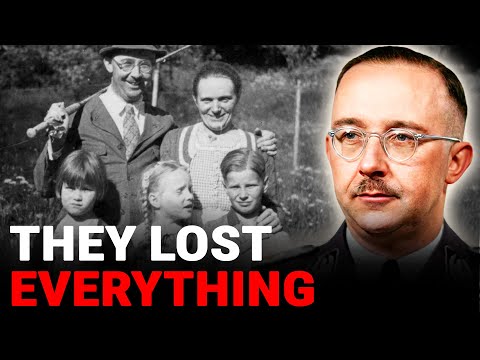
Heinrich Himmler, the architect of the Holocaust, was also a father. His children did not vanish when the Third Reich collapsed. They grew up, aged, built careers, married, and in some cases had children of their own. They navigated secrecy, stigma, and the weight of inherited infamy in a Germany that had to reckon with its past. This is the story of what happened to every known child raised by Himmler, from birth to death or to the limits of reliable documentation.
Gudrun Himmler was born on August 8, 1929, in Munich, the only legitimate child of Heinrich Himmler and his wife Margarete Boden. As the daughter of the Reichsführer-SS, she was born into privilege, protection, and proximity to absolute power. Her father called her “Püppi”, a pet name that remained constant throughout her childhood. From birth, she was embedded in a world where loyalty to National Socialism was not just political belief, but domestic reality.
Gudrun’s early years were marked by material comfort and ideological saturation. The Himmler household was organized around her father’s duties, which meant long periods of absence. Himmler traveled constantly, overseeing SS operations, attending meetings with Hitler, inspecting camps and units across occupied Europe. His presence in his daughter’s life was sporadic, mediated through letters, telephone calls, and brief visits. Despite the distance, Himmler cultivated an image of the devoted father. He wrote affectionate letters, sent gifts, and when possible, brought Gudrun along to SS events and ceremonies. She was introduced to senior Nazi officials, posed for propaganda photographs, and absorbed the worldview her father represented. This was not merely upbringing. It was indoctrination by proximity.
Margarete Himmler managed the household with strict discipline. She was deeply committed to National Socialist ideology and maintained the domestic order expected of an SS wife. The relationship between mother and daughter was shaped by this rigidity. Margarete was not warm in the traditional sense, but she was loyal to the regime, to her husband’s position, and to the image of the family they projected. Before 1945, the dynamic between Gudrun and her mother was one of mutual reinforcement. Margarete ensured that Gudrun understood her place within the hierarchy of the Reich. There was no dissent within the household, no questioning of the father’s work. The family operated as a unit of ideological coherence.
In the spring of 1945, the structures that had defined Gudrun’s world disintegrated as Allied forces advanced and the Reich crumbled. Heinrich Himmler attempted to negotiate with the Western Allies, a move that led Hitler to strip him of all positions in the final days of the war. Himmler fled, disguised as a common soldier. On May 23, 1945, after being captured by British forces, he committed suicide by biting down on a cyanide capsule. Gudrun, then 15 years old, was arrested by American forces along with her mother. The transition was abrupt and total. The privilege, the protection, the identity she had known—all of it collapsed in a matter of weeks. She was no longer the daughter of the Reichsführer-SS. She was the daughter of a war criminal.
Gudrun and her mother were held in Allied custody for several months. They were interrogated, moved between detention facilities, and subjected to the disorienting reality of occupation. For a teenager who had spent her entire life within the bubble of SS privilege, the experience was a rupture. The ideological certainty of her childhood was confronted with the material consequences of her father’s actions. There is no public record of Gudrun expressing doubt or horror during this period. Instead, the available evidence suggests a psychological fortification, a retreat into the memory of the father she had known rather than an engagement with the father history had documented.
After her release, Gudrun attempted to reintegrate into German society, but the stigma attached to her name made this nearly impossible. She faced rejection, hostility, and social exclusion. Schools were reluctant to admit her. Potential employers were wary. The post-war Federal Republic of Germany was engaged in a complex and often incomplete process of denazification, and the children of high-ranking Nazis were caught in a liminal space, neither fully accountable nor fully absolved. Gudrun’s education was fragmented. She completed her schooling, but the experience was marked by isolation. She did not disavow her father. She did not apologize. Instead, she withdrew into circles where her loyalty to his memory would not be challenged.
As an adult, Gudrun Himmler never publicly renounced her father or expressed regret for his actions. In private letters and conversations, she defended him, insisting that he had been misunderstood, that the historical record was distorted, that he had acted out of duty rather than cruelty. This was not a calculated public relations strategy. It was her private conviction. Publicly she maintained silence. She did not give interviews, did not write memoirs, did not engage with historians. Her defense of her father existed in the margins, within enclosed networks among those who shared her view of history.
In 1951, at the age of 22, Gudrun married Wolf-Dieter Burwitz, a journalist and author. The marriage represented an attempt at normality. Burwitz was not a prominent figure, and the couple lived quietly in the Munich area. They maintained a conventional domestic life, at least in outward appearance. The marriage lasted until Burwitz’s death in 2001. It provided Gudrun with a degree of stability and anonymity. As Gudrun Burwitz, she could move through society with less immediate recognition than she would have as Gudrun Himmler.
Gudrun and Wolf-Dieter Burwitz had two children. The family history was not openly discussed in public, but within the household, Gudrun made no secret of her lineage or her loyalty to her father’s memory. Her children grew up aware of their grandfather’s identity, though how this knowledge shaped their own lives remains largely private. Gudrun’s descendants have not sought public attention. The family line continues, but it exists outside the historical spotlight.
Despite her outward domesticity, Gudrun remained active in post-war networks that supported former SS members. She became involved with Stille Hilfe, an organization founded in 1951 to provide legal and financial assistance to individuals accused or convicted of Nazi war crimes. The group operated quietly, channeling funds, arranging legal representation, and maintaining contact with aging SS veterans. Gudrun’s involvement was not peripheral. She attended meetings, participated in fundraising efforts, and used her name, despite its notoriety, to signal continuity and loyalty within these circles. For decades, she served as a living link to the old regime, a figure who refused to break with the past.
Between 1961 and 1963, Gudrun Himmler worked for the Bundesnachrichtendienst (BND), West Germany’s Federal Intelligence Service. The employment was brief and reportedly administrative in nature, but the irony was not lost on historians. The BND, like many post-war German institutions, employed individuals with connections to the Nazi regime, prioritizing Cold War utility over moral reckoning. Gudrun’s employment there reflects the broader compromises of the post-war period, a time when the need for experienced personnel often outweighed the desire for moral clarity.
In her later years, Gudrun continued to live quietly in the Munich area, avoiding mainstream public life but remaining visible within far-right and revisionist circles. She attended commemorations, maintained correspondence with old networks, and never wavered in her defense of her father. She did not grant interviews to mainstream journalists or historians. Her presence was felt more through absence, through what she refused to say, through the circles she kept, through the memory she protected.
Gudrun Himmler died on May 24, 2018, at the age of 88. Her death was reported briefly in German and international media, mostly as a historical footnote. She left behind a complicated legacy, not of her own actions, which were largely private, but of her refusal to disavow the actions of her father. Historians view her life as a case study in loyalty, denial, and the limits of intergenerational accountability. She was not a perpetrator, but she was a defender. She did not commit crimes, but she never acknowledged them. Her life ended as it had been lived, anchored in the past, unbending.
Helge Himmler was born in February 1942, the biological son of Heinrich Himmler and Hedwig Potthast. Potthast had been Himmler’s secretary before becoming his mistress. By 1941, she was living in a separate household established and funded by Himmler. The relationship was kept secret from the public and from Himmler’s wife, Margarete, though it is unclear how much Margarete knew or suspected. Helge’s birth was not announced. There were no photographs in SS publications, no acknowledgement in official records. He existed in the shadow of his father’s public life, a secret son born into a hidden family.
Helge grew up in the household maintained by his mother, Hedwig Potthast. The arrangement was comfortable. Himmler provided financial support, ensured security, and visited when his schedule allowed. But the visits were infrequent, and the relationship between father and son was limited by secrecy. Helge did not attend SS ceremonies. He was not introduced to senior officials. He did not appear in family photographs with Gudrun or Margarete. His existence was compartmentalized, a private reality separate from the public persona of the Reichsführer-SS.
Himmler’s relationship with Helge was defined by absence. He wrote letters to Hedwig about the boy, expressed affection in abstract terms, and made occasional visits, but he was not a daily presence. The bond between father and son was mediated by distance, duty, and the structural impossibility of acknowledgement. Helge grew up knowing who his father was, but without the public validation or the social structure that Gudrun had. He was both privileged and invisible.
When Himmler died in May 1945, Helge lost not only a father but the entire framework of protection and identity that had sustained his childhood. There was no inheritance, no public acknowledgement of his lineage, no institutional support. The structures that had made his existence possible vanished overnight. Hedwig Potthast was left to navigate the post-war period alone with two young children and a name that had become synonymous with genocide.
At some point after the war, Helge’s surname was legally changed from Himmler to Stäik. The exact timing and legal mechanism of the change are not fully documented, but the motivation is clear: survival through anonymity. In post-war Germany, carrying the name Himmler was a liability for Hedwig and her children. The name change was both practical and protective. Helge became Helge Stäik, and the connection to his biological father receded into legal and bureaucratic obscurity.
Reports from post-war years indicate that Helge suffered from chronic health problems. Though the specifics are not well documented, these issues reportedly limited his education and his ability to live independently. He did not pursue higher education, did not establish a visible career, and remained largely dependent on his mother. The nature of his health problems—whether physical, psychological, or both—remains unclear. What is documented is a life shaped by limitation and withdrawal.
Helge Stäik lived the majority of his adult life outside public view. There are no interviews, no public statements, no appearances in historical or journalistic records. He did not join revisionist networks, did not defend his father’s legacy, and did not engage with the historical narrative surrounding the Himmler name. His privacy appears to have been deliberate and total. He simply disappeared from the historical record.
There are no confirmed reports of Helge Stäik marrying or having children. If descendants exist, they have not been identified by historians or journalists. The branch of the Himmler family that began with Helge appears to have ended with him or to have remained so deeply private that no public trace remains. Throughout his adult life, Helge remained close to his mother, Hedwig Potthast. She was his primary guardian, caretaker, and connection to the past. Unlike Gudrun, who defended her father publicly, Helge’s relationship to Himmler’s memory appears to have been mediated entirely through his mother. Hedwig herself lived quietly after the war, avoiding public attention and raising her children in obscurity. She died in 1994, and Helge’s life after her death is even less documented than before.
Nanette-Dorothea Himmler was born in 1944, the second biological child of Heinrich Himmler and Hedwig Potthast. Her exact birth date is unclear. Some records suggest June, others July. The ambiguity reflects the chaos of the period and the secrecy surrounding her birth. She was born into a Reich already collapsing. By mid-1944, the tide of the war had turned decisively against Germany. Her father was overseeing the final desperate phases of the Holocaust even as the military situation deteriorated. Nanette-Dorothea entered the world at the intersection of atrocity and defeat.
Nanette-Dorothea was less than a year old when her father died. She grew up fatherless, raised by Hedwig Potthast in a Germany that had to rebuild itself morally and materially. Unlike Gudrun, who had years of memory and relationship with Himmler, Nanette-Dorothea had none. She knew her father only through stories, photographs, and the weight of his name. Her childhood was shaped by secrecy. Hedwig did not advertise their connection to Himmler. The family lived quietly, and Nanette-Dorothea grew up under the name Stäik like her brother, though her exact legal status and name usage remains somewhat unclear in historical records.
Despite the stigma of her lineage, Nanette-Dorothea pursued higher education and succeeded academically. She attended university and trained in medicine, a field that required intellectual rigor, discipline, and ethical responsibility. Her entry into the medical profession represented a form of social mobility and personal reinvention. There is no indication that her background was widely known during her education. She appears to have moved through professional training without the public scrutiny that might have followed if her identity had been disclosed.
Nanette-Dorothea worked as a physician, building a career separate from her family’s past. She treated patients, maintained a practice, and operated within the ethical frameworks of modern medicine. The contrast between her professional identity and her biological inheritance is stark. Her father oversaw medical experiments and mass murder. She dedicated her career to healing. Whether this professional choice represented a conscious moral counterweight or simply a career path is unknown. She did not speak publicly about the decision.
Nanette-Dorothea married and had at least one son. She built a family of her own, and within that family she maintained strict control over the disclosure of her lineage. According to later accounts, she did not tell her son about his grandfather’s identity until late in her life. The decision to withhold this information appears to have been deliberate, an attempt to spare him the burden she had carried. The psychological implications of this silence, both for her and for her child, are complex. It represents an effort to sever the past, to create a new family narrative untainted by history.
Nanette-Dorothea’s approach to her father’s legacy was fundamentally different from Gudrun’s. She did not defend him. She did not participate in revisionist networks. She did not maintain contact with SS veterans or their families. Instead, she chose concealment and distance. Her silence was not public. It was private and familial. She carried the knowledge alone, shared it selectively, and attempted to prevent it from defining the next generation. This was a strategy of erasure rather than defense.
Nanette-Dorothea Himmler died in 2019 at the age of 74 or 75, depending on which birth date is accurate. Her death received little media attention, and it was only through subsequent revelations by her descendants that some details of her life became more widely known. Her son, after her death, spoke publicly about learning his family history. He described the revelation as shocking and difficult to process. The silence his mother had maintained throughout her life ended posthumously, and the legacy she had tried to contain re-emerged.
Gerhard von der Ahe was not Heinrich Himmler’s biological child, but he was raised within the Himmler household as a foster child. His biological father, an SS officer, was killed during the war, and at some point Gerhard was taken into the Himmler family. He grew up alongside Gudrun, sharing the same household, the same education, and the same ideological environment. The exact circumstances of his fostering are not fully documented, but it was not uncommon for high-ranking SS families to absorb children of fallen comrades. This practice reinforced loyalty within the SS hierarchy and provided material support to families in need.
Gerhard was educated within the elite structures available to SS families. He attended schools selected by Himmler, was exposed to the same ideological indoctrination as Gudrun, and was expected to embody the values of the SS. However, reports suggest that Gerhard struggled academically and did not meet the expectations placed on him. This created tension within the household. Himmler valued discipline, performance, and ideological commitment. Gerhard’s difficulties may have made him a source of frustration or disappointment.
As the war entered its final years, Gerhard, like many teenage boys in Nazi Germany, was drawn into military structures. He was old enough to serve, and by the chaotic end of the war, adolescents were being pressed into service in increasingly desperate circumstances. Gerhard is believed to have been assigned to an SS unit, though the specifics of his service are unclear. The collapse of the Reich in 1945 brought an abrupt end to whatever military role he had assumed. The structures of command, identity, and purpose disintegrated around him.
After the war, Gerhard was captured and held by Soviet forces. The conditions of Soviet captivity were harsh, and many prisoners did not survive. Gerhard, however, was eventually released and returned to Germany. The exact timing and circumstances of his return are not well documented, but he survived the immediate post-war period. His return to a defeated, occupied Germany marked the beginning of a life profoundly different from the one he had been prepared for.
After his return from Soviet captivity, Gerhard von der Ahe effectively disappears from reliable historical documentation. There are no confirmed reports of his later life, no interviews, no public records that trace his trajectory beyond the late 1940s. It is unclear whether he maintained contact with Gudrun, whether he built a new life under a different identity, or whether he died at an early age. The absence of information is itself a fact, one that reflects the fragmentation and obscurity that followed the collapse of the Reich for many individuals connected to its leadership. The limits of what can be known about Gerhard von der Ahe mark the limits of this account. Where documentation ends, responsible history must as well.
The children of Heinrich Himmler lived lives shaped by proximity to one of history’s most notorious figures. Gudrun carried the memory forward, defending it until her death. Helge retreated into privacy and obscurity. Nanette-Dorothea built a professional life and tried to bury the past. Gerhard, fostered and then forgotten, vanished into the margins of postwar Europe.
None of them chose their lineage. None of them committed the crimes their father oversaw. But all of them lived with the consequences—social, psychological, and historical. Their lives, documented here to the limits of reliable evidence, are not lessons or morality tales. They are records of what happened next, when the structures of power collapsed and the children of perpetrators had to find ways to live.
What do you think—can silence ever truly sever the weight of inherited history, or does it only delay the reckoning for the next generation? Share your thoughts below.
Report this article
Select a reason for reporting:






