When we think of World War I, we picture the mud-caked trenches, the deafening roar of artillery, and the young men who charged into no man’s land, never to return. But behind the front lines, another battle raged—a battle not fought with rifles, but with scalpels and sutures. This is the story of the wounded who survived, and the pioneering medics who dared to rebuild them.
The scale of suffering was unimaginable. Over 20 million soldiers were wounded, their bodies shattered by shrapnel, bullets, and gas. Many survived injuries that would have killed them in earlier wars, thanks to advances in battlefield medicine. But survival came at a terrible cost: thousands were left with horrific facial disfigurements, their identities erased by the very conflict they had fought in.
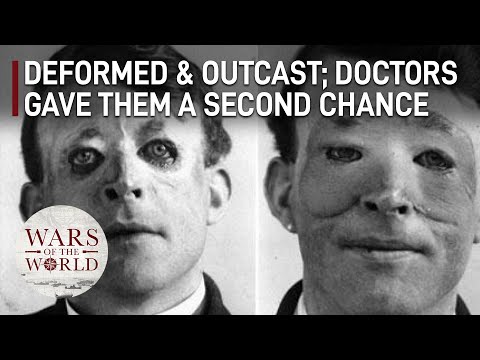
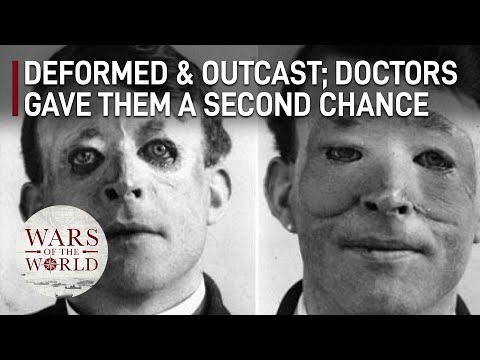
In Britain, a quiet revolution began. At the Queen’s Hospital in Sidcup, a New Zealand-born surgeon named Harold Gillies assembled a team of doctors, dentists, and artists. Together, they would transform the field of plastic surgery—and restore hope to men who had been told they were beyond repair.
One of Gillies’ first patients was Walter Yeo, a young naval officer burned at the Battle of Jutland. “The floodgates in my neck seemed to burst and the blood poured out,” recalled another soldier, John Glubb, whose jaw was torn apart by a bullet. Like many, Glubb waited weeks for treatment, his wounds festering. But Gillies was about to change everything.
Using a technique called the pedicle flap—a strip of living skin kept attached to its blood supply—Gillies rebuilt faces piece by piece. It was painstaking, risky, and often took months. Yet for the first time, men who had been hideously scarred could hope to look human again.
“It was a strange new art,” Gillies wrote, “applied with precision and care for those who needed it the most.” His work didn’t just heal bodies; it restored dignity. Soldiers who had been hidden away, denied mirrors, began to step back into the world.
But the journey was far from over. As the war dragged on, the demand for reconstructive surgery grew. Gillies and his team pushed the boundaries of medicine, developing new techniques that are still used today. And for the men who endured countless operations, the fight to reclaim their lives had only just begun.
Among the wounded was Sir John Glubb, whose jaw had been shattered by a bullet in August 1917. “I could feel something lying loosely in my left cheek as though I had a chicken bone in my mouth,” he recalled. “It was in reality half my jaw which had been broken off, teeth and all, and was floating about in my mouth.” Glubb was sent to a hospital in England that was ill-equipped for facial reconstruction, and due to overcrowding, he was ignored for weeks. His wounds grew septic, and he endured agonizing pain. Yet he survived, and his case became a stark reminder of the urgent need for specialized care.
Harold Gillies had established a dedicated facial injury unit at the Queen’s Hospital in Sidcup, where he could treat patients like Glubb. But the sheer volume of casualties meant that many soldiers still fell through the cracks. “The wards were overflowing with men whose faces had been torn apart,” wrote one nurse. “We did what we could, but it never felt like enough.”
Gillies was not alone in his efforts. He collaborated with dentists, artists, and photographers to document and plan each surgery. The artists, such as Henry Tonks, created pastel drawings of the men’s injuries before and after surgery, helping Gillies visualize the reconstruction. These records were not only medically valuable but also a testament to the human cost of war.
One of the most challenging aspects of facial reconstruction was the risk of infection. Open wounds were highly susceptible to bacteria, and the pedicle flap method, while effective, left the donor site exposed. Gillies refined the technique by developing the tube pedicle, where the skin flap was rolled into a tube and sewn onto the body, protecting it from infection while maintaining blood supply. This innovation significantly improved success rates and reduced recovery times.
But even with these advances, the procedures were grueling. Patients often endured multiple surgeries over months or even years. “The pain was unbearable at times,” recalled one soldier. “But I knew that without it, I would be a monster in the eyes of the world.” Many men suffered from depression and anxiety, struggling to cope with their altered appearances and the long road to recovery.
Despite the physical and emotional toll, thousands of soldiers benefited from Gillies’ work. His patients came from all walks of life, and many went on to lead normal lives, marrying, working, and raising families. Walter Yeo, one of the first to receive a pedicle flap, lived into his seventies, a testament to the durability of the surgery.
The war ended in 1918, but the work of Gillies and his team continued. They treated soldiers well into the 1920s, and their techniques laid the foundation for modern plastic surgery. “The war was a catalyst for change,” Gillies later wrote. “It forced us to innovate, to push beyond what we thought was possible.”
Yet the legacy of these pioneers extends beyond the operating room. Their work challenged societal attitudes towards disfigurement, gradually reducing the stigma faced by wounded veterans. The men themselves became advocates for their own care, demanding better treatment and recognition for their sacrifices.
As we look back on the First World War, we remember not only the soldiers who died but also those who survived with scars both visible and invisible. The medics who fought to save them, often with limited resources and under immense pressure, deserve our admiration. Their story is one of resilience, ingenuity, and the indomitable human spirit.
But the story of wartime medicine was never confined to the operating theater. Behind every reconstructed face lay a network of laboratories, dentists’ chairs, and rehabilitation wards where other specialists fought their own quiet battles. Among them was a young bacteriologist named Alexander Fleming, whose work on wound infection would echo far beyond the wards of 1916.
Fleming had been brought to the front by Sir Almroth Wright, a formidable pathologist who believed that science could save more lives than any rifle. Together they set up a research laboratory in Boulogne, where they studied the bacteria that turned minor wounds into lethal infections. “Every wound is a garden for germs,” Wright warned his team, and the trenches proved him horrifically right.
Gas gangrene was among the deadliest of these infections. Caused by bacteria lurking in the churned soil of no man’s land, it could rot a limb from within in a matter of days. Fleming experimented with antiseptics, saline washes, and careful debridement, and his methods saved countless soldiers from amputation—or worse. He would later credit these grim years for sharpening the instincts that led him to penicillin.
Meanwhile, the dental surgeons at Sidcup were waging their own campaign. Many men arrived with jaws shot away, unable to eat, speak, or even close their mouths. Dentists like William Kelsey Fry worked alongside Gillies to build splints and prosthetic palates, often crafting devices from vulcanite and silver that could be fitted into the ruined architecture of a face. “We were not merely repairing teeth,” Fry recalled. “We were rebuilding the machinery of ordinary life.”
For the soldiers themselves, the psychological wounds often proved harder to treat than the physical ones. Some men refused to leave their beds, convinced that no surgery could make them presentable again. Others grew bitter, wondering why the nation that had sent them to war now seemed to flinch at the sight of them. The wards of Sidcup became a strange sanctuary—a place where the disfigured could exist without being stared at.
It was in this hothouse of suffering and innovation that a new idea took root: that the state had a duty not only to patch men up but to help them return to society. Vocational training, prosthetic workshops, and counseling programs sprang up alongside the surgical units. “We cannot give them back their old faces,” one administrator wrote, “but we can give them back their futures.”
Not every story ended in triumph. Some men died on the table, their bodies too weakened to withstand another operation. Others withdrew from treatment altogether, vanishing into the anonymity of cities where no one knew what they had endured. Gillies kept their photographs in his files, a silent record of the limits of even the most brilliant medicine.
Yet the momentum could not be stopped. By the war’s end, plastic surgery had earned its place in mainstream medicine, and the lessons learned at Sidcup were being taught to a new generation of surgeons across Europe and America. The men who had been rebuilt became living proof that catastrophe could be answered with creativity and care.
As the 1920s dawned, many of Gillies’ patients returned to civilian life, some to marriages, some to careers, and some simply to the quiet dignity of walking down a street unrecognized. Their scars remained, but so did the knowledge that they had been among the first to benefit from a revolution in medicine—one born in the bloodiest of circumstances.
Gillies himself never sought glory. He returned to civilian practice, but the lessons of Sidcup traveled with him. Surgeons from around the world came to learn his methods, and his 1920 textbook became a cornerstone of reconstructive surgery. “We were amateurs at first,” he admitted later. “But the war made us professionals.”
Walter Yeo lived quietly in Devon, his face bearing the marks of history. He rarely spoke of Jutland, but his family knew that every breath was a gift bought by men like Gillies. John Glubb, his jaw rebuilt, went on to command troops in the Middle East, his voice never quite the same but his spirit unbroken.
Today, the faces in Henry Tonks’ pastels stare out from museum walls—silent witnesses to a time when medicine learned to rebuild what war destroyed. Their scars remind us that progress often begins in the darkest of places.
“The world broke them,” one historian wrote, “but they broke the world’s expectations in return.”
What do you think—should these pioneering medics and their patients be remembered as the true heroes of the Great War? Share your thoughts below.
Report this article
Select a reason for reporting: