The cold over Germany was so bitter that frost crept across the inside of the cockpit glass. Below, long streams of American bombers droned toward Berlin, the heart of the Third Reich. And out of the white haze came a new kind of killer—no propeller, no warning, just the roar of turbines and a shape moving faster than anything the Americans had ever chased. The Messerschmitt Me 262. Germany’s last miracle weapon.
Between those jets and the bombers flew a line of silver Mustangs with tails painted blood red. The men inside them were never supposed to exist. For twenty years, a study written by officers of their own army had declared that men like them were too cowardly, too slow, too weak to fly a fighter in combat. Nazi propaganda went further, mocking America as a hybrid nation and laughing at the idea of the men now climbing toward its jets.
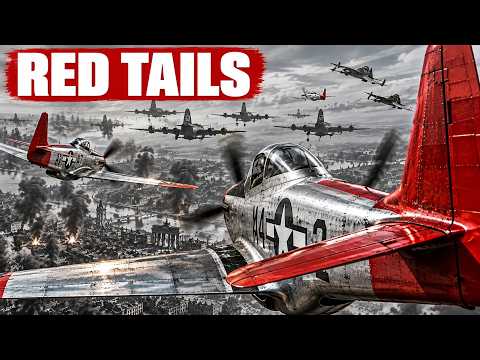
One of those pilots was twenty-three years old. His name was Roscoe Brown. He had a college degree, steady hands, and only seconds to decide what he would do next. By the end of the war, his group would be credited with destroying 112 enemy aircraft in the air. But the number that almost wiped them out—long before they ever reached Berlin—was not 112. It was zero.
Autumn 1925, Washington, D.C. Inside the Army War College, leaves outside the tall windows turned gold, and typewriters clattered in the long, quiet halls. A group of senior officers finished a memorandum. It would be stamped, filed, and nearly forgotten by everyone who read it. And it would shape the lives of thousands of young men who were still children in 1925.
Its title was simple and direct: “The Use of Negro Manpower in War.” The men who wrote it were not villains from a movie. They were professional officers, many wearing medals from the First World War. They believed they were being cautious, even scientific. Page after page, they reached the same conclusion: “The Negro soldier lacks courage under fire. He is superstitious. He lacks the intelligence necessary to lead others. He cannot be trusted with complex technical work.”
The memo recommended keeping Black soldiers in separate units under white officers, far from the hardest jobs in the service. And of all the hard jobs in a modern army, one stood above the rest: flying. To an officer in 1925, a fighter pilot was the new knight. He sat alone in a machine of wood, fabric, and steel. He had to read the wind, the engine, the horizon, and the enemy all at once. He had to make decisions in fractions of a second with no supervisor beside him and no one to tell him what to do.
If the Army believed a Black man could not be trusted with a rifle in the dark, it would never trust him alone in the sky. So the door was closed—not with an angry shout in the street, but with official papers, with policy, with a memorandum that was filed, cited, and quietly obeyed for the next fifteen years.
Across the Atlantic, another kind of contempt was taking shape. In Germany, the men who would build the Third Reich looked at America with disdain. In their speeches and pamphlets, the United States was portrayed as a hybrid nation, a mixed and weak people who could never stand against a pure and disciplined Germany. In 1938, a Nazi exhibition in Düsseldorf attacked jazz as degenerate music. Its poster showed a Black musician playing a saxophone, drawn in crude caricature, with a Star of David pinned to his lapel. It was an image designed to insult two peoples at once.
To the propagandists in Berlin, the idea of a Black American flying a fighter against the Luftwaffe was not a threat. It was a joke. Years later, a story spread that German pilots had a name for the Black American pilots they met in the skies over Europe: “Schwarze Vogelmenschen”—Black bird-men. Veterans would repeat it, and books would mention it. But no German document has ever been found to prove the name was real. It may be a myth. What is not a myth is the contempt that came before it.
On both sides of the ocean, powerful men had already decided what Black Americans could and could not do. All that remained was for someone to prove them wrong.
Into this world came a young man named Benjamin Oliver Davis Jr. He was the son of a soldier. His father, Benjamin O. Davis Sr., had enlisted in 1899 and worked his way up through an army that did not want him. The boy grew up watching his father salute men who would never respect him. He learned early the hard lesson every Black officer of that era learned: you had to be twice as good to be considered half as capable.
In the summer of 1932, Benjamin Davis Jr. was nineteen years old. He entered the gates of the United States Military Academy at West Point, on the cliffs above the Hudson River. He was the only Black cadet in the entire academy. Within days, he realized what was happening. No one spoke to him. At West Point, this was called “silencing.” It was a punishment cadets imposed on those who violated the honor code. But Davis had violated nothing. His only crime was the color of his skin.
His classmates spoke to him only when duty required it. He ate his meals in silence. He had no roommate. On weekends, when laughter and music filled the barracks, he sat alone in his room with his books and listened through the wall. This did not last a week. It did not last a month. It lasted four years.
Imagine it for a moment. Four years of meals where the chairs beside you stay empty. Four years of walking to class through a crowd that parts around you like water around a stone. Four years of stares that make you feel like you are made of glass. Davis did not quit. He studied. He drilled. He marched. He waited. Those who knew him later said the silence hardened something inside him—a calm, unyielding patience.
In June 1936, he graduated 35th in a class of 276. He was the first Black graduate of West Point in the twentieth century. He had one dream above all: he wanted to fly. He applied to the Army Air Corps. The answer came quickly, and it was no. The Air Corps had no Black units and no plans to create any. The reason was simple and cruel. A Black officer would have to command white soldiers, and the Army would not allow that. So there was no place for him in the sky. The door that the 1925 memo had closed remained shut.
Davis was sent to the infantry at Fort Benning, Georgia, where the officers’ club did not welcome him. Then he was sent to teach military science at Tuskegee Institute in Alabama, the Black college founded by Booker T. Washington. To many, it looked like a dead end—a quiet assignment for a young officer the Army did not know what to do with. But it was not a dead end. It was the place where history would be written.
For far from Alabama, the world was catching fire. In September 1939, Germany invaded Poland. By the summer of 1940, France had fallen, and British pilots were fighting for survival over the English Channel. America had not yet entered the war, but it was building an air force at a feverish pace. It needed pilots. It needed thousands of them. And Black Americans were demanding their share of the sky.
Black newspapers like the Pittsburgh Courier campaigned for it week after week. Civil rights leaders pressed the White House. In January 1941, a young Howard University student named Yancy Williams, who already held a civilian pilot’s license, sued the War Department for refusing to consider him for military flight training. That same month, the War Department announced a plan to create an all-Black fighter squadron—the 99th—to be trained at a separate airfield near the town of Tuskegee, Alabama.
On paper, it looked like a victory. In reality, many saw it as a trap. The program was called an “experiment.” The word was repeated over and over in memos, speeches, and headlines. And an experiment, by nature, is something that is allowed to fail. There were officers in the War Department who expected it to fail. Some, it was said, would be quietly relieved if it did. Failure would settle the question raised by the 1925 memo once and for all.
Then, in the spring of 1941, a car arrived at the small airfield used by Tuskegee Institute. The First Lady of the United States, Eleanor Roosevelt, stepped out to visit Tuskegee. At the airfield, she met the chief of the civilian flight instructors, Charles Alfred Anderson, known as “Chief.” He was a Black pilot who had learned to fly years earlier, largely on his own, after buying a plane with borrowed money because every white flight school had refused to accept him as a student.
The First Lady had heard a great deal about Black men and airplanes, and she wanted to see for herself. She asked Chief Anderson to take her flying. Her Secret Service agents were not happy about it, but the small trainer lifted off into the warm Alabama air. The wife of the President of the United States sat behind a Black pilot in a state where a Black man could be arrested for sitting in the wrong seat on a city bus. They flew over the red earth and the dark pine trees. When they landed, she was smiling.
A photographer took a picture of them together in the plane, and that picture spread across the country. It is still remembered today as a turning point. No one can prove whether one flight really changed the mind of anyone in power. But the image said what a hundred speeches could not. A Black man had flown. The First Lady had trusted him. And nothing terrible had happened.
In July 1941, the first class of flight cadets began training at Tuskegee. There were thirteen of them, including Captain Benjamin O. Davis Jr., who was finally allowed to pursue the dream the Air Corps had denied him five years earlier. The training was brutal. Instructors watched every takeoff, every turn, every landing. The cadets knew exactly what the officers in Washington were waiting for. Every failure became a line in someone’s report. Every mistake was evidence. Every crash was proof.
One by one, the cadets washed out. The empty beds in the barracks multiplied. On March 7, 1942, three months after the attack on Pearl Harbor, the survivors stood in ranks under the Alabama sun to receive their silver wings. Thirteen men had started. Five remained. Benjamin O. Davis Jr., Lemuel Custis, Charles DeBow, George Roberts, and Mac Ross. Five men, five pairs of wings, against a memo that had called them incompetent, against a propaganda machine that had mocked them, against a system that had built an entirely separate airfield to keep them apart.
They had proved they could fly. Now they would have to prove they could fight. And the men who would judge them were already waiting with their pens.
Roscoe Brown returned home to his studies. He earned a doctorate from NYU, became an educator and a leader, and served as president of Bronx Community College for many years. He spent most of his life telling young people the story of the men he flew with. He died in 2016 at the age of 94.
In 2007, the Tuskegee Airmen were awarded the Congressional Gold Medal. Elderly men in red jackets stood in the Capitol Rotunda—the same men who had once been barred from an officers’ club.
Today, at the Smithsonian near Washington, D.C., a Messerschmitt Me 262 stands under the lights. Its paint is faded. Its engines are silent. Visitors circle it, marveling at the machine that was supposed to save the Third Reich. It was built by a system that believed some men were born to rule and others to fail. It lost.
It lost to a memo written in 1925 that was proved wrong. To a cadet who endured four years of silence. To a squadron that was almost sent home after scoring zero. To men whose tails were painted red, who were told again and again that they did not belong in the sky.
They never had to say a word in their own defense. The record spoke for them.
But the record also asks us something. When the next memo is written—in whatever form it takes—will we be the ones who sign it, or the ones who prove it wrong?
Report this article
Select a reason for reporting:






